Feeling Sick? Google Begins Asking Some Searchers Who Look For Illness-Related Terms
Why exactly are you searching for “headache” or “ear infection” at Google? Do you have one of these illnesses or are you researching them? Google wants to know, and will find out by asking a small number of people directly within the search results, beginning today. It’s part of a process that Google hopes will […]
Why exactly are you searching for “headache” or “ear infection” at Google? Do you have one of these illnesses or are you researching them? Google wants to know, and will find out by asking a small number of people directly within the search results, beginning today.
It’s part of a process that Google hopes will allow them to improve health-related search results plus perhaps build more trending tools like Google Flu.
“We’d like to do a better job of accurately estimating current levels of flu and extend that to other areas, and to do that, we need to understand better what people are searching for when they’re feeling sick,” said Dr. Roni Zeiger, a medical doctor and Google product manager overseeing the project.
Google will randomly select a small number of people, in the United States, beginning today and show them a simple Yes / No question at the bottom of searches relating to health issues. The experiment will run for at least the next few weeks.
For example, in a search for “headache,” those selected will see this:
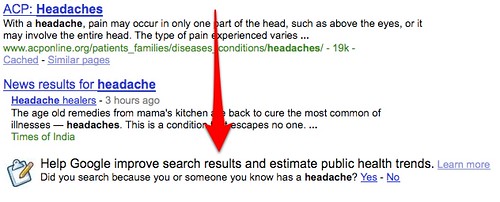
The “Did you search because you or someone you know has a headache” question should fairly quickly help Google understand what percentage of people are conducting headache-related queries because they’re actually suffering one (or know someone suffering one), versus people who are just interested in the topic generally. Similar questions will come up for other illness-related queries, such as:
- Did you search because you or someone you know has ankle pain?
- Did you search because you or someone you know has post-nasal drip?
- Did you search because you or someone you know may be experiencing a reaction to poison ivy?
- Did you search because you or someone you know may have streptococcal pneumonia?
- Did you search because you or someone you know is taking ibuprofen?
- Did you search because you or someone you know may have an ear infection?
Assuming many people are suffering illnesses when they search for these queries, Google could conceivably shift its results to be more “cure” oriented.
How about future trend tools. Will we see a Google Chickenpox, somehow from all this data, down the line? Zeiger laughed about the name but didn’t dismiss the idea that other trending tools may emerge. But what those might be, exactly, he couldn’t say.
“The natural place to look is for other similar infectious diseases that have outbreaks. We’d like to try, but there’s isn’t something specific that we know is next, based on our current insights into health processes,” he said.
With Google Flu, Google correlates search data with reported outbreaks, to increase its confidence level. In cases where it lacks a correlating factor (are poison ivy cases even publicly reported?), understanding how many queries are really based on an actual illness over time might help with creating some future trending. But for the most part, this seems to have a much more immediate application as a way for Google to decide if certain results need more “cure” slanting.
How about privacy? Answer the question, and Google says that it is NOT associated with your Google Account, if you’re logged in. Instead, answers are linked to standard logged information like cookies and user IDs, which I feel are pretty anonymous. And these get destroyed in 9 to 18 months.
Still worried? Assuming you’re one of the few selected, just don’t answer the question. Google’s also blogged more about the program here, and there’s a FAQ here.
Opinions expressed in this article are those of the guest author and not necessarily Search Engine Land. Staff authors are listed here.

Related stories
About the author
