FTC Turns Its Gaze From GoogMob To Apple And iAds
I would love to be a fly on the wall at the FTC. A few weeks ago the agency grudgingly decided not to pursue its lawsuit to prevent the Google-AdMob deal on the purported basis that Apple’s entry into the mobile ad market would sufficiently balance Google’s new push into mobile display: The Commission said that although […]
I would love to be a fly on the wall at the FTC. A few weeks ago the agency grudgingly decided not to pursue its lawsuit to prevent the Google-AdMob deal on the purported basis that Apple’s entry into the mobile ad market would sufficiently balance Google’s new push into mobile display:
The Commission said that although the combination of the two leading mobile advertising networks raised serious antitrust issues, the agency’s concerns ultimately were overshadowed by recent developments in the market, most notably a move by Apple Computer Inc. – the maker of the iPhone – to launch its own, competing mobile ad network. In addition, a number of firms appear to be developing or acquiring smartphone platforms to better compete against Apple’s iPhone and Google’s Android, and these firms would have a strong incentive to facilitate competition among mobile advertising networks.
(emphasis added.)
But now, in a highly ironic turn of events, the FTC is apparently going to investigate Apple and iAds because of the change in its developer agreement that appears to prevent a post-acquisition AdMob from operating in the iUniverse. Here’s the relevant part of section 3.3.9 of Apple’s developer agreement:
You and Your Applications may not collect, use, or disclose to any third party, user or device data without prior user consent, and then only under the following conditions . . .
The collection, use or disclosure is for the purpose of serving advertising to Your Application; is provided to an independent advertising service provider whose primary business is serving mobile ads (for example, an advertising service provider owned by or affiliated with a developer or distributor of mobile devices, mobile operating systems or development environments other than Apple would not qualify as independent) . . .
This language pretty explicitly would seem to bar AdMob now that it’s “affiliated with a developer or distributor of mobile devices, mobile operating systems or development environments other than Apple . . .” (namely Android/Google). In other words, AdMob pre-Google is OK, but now that AdMob is owned by a company Apple considers a direct competitor it’s no longer OK for AdMob to collect data from the iPhone, iPad, etc. Those data are critical for ad serving and analytics.
Though it may seem punitive or retaliatory, one might make the case that it’s a rational decision by Apple and within the realm of its legitimate authority to prevent competitors from getting an “inside look” at its traffic, users and their behaviors, etc.
Apple CEO Steve Jobs was angered by Flurry Analytics’ discovery and posting of information about products (the iPad) that Apple hadn’t released but was testing on the network. And though it might be overly paranoid, it might not be entirely illegitimate for Apple to be concerned about some sort of competitive information (e.g., new product testing) passing through AdMob to Google.
AdMob’s CEO Omar Hamoui raged against Apple’s policy change in a blog post published yesterday:
Apple proposed new developer terms on Monday that, if enforced as written, would prohibit app developers from using AdMob and Google’s advertising solutions on the iPhone . . .
Let’s be clear. This change is not in the best interests of users or developers. In the history of technology and innovation, it’s clear that competition delivers the best outcome. Artificial barriers to competition hurt users and developers and, in the long run, stall technological progress.
AdMob’s objections aren’t simply principled, however, they’re also self-interested. The iPhone/iPod Touch represents the largest single slice of AdMob’s mobile traffic on a global basis.
Hamoui’s argument as a general matter has validity. Apple would be limiting ad network choice for developers and thereby limiting some competition in the market. One of AdMob’s objectives is likely to rile up developers to put pressure on Apple by arguing this would directly hurt them — and maybe to invite the kind of scrutiny from the feds that is now allegedly going to happen.
Pressure from below and above.
This is roughly akin to what Microsoft was trying to do behind the scenes over the last few cycles with Google — unsuccessfully trying to thwart Google’s acquisition of DoubeClick and successfully blocking the Google-Yahoo search deal. In both of those instances, as in this one, you have a former target of anti-trust litigation using anti-trust arguments against a leading rival. That’s not exactly what AdMob is doing; it’s focusing on developers — the little guy — but it implies the anti-trust angle.
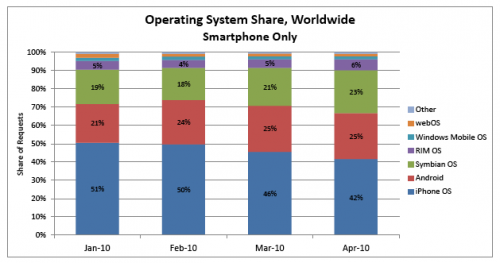
Yet Apple is not a monopoly, nor is it even the category leader. While the iPhone generates more internet traffic, search volume and page views that other smartphones it only “owns” 28 percent of the US market according to Nielsen’s most recent figures:
- RIM — 35 percent
- iPhone — 28 percent
- WinMo — 19 percent
- Android — 9 percent
- Palm — 4 percent
- Others — 5 percent
As mentioned, it’s ironic for Google or AdMob to imply or otherwise push the anti-trust angle given that the company just went through this process itself and it was iAds that prevented the FTC lawsuit from going forward. As the text above indicates, Apple’s iAds program tipped the scales toward GoogMob approval.
Apple may well be doing something very stupid and ultimately self-destructive. But that will be revealed in time by the market. If Apple has done this solely to get at Google it’s unprincipled and unfortunate. But I’m not sure it rises to a level that justifies another federal intervention.
Opinions expressed in this article are those of the guest author and not necessarily Search Engine Land. Staff authors are listed here.

Related stories
About the author