iProspect: Blended Search Resulting In More Clicks On News, Images, And Video
Since the advent of “blended” or “universal search” last year across the major engines, there’s been ongoing discussion and speculation about its impact on user behavior and search marketing. Gord Hotchkiss last year wrote extensively about how blended search (on Google) has in fact shifted the user focus from the so-called “golden triangle” at the […]
Since the advent of “blended” or “universal search” last year across the major engines, there’s been ongoing discussion and speculation about its impact on user behavior and search marketing. Gord Hotchkiss last year wrote extensively about how blended search (on Google) has in fact shifted the user focus from the so-called “golden triangle” at the upper left of the page to a more distributed pattern that resembles an “E.”
Now search marketing firm iProspect has released a study (conducted by JupiterResearch) that shows users are responding to the various specialized content types within search results and are more engaged with them than they are the vertical search silos the search engine have historically offered. Just over 2,400 US adults participated in the iProspect survey, conducted in December 2007 and January of this year. It focused on Google, Yahoo, and Microsoft Live Search.
Among the various content types now showing up in blended search, “news” results were found to be the most clicked form of vertical content. The study’s overall findings reinforce a point increasingly being made: marketers need to broaden and optimize their various content types to be found in blended search results.
Here are the top-level findings of the iProspect study:
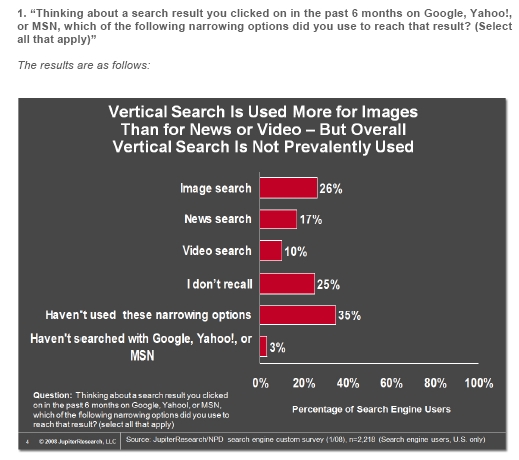
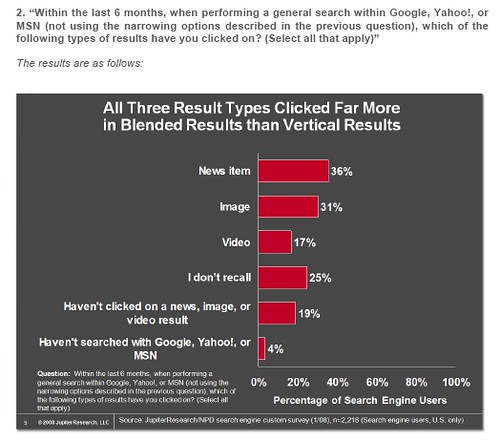
- 36 percent of search engine users click “news” results within blended search results, while only 17 percent click a “news” result after conducting a news-specific search
- 31 percent of search engine users click “image” results within blended search results, while 26 percent click an “image” result after conducting an image-specific search
- 17 percent of search engine users click “video” results within blended search results, while only 10 percent click a “video” result after conducting a video-specific search
While images are the most clicked type of result after a vertical-specific search, news items are the most clicked type of result within blended search results
This higher user engagement with vertical content in traditional web search results comes as no surprise. Vertical search tabs have been largely neglected by users historically (except for image search), as this Hitwise survey of the traffic distribution on various Google properites illustrates:
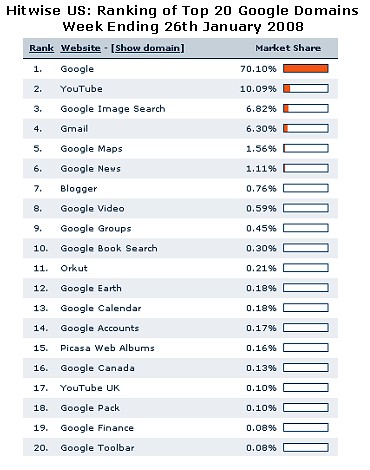
Source: Hitwise, January, 2008
The following charts from the iProspect survey are graphical presentations of the data points cited above, showing the contrast between usage of vertical search in their respective content silos and the higher engagement (clicks) on vertical content within the main search results:
The study also found growth in the user bias toward the first page of search results:
- 68 percent of search engine users typically click results on the first page of search results, compared to 62 percent in 2006, and 60 percent in 2004
- Only 8 percent of search engine users review more than the first three pages prior to clicking on a result
- 49 percent of search engine users who continue their search when not finding what they are looking for change and/or re-launch their search after reviewing just the first page of search results, up from 40 percent in 2006, and 42 percent in 2004
Finally, the study also found an increase in the brand impact associated with appearance at the top of search results: “37 percent of online users associate appearance at the top of search results with a company’s leadership within its industry or category, up slightly from 35 percent in 2006 and 33 percent in 2002.”
This latter point has been made in the past, but it reinforces the notion that search marketing has to be taken seriously as a branding medium. That is being made easier to swallow for many agencies and brand marketers by the recent inclusion of video in paid search ads on Google and Yahoo.
Opinions expressed in this article are those of the guest author and not necessarily Search Engine Land. Staff authors are listed here.

Related stories
New on Search Engine Land
About the author