Study Says Get In Top 5 Not Top 10 & Search Engines May Need To Highlight Official Sites
On Friday, we reported briefly on a new eye tracking study from Microsoft on how users interact with search results. I spent some time doing a deep dive into the survey, which is full of interesting information. Among the findings is that search marketers may need to be more concerned about getting into the top […]
On Friday, we
reported briefly on a new eye tracking study from Microsoft on how users
interact with search results. I spent some time doing a deep dive into the
survey, which is full of interesting information. Among the findings is that
search marketers may need to be more concerned about getting into the top five
rather than the top ten, if they want to be seen. In addition, search engines
might want to seriously experiment more with adding “official site” links at the
top of their pages and possibly enlarge the size of listing descriptions or
“snippets” to help searches find what they are looking for.
The study from Microsoft Research can be found
here in PDF
format. The survey was very small, involving only eighteen people from ages 18
to 50. The small number makes me worry a bit on how much I want to trust some of
the conclusions. Still, it’s a start, and many of the questions were well
thought out and tested.
Those in the survey were assigned both navigational tasks (find the homepage of something
like the World Cup 2006 site) or informational tasks (find when the Titanic set sail).
Answers to all questions were listed within the results they received. They were
all “moderately experienced” at web search.
Part of the test was to see how people interacted with results if they were
given different lengths of listing descriptions or snippets, to use the Google
term. People looked at short (one line), medium (two to three lines) and long
(six to seven lines) snippets.
The study watched where people looked and also measured the time they spent
on a task along with their click accuracy — did they find the best answer?
Heat Maps & Eye Tracking
Where people looked provided no revelations:
First, confirming previous findings, we found that people viewed search
results in a roughly linear order. Most gaze activity was directed at the first
few items; items ranked lower got users’ attention last and least.
The heat map below is one example of how people scanned:
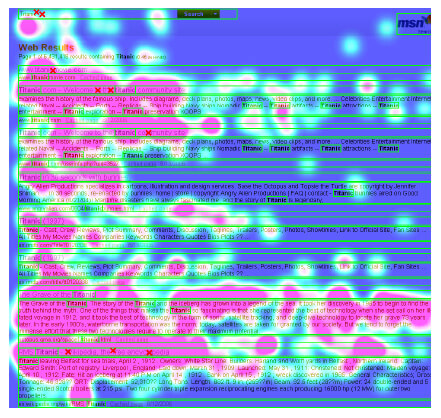 Interesting, the pattern is different that the “golden triangle” that Enquiro
has long talked about in its
eye tracking studies,
where you see all the red along the horizontal line of the top listing
(indicating a lot of reading there), then less on the second listing, then less
still as you move down. That’s because in this particular case, the seventh
listing was the “right” answer plus, as the study explains, the longer than
normal descriptions got people to read more.
Reviewing The Top Five
The study also looked at what people viewed before making a click. IE, did people
review all 10 items listed? Only the first three? Did they review everything in order
until they spotted a choice and clicked? The survey found people often reviewed
one or two items past the item they eventually clicked on:
no matter what result they eventually clicked on, our participants usually
looked at the first 3 or 4 search results. When they clicked on the first or
second result, they still looked at the first 4 results. When they clicked on
lower ranked results, they usually had looked at most of the items ranked above
them. Finally, people go through about 8 results on a page before changing their
queries without clicking on anything (indicated by “Requery
Opinions expressed in this article are those of the guest author and not necessarily Search Engine Land. Staff authors are listed here.

Related stories
New on Search Engine Land
About the author
