Google News To Newsmakers: Send Us Your Comments
Weird. That’s the only way I can describe it. Google News is asking people who are in news stories to email them comments about the story, which will be associated with those articles. From the Google News Blog post: We’ll be trying out a mechanism for publishing comments from a special subset of readers: those […]
Weird. That’s the only way I can describe it. Google News is asking people who are in news stories to email them comments about the story, which will be associated with those articles. From the Google News Blog post:
We’ll be trying out a mechanism for publishing comments from a special subset of readers: those people or organizations who were actual participants in the story in question. Our long-term vision is that any participant will be able to send in their comments, and we’ll show them next to the articles about the story. Comments will be published in full, without any edits, but marked as "comments" so readers know it’s the individual’s perspective, rather than part of a journalist’s report.
This help page explains the process more. You email Google telling them your comment, the story you’re commenting on, your contact info and how they can verify your address.
Frankly, I feel like Google doesn’t know what they’re getting into. The idea sounds fine, that this will enhance the news, as another help page says:
Comments will allow Google News users to find out the story behind a story and to know exactly what the people in the news think about the news.
Maybe. Or maybe Google’s going to get flooded with comment requests from people who are tangentially mentioned in news stories and looking for more visibility in searches.
How’s it actually look? Try a search for McDonald’s, you’ll see this down the page:
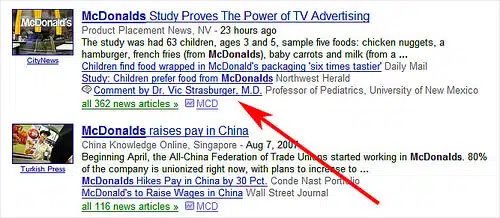
Click on that comment link I’m pointing at, and you end up here:
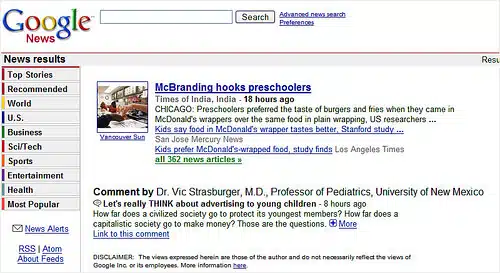
Some observations:
First, this lets Google News for the first time have "story pages" which presumably might gain ads later. To date, Google has not hosted stories on its own site. In contrast, Yahoo has long done this. Look here for an example of how Yahoo is hosting an Associated Press story about Barry Bonds.
Google would need agreements to do this type of hosting. And in fact, it does have them. AFP & Google Settle Over Google News Copyright Case from me covers some of those and how it might let Google directly host material. Interestingly, PC World – Google-AP Deal Passes One-Year Mark from IDG last week covers how to date, Google’s done nothing with these agreements other than to defuse lawsuits. It hasn’t even used it the AP agreement to eliminate duplicates in web search. Try looking for UPS Celebrates Its 100-Year Anniversary, which David Dalka recently pointed out to me has top results all dominated by the same AP story published in various places.
Comments also give Google its own news content. Some news stories will now be "anchors" for user generated content, somewhat similar to how a site like Digg operates. Of course, by trying to only get the "newsmakers" involved, Google may be hoping to eliminate much of the noise you can get in a place like Digg.
Then again, there’s often signal in that noise — and signal coming from people who aren’t actually newsmakers. These people are locked out of the current setup.
Google anticipates this criticism in another help page, which seems designed to explain why they didn’t simply do better integration of blog content with news:
Anyone can write a blog about anything. Although the "blogosphere" plays an important role in online news, Google News will only offer comments about a story that are written by a person who plays a key role in the subject.
That’s too bad. Google Blog Search does have some ability to determine the
authority and relevancy of a blog. Why not show related blog posts on these type
of pages? Why is blog commentary on Google News relegated to that "Blogs" link
in the left-hand column? A simply backlink lookup for a particular article could
instantly give Google plenty of useful commentary on stories.
Sadly, Yahoo used
to blend news and blogs, which naturally compare and contrast well. Then
last August, they
dropped them.
Another disappointment is that Google’s not allowing
those who comment to get links back to their own sites. That should be fixed
immediately. In fact, it ought to be part of a process where Google is building
up a database of newsmakers and commentators, if it’s serious about this new
experiment.
Bottom line, for a marketer, any story
you’re mentioned in means you’ve got the ability to send in a comment. Indeed,
right now they
list very few reasons why they wouldn’t run your comment. You won’t get a
link, but you’ll still get some exposure.
As for news searchers, it all depends on whether
newsmakers find it worthwhile to participate. The link back would provide far
more incentive for this.
The
Google
News Comments help area has more info worth reviewing. Techmeme
has discussion
happening on the web.
Postscript: Q&A On The New Google News Comments is a follow-up with additional information on the launch from Google.
Contributing authors are invited to create content for Search Engine Land and are chosen for their expertise and contribution to the search community. Our contributors work under the oversight of the editorial staff and contributions are checked for quality and relevance to our readers. The opinions they express are their own.

Related stories
New on Search Engine Land
About the author
