Panda Update: Google Lowers The Boom On eHow.com

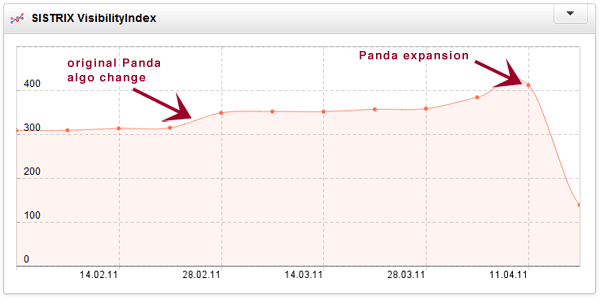
After escaping damage in the first rollout of Google’s Farmer/Panda update, Demand Media’s eHow.com was reportedly not as fortunate in this week’s expansion.
Sistrix, one of the companies that’s been tracking the impact of Google’s changes, says that eHow.com was hit hard by the latest Panda update. We already reported the Sistrix (and other) numbers showing that eHow.co.uk and eHow.com were hit outside the US this week; Sistrix’s latest numbers also show that eHow.com is seeing less visibility inside the US, too.
As the chart above shows, eHow.com’s search visibility has tanked since Google launched the Panda update on April 11. Sistrix says eHow.com dropped 66% in the company’s Visibility Index.
We contacted Demand Media earlier this week after the initial reports that eHow.co.uk and eHow.com were hit on international searches. A company spokesperson told us that, other than their February blog post after Panda’s US launch, “we generally don’t comment or speculate on changes by major search engines.”
How Did Google Hit eHow This Time?
Demand Media properties generally fared well after the first version of the Panda update. Based on Sistrix’s original reporting, eHow.com actually gained in both visibility and number of ranking keywords.

In a late January interview with All Things D, Demand Media CEO Richard Rosenblatt said his company has “a great partnership” with Google.
This is why our partnership with Google makes sense. 1) We help them fill the gaps in their index, where they don’t have quality content. 2) We’re the largest supplier of all video to YouTube, over two billion views and 3) we’re a large AdSense partner. So our relationship is synergistic, and it’s a great partnership. And it’s a partnership that we’re excited to continue to expand.
But Google’s search quality team apparently didn’t feel the same way.
In its blog post this past week about Panda’s international expansion, Google’s Amit Singhal talked about the new signals Google is using and their impact on US searches:
In some high-confidence situations, we are beginning to incorporate data about the sites that users block into our algorithms. In addition, this change also goes deeper into the “long tail” of low-quality websites to return higher-quality results where the algorithm might not have been able to make an assessment before. The impact of these new signals is smaller in scope than the original change: about 2% of U.S. queries are affected by a reasonable amount, compared with almost 12% of U.S. queries for the original change.
It’s not farfetched to imagine that Google’s search quality team was surprised as anyone to learn that eHow escaped the first algo change, and set about tweaking it to go “deeper into the long tail,” as suggested above. And fair or not, eHow is one of the poster children of so-called “content farms” and it’s possible that a noticeable amount of searchers have used the block search results feature that Singhal mentions above.
(To be fair, not all eHow.com content is low quality. I’ve successfully used their articles to do things like connect an unfamiliar wireless router to my parent’s PC. But there’s also some eHow content that leaves you scratching your head … like articles about how to pour a glass of water.)
Other New US Winners & Losers
Sistrix’s latest numbers also reveal additional winners and losers from last week’s Panda update. On the losing side are notable sites like Superpages.com, Spike.com (the cable network’s website), and GreatSchools.org. (I’m somewhat surprised by this last one on the list. GreatSchools.org is a generally well-regarded website that many parents rely on for school and community information, especially when moving to new cities/towns.)
On the winner’s side, Sistrix lists DailyMotion.com, Computing.net and Wiktionary.org as seeing the biggest percentage gains in search visibility. Further down the list are several media sites such as Reuters.com, Boston.com, LATimes.com, CBSNews.com and PCMag.com. Mashable and Huffington Post are also on the winner’s list … never mind the latter’s questionable content generation practices.
For more on the various Panda updates, see the articles listed below.
Postscript: See Demand Media: Panda’s Impact On eHow.com “Significantly Overstated”
Explore more on
Editorial disclosure
Contributing authors are chosen for their expertise and work under the oversight of the editorial staff. Search Engine Land is owned by Semrush. The contributor was not asked to mention Semrush; the opinions expressed are their own.
About the author