Patent: How Google May Trick Search Spammers

 The SEO community has been buzzing about a newly discovered Google Patent document named Ranking documents.
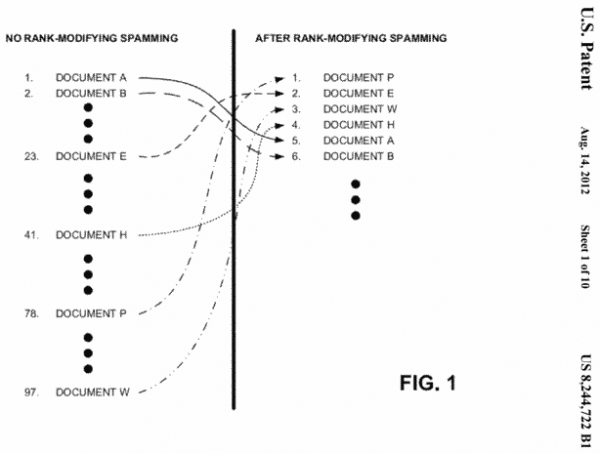
The patent describes how Google may detect certain “rank modifying” techniques and then adjust the ranking of those documents using those techniques in a manner that will confuse the webmaster into thinking that technique did not work. The purpose is to observe how the webmaster (or spammer) reacts to the change and then make more observations based off the next set of changes the webmaster applies.
Here is the specific clause that addresses this in the patent document:
When a spammer tries to positively influence a document’s rank through rank-modifying spamming, the spammer may be perplexed by the rank assigned by a rank transition function consistent with the principles of the invention, such as the ones described above. For example, the initial response to the spammer’s changes may cause the document’s rank to be negatively influenced rather than positively influenced. Unexpected results are bound to elicit a response from a spammer, particularly if their client is upset with the results. In response to negative results, the spammer may remove the changes and, thereby render the long-term impact on the document’s rank zero. Alternatively or additionally, it may take an unknown (possibly variable) amount of time to see positive (or expected) results in response to the spammer’s changes. In response to delayed results, the spammer may perform additional changes in an attempt to positively (or more positively) influence the document’s rank. In either event, these further spammer-initiated changes may assist in identifying signs of rank-modifying spamming.
Clearly this is a way for Google to better learn of different spam techniques and at the same time, keep search spammers on their toes.
There are several blog posts from the search community on this patent. Bill Slawski, who is well known for writing about search patents, covered it. Peter at SEO Book covered it, Barry Adams covered it, I covered it and so did Shaad Hamid where he asked for opinions on it.
Our very own Danny Sullivan responded saying:
Google doesn’t see all SEO as spam. You’re reading way too much into meta tag stuffing and link manipulation to make that into best practices. The meta tag stuffing reference is just odd because Google doesn’t use that. It reads like whoever wrote the patent just shoved in whatever they could think of to be safe. Link manipulation to me reads as targeting spam links.
Here is the “diagram illustrating possible effects of rank-modifying spamming:”
Explore more on
Editorial disclosure
Search Engine Land is owned by Semrush. We remain committed to providing high-quality coverage of marketing topics. Unless otherwise noted, this page’s content was written by either an employee or a paid contractor of Semrush Inc.
About the author