BOFU keywords: The search terms that drive marketing success and profit
Ready to close the deal? Learn what BOFU keywords are, how to find them, and how to use them to capture high-intent traffic and boost conversions.
Bottom-of-funnel (BOFU) keywords drive the clicks that lead to qualified conversions. These are the search terms behind demo requests, pricing page visits, trial sign-ups, and sales conversations, the kind of traffic that fills your pipeline and fuels real revenue.
It’s every marketer’s dream: Marketing Qualified Leads (MQLs) that convert!
While top-of-funnel (TOFU) content builds awareness and middle-of-funnel (MOFU) content educates and nurtures, the BOFU content drives decisions. This is where SEO stops being just a traffic driver and starts becoming a profit center.
This guide will help you identify high-quality, high-intent BOFU keywords, create conversion-focused content, and track results that drive business growth.
What are BOFU keywords?
BOFU keywords are search queries from people at the final stage of the buying journey. They’ve already researched their problem and explored potential solutions, and now they’re evaluating whether your product, tool, or service is the right fit. Their next step might be signing up for a free trial, booking a sales call, or making a purchase decision.
These keywords reflect high-intent search behavior and are often classified into three related categories:
- Transactional keywords: Signals that the user is ready to take a specific action. Think phrases like “buy webinar platform,” “schedule a product demo,” or “get a quote for CRM platform.”
- Commercial keywords: Indicates the user is comparing final options before making a decision. They’re shopping with a purpose, using terms like “best CRM for small teams,” “Mailchimp alternatives,” or “monday.com vs Asana.”
- Conversion keywords: These are terms that consistently lead to conversions, whether the action is a signup, purchase, or consultation. Often includes elements of transactional or commercial intent. Keywords include “free trial SEO tool,” “pricing page builder software,” or “request a demo for [brand].”
BOFU keywords are valuable not just because they generate clicks, but also because they are great indicators that you’re reaching people who are already primed to take the next step.
Common BOFU modifiers
These modifiers reflect purchasing behavior. They indicate that someone isn’t researching whether to buy, but rather what to buy and from whom. When these modifiers show up in your keyword research, whether in Search Console, paid search reports, or SEO tools, they’re a strong signal that the user is close to converting.

Example: Someone searching “how to plan social media content” is likely still figuring out the basics. But if they search “Later vs Buffer” or “Canva Pro pricing,” they’ve moved into decision mode. They’re ready to select a tool, initiate a trial, or obtain budget approval. That’s BOFU intent.
A quick refresher on the marketing funnel
Before we go deeper into the BOFU strategy, here’s a brief recap of the entire marketing funnel, which represents the journey a buyer takes from awareness to decision. BOFU keywords reside at the bottom of the funnel, but it’s helpful to understand how everything differs and works together to convert a lead into a customer.
- Top-of-funnel (TOFU): These are informational searches from users who are just starting their journey. They’re looking to understand a problem or learn something new.
Example: “What is customer relationship management?” - Middle-of-funnel (MOFU): These are educational or comparative queries from users who are exploring solutions. They’re not ready to buy, but they’re narrowing it down.
Example: “Top CRM tools for small businesses” - Bottom-of-funnel (BOFU): These are action-oriented queries from users who are ready to make a decision.
Example: “HubSpot CRM pricing” or “Best CRM for freelancers”
Each stage reflects the buyer’s journey toward conversion, with the final step of BOFU keywords targeting users who are ready to purchase.
The SEO toolkit you know, plus the AI visibility data you need.

Why BOFU keywords matter in SEO
Bottom-of-funnel pages convert at an average rate of 4.78% (nearly 25 times higher than top-of-funnel content!). That’s the difference between attracting curious browsers and bringing in ready-to-buy leads.
That kind of conversion lift is what turns SEO from a traffic channel into a revenue engine. And it all starts with choosing the right BOFU keywords. The beefy explanation is below on why the BOFU keyword is the big money-maker.
Faster conversion
BOFU visitors already know what they want. These queries come from users who are comparing, evaluating, or are ready to act. For example, a user searching “Salesforce vs HubSpot pricing” isn’t learning about CRMs for the first time. They’ve done their research and are serious about purchasing. If your page speaks to that moment, they’ll convert (and quickly!).
Pro tip: Use intent-matching headlines like “Compare [Product] Plans” or “Get a Free Quote” to signal that your page delivers what the searcher is looking for.
Higher ROI than top-of-funnel traffic
A BOFU page that pulls in a few but highly qualified visitors can drive more revenue than a blog post with numerous casual readers. When the traffic is ready to buy, that speaks volumes.
Example: A blog post on “Social Media Marketing Tips for 2025” might attract thousands of readers, but most are just browsing. A BOFU page like “Compare Social Media Management Tools for Agencies” might get fewer visits, but they’re from people actively shopping for a solution.
Pro tip: Make it easy for high-intent visitors to convert. Include clear CTAs, visible pricing, and minimal friction. Don’t bury your “Book a demo” button, keep it visible at the top of the page (before someone has to scroll) so it’s easy to take action right away.
Perfectly align with paid campaigns
Most high-intent terms also show up in paid search campaigns, think “[product] demo,” “pricing,” or “alternatives to [competitor],” and ranking organically for these keywords gives you extra visibility in competitive SERPs and helps reduce reliance on ad budgets. For example, if your team runs ads for “SEO software pricing,” showing up organically for the same term can help you capture clicks without paying for every one.
Pro tip: Review your highest-converting paid search terms and build organic content targeting the exact phrases. It’s one of the easiest ways to sync SEO and SEM.
Connect SEO with revenue
BOFU SEO content helps close deals, and by applying clear CTAs and conversion tracking, you can tie organic search to the pipeline.
Take this scenario:
- You publish a post:
“Best Graphic Design Tools for Marketing Teams” - It includes clear CTAs like:
“Compare Plans” and “Start Your Free Trial”
You tag each CTA with UTM codes and set up GA4 goals
- A user searches:
“Canva Pro for teams”
They land on your post, read the comparison, and click “Start Free Trial”
- Your CRM shows:
That user became a $120/month customer
Now you can prove:
- This blog post attracted three new customers last month
Pro tip: Add UTM parameters and track conversions from organic pages through your CRM. That’s how you go from “this ranks” to “this drives revenue.”
An overlooked but highly lucrative opportunity
Because BOFU keywords tend to have lower search volume, they’re frequently ignored in favor of flashy top-of-funnel terms that bring in more traffic. But the traffic BOFU brings is buyer-ready, and that’s what drives revenue.
Example: A keyword like “Figma vs. Canva for social media design” may get a few hundred searches a month. But the people searching it are actively comparing tools and likely ready to make a purchase decision, making it far more valuable than a TOFU keyword like “graphic design tips.”
Pro tip: Don’t let volume fool you. A few clicks from decision-ready visitors can be more valuable than thousands of unqualified pageviews.
They connect SEO and CRO
Conversion Rate Optimization (CRO) is the practice of turning website visitors into leads, customers, or users. When paired with SEO, CRO helps you not only attract traffic but also turn that traffic into measurable business results.
With BOFU keywords, this connection is even more powerful. If you structure your page well, with clear CTAs, compelling copy, and trust-building elements, you can convert visitors directly from search results.
Here’s how to think of it: SEO gets the right people to your site. CRO makes sure they take action once they’re there. Together, they turn search traffic into real business, like booked calls, trials, or purchases.
Example: If someone searches for “best graphic design platform for agencies,” your SEO strategy brings them in, and a clear CTA, such as “Start your free trial,” along with testimonials and pricing, helps convert them on the spot.
Pro tip: Treat your meta title and description like an ad. Use benefit-driven language and strong verbs that match the action you want people to take, like “Try free,” “Compare now,” or “Book your demo.”
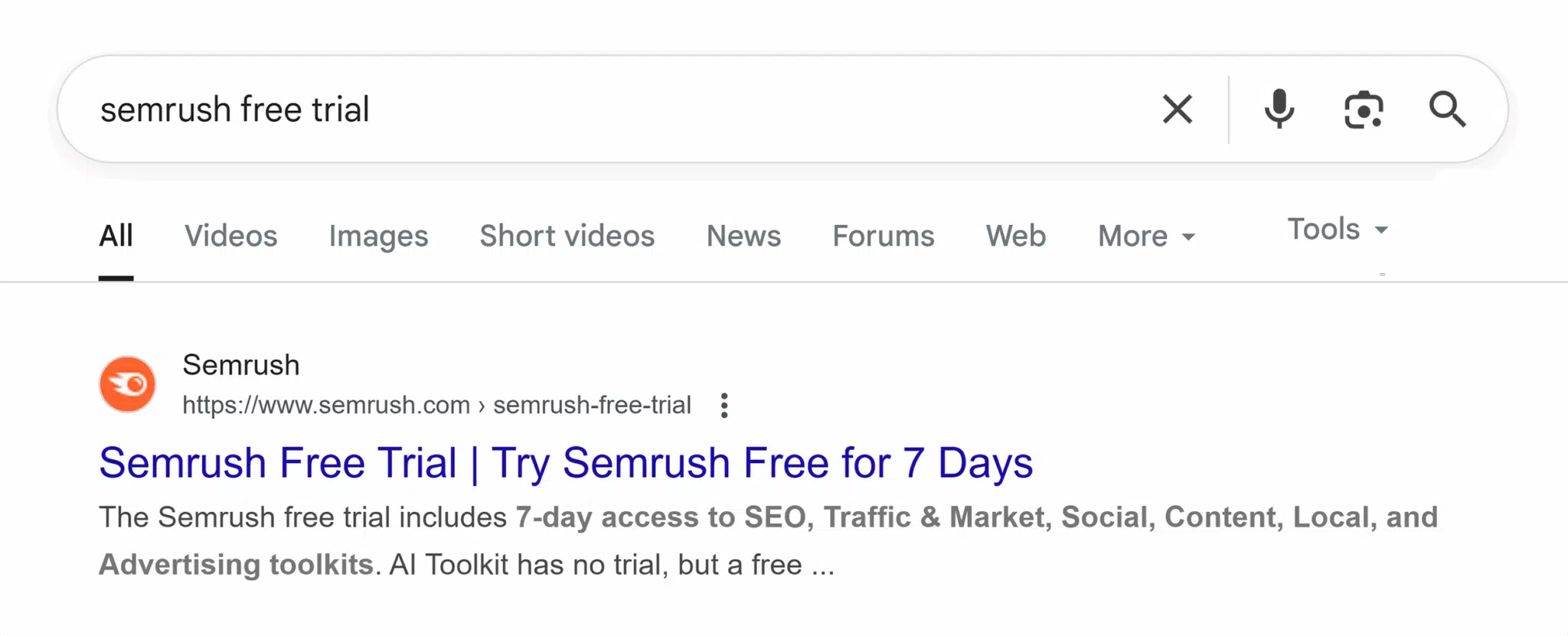
This Semrush snippet uses a bottom-of-funnel keyword (“free trial”) with action-oriented language like “Book a quick demo.” It’s designed to attract high-intent clicks and guide users directly toward conversion.
How to identify high-intent BOFU keywords
BOFU keywords often get overlooked because they don’t always show up in high-volume keyword lists. But with the right tools and behavioral cues, they’re easy to find, and you can start benefiting from them ASAP. One case study found that pages targeting bottom-of-funnel, highly intent-driven keywords converted up to 2,400% better than top-of-funnel content.
Here are the top tactics to secure those highly sought-after BOFU keywords.
Analyze the SERP clues
Before optimizing for a keyword, take a close look at how it shows up in Google. The Search Engine Results Page (SERP) provides clear signals about what the searcher is looking for. For BOFU queries, the SERP often features content tailored for individuals ready to take the final step, such as comparing tools, checking pricing, or contacting a sales team.
Here’s what to look for:
- Paid ads with pricing or demo CTAs
These show that companies are willing to pay to appear for that term, usually because it converts. Keywords like “[tool] pricing” or “book a demo” often attract buyer-ready clicks. - Sitelinks to product pages
When Google shows sitelinks like “Features,” “Pricing,” or “Try Now,” it’s usually because users searching that term often want to explore those pages next. That’s a commercial signal. - Comparison tables or snippets
These highlight feature breakdowns, reviews, or side-by-side product details (perfect for users who are narrowing down their final choice). - Review aggregator listings (e.g., G2, Capterra)
Google often ranks sites like G2, Trustpilot, or Capterra for BOFU queries because users seek social proof and genuine feedback before committing. - Schema-enriched results like FAQs or product markup
Structured data, such as product availability, star ratings, or FAQ dropdowns, shows that the query is tied to product research and conversion decisions. - Shopping carousels or product listings: Common for ecommerce BOFU terms, such as “buy wireless headphones” or “best standing desk under $500.” These signal transactional intent.
Pro tip: Look for keywords that include modifiers like “buy,” “schedule,” or “quote”, these reflect immediate action. Phrases like “compare,” “alternatives,” or “[Brand] vs [Brand]” indicate the searcher is in decision-making mode. And terms such as “best [tool] for [specific audience]” signal niche-specific purchase readiness.
Example: A junior SEO at a marketing agency has a client who wants to attract more ready-to-buy leads for their web design services. You search “best web design agency for small businesses,” and the SERP is packed with paid ads, portfolio pages, pricing CTAs, and review site listings. That’s your signal: this is a BOFU keyword. It demonstrates clear purchase intent and warrants a content strategy designed to convert.
Use keyword tools with intent filters
Once you understand what BOFU intent looks like in a SERP, the next step is to find keywords that match it. That’s when SEO platforms (think Semrush or Ahrefs) become useful for that kind of research.
These tools allow you to filter by intent, including commercial or transactional, so you can focus on queries that are more likely to convert. You can also add specific BOFU modifiers like “pricing,” “vs,” “alternatives,” “best [for X],” or “buy” to surface keywords with decision-stage intent.
But that’s just the first step; there are more ways to find these targeted words. And once you’ve filtered for transactional or commercial intent, your next step is to evaluate the quality of those keywords. Here’s how to dig deeper using tools like Semrush or Ahrefs:
Branded and competitor variations
What are people searching when evaluating you or your competitors side by side?
Use the keyword explorer or organic keyword report to search your own brand and competitor names. Look for queries like “vs.,” “alternatives,” or “[competitor] pricing.” These often signal users in decision mode.
Cost-per-click (CPC)
A high CPC suggests advertisers see these terms as valuable, often because they drive revenue.
Most keyword tools will display CPC next to search volume. A high CPC means advertisers are bidding on it because it is likely to convert. Even if volume is low, CPC can help you spot lucrative terms.
Search volume
BOFU terms may have lower volume, but they deliver higher buyer intent.
Don’t ignore low-volume terms. If the intent is strong (e.g., “get a quote for X” or “compare Y platforms”), they can still drive conversions. Prioritize quality of traffic over quantity.
Who’s ranking
If you see product pages, pricing pages, or comparison posts from your competitors in the top spots, chances are it’s a BOFU keyword.
Type the keyword into Google (or use SERP analysis tools) and check what’s ranking. Are you seeing product pages, pricing tables, or comparison content from your competitors? That’s a good sign, it’s bottom-of-funnel.
Example:
You’re running SEO for a video production agency. Instead of targeting “what is branded video,” try looking for terms like “branded video agency pricing,” “best video marketing agency for tech startups,” or “compare explainer video agencies.” These show up with pricing tables, G2 or Clutch listings, and competitor landing pages, which are all signs you’ve hit BOFU gold.
Mine Google Search Console for bottom-funnel terms
Search Console can show you which queries bring people to your site and how those people behave. BOFU keywords often have low impressions but high click-through rates (CTR). That means not many people search them, but the ones who do click. And clicks from buyers are worth more than a flood of lurkers.
What to look for in Search Console:
- Low impressions, high CTR: This reflects a strong signal of buyer intent
- Queries with modifiers like “pricing,” “free trial,” or “demo”
- Landing pages with conversion goals (not blog content)
- Branded or competitor-related searches that include action verbs
Pro tip: Sort your queries by CTR and scan for transactional intent. These hidden gems can outperform higher-volume keywords in terms of conversions.
Pull high-converting queries from paid search campaigns
If your team runs Google Ads or any other paid advertising campaigns, check in with the person who manages them. Paid search data is a goldmine for BOFU keywords because it reveals exactly which search terms drive clicks, conversions, and revenue.
How paid campaigns help uncover BOFU keywords:
- You can see which keywords drive form fills, demo bookings, or purchases, not just traffic.
- Metrics like cost-per-conversion or Return on Ad Spend (ROAS) reveal which terms are worth the investment.
- Top-performing ad copy often mirrors what high-intent organic searchers are looking for.
Pro tip: Pull a report of your highest-converting paid search terms and use them to guide your SEO content. If people convert from those keywords in ads, they’re likely to convert from organic, too!
Tap into sales enablement content and call transcripts
Sales and support teams often sit on a goldmine of BOFU keyword ideas, and the best part is that accessing that information is as simple as sending a Slack message.
Where to look:
- Call transcripts or summaries from product demos or discovery calls. If your team records sales calls (via tools like Gong or Chorus), ask if you can review the transcripts. Highlight phrases where prospects compare tools, ask about pricing, or express objections. These often reveal BOFU search terms like, “Is [Product] worth it?,” “[Product] vs [Competitor],” or “Does [Tool] work for [specific use case]?”
- Sales battlecards that reps use to handle competitor objections. Ask your sales enablement team if they have these on hand or if they can share them by email. You can use sales battlecards to identify common objections and differentiators that can be turned into BOFU keywords and compelling comparison content.
- Final-stage decks and one-pagers are the materials reps send just before closing a deal. These often answer questions buyers are Googling. Check your company’s content library or internal sales folders (sometimes hosted in Notion, Highspot, or Google Drive).
Pro tip: If you see the same questions, objections, or product comparisons come up repeatedly in sales conversations, chances are those terms are being searched in Google, too. Create SEO content that directly answers their questions.
Scan chat logs, internal site search, and support tickets
Your customer support tools and chatbot platforms are full of gold from the voice of the customer. These are the real, unfiltered questions prospects ask when they’re this close to converting.
People don’t always go straight to Google. Sometimes they ask your chatbot about “pricing breakdown” or search your site for “free trial length.” That’s bottom-funnel behavior. Capturing and analyzing this language helps you create content that clears up friction and supports conversion, right when buyers need it most.
Where and how to access chatbot activity:
- Chat transcripts from tools like Intercom, Drift, or Zendesk Chat. Ask your support or CX team if they can export recent transcripts (some tools offer easy CSV exports or tagging filters).
- Internal site search reports from tools like Google Analytics (Site Search tab) or built-in search logs in platforms like WordPress or Shopify.
- Support ticket tags or summaries; this data typically resides in tools like Zendesk, Intercom, or HubSpot. By reviewing ticket tags or filtering for pre-sales inquiries, it’s super easy to make a list of the most common questions that come in before your ideal persona reaches out to you.
What to highlight from prospects during BOFU research
Listen for the kinds of questions, searches, and hesitations that show buying intent. These are the phrases that can inspire content ideas and keyword targets:
Feature questions: Prospects often ask:
• Does it integrate with [tool]?
• Do you offer nonprofit pricing?
• What’s the difference between plans?
Search behavior: Keep an eye out for searches like:
• Free trial
• Cancel policy
• Compare plan features
Hesitation points: Look for moments of hesitation, such as:
• Is this secure?
• Can I talk to someone first?
• What happens after I sign up?
These are signals that the person is close to making a decision, but might need one more push from your content. Time to put those marketing skills to work.
Example: If your support team receives numerous tickets asking, “How does your refund policy work?” that’s a signal to create a clear explainer page targeting BOFU keywords like “refund policy [your brand].”
How to optimize BOFU content
Ranking for a BOFU keyword is only half the job. Once users land on the page, your content must be effective in converting them. That means aligning every element of your layout, messaging, and structure to help the visitor take the next step.
Here’s how to do it.
Map keywords to high-intent CTAs
BOFU visitors are looking to take action, but only if it’s obvious what the next step is. Your CTA should be easy to spot and simple to complete. Don’t make buyers hesitate to get in touch.
Use CTAs that match the keyword’s intent.
If someone searches “get a quote for marketing automation,” they expect a clear path to do just that, not a blog post or vague contact form.
Examples of high-intent CTAs:
- “Buy now”
- “Talk to sales”
- “Book a free consult”
- “Compare plans”
- “Request a quote”
Pro tip: If your CTA doesn’t match the searcher’s stage in the funnel, they’ll bounce. Use language that mirrors the query and keep it visible, rather than burying it at the bottom.
Use on-page elements that drive conversions
BOFU traffic is too valuable to waste on low-converting pages. Make sure your layout supports fast, confident decision-making.
Incorporate these conversion-focused elements:
- Sticky CTAs, so there’s always a visible action to take
- Pricing visibility that allows easy access for users
- Trust badges (security, partnerships, certifications)
- Social proof like testimonials, review scores, or client logos
- Limited-time offers to encourage urgency
Pro tip: Cut the fluff! Remove excess copy, eliminate unnecessary fields in forms, and reduce distractions around your CTA.
Support indexation with technical SEO
Even the most persuasive BOFU page won’t convert if it’s invisible to search engines. You need to get the basics of technical SEO right.
Confirm technical SEO is working:
- Fast load speeds, especially on mobile (Google prioritizes the mobile experience above all)
- Schema markup, think (Product, FAQ, LocalBusiness), to enhance appearance in SERPs
- Canonical tags if you’re duplicating pages for different services, locations, or pricing tiers
Pro tip: Use Google Search Console or a crawler like Screaming Frog to check that your BOFU pages are being indexed properly and not blocked by robots.txt or noindex tags.
Match the SERP format
If the top results for your keyword use comparison tables or G2-style reviews, your content should too. Meeting the SERP format expectations increases your chances of winning clicks and conversions.
Matching the SERP format not only boosts clicks and conversions, but it can also help you rank in SERP features like featured snippets or AI Overviews.
Common SERP-aligned formats:
- Product schema for e-commerce and software
- Comparison tables for “vs.” or “best for” queries
- Review aggregations for affiliate or local services
- FAQ sections for objection handling and trust-building
Pro tip: Don’t just copy the format, improve it! Use visual cues (like ratings or feature checkmarks) to make decisions easier.
Measure what matters: Conversions over clicks
Ranking #1 for a bottom-funnel keyword doesn’t mean much if the page isn’t helping your business grow. BOFU SEO should be measured not by how many people click, but by how many take action once they arrive.
That means shifting away from vanity metrics (like traffic or impressions) and focusing on what moves the needle:
What to measure instead:
- Form submissions: How many visitors are signing up, requesting quotes, or booking calls?
- Sales-qualified leads (SQLs): Are these leads a good fit and moving through your sales pipeline?
- Purchases or subscriptions: Are people buying after landing on these pages?
- Revenue influenced by SEO: What deals can you tie back to specific BOFU content?
How to track it:
- Set up goals or events in GA4 to capture key actions like form fills, demo bookings, or button clicks.
- Use UTM parameters on links in email campaigns, social, or ads that drive to BOFU pages so you can separate organic from paid.
- Integrate your CRM (like HubSpot or Salesforce) with Google Analytics or your CMS so you can trace a lead’s path from search to sale.
- Use attribution reports to connect organic traffic to revenue outcomes. Even if a visitor doesn’t convert on the first visit, these reports can show influence across touchpoints.
Pro tip: Make sure each BOFU page has a single, clear conversion goal. A pricing page should push people to sign up or book a call. Keep your pages laser-focused on the action you want the visitor to take.
BOFU content types that convert
BOFU needs to be, above all, persuasive. It guides high-intent users to the finish line, whether that’s signing up, making a purchase, or reaching out.
These content types are built for decision-making. Here’s what they are, what they’re best for, and a quick example of each to help you see them in action.

Why this matters
If you’re early in your content marketing career, you might assume that blog posts and how-to guides are enough to drive conversions.
But when someone is close to buying, they need content that helps them compare, trust, and act.
These BOFU pages:
- Speak directly to the buyer’s needs
- Support sales and paid campaigns
- Are easier to tie to the pipeline and revenue
These are the assets that turn interested readers into actual customers.
Track, optimize, and win in Google and AI search from one platform.
Make BOFU keywords the backbone of your SEO strategy
You’ve just seen why bottom-of-funnel keywords matter, how to identify them, and how to optimize pages that convert real buyers. Now, it’s time to turn that insight into action.
Ask yourself these questions to evaluate whether your BOFU keyword strategy is truly revenue-ready:
Does your keyword match the searcher’s intent?
Check the SERP for decision-stage signals like pricing pages, demo CTAs, or review sites. If those aren’t showing up, it’s probably not a BOFU keyword.
Is your CTA aligned with the next step?
Every BOFU keyword should lead to a clear, intent-matching action, like scheduling a call, signing up, or comparing plans. That CTA should be visible immediately and repeated with purpose.
Are trust signals and conversion cues in place?
Elements such as testimonials, star ratings, certifications, and transparent pricing help reduce hesitation and build buyer confidence.
Does the content match the SERP format?
BOFU pages should reflect what’s already ranking, comparison tables, product cards, review snippets, or FAQs. Schema markup enhances this alignment and improves visibility.
Are you tracking performance beyond traffic?
Clicks alone don’t show value. Measure conversions, UTM-tagged actions, goal completions in GA4, and CRM attribution to prove ROI.
Does a larger content strategy support the page?
Link to it from your TOFU and MOFU content, and make sure visitors can explore deeper if they’re not quite ready to act.
Want to make sure your BOFU keywords truly align with searcher needs? Start here with our guide to search intent in SEO.
About the Author