Impact of bad responses in Google Reviews

It’s never pleasant to receive negative reviews for your business. And unfortunately, they create a difficult decision for the business owner. Path one is the smart practice of responding to customer complaints with professional skill and courtesy, as this can restore consumer trust and improve your reputation in the eyes of the general public. Path two, however, takes the brand down the alternate route of publicly sparring with the unhappy customer instead of restoring their satisfaction.
This second choice creates a permanent public record that indicates the brand mistreats its customers when problems arise. This poor online reputation will follow the business not just across its review profiles, but also in AI interfaces like Google AI Mode, Claude, and ChatGPT.
Seeing both paths as a choice is the first step toward making optimal reputation-management decisions. By understanding the far-reaching consequences of bad responses to Google Business Profile reviews, brands inevitably become increasingly motivated to write owner responses that solve problems and earn public trust.
The bad review isn’t always the biggest reputation problem
At some point, most local business owners have been tempted to respond to a negative review on their Google Business Profile like this:

It might seem easy to simply ban the customer and make the complaint headache go away. But there’s a serious problem with this impulsive approach.
A negative review tells prospective customers that one person had a bad experience. An angry, defensive, or unhelpful owner response tells them something much more significant: This is how the business behaves when something goes wrong.
Consumer behavioral surveys clearly outline public expectations for review responses, showing what customers want and what drives them away. Ahead, we’ll look at statistics that local business owners can use as a cautionary tale to moderate their responses and avoid significantly undermining their success, both online and in the real world. We’ll also consider how the rise of AI (which has a knack for surfacing old content) is bringing new attention to this important topic.
Bad review responses can potentially follow a brand for life. It’s not always comfortable meeting consumer expectations, but it’s generally the best business plan.
The hidden audience for every review response
After receiving a bad review, it’s natural to want to clap back at the complaining customer. This is a common gut reaction to criticism of any kind. Harsh words can feel like a personal attack instead of a critique of the brand.
But in business, you need to make a critical distinction: You’re not just responding to the reviewer — you’re responding in front of:
- Prospective customers researching the business
- Existing customers deciding whether to return
- People comparing several local businesses
- Anyone who later encounters screenshots should the exchange go viral
It’s okay if a negative review privately makes you want to reply with a sassy answer — as long as you don’t act on it. You must ask yourself how a public exchange will help you win the future customers you need to run a viable business.

While it might (temporarily) feel emotionally gratifying to write a reply like the above, don’t do it! A hidden audience is watching and will base their own transactional decisions on whether your brand has a reputation for helping customers when problems arise.
How consumers (and Google) actually want businesses to react to bad reviews
Your best defense against writing heated Google review responses that undermine your company’s reputation is to follow a simple blueprint based on what consumers want.
Most customer needs are relatively simple. When something goes wrong with a transaction, most consumers want to receive:
- A timely response to their review
- An apology when a problem has occurred
- An offer from the business owner to make things right
When an owner fails to meet these criteria, they miss the chance to:
- Win back the trust of the unhappy customer
- Inspire that customer to update their negative rating and review
- Earn increased loyalty and referrals from the restored customer
- Impress prospective customers with how well the brand treats its patrons when a problem arises
The most recent large-scale consumer behavioral study with reputation management brand GatherUp contains all the elements you need to build out your calm and collected owner response plan. While the next section will go into this blueprint in detail, first we’ll review some important statistics uncovered by this study that feed the blueprint and how they shape reactions from the brand:
| Statistic | Brand win | Brand fail |
| 81% of consumers consider owner responses to reviews a necessary part of customer service. | A good response is an easy victory that will likely satisfy 80% of your customers. | Ignoring reviews is an automatic letdown for all but 19% of your consumer base. |
| 73% of positive reviewers want to be thanked in an owner response. | Make almost ¾ of your happy customers even happier with the simple act of responding. | You’re losing the chance to make a second positive impression when you don’t express gratitude for positive sentiment. |
| 72% of negative reviewers expect an owner response. | Basic responsiveness to complaints is the start of winning back unhappy customers and making a good impression on prospective customers. | When you ignore complaints, you burden your brand with the necessity of acquiring new customers instead of restoring existing ones to satisfaction. You also let prospective customers know you won’t help them if anything goes wrong. |
| 58% of consumers expect a response within three days or less. | Use review-monitoring software to receive instant alerts of incoming sentiment. Fast responses make a good impression on nearly 60% of customers. | Delayed responses can close the window of opportunity for winning back a dissatisfied customer. |
| 66% of consumers feel increased trust in brands that respond with an offer to make things right for unhappy customers. | A negative review is often a cry for help. Use your complaint-resolution skills to restore satisfaction with the brand and build public trust. | Failure to respond to complaints means missing out on key trust-building opportunities with more than 60% of the public. |
| 64% of consumers are positively impressed when owners apologize for negative customer experiences. | Say “I’m sorry” and take responsibility for customer-service failures. Just two little words go a long way toward earning forgiveness. | Refusing to apologize can make your brand look unaccountable and arrogant. |
| 44% of consumers experience increased trust when owners provide contact information for following up on complaints. | Provide a phone number, text line, or email address, then directly ask the negative reviewer to get in touch. This allows you to hear more about the issue they experienced and offer to make things right. | You’re decreasing your opportunities to improve reputation, consumer loyalty, and business operations if you don’t follow through on investigating the causes of complaints. |
| 38% of consumers appreciate hearing about changes the business has made to prevent future customers from experiencing the same problems. | In cases where the root cause of a customer-service failure can be identified (e.g., broken fixtures, unexpected staff shortages, etc.), it’s a good practice to mention remedies that have been put in place. | If you ignore complaints, you’re almost guaranteed to overlook structural problems in your business. Over time, unaddressed issues will drag down your average star rating. |
| 69% of negative reviewers will give local businesses a second chance when owner responses resolve their complaints. | A skillful, problem-solving response has the power to win back nearly 70% of unhappy customers. This is a massive budgetary win because the brand isn’t obliged to replace lost patrons. | Failure to earn a second chance via a helpful owner response puts unnecessary pressure on new-customer acquisition-programs instead of safeguarding your existing consumer base. |
| 48% of negative reviewers will improve the sentiment and rating of their initial review following complaint resolution. | Improve your reputation, star ratings, local rankings, and AI trust by restoring consumer satisfaction with responses that solve their problems. | When you don’t restore customer satisfaction with a skilled response, reputation damage that impacts star ratings often follows, which also hurts local search rankings, AI trust, and the willingness of future consumers to choose your brand. |
| 32% of consumers say they would recommend a business to their circle of contacts after a complaint is handled well. | Earn valuable trust-based referrals through simply taking good care of existing customers who experience problems. Even a few recommendations can make a significant impact on profitability. | Local brands and small businesses live and die by reputation. You’re losing customers if you let unhappy patrons walk away without restoring their confidence that your business is worth recommending to others. |
| 21% of consumers feel increased brand loyalty after an owner response resolves their complaint. | No brand enjoys complaints, but any tactic that builds loyalty is valuable. Complaint resolution is a major building block of repeat transactions. | Failure to resolve complaints leaves the door open for competitors to acquire your customers through better treatment. |
A negative review response blueprint
Now we can take all of the important information collected from the study and develop a proper framework for how to respond to negative business reviews. Ensure that every staff member or third-party marketer tasked with responding to your reviews has access to the response blueprint, as it’s critical that your brand always responds appropriately.
This simple workflow is the blueprint for responding to negative reviews:

By following this sequence, you can sometimes inspire negative reviewers to update their initial sentiment to reflect a better subsequent experience with your brand. This is what success looks like (examples pulled directly from Google AI Mode to further emphasize how public this record of good responses can be):

These negative review response examples reveal that the brands in question were doing all the right things to:
- Closely monitor incoming reviews
- Recognize legitimate service failures
- Quickly respond with offers to make things right
If you’re not confident that a drafted response to an unhappy customer has the power to transform the situation, do a “screenshot test” by asking yourself the following questions:
- Does this sound angry?
- Am I trying to resolve the situation — or win?
- Am I attacking the person rather than addressing the complaint?
- Am I revealing information that shouldn’t be public?
- Would I say this face-to-face in front of ten prospective customers?
- Does my response make the business look calmer than the reviewer?
- Should I wait an hour before posting this?
Pro tip: Never respond while emotionally activated. Draft it. Walk away. Come back and reread the response as a prospective customer. Then decide if this is the correct response to post.
Anatomy of an angry owner response
The public aftermath of angry owner responses to negative reviews can provide all the motivation you need to stick with the response blueprint. Examples of bizarre or angry local business responses to reviews sometimes go viral, even earning news coverage, such as in this case of an embarrassing public exchange about a restaurant refusing to serve tap water.
While such press may earn clicks for the sake of entertainment, brands are better served by understanding what’s really happening with the customer so they can better defend their own reputations. Let’s break down a few real examples of common owner response failures.
Example 1: Escalating drama instead of defusing it
Whitespark’s Darren Shaw recently highlighted this example of an owner response to a review in which a consumer complained about the lack of utensils and napkins at a restaurant. The patron actually gave the business a three-star rating because they enjoyed the food, but they also alleged the owner demanded the customer take out their phone and write a good review.
This is dangerous territory for the brand, as this tactic is a violation of Google’s review policies and can be reported to Google via the report business conduct form, risking review removal and even Google Business Profile listing removal.
Of course, such an allegation absolutely deserves the attention of the brand, a correction of review-acquisition tactics if the allegation is true, and an effort to diffuse the drama surrounding this transaction. Instead, the owner chose to escalate by writing this rambling rebuttal:

A better approach to this negative review would have been to:
- Investigate whether any of the business’s review acquisition practices violate review platform guidelines or legal codes, and immediately stop using those tactics, if so.
- Reach out to the customer directly, if possible, for complaint resolution, explaining what the business has done to correct course and resolve any complaints.
- If there is no way to privately resolve the issue and inspire the customer to update their review, this would be a better public response:
Dear [Customer Name],
This is [Business Owner Name], the owner of [Company Name]. I am so sorry for the poor experience you had with us, and I am very eager to make things right. I have spoken to all my staff, and we are struggling to recall some of the details you describe. I would be so grateful if you would reach out to me directly at [phone number] so that I can be 100% clear on what went wrong and do everything I can to make it up to you. I want to ensure you’ve been heard, understood, and received the best possible customer service. I hope to hear from you soon. Thank you so much.
Sincerely,
[Business Owner Name]
Even if the brand never hears back from the unhappy customer, the above response signals to the public that the owner is eager to listen, help, and make amends.
Example 2: Refusal to accept responsibility
The negative review shown here is fairly typical, complaining about price and portion size:

Rather than responding directly to the reviewer’s shock at the price tag for this meal (perhaps with a frank discussion about inflation-related problems and how they negatively impact restaurants), the owner brushes the customer off, making light of their dissatisfaction.
Example 3: Attacking the customer
A one-star review from a customer is an extreme reaction to a product or service’s price. In this example, the reviewer’s language is mild, simply stating that the dermatological services offered might fall outside some budgets.
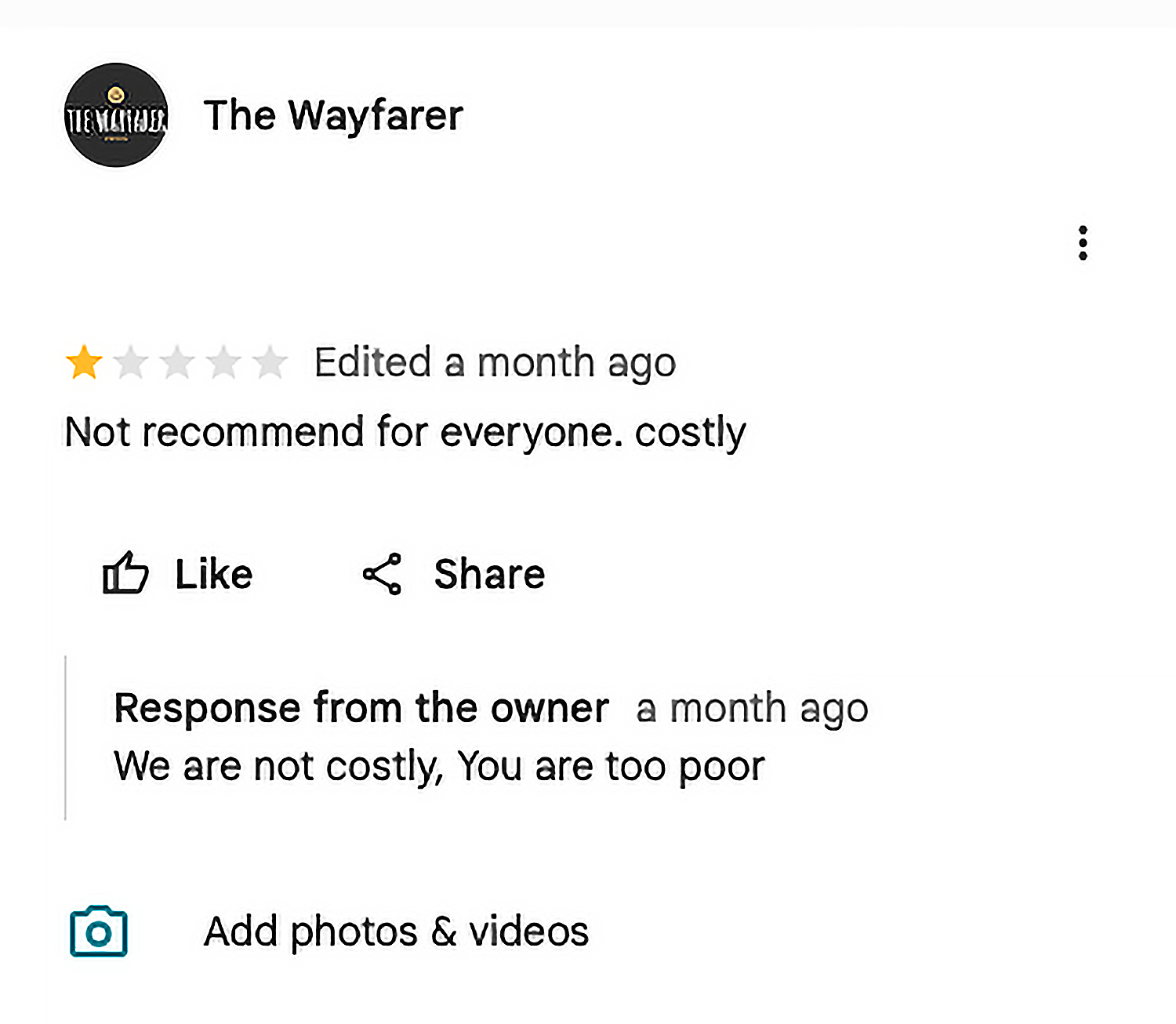
Unfortunately, the skincare practice chose to respond by attacking and insulting the reviewer. The consumer was then upset enough to report this exchange in the Google Maps Help Forum, where respondents suggested they flag the content as potentially violating Google’s prohibited and restricted content policies.
The business might have avoided all this if the owner had simply responded:
Dear [Customer Name],
This is [Business Owner Name], the owner of [Company Name]. I am so sorry our fee structure was not a good fit for you at the moment. Would you be willing to contact me directly at [phone number] so that I can learn more about where we are failing to make our pricing clear before bookings. I’m concerned if you were surprised when you received your bill. I really care about your experience with us, and I would very much appreciate the chance to talk further. I’d also like to ensure you know about all our available discounts and specials in case they might give us the chance to serve you again. Thank you for considering calling me. I’ll hope to hear from you soon.
Sincerely,
[Business Owner Name]
In all three cases, the business owners make things worse for themselves by failing to adhere to the blueprint outlined earlier for successfully responding to negative reviews.
Here are some of the most common patterns seen in poor review responses:
- The courtroom response: A paragraph-by-paragraph rebuttal designed to prove the customer wrong
- The personal attack: Insulting the reviewer’s intelligence, character, finances, appearance, and so on
- The threat: Threatening lawsuits, police, exposure, or retaliation
- The public shaming response: Revealing embarrassing details about the customer
- The sarcasm response: Mocking the complaint or reviewer
- The indifferent response: “We don’t want customers like you anyway”
- The rage essay: A 700-word response to a two-sentence complaint
The truth is that unhappy customers are frequently rude in the reviews they write. Instead of writing something like “I was disappointed that my pizza arrived cold,” they lash out with language like, “Never eat here…this is the worst pizza place in the world.”
If an over-the-top negative review has upset you, you might identify with this business owner who wondered whether they should respond at all, fearing they might make the situation worse:
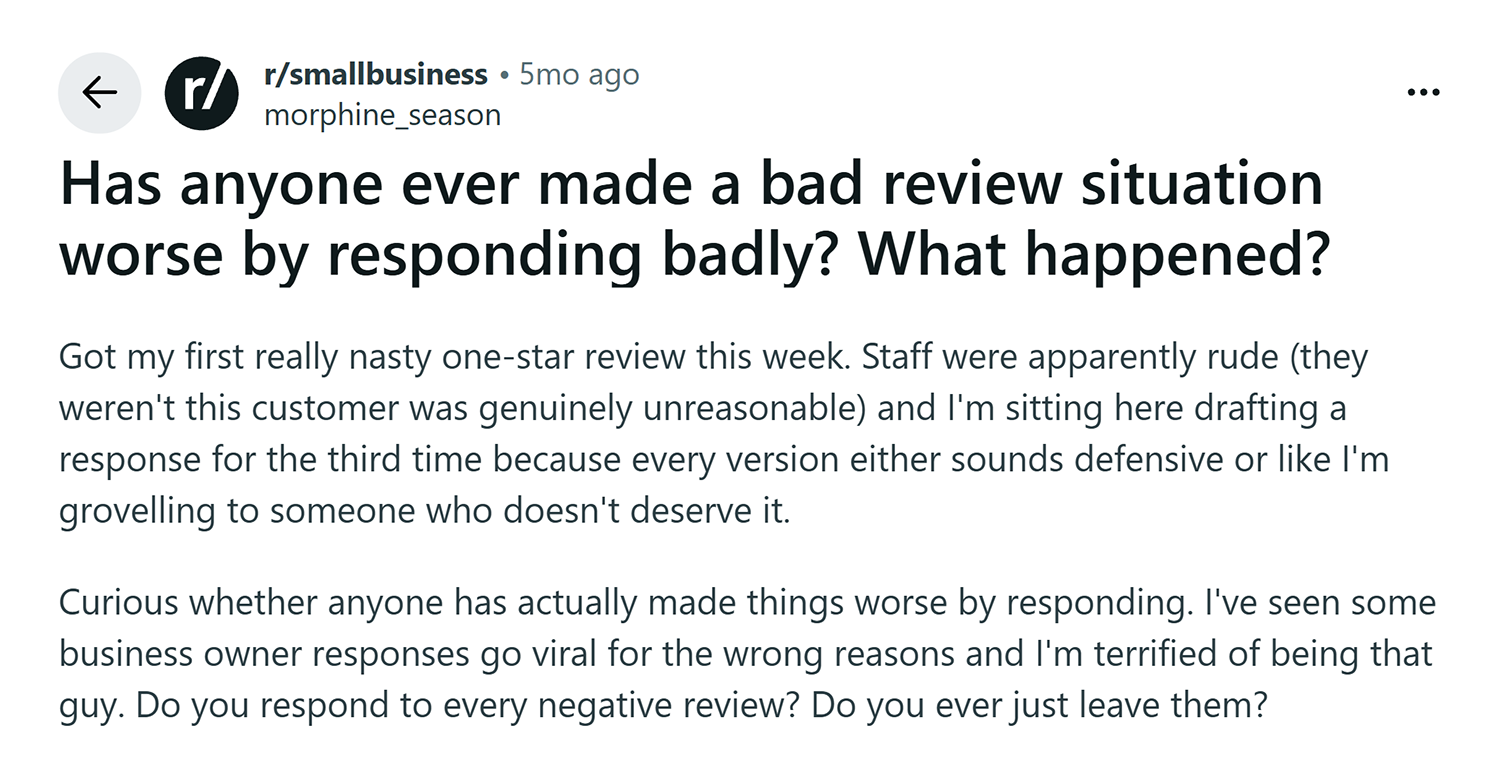
It’s absolutely possible to make a bad situation worse if you respond to a negative review while in the wrong frame of mind. A separate consumer behavior study at Moz revealed the following statistics on the outcomes of responding poorly:
- 54% of respondents said they would definitely avoid a brand that failed to offer a solution in response to a complaint in a review, while an additional 39% said they might avoid it
- 33% said they would avoid a business that accused a customer of lying, while 56% said they might avoid the business
- 46% would definitely avoid a business owner who argues with customers in review responses, and 45% might also avoid it
- 47% would definitely avoid a business that fails to apologize for a customer’s poor experience, and 43% might avoid it for this reason
It’s clear from these statistics that a bad response to a complaint creates a very negative impression of any brand. Keep going back to the response blueprint and think about the long-term success of your business until you feel calm enough to respond appropriately.
While there doesn’t appear to be a study that quantifies the financial impact of poor owner responses to negative reviews, we can connect the dots in GatherUp’s finding that the majority of customers now consider review responses as part-and-parcel of customer service. A study from Qualtrics XM predicts that global brands will lose $3 trillion to poor customer service in 2026. Local businesses that either ignore negative reviews or respond poorly are setting themselves up for failure, as they are neglecting a core aspect of customer service.
Do replies affect brand reputation and customer loyalty?
As cited earlier, the GatherUp study found that 21% of consumers feel increased loyalty after a brand successfully resolves their complaint. A separate survey from BrightLocal suggests that how a business responds to reviews is as important as the review itself, based on the following statistics:
- Businesses are more likely to be chosen by 80% of consumers when all reviews receive a response from the owner
- 42% of respondents are unlikely to choose a business that entirely ignores its reviews
- 89% of the public now expects brands to respond when a review is left
- 81% of reviewers expect a response within a week, and 19% want a same-day response
- 50% say they are unlikely to choose a business that appears to be using generic review response templates
While figures may vary from study to study, we can see that a consistent narrative of consumer expectation and brand power emerges from multiple consumer behavioral surveys. Think of it this way:
- Great expectations: Consumers express a strong desire to be heard when they take the time to write either a positive or a negative review. They yearn for thanks in response to the praise they give and for solutions in response to complaints. Reviews are an invitation to a conversation between the customer and the local business.
- Great power: The brand has the power to either disappoint these expectations by ignoring the review or writing a combative and unhelpful response, or restore the satisfaction of the unhappy customer with an accountable, problem-solving reply.
- Public proceedings: All of this activity is observed by the general consumer public, and it strongly influences whether prospective customers choose a business because it seems responsive and helpful or avoid it because it treats customers badly when things go wrong.
- A downward spiral: When negative reviews are ignored or receive a poor response, the business’s reputation suffers. In these situations, the brand forgoes influencing customers to update low star ratings and sentiment to reflect a better subsequent experience with the business owner. The same study from GatherUp found that only 7% of consumers will choose a business after its average rating dips below three stars. Meanwhile, unresolved negative reviews will quickly erode local search visibility. Whitespark’s Local Search Ranking Factors survey found that high numerical Google star ratings are the sixth-most influential factor on local pack/Google Maps rankings. No business can afford to shed existing customers, potential customers, and local search visibility in this way.
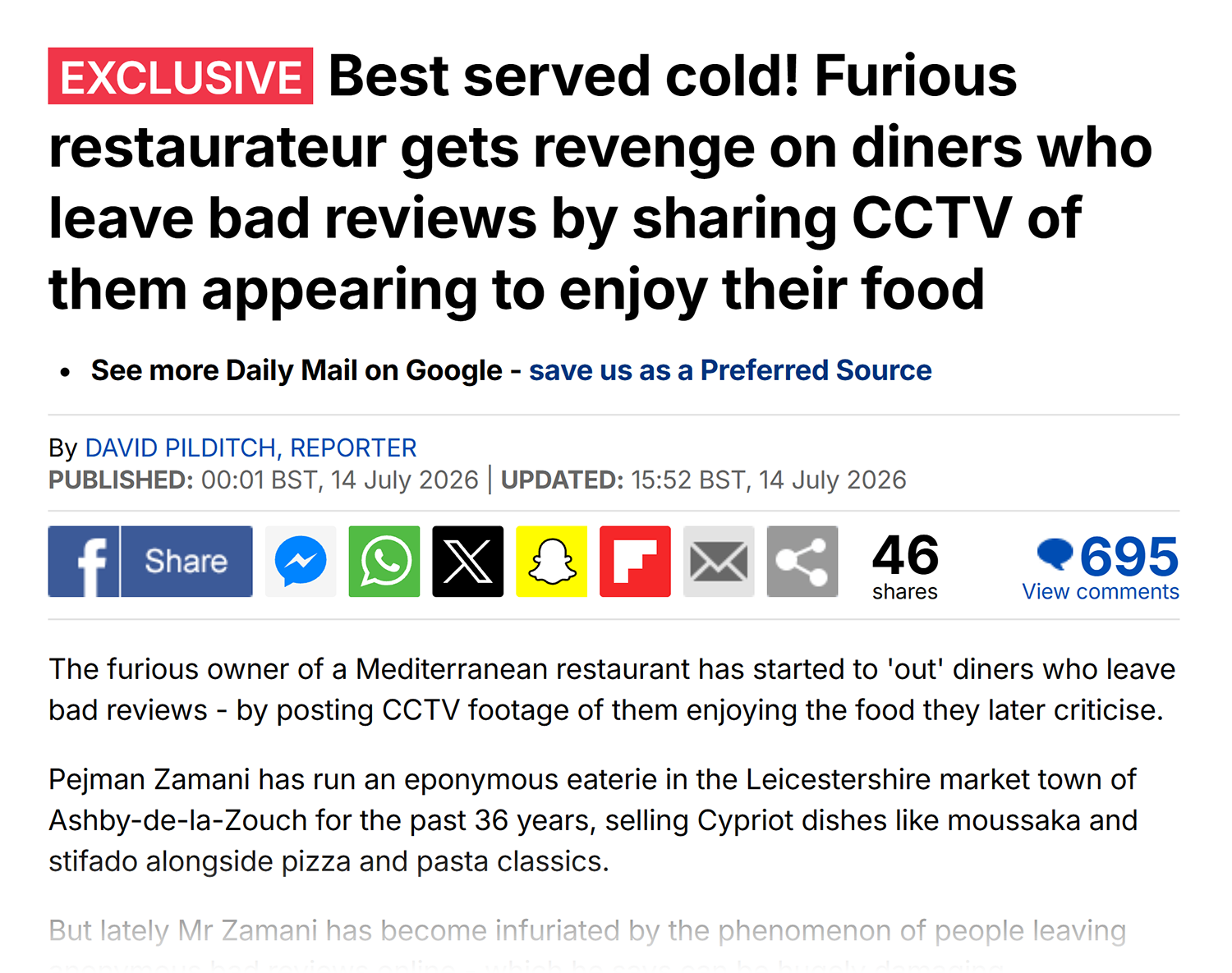
- Permanent negative press: As we’ll soon investigate, AI appears to create a nearly permanent record of negative press. Not only does ignoring or mishandling complaints build a body of evidence that a business can’t be trusted to provide good customer service, but in extreme cases, hostile review responses can go viral. Regardless of how old viral news stories are, AI frequently surfaces this content when potential customers inquire about local brand reputations:
Following the blueprint is the best way to avoid developing a reputation that results in business closure.
Do review replies affect SEO?
Whether review responses directly impact SEO is a commonly asked question. Unresolved negative reviews impact average star ratings, and this absolutely affects rankings. Beyond this, however, the question deserves a more nuanced answer.
Local SEO subject matter experts tend to answer this query by saying that owner responses indirectly impact SEO in multiple ways, rather than directly. See the following answer from Google Business Profile Help Forum Diamond Product Expert, Mike Blumenthal, where he is asked this very question:

Blumenthal provided a sound and standard industry answer to this query, highlighting how owner responses can positively influence conversions and behavioral signals, which are core SEO topics. You’ll find similar sentiments expressed in this thread at Sterling Sky’s local search forum. Forumgoers point out that behavioral signals like user engagement from review responses deserve to be considered part of SEO.
However, definitions of SEO are broadening as a result of the emergence of artificial intelligence (AI). Some practitioners have suggested new industry acronyms like generative engine optimization (GEO) or artificial intelligence optimization (AIO). Regardless of nomenclature, it’s now necessary to think beyond how mishandled owner responses impact just search engine rankings.
Do review replies affect AI search?
AI search results in tools like Google AI Mode and ChatGPT provide a body of evidence about how local brands treat their customers. For example, this screenshot shows Google AI Mode’s reputation summary for a branch of Walmart in Fresno, California, based on reviews its customers have left:

Given AI’s dependence on review content when asked to summarize brand reputation, local brands are rightfully asking whether owner responses are retrieved by these systems and can influence AI outputs.
Despite multiple queries submitted to both ChatGPT and Google AI Mode, we have not been able to prompt either to directly display owner responses to reviews on sources like Google Business Profiles, Bing Places listings, or Yelp reviews. Instead, these tools pick up third-party content citing problematic review responses:

So, in cases where a business earns publicity for combative owner responses, their replies absolutely impact AI results, even if this is picked up from third-party sites rather than stemming directly from their local business listings.
ReputationArm’s Claudia Tomina suggests:
“If large language models are reasoning over customer reviews to build AI Overviews and summaries, does that mean they’re also evaluating the way a business responds?
Your replies might be giving AI additional context to work with.
Responding to reviews has always been good business practice, but in the age of AI-powered search, it may also become a key content signal.”
Currently, nothing indicates that AI models train on review replies. However, review responses include exactly the type of information and context that could help AI platforms gain a deeper understanding of individual businesses. So even if AIs don’t seem to be accounting for this information today, it’s best to assume that someday they will and temper your review responses accordingly.
Tomina later offered speculative examples of how owner responses could become direct AI training sources in the future, such as a review from a consumer expressing appreciation of a restaurant patio and then receiving a response from the brand about how the patio is heated in the winter.
This information is additional detail that might help AIs answer other user prompts, such as “Are there any restaurants near me with heated patios?” Being forward-minded with how you handle review replies and what extra details you can include means you’re actually writing replies not just for the original customer, but also for future customers searching online.
Given that AI already cites third-party content featuring examples of poor owner responses, and that these tools could eventually surface direct citations of owner responses, it’s good advice to reply to negative reviews fully aware that whatever you write becomes a matter of public record. Don’t respond with any language you wouldn’t want AI to surface about your brand.
It’s also important to understand that AI tools can surface very old reputation content. In a Whitespark column, Reviews + the Real World: Learnings from Famed Restaurant Reviewer, Marilyn Hagerty, in response to a question about bathroom cleanliness at Olive Garden, AI surfaced this example of Google’s “Ask a Question” feature, citing a professional review from 2014:

This example highlights how AI tools can reach back across the decades for evidence of brand reputation. It has never been more important for local brands to operate in a consumer-centric fashion across all aspects of the business so that online evidence speaks well of them.
“But what if the reviewer is lying?”
In a perfect world, all sentiment left by reviewers would be accurate, honest, and fair. However, it’s not uncommon for members of the public to:
- Misrepresent what happened
- Exaggerate
- Use rude language and personal attacks on staff
- Leave reviews for businesses they never visited
- Demand unreasonable compensation
- Weaponize reviews after not getting what they want
Your brand needs to be skilled at differentiating between:
- Biased reviews
- Reviews that violate review platform guidelines or laws
In nearly all cases where a consumer exaggerated about the specifics of a transaction, your brand is best off following the blueprint for apologizing and offering to make things right for the unhappy customer. For example, you might have a customer who is unbearably rude to your staff and even have video documentation of their anti-social behavior. It can be tempting to respond to their complaint-filled one-star review by calling out the reviewer’s bias and misrepresentation.
How you respond to reviews is ultimately up to you, but it’s typically wise to not air dirty laundry in public because the conflict will become part of your brand reputation’s permanent public body of evidence. It’s best to respond in a way that demonstrates you are sorry for any customer dissatisfaction and are doing everything on your end to provide a solution.
You may not satisfy an unreasonable customer, but you can absolutely signal to the public that your brand is responsive, accountable, and helpful when complaints arise.
When a review violates Google’s guidelines
In cases where a review violates Google’s prohibited and restricted content guidelines, you have the option to follow Google’s steps for reporting the review for removal. For example, if a review contains misinformation, hate speech, personal attacks, or other forbidden content, you can make your case to Google that the review should be removed. Google does not guarantee removal, but some reviews contain such obvious violations of platform policies that they should be reported.
Dig deeper: For a complete tutorial on reporting reviews, read Google reviews & SEO: Advanced strategies that scale.
Review extortion is a case of its own. If your business is attacked with fake reviews followed by a demand for money, Google has created this unique and separate process for reporting review extortion.
If Google fails to respond to your requests for the removal of reviews that violate either platform guidelines or the legal codes of your state or country and you are not satisfied with this outcome, these options are open to you:
- Contact an attorney for legal advice
- Take your case to the Google Business Profile Community Help Forum and request additional help from the volunteer product experts who have the power to escalate issues to Google’s staff
- Seek press coverage of a widespread Google review attack that the company is ignoring, in hopes of bringing pressure due to public attention
- Use the owner response function to reply, “This review has been reported to Google for violation of the Prohibited & Restricted Content Guidelines.”
You may not be able to reach an ideal outcome with every fraudulent review, but you are not powerless to improve the situation.
You’re writing review responses for the next customer
It’s perfectly normal to instinctually respond to criticism by defending yourself and your business, but your first reaction to a negative review is a private matter. You have time to transform your private feelings into a public response that serves your business well instead of undermining its success. Take an hour or even a day to move from a place of hurt or anger to one of empathy and empowerment.
The most important person reading your response may not even be the complaining customer. It’s all the prospective customers quietly scrolling through reviews a month later, trying to answer the question, “Do I trust this business?”
Ready to maximize the power of your reviews? Read: 7 Local SEO wins you get from keyword-rich Google reviews.”
Explore more on
Editorial disclosure
Search Engine Land is owned by Semrush. We remain committed to providing high-quality coverage of marketing topics. Unless otherwise noted, this page’s content was written by either an employee or a paid contractor of Semrush Inc.
About the author