Content pruning case study: Cutting 33% of pages that drove just 3% of clicks

Somewhere on a healthcare company’s website, a holiday card from 2021 was still wishing Google a happy New Year.
Google, for the record, never wrote back.
The card had roommates. Seven “in case you missed it” posts for people who had, in fact, missed it. An early bird reminder for a conference that ended two summers ago. An invitation to a nautical-themed reception that I can only assume was a lovely evening for everyone except the XML sitemap.
All of it indexed. All of it standing in line at Google’s front door with a résumé.
So in December 2024, I did the thing every SEO threatens to do and most never get sign-off for.
I crawled 600 URLs and marked 198 of them, a third of the crawl, for the exit. Those 198 pages had earned 144 clicks between them. That’s 3.1% of the site’s clicks, or roughly what the homepage does before lunch.
Here’s what happened next. All of it. Even the embarrassing parts.
Content pruning results: Clicks up 37%, sessions up 55%, top 10 rankings up 3%
Nothing broke. I’m leading with that because it’s the only result in this article I’d defend in court.
In the four months after I pruned, Google Search Console clicks rose 37%, impressions rose 49%, and organic sessions in GA4 rose 55%. Top 10 rankings went from 264 keywords to 271.
| Dec. 2024 | April 2025 | Change | |
|---|---|---|---|
| Search Console clicks | 5,710 | 7,840 | +37% |
| Search Console impressions | 247,000 | 368,000 | +49% |
| GA4 organic sessions | 10,404 | 16,103 | +55% |
| Ranking keywords (Semrush) | 4,348 | 6,742 | +55% |
| Keywords in the top 10 (DataForSEO) | 264 | 271 | +3% |
| GA4 paid search sessions | 11,863 | 182 | -98% |
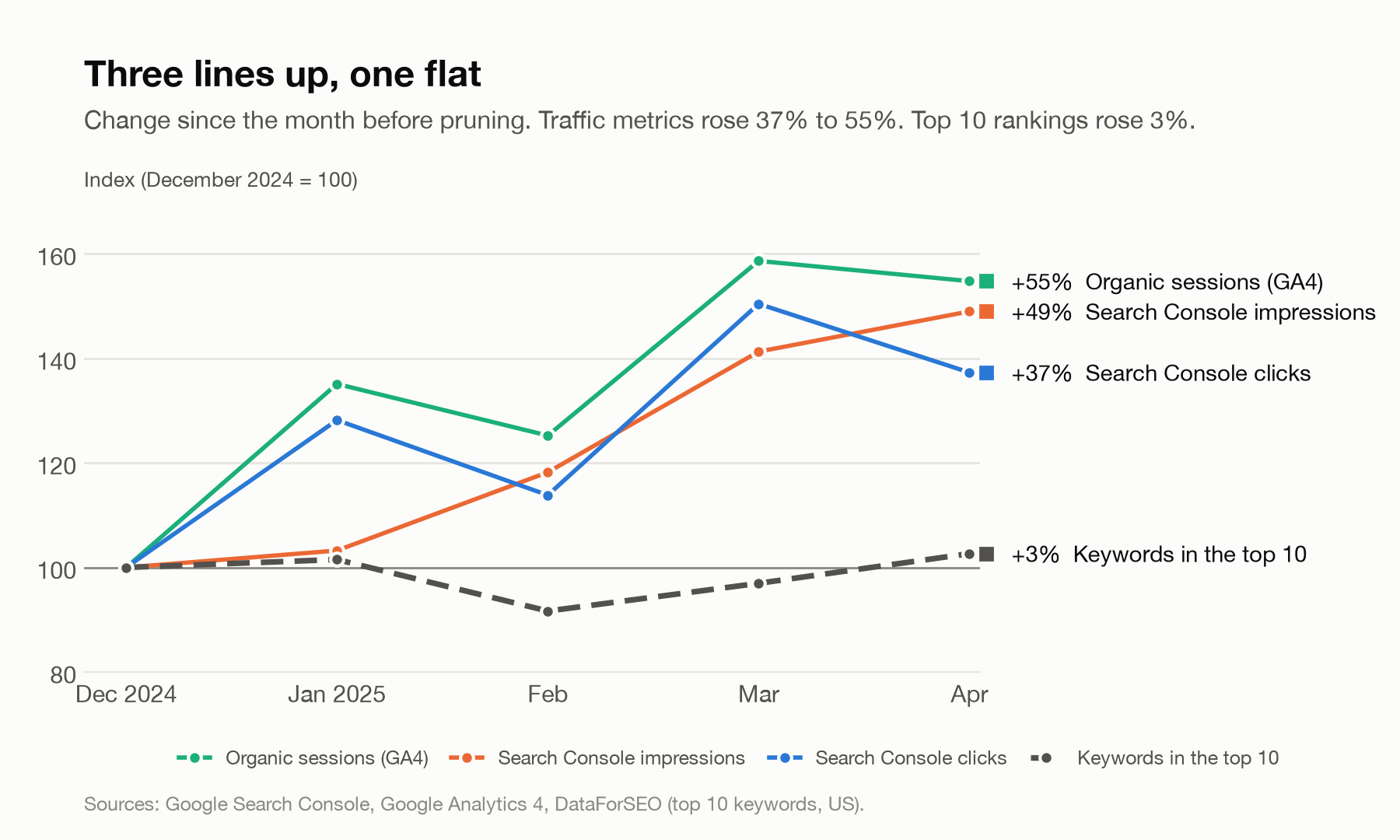
Look at that table the way you’d look at a dating profile. Three lines are up and gorgeous. One line, the one that tells you whether Google thinks more of your pages, is sitting on the couch in sweatpants.
And then there’s the last row, which we’ll get to. It’s the reason I don’t trust any pruning case study with one chart going up and to the right. Including the one I could have made from this data.
The site belongs to a B2B company. Small site, long sales cycle, and at the time, more than 80% of its organic clicks were people typing the brand name.
What we pruned: 198 of 600 URLs that earned 144 clicks
I removed four kinds of pages. Not one of them was written for a human being with a question.
| What it was | URLs | What we did |
|---|---|---|
| Old event promo posts (speaker previews, early bird reminders, the boat party) | 50 | 301 to the events hub, then noindex |
| Holiday greetings, ICYMI roundups, dated news, 2020 pandemic posts | 43 | 301 to the resources hub, then noindex |
| Customer logo pages, roughly 94 to 156 words each | 51 | Unpublished and redirected |
| Thin podcast stubs, syndicated reposts, near-duplicates | 24 | Noindex, nofollow |
Of the 198 pages we cut, 140 had never earned a click. Not a slow month. Never.
A second batch a month later took out 60 orphaned URLs, mostly taxonomy archives the CMS had been breeding in the basement.
About those event pages. I asked the web manager why there were so many, and her answer belongs in a museum: to get an event to show up on the site at all, the CMS makes you publish a full page for it.
“It’s complicated (and dumb),” she wrote.
I felt that in my chakras.
Because that’s what index bloat usually is. Nobody sat in a meeting and decided to publish 50 thin event pages. A template did it. Mercury wasn’t in retrograde. The CMS was.
How to decide what to prune when 213 of your ‘keeper’ pages have zero clicks
I read every URL. That’s the method. I’m sorry it isn’t sexier.
Each page got a row: status code, indexability, word count, internal links, near-duplicate matches, plus clicks, impressions, and position from Search Console.
Then every row got a description and a seat in one of four tabs. Redirect. Noindex. Keep. Questions.
You’ll notice there’s no traffic threshold in there. Here’s the number that killed it.
Of the 386 pages we kept, 213 also had zero clicks. If ‘no clicks, no mercy’ had been the rule, we’d have gone full Cobra Kai on more than half the survivors. Product pages. Case studies. The privacy policy, which nobody searches for and legal would like to keep, thanks. Pruning is more Mr. Miyagi with the bonsai: small cuts, and you look at the whole tree first.
Clicks told us where to look. They did not tell us what to do. These did:
- Was this page ever meant for search? A holiday card wasn’t. Bye.
- Is it thin now but valuable later? Noindex it and put it on the rewrite list. (Hold that thought. The podcast section is coming and it’s the best part.)
- Does the business need it alive? Then it lives. See the next section before you argue.
- Is there a closer match? If two pages covered the same report, we picked one and pointed the other at it.
One rule did more work than all four questions. Redirect first, then noindex or unpublish. Two steps. In that order. You’ll see shortly what happens when someone does it in one.
And one stat I can’t stop thinking about: two URLs, the homepage and the client login page, drove 62% of every click in that crawl. When a site is that top-heavy, pruning was never going to be a traffic play. It was housekeeping. Sage-the-apartment, open-the-windows housekeeping.
Content pruning in phases: The 67 thin pages the business needed to keep
Here’s where the tidy SEO framework meets an actual company with actual departments.
All 67 newsletter archive pages were thin, duplicative, and, by every metric in my spreadsheet, dead weight. They also had a job. The newsletter team sent people to them, and the website was the only place the company had to put them. There was no other platform. There was no plan B. There was the CMS and a prayer.
Same story elsewhere. Presentations that conference attendees needed a link to. A partner page that had to be published but had no business in a search result. A page the web manager refused to un-redirect because, in her words, people have old bookmarks and they need to land somewhere.
She was right every time. “Thin” is an SEO opinion. “Our customers use this” is a fact.
So I stopped treating pruning as one heroic weekend with a machete and ran it in phases:
- Cut (January 2025): The 198. Pages nobody inside or outside the company needed.
- Hold: Pages the business needed live stayed live and got a noindex. Users can reach them. Google is politely asked to look away. Newer newsletter issues were noindexed from the day they published.
- Rebuild: Thin pages with real substance trapped inside went on the content roadmap. As each one was rewritten, the noindex came off. About 16 pages have gone back into the index this way.
- Move out: The client agreed to relocate the newsletter archive to a different platform entirely. That takes a build, a budget, and a calendar that isn’t mine. [VERIFY: current status of the newsletter move.]
Phase 4 is the unglamorous truth of content pruning at a real company. Sometimes the right answer is “yes, and it’ll take a year.” You take the yes.
In the meantime, the hold did its job. Between July and October 2025, the newsletter archive earned zero impressions in Google Search. Not low. Zero. The pages were still there for every subscriber who clicked through from an email, and completely invisible to everyone else. That’s the whole trick.
The industry’s trusted source for essential news and analysis.
Sign up for our newsletter to receive exclusive insights and updates directly to your inbox.
- Daily breaking news
- Expert analysis from industry veterans
- Join over 200k subscribers
- Covering SEO, PPC and AIO
Thin content worth saving: How 24 podcast pages went from position 17.3 to 9.0
Now the fun part. The podcast pages were, on paper, the worst content on the site. A title. An audio player. A two-sentence blurb. Word counts that would embarrass a fortune cookie.
They were also the best content the company owned.
Each episode was roughly 30 minutes of a health system executive, a chief experience officer, or a physician leader explaining exactly how they’d solved a problem the audience was googling.
Real names. Real hospitals. Real numbers. The kind of firsthand expertise every SEO deck begs clients to produce, and here it was, already produced, locked inside an MP3 where no crawler and no answer engine could hear it.
Deleting those pages would have been like donating a coat to Goodwill with $10,000 still in the pocket.
So I kept the pages and rebuilt what was on them. Each episode became an evergreen, in-depth article at the same address: the expert’s argument, the steps, the quotes, and the data, all written out, with the audio still there for anyone who prefers their insights at 1.5x speed.
What happened: comparing July 9 to Oct. 8, 2025, with the same weeks in 2026, the podcast section’s average position in Search Console went from 17.3 to 9.0. The number of podcast pages earning impressions went from 22 to 24.
And clicks went from 195 to 112.
Yes. Down. I told you I’d show you everything.
If you’re wondering how a set of pages can rank nearly twice as high and earn fewer clicks, welcome to search in 2026, where 220 of this site’s keywords now trigger an AI Overview (it was 16 a year earlier) and a top 10 ranking is a participation trophy. Some of that position gain is also Google’s September 2025 reporting change, which stopped counting a lot of deep rankings and flattered everybody’s average.
I’d still make the same call tomorrow. The alternative was 24 pages of nothing, and you can’t get cited by an answer engine for a blurb and a play button.
Did content pruning cause the growth? Paid search fell 98% the same quarter
No. Or at least, I can’t prove it did, and I’d side-eye anyone who says they can.
Here’s everything else that was happening to this site while I was admiring my own spreadsheet:
- Paid search got switched off. GA4 recorded 11,863 paid search sessions in December 2024 and 182 in April 2025. On a site where most people search the brand name, those visitors didn’t vanish. They clicked the organic listing instead.
- Two Google updates wrapped the week of our crawl (a core update Dec. 12 to 18 and a spam update Dec. 19 to 26). Another core update hit in March.
- Page speed fell off a cliff in January, from about two seconds to six.
- Rewritten content started going live in April.
- The click gains in January and March were mostly branded.
Now do the math on that first bullet, because it’s the most savage number in this article.
Organic sessions rose by 5,699. Paid search sessions fell by 11,681. Add the two channels together and total search sessions dropped 27%, from 22,267 to 16,285.

So my beautiful 55% organic lift? A good chunk of it is the ad budget wearing a different hat.
That’s the chart nobody puts in the case study. I’m putting it in the case study.
What I can claim is smaller and, I think, more useful.
I removed a third of the crawled URLs and lost nothing measurable. Semrush’s site health score jumped from 69% to 79% the month the changes shipped, then gave nine of those points back in February, because a health score is a mood ring.
What I told the client that month: the growth so far came from cleaning up, and the bigger gains would have to come from publishing better pages.
Top 10 keywords sat at 264 in December 2024 and 271 in April 2025. They didn’t climb until the rewrites had been live for months, hitting 338 by December 2025. That’s 28% above the pre-pruning baseline.
Pruning cleared the room. The content did the work.
Indexed pages fell 57% while top 10 keywords rose 65%
If you want one image from this whole project, it’s this one.
Search Console showed 1,412 indexed pages in September 2024 and 1,297 on Dec. 2, 2024, right before the pruning. In October 2026, it shows 559. That’s a 57% drop. Another 1,369 URLs sit under “Excluded by ‘noindex’ tag,” every one of them there on purpose.
chart-3-content-pruning-less-site-more-rankings.png
Chart showing indexed pages in Google Search Console falling 57% between December 2024 and October 2026 while keywords ranking in the top 10 rise 65%, from 264 to 435.
That 559 isn’t the pruning alone. It also includes a later rule that noindexed 374 old PDFs, a hosting migration, and nearly two more years of phases two through four.
What it shows is direction: the site has fewer than half the indexed pages it used to, and 65% more keywords in the top 10 than it had before we started cutting: 435 in October 2026, up from 264.
What I can’t show you is the indexed count for February 2025, the month after the pruning shipped.
Which brings me, with a deep cleansing breath, to my mistakes.
6 content pruning mistakes I made (including 51 instant 404s)
In order of how much they still haunt me.
1. We didn’t take the ‘after’ photo
I have the indexed count from three weeks before the pruning and from 22 months after. Nothing in between. Search Console keeps 90 days of indexing history and 16 months of performance data, and I went looking in month 22. Export the report the day you start and again at 30, 60, and 90 days. Google won’t hold your memories for you. It’s not that kind of relationship.
2. Unpublishing created 51 404s
The customer logo pages were unpublished before their redirects existed. For a stretch, all 51 served a 404. My comment is on every one of those rows like a ransom note: confirmed unpublished, now a 404, please redirect. Two steps. In order. I said this already. I’ll say it at my funeral.
3. We pruned a page that was on the content roadmap
A leadership Q&A got marked for redirect and noindex while it was scheduled for a refresh. My note in the sheet reads, in its entirety: “So sorry! This was a mistake.” It was back in the index within days, and only because a human happened to look.
4. I redirected to hubs instead of matches
We had:
- 50 event posts to the events page.
- 43 to the resources page.
- 51 customer pages to one generic “why us” page.
That last page went on to earn 85,200 impressions and 50 clicks over 16 months at an average position of 7.3, and for a while I blamed our redirects. Then I pulled the queries. The biggest one, at 29,596 impressions and exactly one click, is the company’s bare acronym. Next up: the brand name plus “login.”
So the redirects are innocent. They were still lazy. Nobody looking for a specific hospital’s story wanted a generic “why us” page, and I can’t measure the people who landed there and left.
5. Redirects are debt
By September 2026, 278 of the site’s 923 crawled URLs were 301 redirects, and 3,390 internal links still pointed at them. We took the pages out of the index and left the links to them all over the house, like an ex’s hoodies.
6. The template kept publishing
A few months after we pruned 50 event posts, a brand-new event post was one of the site’s top five landing pages. The next conference produced another batch. We mopped the floor and left the tap running.
Content pruning checklist: What I’d do differently on the next 600 URLs
All learned the expensive way.
- Map every redirect to its closest relative: A 2023 speaker preview belongs with that year’s recap, not the generic events page. No relative? Let it 404 or 410 and go in peace.
- Take the before and after on day one: Indexed pages, crawl stats, and clicks for every redirect target.
- Fix internal links in the same sprint: A redirect without the link update is just the mess with a forwarding address.
- Check the content roadmap before the crawl: Zero clicks plus a refresh scheduled next month is not a pruning candidate.
- Ask what’s inside the thin page before you judge it: A 90-word page wrapped around a 30-minute expert interview isn’t thin. It’s unopened.
- Write the rule that stops the bloat: Ours, eventually: one event page, updated every year. If promotion needs separate pages, they’re noindexed from birth.
Should you prune content? What 198 deleted pages bought me
Yes. With your expectations in the right place and your ego in a drawer.
Pruning this site removed a third of its crawled pages at a cost of 3% of its clicks, with no measurable loss in rankings. It didn’t create the growth. It made the growth easier to see, easier to earn, and it started the conversation that mattered more than any redirect: why does this website keep making pages nobody wants, and what are we hiding in the ones we thought were worthless?
It also never ended.
Last week, I pulled the site’s “not found” report – 58 URLs. Seven needed a fix and 41 had never been pages at all. And one podcast episode was stuck in a redirect loop, two URLs pointing at each other for eternity, each waiting for the other to go first.
Somebody will break it up. Probably me. Probably Tuesday.
Explore more on
Editorial disclosure
Contributing authors are chosen for their expertise and work under the oversight of the editorial staff. Search Engine Land is owned by Semrush. The contributor was not asked to mention Semrush; the opinions expressed are their own.
About the author