Semantic depth in SEO: Go beyond keywords to rank higher


You followed the SEO playbook. You carefully selected keywords, analyzed competing content, and published long‑form articles that filled gaps in coverage for dozens of topics. Yet your Google rankings haven’t budged—and your brand’s still not appearing in AI Overviews, ChatGPT, or Perplexity.
One likely culprit?
Lack of semantic depth: the degree to which your content demonstrates comprehensive coverage, expertise, and topical authority for the topics you want to be known for.
These days, semantic depth is a baseline requirement for your domain’s content to be visible in modern search engines like Google and across LLM platforms.
Sites that demonstrate semantic depth are more likely to:
- Rank consistently for complex queries
- Earn citations in AI‑driven answers
- Build durable topical authority that persists through updates
- Have high brand trust and authority
This guide explains what semantic depth is, how Google and LLMs evaluate it, and how to effectively integrate it into your content strategy without compromising clarity. You’ll get frameworks, examples, and metrics to help you create semantically rich content across your site, earn topical authority, and track your progress over time.
What is semantic depth?
In SEO, semantic depth refers to the degree to which a site comprehensively covers a topic, its subtopics, and related topics from multiple angles. Content that is semantically rich or deep clearly defines and explains a core topic’s entities (the people, places, things, or ideas involved), their attributes (the traits that define them), and their relationships (how those concepts connect).
The SEO toolkit you know, plus the AI visibility data you need.

Targeting the keywords and intent of queries still matter. But to be recognized as both a topical authority and a trusted source, your site’s content must demonstrate mastery of the core topics you want to own. Put plainly, that means your domain needs to cultivate topical authority and semantic depth.
Semantic depth versus topical authority
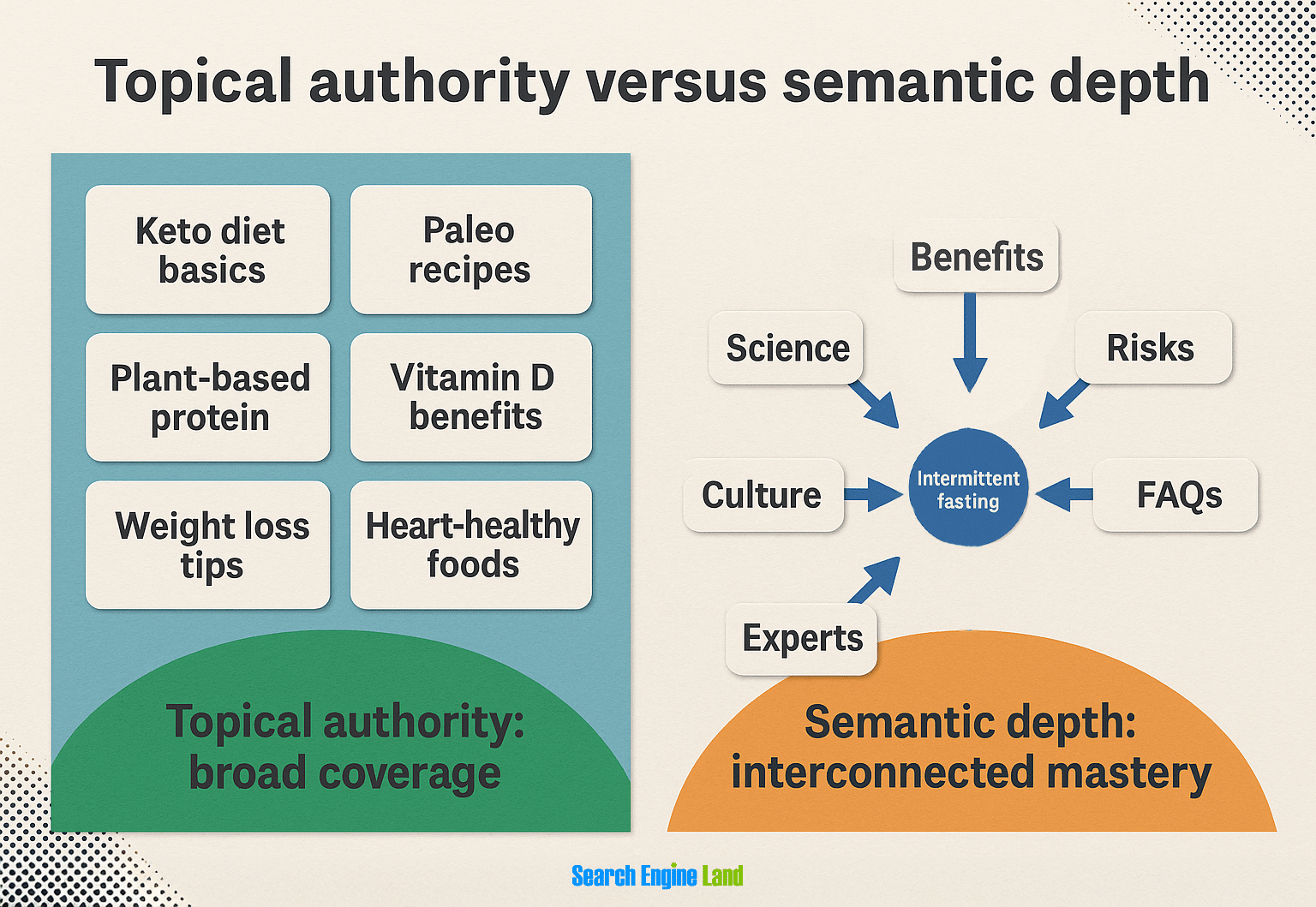
Topical authority reflects the breadth of demonstrated expertise and coverage across a subject area. Semantic depth reflects the depth within it.
These two concepts reinforce one another: topical breadth shows that your site is trusted across a category, while semantic depth proves you’ve mastered the topics that matter most to your audience and business.
| Semantic SEO | Topical authority | Semantic depth | |
| Definition | Optimizing content to align with meaning and intent, not just keywords | Breadth of expertise across a domain | Depth and connection across a topic’s entities, attributes, and relationships |
| Scope | Page-level optimization | Category- or domain-level expertise | Topic-level mastery with entity mapping |
| Primary output | Better keyword-to-intent matching | Recognition as a broad resource | Evidence of mastery, trust, and long-term authority |
Why does semantic depth matter for SEO?
Semantic depth matters for SEO because it helps modern search engines determine if your content provides the best answer for a query.
In practical terms, here’s how semantic depth can help your content succeed in Google search:
- Better intent matching: Semantically rich content anticipates follow-up questions to initial queries and answers them, keeping users engaged
- Clearer entity connections: Explaining entities, attributes, and relationships helps Google map your content to its Knowledge Graph
- More visibility in AI features: Pages with depth are more likely to be cited in AI Overviews and other generative search results because they provide the detail and context that models rely on
- Broader query coverage: By including related concepts, your content can rank for long-tail queries and more complex, contextual searches
Consider a nutrition site.
A site with topical authority might publish dozens of articles: “keto diet basics,” “paleo recipes,” “plant-based protein sources,” “vitamin D benefits,” and so on. This volume and coverage signal authority to Google.
But without semantic depth, each topic is often treated in isolation. For example, an “Ultimate Guide to Intermittent Fasting” might exist, but it stops at surface-level advice. The site ranks for broad “what is…” queries but fails to capture complex, high-intent searches.
By contrast, creating semantic depth for a domain starts with selecting a few main topics to focus on (e.g., intermittent fasting, vitamin D, and plant-based protein). Once you’ve done that, you can create an ecosystem of content based on their subtopics and related topics.
For the nutrition site, that ecosystem might include:
- A science-based article on metabolic effects and circadian rhythm
- Guides to different fasting schedules (16:8, 5:2, OMAD)
- Comparisons to related diets (keto, paleo, plant-based)
- Cultural and religious perspectives on fasting
- FAQs that address risks, myths, and practical challenges
- Expert commentary from nutritionists and doctors
How do search engines evaluate semantic depth?
Search engines assess semantic depth by how well your content helps them map connected entities to their knowledge graph. Google’s ranking systems use the Knowledge Graph and AI models (RankBrain, BERT, MUM) to assess whether content demonstrates mastery of a topic. Pages that align are more likely to surface in SERPs, snippets, and AI Overviews.
From keywords → intent → entities → depth
The way Google evaluates content has changed dramatically over the past two decades.
Early ranking systems rewarded keyword frequency and backlinks. Over time, they began matching queries to content based on search intent and topical relevance. Later, Google’s systems began using entities and context to better understand how queries and content relate.
Today, Google and AI models prioritize authoritative, trustworthy content that demonstrates mastery of a topic.

These shifts can be grouped into four broad eras:
- Keywords + links (1998–2012)
- Ranking systems: PageRank, Panda
- Key signals: keyword density, backlinks
- Content model: flat, keyword-optimized pages
- Intent + semantics (2013–2017)
- Ranking systems: Hummingbird, RankBrain
- Key signals: query intent, machine learning
- Content model: hub-and-spoke structures
- Context + entities (2018–2021)
- Ranking systems: BERT, MUM
- Key signals: entity recognition, contextual nuance
- Content model: pillar + clusters
- Authority + AI (2022–today)
- Ranking systems: Helpful Content, E-E-A-T, AI Overviews
- Key signals: authority, trust, entity-rich coverage
- Content model: people-first clusters with semantic depth
Each step raised the bar for what “quality content” means. What started as keyword and link ranking is now entity- and authority-driven.
Dive deeper: Explore Google’s algorithm timeline to learn more about ranking systems and the evolution of search.
Signals used to evaluate semantic depth
Key signals of semantic depth indicate which domains are the most comprehensive, authoritative resources for specific topics.
Here are some of the most important signals Google uses to evaluate semantic depth:

These signals tell Google whether your content reflects true subject mastery or just surface coverage. The closer your content matches real-world connections between ideas, the more likely it is to be trusted as authoritative.
How semantic depth influences Google’s AI-powered search
Semantic depth shapes not only how pages rank in classic results, but also how they’re selected for Google’s AI-powered features.
BrightEdge research found that 82.5% of AI Overview citations point to “deep pages” with URLs located two or more clicks from the homepage, not surface-level content. This suggests Google’s AI features lean toward detailed, specialized resources rather than high-level summaries.
Google’s own documentation explains that AI Overviews and AI Mode may use a “query fan-out” technique, splitting a query into related subtopics and combining supporting pages into a response. Pages with strong entity coverage and subtopic depth are more likely to match those fan-out queries and be selected as sources.
Here’s how the evaluation typically works:
- User query → A question or task initiates retrieval
- Entity graph understanding → Google maps entities, attributes, and relationships tied to the query
- Source selection → Comprehensive, trustworthy pages with strong depth signals are prioritized
- AI output → Chosen sources appear in snippets, Knowledge Graph panels, or are synthesized into AI Overviews
Depth is now a visibility factor across Google’s ecosystem. The pages most likely to appear in both SERPs and AI-powered features are those that cover entities, their attributes, and their relationships in a structured, trustworthy way.

What are content signals of semantic depth?
Modern search engines look for these tangible signals that your site’s content has semantic depth.
Content clustering
Clusters demonstrate coverage beyond a single page. A deep cluster links a pillar to related subtopics and FAQs, mapping entities, attributes, and relationships into a connected network. Shallow clusters stop at a lone guide; deep clusters provide breadth and context.
For instance, a retirement planning cluster might start with a pillar on retirement plans, supported by sub-pillars that focus on subtopics like 401(k) accounts, Roth IRAs, and pensions. Each of these sub-pillars links to spoke pages that explore key attributes and comparisons, such as “401(k) contribution limits,” “Roth IRA tax benefits,” or “defined benefit vs. defined contribution plans.”
This interconnected network of content (or deep cluster) covers a topic in-depth and demonstrates mastery of it, which signals semantic depth.

Internal linking
The density of internal links and the context in which they appear across your site (plus clear anchor text) make it easy for search engines to see how the topics you write about connect. Using descriptive anchors reinforces entity relationships and topical hierarchy.
For example, using anchor text like “401(k) contribution limits” to link directly to a dedicated page on that topic inside a retirement cluster shows semantic depth. It tells search engines that the cluster covers this specific attribute of 401(k) accounts and makes the relationship between the pillar, sub-pillar, and spoke page explicit.
On the other hand, a general article on retirement that links back to the homepage with vague anchor text like “learn more” does not help. Generic links provide no semantic context and fail to show how content within a cluster connects.
Structured data
Organizing your content so it’s easy to parse using HTML and schema markup makes it easier for machines and people alike to navigate and parse your content. Examples include headings that follow a clear hierarchy (H1, H2, H3), tables, bulleted lists, and numbered steps, as well as Article, Product, and FAQ schema.
For instance, FAQ schema on a 401(k) page with a table of annual limits by age can appear in AI Overviews and rich snippets that answer common questions about 401(k) contributions.
Diverse content formats
Covering a topic from multiple angles means using a mix of content formats. Mixing definitions, comparisons, how-tos, video, charts, and structured data:
- Makes content more user-friendly
- Improves user engagement
- Appeals to multiple learning styles
- Signals comprehensive coverage of a topic (semantic depth)
For example, a retirement planning hub could include a plain-language guide to retirement plans, a comparison table of 401(k) versus Roth IRA attributes, an explainer video walking through contribution rules, an explainer video for setting up a retirement account, and a chart visualizing growth over time based on various contribution schemes.
Engagement signals
When readers stay longer, scroll deeper, and move into related pages, it suggests the content fully answers their query. Google hasn’t declared engagement as a ranking factor, but it serves as a proxy for semantic depth and aligns with Google’s Helpful Content system.
Use these metrics to track engagement in your analytics:
- Time on page
- Scroll depth heat maps
- Bounce and exit rates
You can also use path exploration reports to see how users navigate the related pages in a cluster.
Using your analytics in this way can help you determine if you’re effectively addressing user queries and intent, while encouraging deeper exploration of your content clusters over time.

Clusters, links, schema, formats, and engagement are the markers of content with semantic depth. Together, they let users and search engines know that your site offers structured, authoritative coverage of a topic.
How to build semantic depth, step by step
To build semantic depth, organize content around entities and intents. Create pillar pages supported by sub-pillars, spoke content, and strong internal linking.
Step 1: Choose your core topics → map them to entities
The first step in building semantic depth is choosing the core topics you want your site to rank for. These should align with your business strategy and audience needs.
Once topics are set, map them to entities: the people, places, concepts, and terms Google recognizes in its Knowledge Graph. Entities give search engines a structured way to understand your content.
Follow this workflow to map entities:
- Define core topics: For example, a financial planning site may choose “retirement plans” as a core topic
- Search the topic on Google: Note entities surfaced in Knowledge Panels, People Also Ask, and related searches
- List entities and attributes: For “retirement plans,” entities could be “401(k),” “Roth IRA,” and “pensions,” while attributes could be “contribution limits,” “employer match,” and “tax treatment”
- Note relationships: “401(k) ↔ Roth IRA” is a good relationship, as both are retirement accounts that have unique tax rules
- Sketch cluster coverage: Use these entities, attributes, and relationships to plan pillar, sub-pillar, and cluster pages
Remember, topics tell you what to cover. Entities tell Google how that coverage fits its knowledge graph. Together, they form the blueprint for the clusters you’ll design in the following step.
Step 2: Map your clusters with intention
Once you’ve identified topics and their entities, the next step is to design clusters that cover them entirely. A cluster is a network of content organized around a pillar page. Pillars cover the broad entity, while sub-pillars and cluster pages address attributes, relationships, and user questions.
Follow this workflow to map a cluster:
- Choose a pillar page: For example, “retirement plans” (broad entity)
- Define sub-pillars: Narrow themes tied to the pillar, such as “401(k),” “Roth IRA,” and “pensions”
- Add cluster pages: Answer specific questions, explain attributes, or compare entities. For a 401(k) cluster, this might include “contribution limits,” “employer match rules,” and “401(k) vs. Roth IRA.”
- Note relationships: Show how entities connect. For instance, “401(k) ↔ Roth IRA” (both retirement accounts, different tax models).
- Check coverage: Does the cluster answer informational, commercial, and practical queries? Fill gaps before moving on.
Use this “retirement plans” example as a template to map content clusters
| Pillar | Sub-pillar | Cluster pages | Intent types | Status |
| Retirement plans | 401(k) plans | Contribution limits, employer match | Informational, transactional | Drafting |
| Retirement plans | Roth IRA | Eligibility, tax benefits, comparisons | Informational, commercial | Published |
| Retirement plans | Pension plans | Defined benefit vs. contribution | Commercial | In planning |
Clusters transform isolated pages into a structured ecosystem. This organization signals topical authority to search engines and gives users a clear path through your content.

Step 3: Address multiple levels of intent
A cluster isn’t complete if it only answers one type of query. To show actual depth, it must meet users at every stage of intent: informational, commercial, transactional, and navigational. This mirrors how Google groups related queries in its systems.
Follow this workflow to build intent coverage:
- List core queries: Start with your pillar or sub-pillar (for example, “401(k) plans”)
- Map each to an intent type:
- Informational: “What is a 401(k)?”
- Commercial: “401(k) vs. Roth IRA”
- Transactional: “Best retirement calculators”
- Navigational: “Fidelity 401 (k) login”
- Assign content formats: Use definitions for informational queries, comparison tables for commercial, how-tos/tools for transactional, and clear links or resources for navigational
- Check for balance: A deep cluster should cover all four intent types. If one type is missing, add it.

Covering all intent types signals both completeness and usability. Search engines see a trustworthy cluster, and users see answers for every stage of their journey.
Step 4: Strengthen internal linking
Links are how you prove relationships. They guide users, concentrate relevance, and make your cluster machine-readable.
Follow this workflow to build a semantically rich link graph:
- Wire the hierarchy
- Pillar → links to every sub-pillar and key cluster page
- Sub-pillar → links up to pillar; links down to all cluster pages in its theme
- Cluster page → links back to its pillar and sub-pillar
- Cross-link siblings: Connect related cluster pages (e.g., “401(k) contribution limits” ↔ “employer match rules” ↔ “401(k) vs. Roth IRA”)
- Use descriptive anchors: For example, use “401(k) contribution limits” over “learn more.” Keep anchors specific and entity-aware, and try to limit them to three to eight words.
- Prioritize in-body links: Navigation is helpful, but contextual, in-paragraph links carry clearer topical signals
- Eliminate orphans: Every cluster page should have ≥ two in-links (from pillar/sub-pillar) and ≥ two out-links (to siblings)
- Resolve duplication: Consolidate overlapping URLs, 301 the weaker pages, and keep one canonical target
- Keep it fresh: When a new cluster page ships, add links from the pillar, sub-pillar, and at least one sibling
- Quality check (monthly): Crawl the cluster, export internal links, and spot gaps. Track in-links to your pillar, average contextual links per cluster page, and orphan pages.

Step 5: Reinforce entities with structured data
Schema clarifies meaning. It doesn’t replace good content, but it confirms which entities, attributes, and relationships your page covers and may increase eligibility for rich results.
Follow this workflow to add schema that supports depth:
- Pick the right type per page
- Pillar/Sub-pillar:
ArticleorWebPage(+BreadcrumbList), optionallyItemListto index child pages - How-to guides:
HowTo(steps, tools, time) - FAQ sections (visible on page):
FAQPage - Comparisons/lists:
ItemListwithListItementries - Videos/infographics:
VideoObject/ImageObject
- Pillar/Sub-pillar:
- Name the entity: Use
aboutandmentionsto reference core entities (e.g., “401(k)”). AddsameAsfor authoritative IDs (official org/topic URLs) when appropriate. - Fill required + helpful properties:
headline,description,datePublished,dateModified,author,mainEntityOfPage- For
HowTo:step,tool,supply,totalTime - For
FAQPage:name(question) andacceptedAnswer.text
- For
- Match the visible content: Only mark up what a user can read on the page. Keep answers concise and consistent.
- Validate and monitor
- Test with Google’s Rich Results Test
- Review Search Console enhancement reports
- Fix warnings
- Re-crawl after updates
- Operationalize
- Add JSON-LD blocks to CMS templates
- Auto-populate
dateModified - Include schema in content QA.
Here’s an example schema of an FAQ excerpt for contribution limits (replace bracketed values with current figures):
{
   "@context": "https://schema.org",
   "@type": "FAQPage",
   "mainEntity": [{
      "@type": "Question",
      "name": "What is the maximum 401(k) contribution for [YEAR]?",
      "acceptedAnswer": {
         "@type": "Answer"
         "text": "For [YEAR], the 401(k) contribution limit is [BASE_LIMIT], with an additional catch-up of [CATCH_UP] for individuals aged 50 and over.
      }
   }]
}

Step 6: Iterate with our workflow loop
Depth decays without upkeep. Run a simple, repeatable loop to keep clusters complete and connected.
Follow this workflow to maintain and scale semantic depth:
- Discover (monthly/quarterly)
- Audit SERPs for your pillar and sub-pillars; list missing entities, attributes, and PAA questions
- Check Search Console for cannibalization (multiple URLs ranking for the same queries)
- Log AI citations you earn (AI Overviews, Perplexity, Bing Copilot) and note which pages are cited
- Plan (2-week sprint)
- Score opportunities (Impact × Effort)
- Write acceptance criteria per page: entities to cover, relationships to explain, target intents, required schema, and internal links to add
- Create/refresh
- Ship missing cluster pages; refresh stale ones (update stats, expand FAQs, add comparisons)
- Consolidate duplicates; redirect legacy URLs
- Link
- Add/update contextual links from pillar and sub-pillars; add one to two sibling cross-links per new page
- Fix orphans; verify breadcrumbs and related-content modules
- Measure/track
- Unique queries per page
- In-links to pillar pages
- Topic-level visibility
- Snippet/AI citations
- Engagement time
- Improve underperforming pages
- Compare entity/attribute coverage to top results
- Expand missing pieces
- Tighten anchors
- Re-validate schema
- Request re-indexing
Two-week sprint checklist (copy/paste into your project management tool):
- Gap list approved (entities, attributes, PAAs)
- Pages scoped with acceptance criteria
- Drafts reviewed for entity/relationship coverage
- Schema added + validated
- Links added (pillar, sub-pillar, siblings)
- KPIs logged (queries/page, in-links, visibility, citations, engagement)

How to measure semantic depth
Measure semantic depth by checking whether your clusters are complete, connected, and trusted. The metrics below show if pages cover the right entities and attributes, link together coherently, and earn real usage and citations.
Topic-level visibility
Are you visible for the whole topic, not one term?
Track share of voice or visibility for a set of queries tied to the same entity (e.g., “retirement plans,” “401(k) contribution limits,” “Roth IRA eligibility”). Rising coverage across the set signals depth at the cluster level.
Unique queries per page
Deep pages attract many distinct queries.
In Google Search Console, open a URL and count unique queries driving impressions. Growth here means your content maps to more attributes, questions, and comparisons—not just one head term.
Content completeness scores
Use natural language processing (NLP) tools to see what’s missing.
Run MarketMuse, Clearscope, Surfer, or Semrush’s Content ToolKit against top results. Fill gaps in entities, attributes, and related questions. Treat the score as a checklist for coverage, not a ranking metric.
Internal link density
Depth requires connections.
Crawl the site. Check in-links to your pillar and sub-pillars. Add contextual, in-body links between sibling pages (e.g., “401(k) contribution limits” ↔ “employer match rules”). You want fewer orphans, more relevant anchors.
AI citation frequency
Are AI systems citing you?
Log mentions in AI Overviews and LLM tools. Track which pages get credited and which entities they cover. Spikes here often follow better coverage + cleaner structure.
Engagement signals
Do users stay and explore?
Monitor average engagement time, scroll depth, and next-page clicks within the cluster. Longer sessions and deeper paths suggest the content answers the task and invites follow-ups.
Semantic depth scorecard
| Metric | What it shows | How to measure | Tools |
| Topic-level visibility | Authority across a whole entity/theme | Track the share of voice for a grouped keyword set | Semrush, SISTRIX, Ahrefs |
| Unique queries per page | Breadth of questions a page satisfies | GSC → Performance → filter by URL → count queries | Google Search Console |
| Content completeness | Entity/attribute coverage vs. peers | NLP content analysis against SERP leaders | MarketMuse, Clearscope, Surfer |
| Internal link density | Strength of the cluster’s graph | Crawl; tally in-links to pillars/sub-pillars; find orphans | Screaming Frog, Sitebulb, InLinks |
| AI citation frequency | Recognition in AI answers | Track AI Overview/LLM mentions by URL | Semrush Enterprise AIO, ZipTie, LLM Tracker |
| Engagement (time, depth) | Whether pages satisfy intent | Avg. engagement time, scroll, next-page within cluster | GA4 |
Benchmarks to aim for (use as starting points):
- Unique queries per page: +25–100% after filling entity gaps
- Internal links: Each cluster page has ≥2 in-links (pillar + sub-pillar) and ≥2 sibling cross-links
- Engagement: 2–3 minutes average on key long-form pages, rising with updates
- AI citations: Track monthly; annotate content changes that preceded gains
How to operationalize this (simple loop):
- Collect: Export the scorecard monthly
- Compare: Flag pages with low queries/page, weak in-links, or no AI mentions
- Fix: Add missing entities/attributes, improve anchors, tighten structure, and validate schema
- Re-check: Request reindexing; monitor deltas the next month
The future is semantic: How to prepare for what’s next for AI-driven search
To prepare your site for AI-powered search and LLM-driven platforms, build content ecosystems that go beyond ranking for keywords. Instead, make your site retrievable, quotable, and trusted as a reliable source.
This means treating semantic depth as a forward-looking investment. Content clusters that capture entities, attributes, and relationships now will be the content ecosystems AI systems rely on for answers tomorrow.
From SEO → AIO → GEO
The evolution is clear:
- Classic SEO relied on keywords, backlinks, and technical health
- AI Overviews (AIO) elevate content that explains entities and attributes in context
- Generative Engine Optimization (GEO) is the next stage, where large language models retrieve and synthesize entity-rich clusters directly into responses
In this environment, topical breadth is not enough. Semantic depth is what determines whether your site is cited or skipped.
Track, optimize, and win in Google and AI search from one platform.
Why this shift matters
AI systems don’t index everything equally—they extract and summarize from structured, semantically rich sources. That means content showing depth at the entity, attribute, and relationship level has three advantages:
- It’s more likely to be selected as a trusted citation in AI Overviews
- It earns visibility for entire topic clusters, not just single keywords
- It strengthens long-term authority, making your site harder to displace in generative search
Creating GEO-friendly content readiness
To prepare your content for generative engine optimization (GEO), prioritize taking these four actions:
- Expand entity coverage: Map the core entities in your domain and create clusters that address their defining attributes and common relationships
- Diversify content formats: Cover definitions, comparisons, FAQs, and workflows so AI systems find multiple entry points to cite
- Reinforce with structure: Use schema markup and dense internal linking to highlight entity relationships and cluster hierarchy
- Demonstrate expertise: Add original data, expert commentary, or research to give your content unique authority signals AI models prefer
Example: A SaaS brand targeting “marketing automation” should not stop at one guide. A deep cluster would include definitions, platform comparisons, workflow tutorials, case studies, and benchmark reports, making the ecosystem retrievable and quotable.
Looking ahead
GEO is still an emerging practice, but the direction is clear: generative engines will increasingly evaluate content ecosystems by their semantic depth. Teams that invest in building deeper clusters today will have a durable advantage as search shifts from “ranking” to “retrieval.”
Next steps: Audit your content for semantic depth
Start by selecting one high-value pillar topic and auditing it for depth. Check whether the topic covers related entities, attributes, and user questions. Add missing subtopics, strengthen internal linking, and map schema markup to your clusters.
Even a single upgraded cluster can show results in rankings, engagement, and AI inclusion.
For a deeper dive into how to structure clusters and measure their performance, explore our guide to writing snippet-friendly content for SEO and AI.
Explore more on
Editorial disclosure
Search Engine Land is owned by Semrush. We remain committed to providing high-quality coverage of marketing topics. Unless otherwise noted, this page’s content was written by either an employee or a paid contractor of Semrush Inc.
About the author
