
Free Ecommerce Keyword Tool
Boost online sales with smarter keywords. Use an ecommerce keyword research tool to uncover buyer intent, seasonal trends, and profit-driving queries.
Keyword research is at the heart of any SEO strategy. But when it comes to ecommerce, the stakes and challenges are higher. Unlike informational blogs or B2B lead-gen sites, ecommerce stores live and die by their ability to attract buyers who are close to converting. The keywords you choose determine whether your products surface in the noisy landscape of search engines, marketplaces, and AI-driven recommendation systems.
In short, there’s a direct correlation between your ecommerce keywords and your online store’s ROI.
This guide explores the unique challenges of ecommerce keyword research, and then dives into advanced, actionable techniques that SEOs can use to find, prioritize, and win with the right keywords.
How to use the ecommerce keyword tool
1. Enter your keyword

2. Select your country
In the free version of this tool, you can look at Google search engine results in the United States, Canada, United Kingdom, or Australia.
The paid version offers more country SERP data.
3. Check out the data!
The tool gives you a list of not just your keyword, but related keywords. You can check out monthly search volume, difficulty, cost per click, number of results, and even a rough sketch of search trends over time.
The fact that you get both organic and paid insights at a high level gives you a full birds’ eye view of the marketing landscape so you can make better decisions across all media channels.
Why ecommerce keyword research is different
The scale problem
Most stores have hundreds (or thousands) of SKUs, each with variations in color, size, or feature set. Such a large number of product variables creates millions of potential keyword combinations. Unlike a blog where one keyword = one post, ecommerce sites must filter and prioritize at scale. Without a data-driven framework, keyword research becomes unmanageable.
Intent matters more
A blog post can thrive on top-of-funnel informational queries. Ecommerce can’t. Ranking for “what are running shoes” won’t pay the bills. Ecommerce keyword research is all about commercial and transactional intent: think “best cushioned running shoes for flat feet” or “buy Nike ZoomX size 10.” These middle-of-funnel (MOFU) and bottom-of-funnel (BOFU) queries convert, but they’re also more competitive.

And so, you’ll likely want to target MOFU and BOFU queries with higher search volumes, also factoring in things like competitive difficulty and how well you know these products convert for your shoppers.
SERP environments are tougher
Google increasingly treats product queries differently, filling SERPs with shopping ads, product carousels, “People Also Ask” boxes, and AI Overviews. Even when you rank organically, visibility and clicks are siphoned away as your listing is pushed further down the page by all the SERP features. Keyword research must account for this reality: Some terms are valuable but practically un-winnable for organic clicks.
Seasonal and trend volatility
Ecommerce search demand spikes around holidays, product launches, and cultural trends. Unlike evergreen blog topics, ecommerce SEOs must align keyword targeting with shifting calendars — or risk missing high-intent windows.

Core metrics for ecommerce keywords
Before we get into advanced tactics, let’s hone in on the metrics that matter:
- Search volume: Essential, but relative. You need context. A keyword with 500 monthly searches can still be valuable if it matches a high-ticket product.
- Keyword difficulty (KD): High-volume, high-KD keywords might be vanity plays; look for attainable opportunities where your domain can realistically compete.
- Cost per click (CPC): A proxy for commercial value. If advertisers are paying $8+ for clicks, you know the keyword converts.
- Search trend: Rising or seasonal demand should influence when and how you deploy content.
- SERP landscape: Who’s already ranking, and what SERP features (ads, shopping results, AI overviews) dominate?
The nuance isn’t in what these metrics are — it’s in how you weigh them differently for ecommerce compared to other verticals.
Advanced ecommerce keyword research tactics
Mine marketplaces for buyer intent (and verbiage)
Google isn’t the only search engine that matters. Amazon, eBay, Etsy, Walmart, and niche marketplaces all reveal what buyers actually type when they’re ready to spend.
- Amazon autocomplete: Type seed keywords with modifiers like “for,” “with,” or “vs.” Amazon’s suggestions often reflect feature- or use-case-driven intent (e.g., “wireless headphones for gym workouts”).

- eBay completed items: Use advanced search by clicking “Advanced” to the far right of the search bar > check “Completed items” + “Sold items.” The phrasing used in titles shows what terms led to actual sales — gold for prioritizing transactional keywords. Note: this is the workflow for the browser version of ebay.com. On Mobile, you run a search, then navigate to Filter > Show More before clicking on “Completed Items” and “Sold Items.”
- Etsy categories: Great for long-tail, style-driven keywords (e.g., “minimalist wall art printable download”).
Pro tip: Export these variations, then cross-check with search volume and CPC in your preferred keyword tool.
Map keywords to product taxonomy
With large catalogs, chaos sets in unless you create a keyword map. Assign primary keywords at three levels:
- Category level: “Women’s running shoes”
- Sub-category/collection level: “Trail running shoes”
- Product level: “Nike Pegasus Trail 4 size 9”
This prevents cannibalization, ensures logical internal linking, and aligns with how Google builds topical relevance.
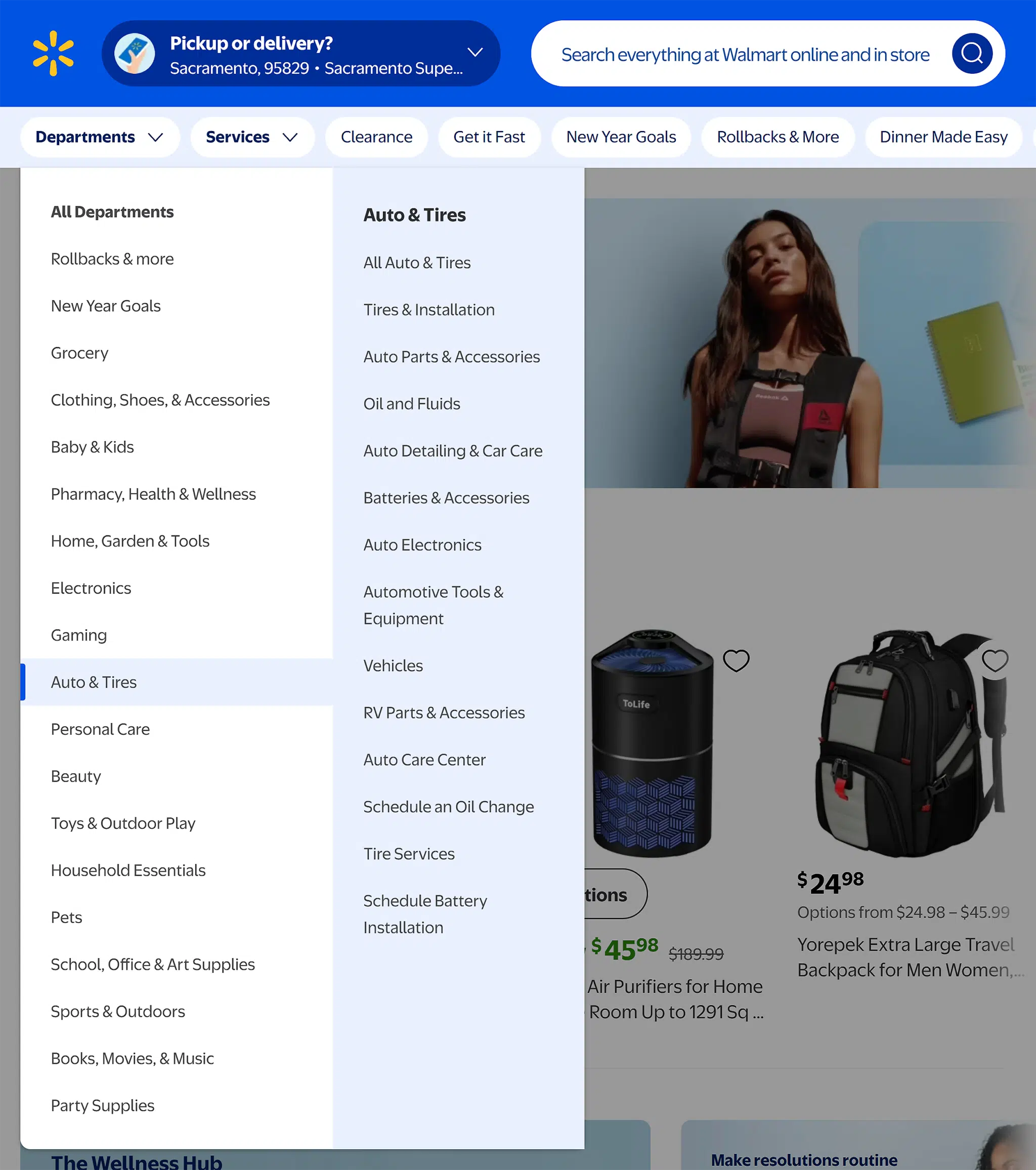
A well-structured keyword map also helps you future-proof your content architecture. As new products, collections, or seasonal lines are introduced, you can slot them into the existing hierarchy without diluting authority or accidentally overlapping existing pages. This makes it easier to scale your site while keeping each page’s intent crystal clear.
It also improves crawl efficiency: Search engines can better understand the relationships between categories, sub-categories, and products, which strengthens topical clusters and helps your catalog compete against bigger players.
In practice, this means fewer wasted URLs, cleaner internal linking, and a site structure that grows strategically instead of chaotically.
Account for AI search and zero-click
2026 is the year of AI Overviews and zero-click search. That means many high-volume queries will generate answers without sending users to your site.
How to adapt:
- Target long-tail, specific modifiers AI is less likely to summarize generically (e.g., “copper water bottle dishwasher safe BPA-free”).
- Build structured data (schema.org/Product, Offer, Review) so AI systems surface your products as trusted entities.
- Track AI search visibility with third-party tools (e.g., Semrush BVI or custom GSC log analysis).
Beyond visibility, the rise of AI Overviews means ecommerce brands must think about entity recognition. Search engines and AI systems increasingly rely on structured data and consistent brand signals to decide which products to highlight. If your catalog isn’t tied back to clear entities — like product names, SKUs, GTINs, or even brand-authoritative content — then you risk being left out of AI-driven responses altogether.

It’s also worth diversifying where you capture demand. Zero-click doesn’t always mean zero opportunity. AI-generated answers often link out to a handful of trusted sources, so becoming that trusted source through authoritative product details, reviews, and third-party mentions is just as important as ranking organically. The brands that treat AI surfaces as a new distribution channel, rather than a threat, will be the ones that keep winning traffic and conversions.
Exploit seasonal and promotional keywords
Shoppers don’t just search for products — they search for deals, bundles, and urgency signals. In Q4, volume spikes for keywords like:
- “[product] Black Friday sale”
- “Cyber Monday [brand] deals”
- “Best gifts for [audience] under $50”
Advanced play: Build “evergreen seasonal” landing pages that you update each year, retaining authority and backlinks rather than starting from scratch each season.
An additional layer here is seasonal modifiers beyond holidays. Think about keywords tied to life events, weather changes, or cultural moments: “back-to-school backpacks,” “summer patio furniture sale,” or “wedding guest dresses spring 2026.” These searches recur every year, and building persistent landing pages for them allows you to capture predictable spikes without constantly rebuilding content from scratch.

You can also leverage urgency-driven copy in meta tags and on-page content — terms like “limited edition,” “last chance,” or “while supplies last” — which not only align with seasonal search behavior but also increase click-through rates. Pairing these with structured data for promotions and offers ensures your discounts surface directly in SERPs, giving you a competitive edge during high-volume shopping windows.
Use customer data to validate keywords
Don’t just trust third-party tools. Mine your own assets:
- On-site search logs: What do customers type into your search bar? These often reveal mismatches between how you label products and how buyers describe them.
- Support tickets and reviews: Customers describe products in their own words — great for long-tail modifiers.
- CRM and sales data: High-margin or frequently returned products deserve a different keyword strategy than your “loss leaders.”
You can also pull insights from email marketing campaigns and PPC data. Subject lines and ad copy that earn higher open or click-through rates often mirror the phrasing customers actually respond to, making them prime candidates for keyword targeting. Similarly, analyzing the exact queries that trigger profitable paid search conversions can highlight bottom-of-funnel keywords worth further organic optimization.
Another overlooked source is social listening. Monitoring how customers talk about your products on platforms like TikTok, Reddit, or Instagram can reveal emerging slang, trending use cases, or modifiers you won’t yet find in keyword databases. These “in the wild” terms can be early signals of search demand, letting you capture traffic before competitors catch on.
Prioritize by revenue potential, not just volume
Traditional keyword research = chase higher search volume. Ecommerce keyword research = align keywords with profitability.
- High-volume but low-margin? Maybe not worth it.
- Low-volume but high AOV (average order value)? Absolutely worth it.
Build a simple framework:

Taking this further, you can refine the framework by layering in customer lifetime value (CLV). A keyword might lead to a modest first purchase, but if that product drives repeat buys or cross-sells, its long-term value is far higher than the initial transaction suggests. Factoring CLV into your keyword prioritization ensures you’re not just chasing quick wins but investing in terms that build sustainable revenue streams.
It’s also smart to look at operational impact. If ranking for a certain keyword consistently drives sales of products with high return rates, supply chain challenges, or razor-thin margins, that keyword might be less attractive despite healthy traffic. Balancing profitability with operational realities helps ensure your SEO efforts meaningfully contribute to the bottom line instead of creating hidden costs.
Spy on competitors at the SKU level
Most ecommerce SEOs heavily focus on broad category or collection keywords, but the real money often lies in product-level, SKU-specific searches.
Queries like “Nike Pegasus Trail 4 men’s size 10” or “Sony WH-1000XM5 noise cancelling headphones review” typically signal that a shopper has already done their research and is close to purchasing. These bottom-of-funnel searches tend to convert at a much higher rate than generic category terms like “running shoes” because the intent is crystal clear: The user knows exactly what they want.
The challenge and opportunity comes from spotting where competitors are ranking for these precise terms and dissecting whether they’re leveraging product detail pages, category hubs, or even content-heavy blog reviews to secure visibility.
This SKU-level analysis also reveals gaps you can exploit. If a competitor is ranking with a thin product page that lacks rich media, structured data, or social proof, you can often overtake them by building a more robust page. Adding high-quality images, detailed specs, FAQs addressing common buyer questions, user-generated reviews, and proper schema markup gives both users and search engines more reasons to trust and reward your content.
While category terms may draw larger search volumes, SKU-level targeting taps into the highest-intent audience, often with less SEO competition, making it one of the most overlooked levers for driving ecommerce revenue.

Your ecommerce wins start with keyword research
Ecommerce keyword research isn’t just “blog SEO at scale.” It’s a discipline of its own, balancing intent, revenue, seasonality, and SERP realities. Advanced SEOs who master this skill gain a competitive edge: Instead of chasing vanity keywords, they build systems that capture buyers at the moment they’re ready to purchase.
Done well, ecommerce keyword research doesn’t just drive traffic, it drives sales, customer loyalty, and long-term business growth. Use the ecommerce keyword research tool at the top of this page to improve your understanding of customer needs — including your untapped audiences — and outpace your competition.
About the Author


