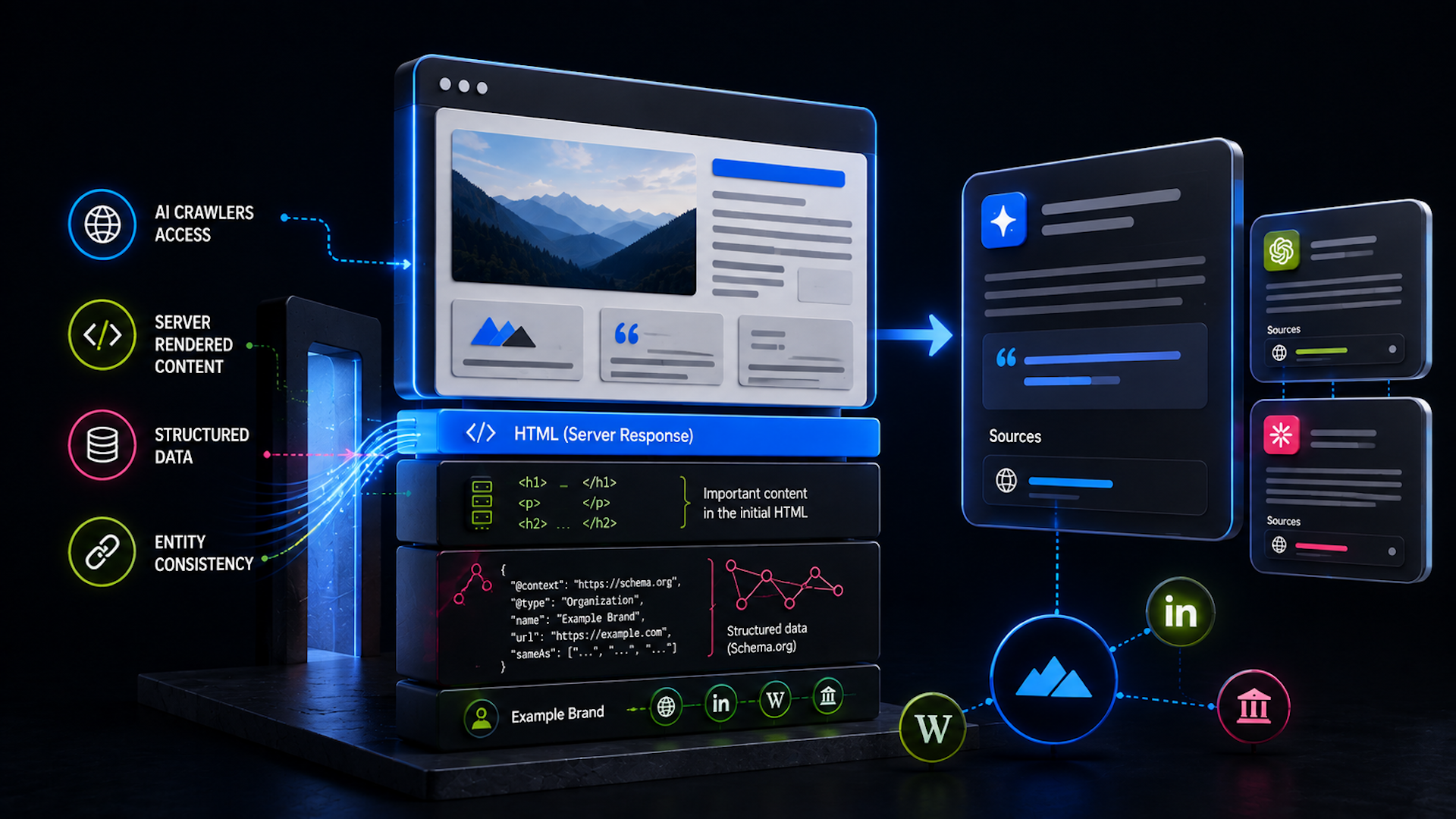
Free AI Visibility Checker
Search is no longer just a list of links. The search experience now focuses on providing answers.
AI assistants like ChatGPT and Perplexity, along with Google’s AI Overviews and AI Mode, act as discovery engines. They take a question, scan multiple sources, and synthesize a clear response, often with a few selected citations.
Instead of competing only for rankings, brands are now working to be cited by large language models (LLMs), included in AI-generated answers, and surfaced by AI assistants in the moment customers make decisions.
This means visibility now involves:
- Mentions inside AI answers
- Citations as a source
- Recommendations without a click
AI search is becoming an important visibility channel alongside SEO — and ignoring it may mean missing part of your audience.
That’s exactly where AI visibility tools come in. We’ll walk you through what they are, how they work, and how to use them to find your footing and steadily climb your way to the top.
What is an AI visibility tool?
An AI visibility tool is a platform that tracks how and where your brand appears in AI-generated answers about your company, category, product or service, or other relevant topics.
Think of it as an evolution of rank tracking. Except instead of checking if you rank at the top of the search engine results page (SERP), you track if you’re included in relevant AI answers.
AI visibility tools track multiple metrics to give you a clear, complete view of your presence in AI answers:
- AI citations refer to instances where an AI engine explicitly references your content as a source. These always include a link, allowing users to click through and explore further. From a visibility standpoint, citations are a strong signal of trust and authority.
- LLM brand mentions occur when your brand name is included in the answer. For example: “Brands like XYZ are known for this.” These mentions reflect awareness and market positioning, and they’re valuable for brand recall and category association. Mentions don’t include links to your site.
- AI referral traffic focuses on user behavior after discovery. It measures whether users click through from a citation in an AI-generated answer to visit your website. This makes referral traffic a downstream metric, reflecting how compelling your content is.
- Prompt-level visibility looks at which queries trigger your brand’s presence across AI engines. For instance, your brand might earn mentions in one topic but stay invisible in another. Analyzing this metric helps identify gaps in coverage and opportunities to expand your content strategy in a targeted way.
These tools give you insight into the topics where you’re visible, the conversations you’re missing from, and how visible you are compared to your competitors. So instead of guessing, you can start making informed decisions to improve your visibility.
Why AI visibility matters for SEO and marketing
AI visibility supplements everything you already do for SEO. It determines whether your brand appears in the search interfaces that shape decisions now.
Let’s walk through what’s changing, step by step.
Search is expanding beyond Google rankings
While Google rankings still matter, search has expanded to include another layer of visibility.
Take this skincare example: You might rank second for “acne skincare routine.” In the past, that may have driven steady search traffic.
Now, that same query might trigger an AI Overview at the top of the SERP, summarizing the routine and pulling in a few selected sources. That’s where attention goes first.
When AI Overviews are present, organic click-through rates (CTRs) can drop significantly. This can lead to substantial traffic loss for top-ranking pages.
So, the more useful question becomes: Are you included in that AI-powered summary?
If not, you might still rank secondarily in organic search results. But because many SERPs now include AI Overviews, your blue link is less likely to be seen or clicked.
AI assistants now control discovery
Many people have adopted AI assistants to discover and research products and services.
This shift is happening quickly. Instead of opening multiple tabs and manually comparing sources, users can ask one question and get a structured answer. The AI assistant does the scanning, filtering, and summarizing upfront, making the process more efficient.
They pull from existing content across the web. Then, they select, combine, and summarize what they find based on signals like:
- How clearly the content answers the question
- How well it’s structured and easy to extract
- How credible and consistent the content appears across sources
Citation visibility is the new ranking layer
Unlike mentions, which name your brand in AI-powered answers, citations link back to your brand’s content. A citation signals that AI engines trust your content enough to use it as a source.
ChatGPT, Google AI Mode, and Perplexity cite websites like Reddit, LinkedIn, and Wikipedia most often. But within many topic areas, ample space remains for other trusted, authoritative sites to earn citations.
Where AI visibility happens
AI visibility happens across several popular AI assistants, LLMs, and AI search tools. Let’s look at how each one works and what they value.
ChatGPT
With almost 1 billion weekly active users, ChatGPT is where a large portion of conversational discovery occurs. It’s increasingly used for research, recommendations, and decision-making.
This makes ChatGPT an important touchpoint for discovering information, products, and brands — often before or in place of visiting a traditional search engine.
ChatGPT tends to value:
- Clear, structured explanations
- Trustworthy, well-established sources
- Content that is easy to summarize
Google AI Overviews
Google AI Overviews are AI summaries that appear inside Google search, typically at the top of a SERP. Their scale is massive.
Google processes over 5 trillion searches per year. They’re particularly common with informational queries.
AI Overviews lean heavily on:
- Traditional ranking signals
- Content that aligns with search intent
- Well-structured pages
Google AI Mode
Google AI Mode is Google’s conversational AI search experience. Users can pose questions, ask follow-ups, and explore topics more deeply without leaving the interface.
It values:
- Depth of content
- Topical authority
- Consistency across related queries
Gemini
Gemini is Google’s standalone AI assistant. It’s built to handle conversational queries across text, voice, and multimodal inputs.
It draws from a mix of:
- Google’s search index
- Its understanding of entities
- Real-time or up-to-date information where relevant
When researching questions and analyzing information, Gemini tends to prioritize accuracy and factual consistency, strong entity signals, and clearly cited information.
Perplexity
Perplexity is an AI-powered search engine designed to answer questions and provide detailed source lists. You can click through, ask follow-up questions, or refine the query, all within the same flow.
Perplexity tends to value:
- Clear, answer-first content that directly responds to the question
- Strong, credible, and consistent sources it can cite and verify
- Well-structured information that’s easy to extract and reference
Claude
Claude is an AI assistant designed for longer, more structured responses. It’s helpful for complex queries and content generation that requires deep reasoning instead of a quick answer.
Claude tends to prioritize:
- Content that fully explains a topic
- Ideas that build logically and make sense from start to finish
- Information that holds together across a longer response
Grok
Grok is an AI assistant built by xAI and integrated into X. As a result, it has direct access to real-time conversations and trends — including sentiment.
It’s designed to answer questions while taking into account what’s happening right now, especially across social discussions, breaking news, and trending topics.
Grok tends to surface:
- Timely, relevant content
- Perspectives that are gaining traction
- Information that connects to ongoing conversations
How AI systems decide which sources to cite
When determining which sources to cite, AI systems follow patterns and make decisions based on a set of signals.
Authority signals
When looking for sources to pull from, AI systems tend to favor those that already carry weight.
In traditional search, Google relies on its E-E-A-T framework (experience, expertise, authoritativeness, trustworthiness), which emphasizes that high-quality content should come from credible, authoritative sources.
While AI systems don’t explicitly apply E-E-A-T in the same way, similar patterns emerge from how LLMs are trained.
These models learn from vast amounts of web data, where information that is widely published, frequently linked, and consistently referenced becomes more prominent. As a result, LLMs are more likely to learn, surface, and synthesize content associated with strong authority signals.
Authority signals include:
- Strong domains
- Recognized brands
- Consistent backlinks
- Mentions across the web
This may explain why you see competitors cited more frequently. Their content may not be better, but they may have stronger authority signals.
Content extractability
AI engines need to extract information from your content and synthesize it into an answer. But if your content is vague or overly complex, it becomes harder to use.
Content that earns AI citations is usually:
- Clearly structured
- Broken into steps or sections
- Direct in its explanation
In fact, AI assistants like ChatGPT are more likely to cite pages with structured headings.
Freshness signals
AI systems pay attention to how fresh your content is and if it includes current data.
Content that’s regularly updated tends to receive more citations than older material that hasn’t been refreshed. Even strong content can lose visibility if it’s no longer current.
This happens because AI systems often combine historical knowledge with real-time retrieval, making newer, relevant content more likely to be selected.
Evidence and citations
When analyzing sources, AI tools look for content backed by evidence. This can involve data, studies, subject matter expert input, and referenced sources.
But AI systems don’t rely on a single source. They cross-reference information across multiple sources to verify accuracy before using it.
Knowledge graph alignment
AI systems try to understand entities, brands, people, and topics — as well as how these entities connect.
This process builds on Google’s Knowledge Graph concept. The search engine maps relationships between entities to understand meaning rather than keywords alone.
AI systems extend this concept by using those relationships to decide how and when to surface a brand in an answer. They build this understanding by:
- Cross-referencing multiple sources
- Identifying consistent associations
- Validating information across the web
This creates a kind of web of trust. Your brand becomes easier to recognize and prioritize when it’s consistently described, clearly associated with a specific topic, and mentioned across multiple credible sources.
Core metrics every AI visibility tool should track
There are several metrics that can help give you insight into your AI visibility: AI visibility score, AI share of voice, prompt coverage, citation frequency, and AI referral traffic. Each one answers a specific question, and together, they give you a consistent way to measure, compare, and improve your presence over time.
Rather than checking performance in isolation, this framework helps you return to the same set of signals, track progress, and understand where to focus next.
We’ll dive into what each one looks like and what to expect.

AI visibility score
Your AI visibility score is your overall presence across AI platforms. It’s a combined view of how often you appear, get cited, or mentioned.
Think of it like your health score.
On its own, it’s a snapshot that tells you how present your brand is in AI search. When you compare it to other brands in your space, it becomes even more useful.
For example, your brand might have an AI visibility score of 32. And your biggest competitor might have a score of 68. Immediately, you know there’s a gap to address.
AI share of voice
AI share of voice measures how much of the total visibility within AI-generated answers your brand owns compared to competitors.
AI visibility tools calculate this metric across the prompts you track, factoring in answer appearances, citations, and mentions.
With share of voice data, you can:
- Identify the gap: Which topics or prompts include competitors but not your brand?
- Study what’s working: How do competitors structure their content? How do AI engines cite it?
- Close the gap: Create or refine content so you can start appearing in those same answers.
Prompt coverage
Prompt coverage shows which questions typically include your brand in the answer — and how often.
Say you’re tracking 50 prompts. You appear in 15 but not in the other 35. Your prompt coverage is 30%.
It also shows which prompts you appear in. This helps you see patterns across relevant prompts that include your brand and those that don’t.
Then, you can act on the data. If you’re missing from an important prompt, you might create content that directly answers that question. Or, you might structure your answer in a way that’s easier for AI to extract and use.
Brand mentions
Brand mentions track how often your brand appears in AI-generated answers, regardless of whether it comes with a citation or a link.
Think of it as your brand’s raw presence in the conversation. A citation means AI pulled from your content. A mention means AI knows your brand well enough to bring it up on its own.
For example, you might find that a competitor gets mentioned in 40 out of 50 prompts, while your brand shows up in 12. Even without a link, those 40 appearances shape how users perceive that brand in your space.
With brand mention data, you can:
- Spot authority gaps: Which brands does AI consistently name when yours is absent?
- Understand context: Are your mentions positive, neutral, or tied to specific use cases or topics?
- Build toward unprompted visibility: Improve your content and credibility so AI starts reaching for your brand name naturally
Instead of waiting to see if a citation appears, you can track mentions as an earlier signal of whether AI engines recognize your brand as a relevant voice in your category.
Citation frequency
Citation frequency tracks how often AI engines use your content as a source.
Differences in citation frequency usually come down to a few things. When a brand has higher citation frequency, its content is typically:
- More authoritative
- Easier to extract and structure into an answer
- Better supported with evidence
Instead of guessing how to earn more citations, you can analyze the content that already has the most. From there, you can improve your own content and close that gap.
AI referral traffic
AI referral traffic shows whether AI visibility is driving visits to your site.
For example, you might notice that AI engines frequently mention or cite your content. But traffic from AI tools might remain low.
If users aren’t clicking through, you can:
- Target high-intent queries: Prioritizing mid- to bottom-funnel queries, where intent is higher and users are closer to conversion, tends to drive more meaningful engagement even in an AI-dominated landscape
- Front-load your answers: Place your direct answer at the top of your content rather than building up to it. AI systems tend to extract from the beginning of a page, so leading with the answer increases the chances your link appears earlier and more prominently in the response.
- Build brand authority beyond your site: Research shows prospects who encounter brands inside AI answers often skip research steps, moving faster to pricing or product proof even if they don’t click immediately. Brand recall from AI citations drives direct traffic and branded searches that appear in your analytics later.
Instead of seeing low traffic as a problem, you can use it as a signal. It shows you where visibility exists and where you need to turn that visibility into engagement.
Features to look for in an AI visibility tool
The best AI visibility tools typically have a few core capabilities:
- Tracking how you perform across real prompts
- Understanding where and how you’re cited
- Seeing who shows up instead of you
- Knowing how your brand is being described
- And getting clear direction on what to improve
Let’s walk through the features to look for in an AI visibility tool.
Prompt monitoring
Prompt monitoring shows you how your brand performs across real user questions.
Does your brand appear in the prompts you care about? Or is it missing from an important topic area? Instead of guessing about performance, prompt monitoring helps you make data-driven decisions.
AI citation and mention tracking
AI citation and mention tracking shows where your content is used as a source and where your brand name is brought up in a response, with or without a link.
For example, you might find that your blog is cited for “sensitive skin tips” but only mentioned by name for “acne treatment routines,” while a competitor is being cited for that same topic.
A mention means AI recognizes your brand. But a citation means it trusts your content enough to reference it directly.
Tracking both helps you understand where your brand has authority and where it still needs to earn it.
Competitor analysis
A competitor analysis reveals who’s showing up instead of your brand and how often.
So, if a competitor appears in 40% of acne-related answers and you appear in 10%, you have a clear benchmark.
The next question to ask is: What are they doing that we’re not?
Brand narrative monitoring
Brand narrative monitoring shows how AI systems describe your brand, including:
- What you’re known for
- How you’re positioned
- Whether the messaging is accurate
For example, do AI engines describe your brand as “affordable skincare for sensitive skin” or a “clinical acne treatment brand”? If they use the wrong narrative, consider it a signal to revisit your messaging.
Pay attention to the tone of those descriptions too. Sentiment, whether AI portrays your brand positively, neutrally, or negatively, is part of the narrative and worth tracking alongside accuracy.
AI content optimization insights
AI content optimization insights help you understand how to improve your chances of being mentioned and cited.
Their recommendations might include:
- Improving structure
- Adding clearer explanations
- Strengthening evidence
- Expanding topic coverage
You can implement these recommendations to improve your brand’s AI visibility.
Best AI visibility tools
Instead of asking which tool is best overall, focus on which one fits how you work and the metrics you want to track.
Here’s a quick comparison of the best AI visibility tools:
| Tool | Best for | Platforms covered |
| Semrush | SEO teams | Google (Search, AI Overviews, AI Mode), ChatGPT, Gemini, Perplexity |
| Meltwater | Public relations (PR) and brand monitoring | ChatGPT, Perplexity, Grok, DeepSeek, Gemini, Claude, Meta LLaMA, Google (AI Overviews, AI Mode) |
| Profound | AI brand analytics | ChatGPT, Claude, Gemini, Perplexity, Google (AI Overviews, AI Mode), Grok, Copilot, Meta, DeepSeek |
| Peec AI | AI answer monitoring | ChatGPT, Perplexity, Google (AI Overviews, AI Mode), Copilot, Grok, Gemini, Claude, DeepSeek |
Semrush
Semrush brings AI visibility tracking, SEO, competitor research, and content optimization into one platform — so the tools you need to understand and improve your brand presence live in one place.
For SMBs and smaller agencies, the Semrush AI Visibility Toolkit helps you measure your presence in AI answers and track mentions and citations over time. Analyze competitors and identify topic, prompt, and source gaps where rivals are mentioned over you to prioritize which gaps to close first.

It’s particularly useful when you want to know how your AI visibility connects to your current SEO performance.
For larger teams managing multiple brands, markets, or product lines across global regions, Semrush offers Enterprise AIO. It has the same core AI visibility capabilities, but at a larger scale and with more granular tracking.
Meltwater
Meltwater comes from a PR and media intelligence background. So, rather than focusing only on search, it looks at how your brand is talked about across channels, including AI systems. It’s strong on narrative, sentiment, and broader brand presence.
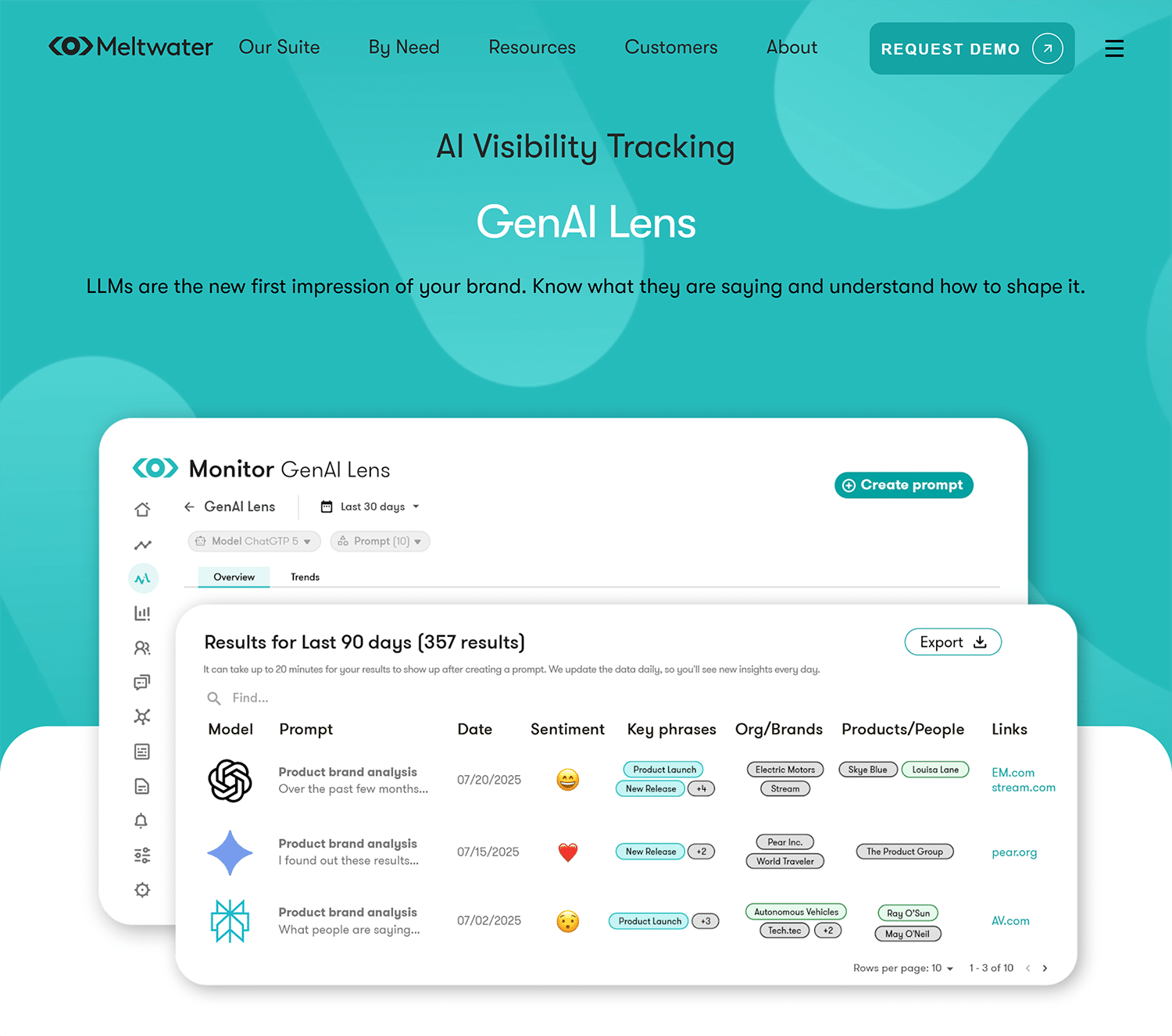
This makes it a good fit when you want to know what stories AI engines are telling about your brand and where it shows up.
Profound
Profound is a new tool that is solely built for AI visibility. It leans into brand analytics within LLMs: how often you appear, how you’re positioned, and how that changes over time. There’s less legacy SEO thinking here and more emphasis on AI-native insights, which limits its usefulness from a more complete marketing perspective.

So you might lean this way when you want to understand and grow your presence inside AI answer engines.
Peec AI
Peec AI is more focused on AI answer monitoring. It tracks how brands appear across conversational outputs, often at the prompt level. That makes it especially helpful for understanding which questions trigger your visibility.
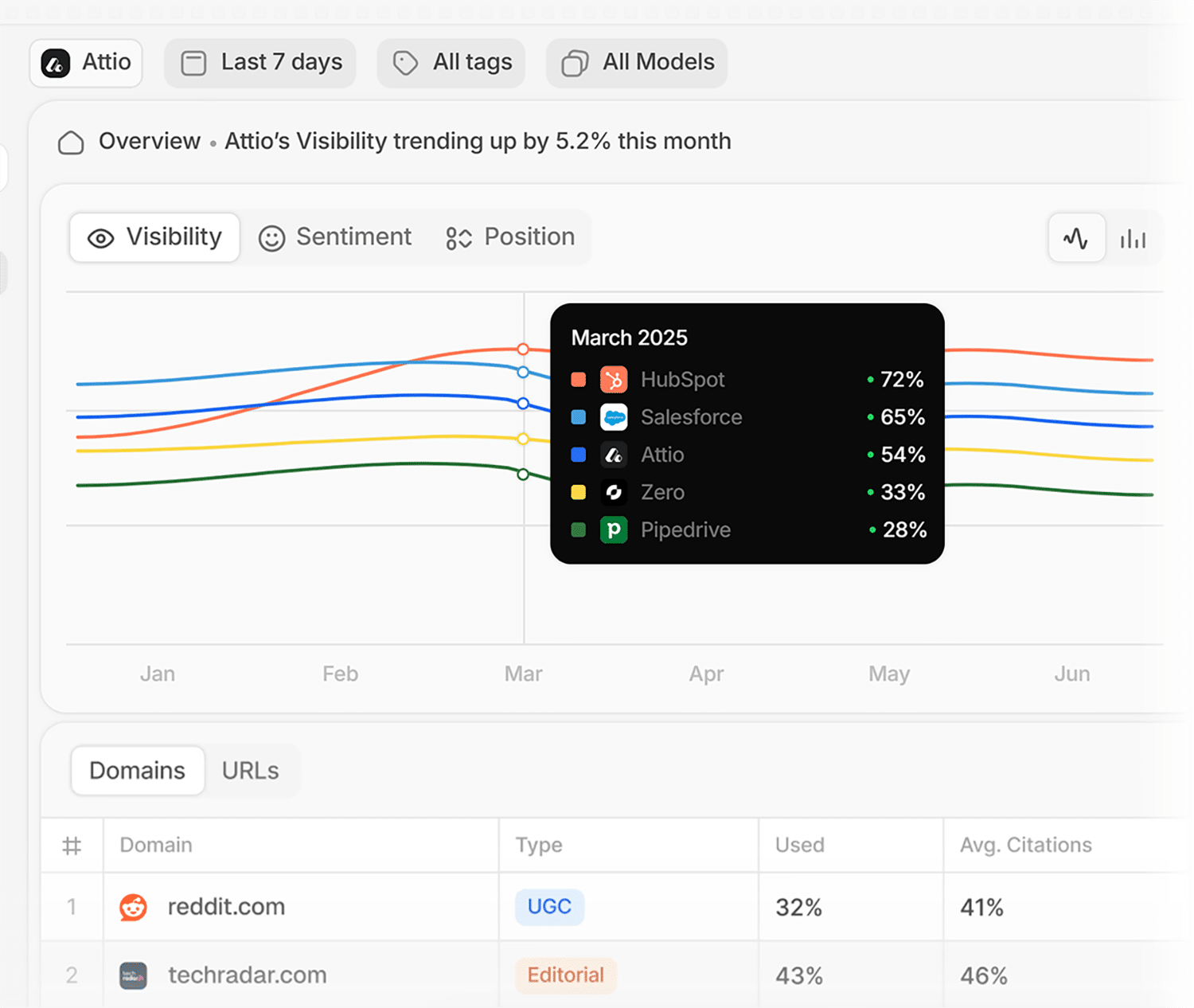
This is useful when you need to know if your brand shows up in the prompts that matter to you.
How to improve your AI visibility
Here’s what improving AI visibility looks like in practice:
- Creating content that’s easy for AI to analyze and reference
- Building clear authority around your topic
- Structuring information so it can be extracted and reused
- Strengthening your content with evidence
- And making sure it exists beyond your own site
We’ll show how you can do that, step by step.
Create AI-citable content
Start with how your content reads. AI systems look for answers they can lift and reuse.
To make it as easy as possible for AI engines to cite your content:
- Answer the question early, without long lead-ins
- Keep explanations concise and focused on one idea at a time
- Use clear, unambiguous language
- Avoid filler or overly complex phrasing
- Make sure each section includes a takeaway
The goal is simple. Your content should read like something AI engines can easily synthesize into an answer without needing to rewrite it.
Build entity authority
Entity authority indicates that your brand is a credible, trustworthy source on relevant topics. But building an authoritative entity goes beyond a single page. It comes from consistency across the web.
To establish entity authority:
- Align your messaging everywhere: Use the same positioning, descriptions, and terminology across your website, social profiles, and listings
- Earn mentions on trusted sites: Contribute to publications, get featured, or collaborate so your brand appears in credible contexts
- Reinforce your association with a topic: Consistently create and publish content around the same core theme
- Show up in third-party validation: Reviews, round-ups, and external references help confirm what you’re known for
Use structured content
Structured content with headings, lists, and clearly defined sections helps both humans and AI systems navigate your content efficiently.
Instead of publishing long blocks of text:
- Create clear headings that match the question you’re answering
- Use content chunking to break content into sections where each part covers one idea
- Add lists where possible to make steps or points easy to follow
- Place direct answers under headings so the key takeaway is easy to find
Strengthen evidence and sources
Incorporate original data and reliable sources to make your content more credible.
To strengthen your content:
- Back up key claims with data: Include statistics, studies, or research that supports what you’re saying
- Reference credible source: Link to trusted publications, expert opinions, or recognized authorities
- Include expert input where possible: Add weight with quotes or guidance from professionals
- Show your reasoning: Explain why something works and discuss your process
Expand content distribution
AI visibility doesn’t end with your website. You can improve your chance of earning mentions and citations by publishing content on other sites and platforms.
To expand your distribution:
- Republish or adapt content for industry platforms: Turn your core content into guest articles, contributions, or thought pieces on relevant sites
- Build partnerships: Collaborate with other brands, creators, or publications so your content is shared beyond your own channels
- Participate in communities: Share insights in forums, newsletters, or niche platforms where your audience is active
- Create multiple formats: Turn one piece of content into posts, summaries, or discussions for different sites
The more surfaces where your content appears, the more opportunities arise for AI systems to discover, reference, and use it.
Future of AI visibility
If this all seems like a lot of moving parts, that’s because a shift is happening. What used to be three different worlds (SEO, AI discovery, and recommendation engines) is blending into one continuous experience.
A few years ago, the journey would typically go from a Google search to a blog post to a product page.
Now, search, discovery, and recommendations happen at the same time. An AI assistant suggests a solution, pulls in a few trusted sources, and reinforces recommendations based on what’s popular or reviewed most often. Then, it leads the user towards a decision, often without leaving the interface.
So, instead of just ranking, you need to know how to show up, build trust, and get chosen.
SEO remains the foundation. Your authority, content quality, and structure feed directly into how AI systems evaluate and select sources.
But AI compresses the journey.
It reduces the number of touchpoints between question and answer. That means you have fewer chances to win attention and more pressure to be included in the first response.
The future of AI visibility requires you to look beyond what your content says and consider how your brand exists across the wider search ecosystem.
FAQs about AI visibility tools
What is AI visibility?
AI visibility indicates whether your brand or content shows up inside AI-generated answers. It’s about being mentioned, cited, and included in these responses.
How do AI assistants choose sources?
AI assistants look for content that’s trustworthy, easy to understand and extract, up-to-date, and supported by evidence. When they choose sources, they aim to minimize risk.
Can ChatGPT cite my website?
Yes, ChatGPT can cite your website. To increase the chance of earning citations, your content needs to be relevant to the question, clearly structured, and credible enough to trust. If you’re not being cited, it usually points to gaps in authority, clarity, or coverage.
What tools track AI mentions?
Several tools track AI mentions, including Semrush One, Meltwater, Profound, and Peec AI. They help you see where your brand appears across AI platforms, how often, and in what context.
How do you optimize for AI search?
To optimize for AI search, focus on clear, structured, answer-first content that directly addresses real questions. Build authority around a specific topic, support your claims with credible evidence, and make your content easy to extract and reuse. Then go a step further by distributing it beyond your own site, so it has more chances to be discovered and cited.
Turn AI visibility into an actionable priority
To monitor AI visibility, you need to know if your brand is showing up in the prompts that matter and if you’re outperforming competitors in terms of mentions and citations.
Get started with the AI Search Visibility Checker.
This free tool analyzes your brand’s presence across ChatGPT, AI Overviews, and Gemini — providing the data you need to make informed decisions about improving your AI visibility.
Explore more on
Editorial disclosure
Search Engine Land is owned by Semrush. We remain committed to providing high-quality coverage of marketing topics. Unless otherwise noted, this page’s content was written by either an employee or a paid contractor of Semrush Inc.
About the author