Want to rank better on Google? Get people to add you to their Google+ Circles, and that seems to be a potentially huge boost, based on a search I just did.
I’m Friends With Ford
When I looked for cars about an hour ago, I found a listing for Ford at the bottom of the first page of results, in the 10th position. In addition, there was an enhancement telling me that Ford had shared this link:
Interesting. Why is Ford showing up and with that enhancement in my results? Hovering my mouse over the Ford Motor Company link displayed this:

Indeed, I am connected to Ford through Google Plus. Ford is one of the very few brands that Google has allowed to maintain a brand page on the new Google social network. That connection is allowing Ford to rank better in my search results.
Content From Friends Has Long Ranked Better
In many ways, there’s nothing new here. Google’s Social Search results have, since October 2009, allowed content from people you know to rank higher, if you’re logged in.
That’s what’s happening here. I “know” Ford, which is why Ford’s page is showing up in the top results. When I’m logged out, and Google can’t tell that I know Ford, the page doesn’t appear in the first 50 search results that I reviewed, which means it’s effectively invisible.
Side Note: Social Search Seems Sort Of Screwy
As an aside, Google Social Search’s connections seem to be radically screwed up, at the moment. Consider:
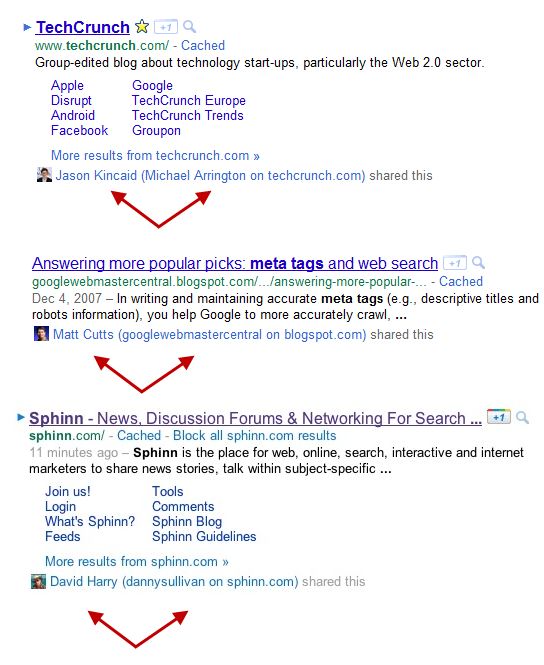
In the first example, you can see that I’m told that Jason Kincaid shared a link, but then I’m also told he’s Michael Arrington. In the second, Matt Cutts is also apparently Google Webmaster Central. My favorite, found by Andrew Bleakley, is where David Harry is apparently me.
I think what’s happening is that the indirect “friend of a friend” connections are being shown. I might be connected to Mike from TechCrunch, which is why I see in turn something Jason shared, for example. Or maybe things are just broken.
Brands Are Newish To Social Search
Back to the Ford result. Why did it surprise me so much to see it today, when Google Social Search has long worked to boost content from your social connections?
Until recently, the social connections that Google Social Search uses have been mostly actual people. While brands were allowed to have Google Profiles until March of this year, few of them did. That meant relatively few brands were available for direct connections through Google.
It was possible to connect with brands in Google Social Search if you followed brand profiles on Twitter, Facebook or some other ways. However, it was fairly unusual for me to spot that something was getting a boost in Google’s search results through that type of connection.
Coming: The Google+ Brand Boost
Bottom line: being a brand on Google+ will mean people can make a direct connection to you, and that’s going to result in an increased chance that you’ll rank better for those people, when they’re logged in.
Of course, right now you can’t be a brand on Google Plus. Only a tiny number of brands are being accepted, with the promise that everyone will be allowed to have brand pages around the third quarter of this year.
I’ve asked Google three times for a list of all the approved brands in Google Plus. So far, it still hasn’t provided one. But Ford carries a big “Test Account” label like this:
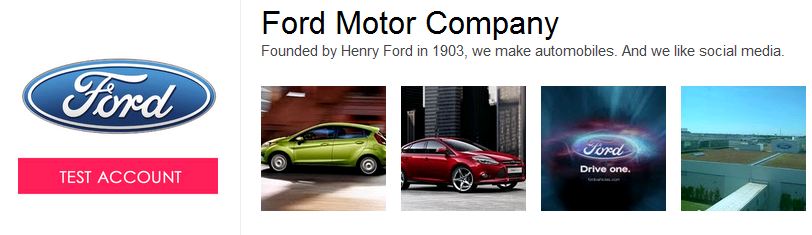
If you see a brand with “Test Account” label on it, then it’s likely part of the program. If not, then it’s likely hoping to stay under the radar but might get pulled at any time.
While Brands Wait, The +1 Button
While brands can’t be part of Google+, they can take part in the entirely separate Google +1 program, which allows for anyone — even if they’re not in Google+ — to indicate that they like a page directly to Google.
Google has previously said that gaining +1s can help improve your ranking for those who have directly +1ed your content, as well as for those they are connected to. In addition, it can show even those who aren’t connected or using +1 an overall count for your page, should it appear for them naturally.
The articles below have more about the use of +1 for search rankings and for placing the button on your site:
- Meet +1: Google’s Answer To The Facebook Like Button
- Confirmed: Google Showing Google +1 Counts To Logged Out Users
- It’s Here: Google +1 Buttons For Websites
- Google Plus One Button Now 3X Faster
Background On Google Social Search
If you want to know more about Google Social Search, which taps into Google +1 and Google+ but is separate from those programs, see these articles:
- Google Social Search Launches, Gives Results From Your Trusted “Social Circle”, Oct. 2009
- Google Social Search Goes Live, Adds New Features, Jan. 2010
- In The Wake Of Bing & Facebook, Google Web Search Tests Getting More Social, Oct. 2010
- Google’s Search Results Get More Social; Twitter As The New Facebook “Like”, Feb. 2011
- You Can Hate (Block) But No Longer Love (Star) Google’s Search Results, March 2011
- Meet +1: Google’s Answer To The Facebook Like Button, March 2011
More About Google+
As for Google+, see these background pieces:
- Google’s Facebook Competitor, The Google+ Social Network, Finally Arrives
- First Look: “Hands On” With Google+
- Google Removes Mashable, Sesame Street & Other Prominent Accounts From Google Plus
- Google+: Business Profiles Terminated, Blueprint For Businesses On Google+ Will Be Made Available To All Shortly
- Tech Celebs Most Followed On Google+ While “Real World” Rules On Twitter & Facebook
Postscript: See our follow-up article, Google+ Public Posts Coming To Google’s Social Search Results.
Related Topics: Features: Analysis | Google: +1 | Google: Google+ | Google: Social Search | Top News


That’s indeed a good share, Danny but all only when you’re logged in and search something. Else there’s no story. So ideally, it is not affecting rankings for the users but only for you when you’re logged in. Sometimes, I see some of my sites on page 1 when I signed in (which are actually on page 8 or 9). Just because, I am Google plus, connected on analytics with same id.
Though I surely believe that Google plus content is ranking great and spread quick. That’s seem to be a promising way of marketing and getting direct targeted traffic. Just a humble opinion..
What might be interesting to look at is if this connection has affected the search results of your other Google+ connections who don’t have Ford in their circles. Maybe ask them to do the same search and see if they get this even though they are not connected to Ford, but just because they are connected to you.
Also, interesting to see the Test Pages for businesses on Google+, I wonder how Ford ranged this? And how long it will be until all businesses can get on to Google+?
I think this is how Google wil position its marketig strategy: if you have a brand page on G+, your fans will see you in the best spots of your search results.
It’s kind of integrated with AdWords. I wonder if business pages will be charged or if this is a feature that you get only if there is actually an paid campaign attached to Ford’s page.
It would be good to ask Ford about this.
What happened to you is basically you had google search reminding you that you are a fan with Ford when you are potentially looking for a new car – this tells it all!
I am not a fan of Ford on G+ (I have serious concerns about privacy with G+ so I am not using it – check my concerns here in my blog post http://bit.ly/kr4I0H ) and I just tried your search: Ford does not appear on the first 2 pages!
The bad news is I am pretty sure Ford employees (and Ford marketing ppl) will have Ford in their first results, so they may think this is the ranking others see.
Whatever the result, however, I don’t like the fact that google search results are affected by your presence on google plus. And I am even more scared about privacy now.
So we could use many means, including paid search to create traffic on interesting, popular subjects, even if those subjects are not directly related to our primary sales funnel. Visitors who +1 those derivative content create a trust map for the brand that can be “re-marketed via SERPs” later when a search more closely focuses on their primary product line.
example: If I +1 a great article about buying a bike rack written by Ford, and then months later search for car-related phrases, like “safe hybrid cars”, Ford will have an advantage organically despite the difference in +1′d content because the trust-graph has been established on Google+.
I’m not sure what to believe which is great about SEO! Everyone on different authority sites and blogs post differing opinions! I love it. Google just told me yesterday +1 will not have a direct link to SEO rankings. It will help in SEO traffic because the +1s in SERPs will lead to higher CTRs. SEO, you’re great.
There’s a lot to be said for the major impact this could have on relevancy… after all if I’m planning a group trip to Vegas you can bet the hotel my friends are all +1ing is likely the result I want. As more data is collected you can get even more subtle, devising if my network really likes to eat apples or apple computers and all sorts of amazing insights.
If Google evolves this to allow engagement right on SERP listings, which is a highly logical future step, you could change the way people validate purchases and how traffic flows around the web essentially pre-qualifying any given site or vendor based on your friend’s very real opinions. That’s a game changer.
However the system seems very open for group gaming much like the early days of backlinks. Since you need a ranking in each network, I can see webmasters swapping +1s soon — if they’re not doing so already. Eventually this could lead to building lists of highly connected people who span different topics with enough authority to scale out to large parts of the web for quick ranking boosts. You have the very real prospect of people going into business selling their +1 abilities.
Of course the entire approach, gaming included, is brilliant. Want more qualified visitors who have intent to look at sites like yours? Throw aside Facebook & Twitter and push +1 front and center to win the social sharing war.
Premium member since 12/2008
Sunita, yes, this only impacts results when people are logged it. That’s the point. When you’re logged in, your social connections can have a big impact on your search results — so for SEO purposes, it’s more important than ever for companies to be involved in social.
Matthew, some people have been sharing those types of experiences in this Google+ thread:
https://plus.google.com/113217924531763968801/posts/DDKjNkmTrEY
David, if you see the Meet Google+ article, that’s pretty definitive about what Google said +1 will and won’t impact. They were pretty clear it would have an impact on rankings, if you’re logged in.
Are you sure that it got a boost because you were following Ford (which is different from there being a “connection”)? Many other factors lead to differences between logged-in and logged-out results, and you’d need to do a more solid test than this to prove anything.
As for your screenshot, you misunderstood what Social Search is trying to tell you, thanks in part to poor wording on Google’s part. For example, when it says “Matt Cutts (googlewebmastercentral on blogspot.com) shared this”, what it actually MEANS is “Matt Cutts shared this article that was written by googlewebmastercentral”. We’ve known for a while that Google tries to determine who posted content and includes its perception of the writer’s influence and authority into the page’s ranking. It’s clearly not as smart or as accurate as it could be, but it’s still a keen look into one of the lesser-known parts of the Google algorithm.
Danny,
Currently, from the same view, I see it telling me that people I am connected to on Buzz and Gmail etc shared that content.
But in all honesty, I see this as being a big problem. When I do a search for ‘cars’ logged out, my first result is Cars the movie. That is a pretty drastic shift to say Ford is most relevant to the query car’s just because I am connected to them.
The term ‘cars’ is far too generic to determine that it should rank #1. So, if what you are saying is true, I would expect G+ to lower the importance in the algorithm so it doesn’t carry quite as much weight, which appears to be significantly more than the +1 button.
But that being said, might as well take advantage first chance the brands get
Aaron Friedman | @aaronfriedman
Premium member since 12/2008
Max, I’ve not been to the Ford site any time recently. In fact, Google Web History shows that I haven’t been to it at all. In addition, there’s no “Search Customizations” flag showing for that search. The only reason for it to be showing is because of the explicit connection with me and Ford in Google+ — so I’m 99.9% certain that’s the reason it’s elevated. In addition, I see many other sites that are elevated based on personal connections that I’ve never visited. This is social search causing the lift.
As for the connections Social Search is showing, such as “Jason Kincaid (Michael Arrington on techcrunch.com)”, that’s a new format that’s not been used that I recall since I’ve covered Google Social Search since it launched.
If it’s trying to do what you suggest, it’s a poor implementation. Otherwise, that example I just gave means “Jason Kincaid” shared Michael Arrington that was written on TechCrunch.
I think Google Social Search is just a bit broken in the wake of the Google+ rollout. Several things have been broken from that.
Aaron, it’s not a problem if you’re Ford :)
It can have a big impact on search. Normal users r not aware that result can be different when you are logged on any of ur g account. They will search & open which so ever sites come 1st.
Only search mktg ppl like us are aware of this feature. Google wants to target masses through this feature and they can easily do If g+ picks up with time. Personally i have seen in India, most of my friends search while logging on gmail & FB.
these 2 sites are permanently open in their browsers
What is funny is someone that doesn’t know that searches are changed (new blogger, not me) when you are logged into Google will look for their blog to see where they rank. (not me) And when the results come in one of the top 3, that new blogger gets REAL excited. (Not me.) But then realizes later that when she (not me) is NOT logged in she (not me) cannot find her blog anymore, even on page 11. (Again, I did not do this. lol.)
So she bought SEO software and began her journey to stardom. (Hopefully me, ha ha.)
TY!
~Allie
Danny – Were you able to figure out the other two test accounts Google is using?
If beings friends in Google+ will lead to better search engine result, then it starts for another friend spamming activity on Google+?
Google is favoring the big brands, who has got huge chunks of money to be spent on adword campaigns and this directly reflects in the organic rankings as well. The more you spend the more you get and sometimes unexpected gains that are huge.