What Google AI Mode follow-up questions reveal about your content


Most service pages answer the same basic questions as their competitors, giving AI search little distinctive information to work with.
Google AI Mode’s follow-up questions can reveal what those pages are missing — and where your business’s firsthand expertise can provide answers competitors can’t easily replicate.
What competitor audits miss about your local content
Comparing competing service pages can reveal how similar their content is, but it doesn’t necessarily show you what they’re all missing.
My client’s car accident page was a perfect example. It told a buyer to call an attorney quickly, explained contingency fees, and summarized Michigan’s comparative-fault rule. So did more than a dozen competing firms. Almost word for word. It had nothing that an AI model or a potential customer could extract that the next firm down the street didn’t already say.
“Call us. We fight for you. Contingency means you pay nothing unless we win.” That’s what you would call commodity content.
After I audited the page, I started an AI search a real person might make after a car accident: “Do I need a lawyer after a car accident in Michigan?” Then I ran that query through Google AI Mode and followed the questions it suggested next.
The model didn’t stay at the generic “contact an attorney” level. It surfaced the decisions people need help making, like whether a case can clear Michigan’s pain-and-suffering threshold, how comparative fault affects a settlement, what happens if the other driver is uninsured, where a local claim may be filed, and when vehicle damage belongs in small claims court.
That was the lightbulb moment. Instead of asking AI to write more copy for a landing page, use a real buyer search query to make the model expose the questions behind it. Those follow-up questions become your content map. If AI Mode keeps branching into a question, it’s a strong signal that the page should give the buyer a clear, evidence-backed answer.
I prefer Google AI Mode for this kind of local research because Google has a local advantage: It understands the places, businesses, entities, and local context surrounding the search.
The goal isn’t to produce more generic text. It’s to find the first-party facts, thresholds, and judgment calls that make a service page useful, defensible, and difficult for a competitor to copy.
Dig deeper: Local content playbook: From service pages to jobs-to-be-done pages
A repeatable workflow for finding AI search gaps
I built the repeatable version of this process and published it on GitHub. It walks through 10 phases:
- Phase 1: Auditing your existing page for facts, unsupported claims, and gaps
- Phase 2: Defining the one natural-language question a buyer would ask
- Phase 3: Mapping the follow-up questions that branch off it
- Phase 4: Logging how the answer changes across those branches
- Phase 5: Building a terminology log of the technical terms buyers and the model both use
- Phase 6: Scoring the gaps it finds
- Phase 7: Building an evidence plan that separates public research from client records and subject-matter expert input
- Phase 8: Drafting answer-first content briefs
- Phase 9: Deciding whether each finding becomes its own page or a section on an existing one
- Phase 10: Delivering everything in a defined order with quality checks attached
An important control is the claim labeling. Every finding is tagged OBSERVED, VERIFIED, CLIENT-SUPPLIED, INFERRED, or UNKNOWN. This keeps a plausible assumption from becoming a published fact by the agent.
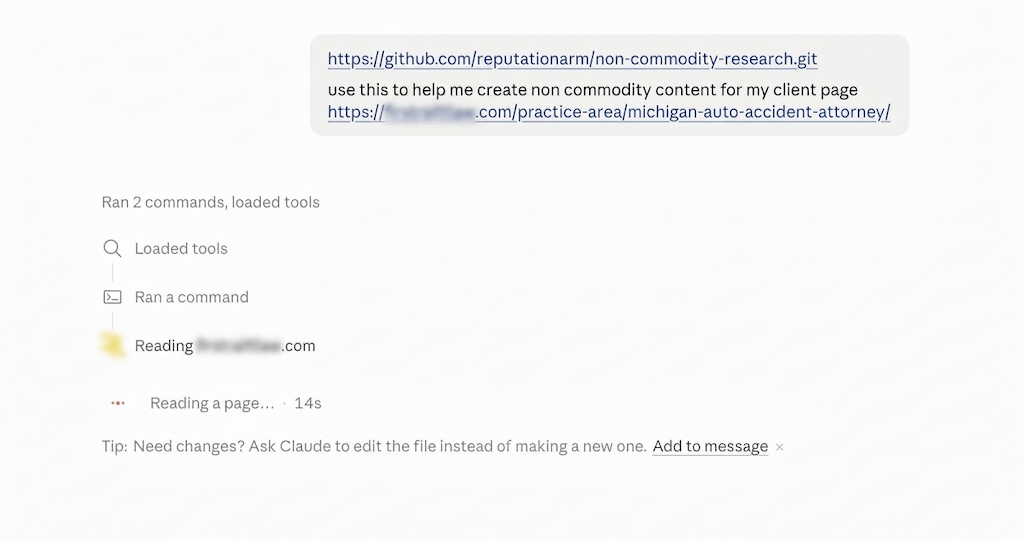
To use the workflow, open the GitHub repository, copy the master prompt, and paste it into an AI tool with browsing access. Then add your client’s service-page URL using this instruction:
- Use this to help me create non-commodity content for my client page: [Insert service-page URL].
The workflow adapts to the page you provide, but the evidence rules stay the same.
Dig deeper: Local 5.0: The next evolution of local SEO is here
What the workflow found on a real client page
I ran the workflow against a client’s car accident practice-area page. It had a short hero statement, a list of related practice areas, and four brief FAQs. You can see the full analysis here. The prompt I shared should produce a similar brief for your client’s page. I used Claude for this example.
The gap analysis turned up specifics that no competitor page in the audit had: which actual local courts a case in that market runs through, a separate small-claims threshold for vehicle damage that most pages skip, and the exact legal test that determines whether a client can recover pain-and-suffering damages.
Just as important, the workflow didn’t write around what it couldn’t verify. In other words, I explicitly tell it not to infer anything in the master prompt. Settlement ranges, years of experience, case volume, and other client-specific facts came back as UNKNOWN, each paired with a precise question for the attorney. Publicly verified facts stayed separate from client-supplied claims and inferences.
The output gave me four prioritized content briefs. Each brief identified the buyer’s question, where the answer should live, which facts still required attorney input, and any legal accuracy risk. It also supplied test queries for Google AI Mode, ChatGPT, and Perplexity so the hypothesized branches could be checked in fresh sessions.
Turn unknowns into an evidence plan
The brief ended with two dependencies: confirm the first-party facts and test the AI-search branches. From there, the next steps were to:
- Run the SME interview using the seven questions the brief had already prepared. That interview alone unlocks the content opportunities, since none of them could be drafted without his answers.
- Run the six hypothesis queries in fresh, signed-out sessions across Google AI Mode, ChatGPT, and Perplexity. Record what each tool returns.
Once both are back, a writer or your favorite LLM can draft the content outlined in the now fully evidenced briefs.
Turn public conversations into answers that move the work forward
Rather than wait on a scheduled interview, I realized the attorney had already answered most of these questions publicly in his own YouTube podcast appearances. I fed those transcripts back in as the evidence source.
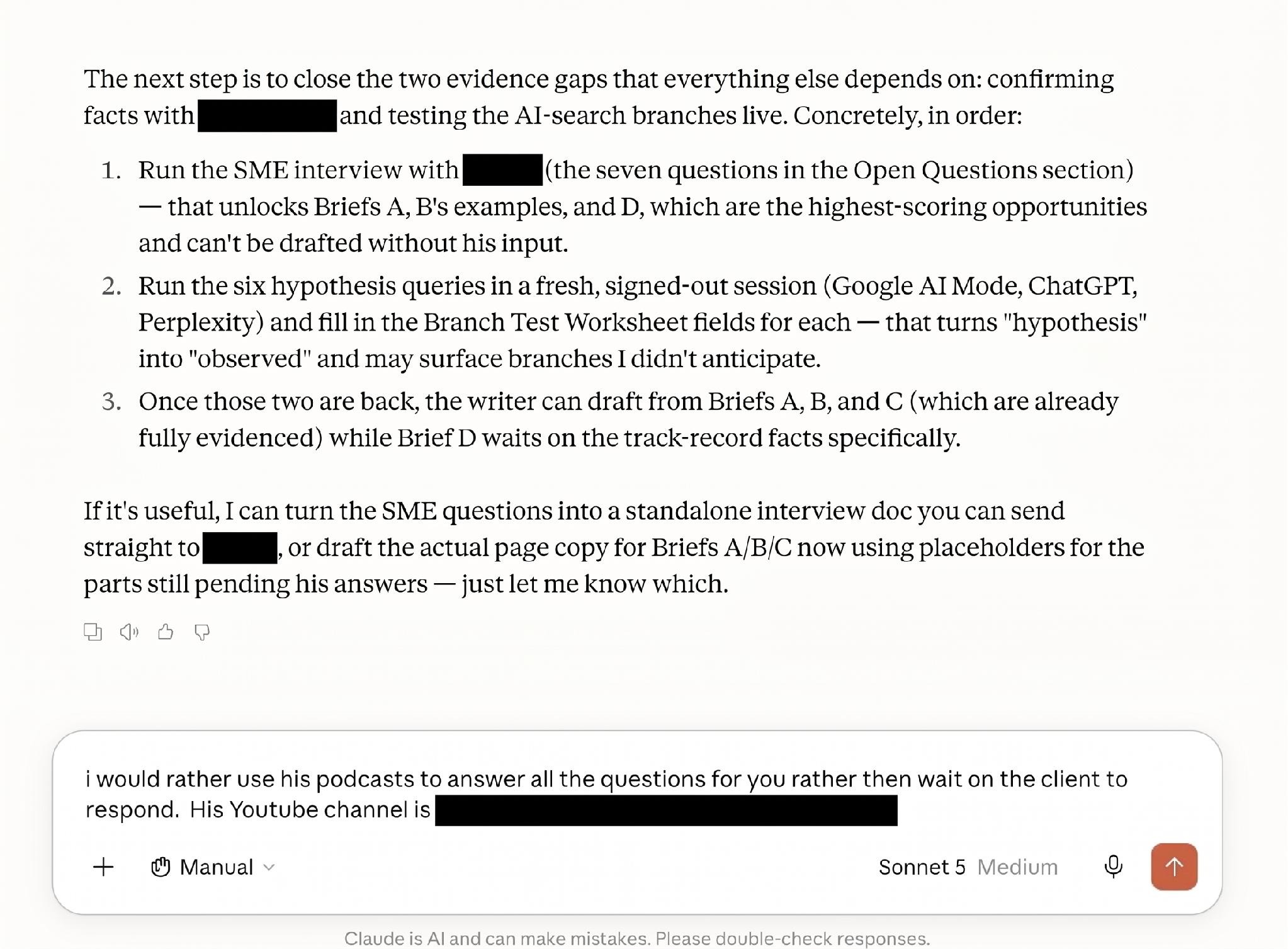
What matters most is that I could feed 13 hours of podcast transcripts into Claude to answer the questions the workflow identified. It gave me a sequenced plan, pinpointed what still needed human confirmation or explanation, and made the process much easier. That’s AI automation at its core.
The industry’s trusted source for essential news and analysis.
Sign up for our newsletter to receive exclusive insights and updates directly to your inbox.
- Daily breaking news
- Expert analysis from industry veterans
- Join over 200k subscribers
- Covering SEO, PPC and AIO
The one semimanual step in an otherwise automated workflow
YouTube doesn’t make it easy to pull a transcript. There’s no clean export button or scraping option, so I had to activate an agent to open each video page, click into the transcript panel, and copy the text out manually, then paste it into a Google Drive doc so it could be fed into the next phase of the prompt.
If your client doesn’t have a podcast, you’re much better off scheduling a call that can be recorded and asking all the questions in a one-hour session. Claude can use that transcript to draft a much more specific page.
From brief to finished page
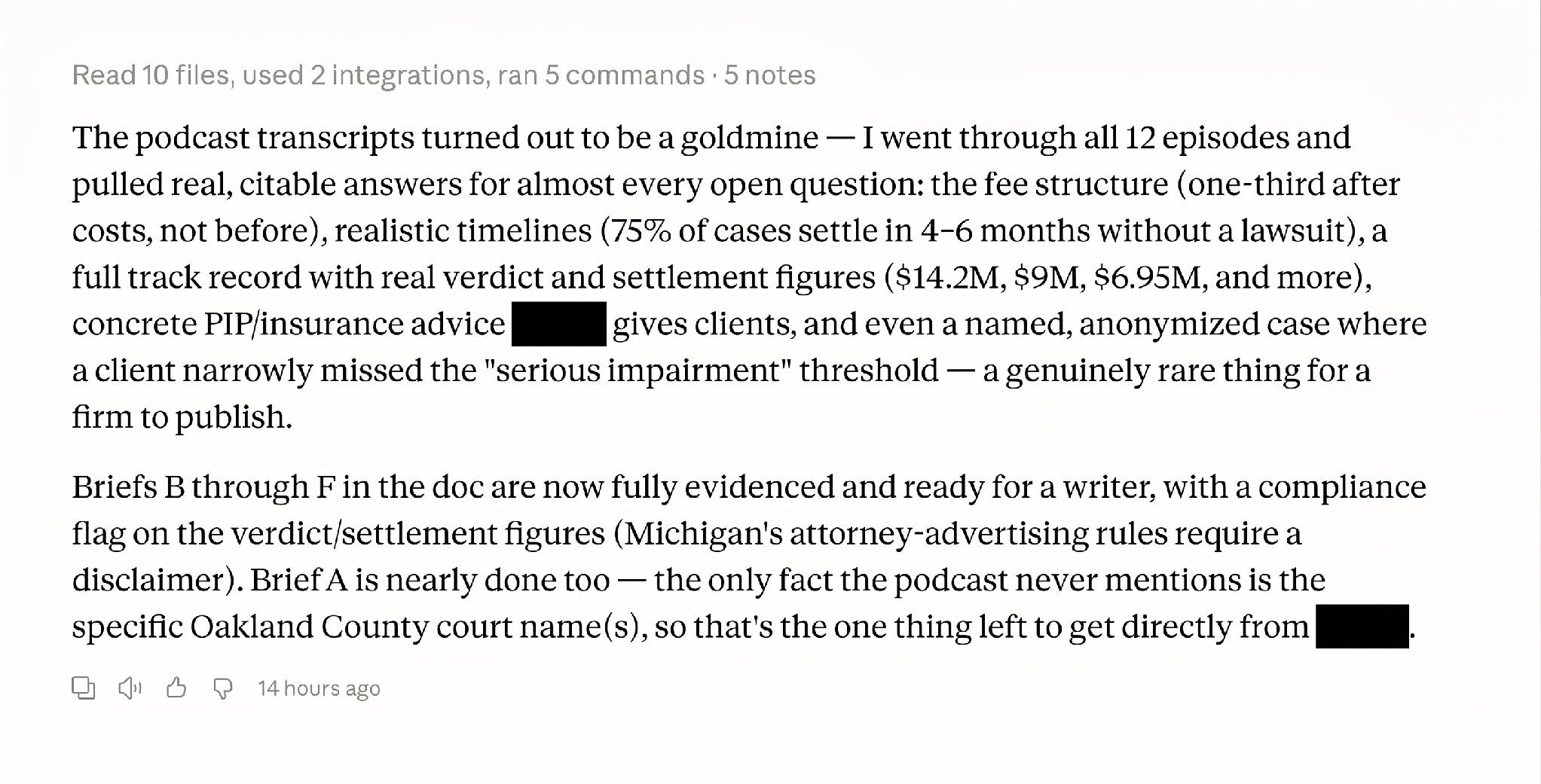
The podcast transcripts closed almost every gap the brief had flagged as unknown. Once I fed them in, the agent came back with real numbers:
- The fee structure.
- How long cases take (about three-quarters resolve without a lawsuit in four to six months).
- A full track record with actual verdict and settlement figures.
It even surfaced an anonymized case where a client’s injury narrowly missed the legal threshold for a claim. It’s the kind of honest, specific non-commodity content that doesn’t show up on a single competitor page.
From there, I asked it to draft the actual replacement page and the output:
- Named the specific courts a case runs through and why.
- Walked through the comparative-fault math with a worked example.
- Explained the order fees get deducted in (and why that order matters to a client’s final payout).
- Laid out the firm’s real case results with the liability disclaimer the state’s attorney-advertising rules require.
Every claim traced back to something the attorney had already said publicly, giving me a clear source to review and verify before publishing.
What surprised me most was that the podcast transcripts gave me exact timestamps for every claim. That means the finished page could link directly to the relevant moments in the videos, allowing readers (or AI models) to verify a claim by watching just 30 seconds of footage. We could even embed YouTube clips alongside those claims — an added benefit I hadn’t anticipated.
Why non-commodity content matters more in AI search
Yext’s analysis of 17.2 million AI citations found Gemini favors official websites. Claude cites reviews and social content two to four times as often as other models. Perplexity cites business-owned websites between roughly 37% and 50% of the time, depending on the sector. ChatGPT’s citation mix varies by industry.
Every model builds its answer out of different raw materials. That’s why non-commodity content matters now in a way it didn’t five years ago. An AI model is extracting facts and judgment to assemble an answer that’s different for every user, every platform, and every query variation — a sample size of one, as I like to put it.
Generic claims give the model nothing distinctive to extract, so the page gets summarized into the same pile as every competitor’s page, and the model fills the actual decision-making content in from wherever it can find it.
The fix was never to write more content. It’s to write the specific facts, thresholds, and knowledge that only your business can supply, and that means knowing exactly where the gap is before you draft anything. That’s what this prompt can help you with.
Explore more on
Editorial disclosure
Contributing authors are chosen for their expertise and work under the oversight of the editorial staff. Search Engine Land is owned by Semrush. The contributor was not asked to mention Semrush; the opinions expressed are their own.
About the author