How to become the answer in AI search: The ASC framework


AI has inserted itself into our search marketing walled garden. What do we actually do about it?
One camp says GEO and AEO are just SEO, so carry on as you were. I don’t think that’s quite right. The start and end points differ, but the work is similar enough that SEOs remain the right people for it.
ASC — analysis, SEO, and content — bookends traditional SEO to help you understand how AI sees your brand, identify where you’re missing, and turn those gaps into a practical visibility plan.
It wraps a strategic framework around three areas you already know, taking you from “I have no idea what AI says about us” to a one-page plan. It’s built around Google, where the volume is, but the mechanics travel to ChatGPT, Claude, and Perplexity.
Analysis: What does AI actually think about you?
Our goal here is to understand your current situation and what AI thinks about your products, services, and marketplace.
This gives us three questions, in this order.
- What does AI say about my category? Not about you. About the problem your customer has. This is where you find out whether you’re in the conversation at all.
- Who does it recommend? The competitive set an AI builds comes from patterns in what it has read, and often doesn’t match yours. Brands you’ve never heard of appear. Rivals you obsess over do not. That gap is a powerful diagnostic.
- What does it say about us, and is it right? Models don’t hallucinate at random — they fill gaps with plausible content. The thinner your coverage, the more they invent. Fill the gaps yourself.
Do it manually first
Start with one distinct customer segment. The answers differ by audience, so this matters. Then write 20 or so prompts across the journey. Adapt these to your business.
Awareness: Does the category conversation name you at all?
- What’s the best way to fix [problem]
- Why does [problem] happen
- What are the different types of [category]
- How do I know if I need [service]
- What should I look for when choosing a [category] provider
- Is it worth paying for [service] or can I do it myself
- What are the most common mistakes people make with [problem]
Consideration: Are you on the shortlist and who is on it with you?
- Best [category] companies in [location]
- Who are the leading providers of [service]
- [Competitor] alternatives
- [Competitor] vs. [competitor]
- How much does [service] cost in [location]
- What should I expect to pay for [service]
- Best [category] for [specific customer type or size]
Action: Is what it says about you actually right?
- Is [your brand] any good
- [Your brand] vs. [competitor]
- [Your brand] reviews
- What does [your brand] specialize in
- Who should I use for [specific service] in [location]
- Is [your brand] a good fit for [customer type]
Two things matter more than the prompts themselves. Run each prompt in a fresh chat, because answers can drift once a session builds context. Also, log out or use a private window. Otherwise, you’re seeing what AI thinks of you as an existing user rather than what it would say to a stranger.
Run the prompts in AI Mode, Gemini, and ChatGPT. For each prompt, record three things: whether you were mentioned, who else was mentioned, and which sources were cited.
Then use a tool
Manual testing gives you a snapshot, not a baseline. I have looked at most of the AI visibility platforms. The one I keep returning to is Waikay — “what AI knows about you” — because it’s built around diagnosis rather than a single score. Its guide sets out four layers, and the sequence is the valuable part:
- Visibility (Are you in the conversation?)
- Perception (What does AI think you are?)
- Influence (Why does it say that?)
- Methodology (Can you trust your own numbers?)
The point worth underscoring is that a share of voice (SOV) score is a temperature reading, not a diagnosis. It tells you where you are, not why or what would move it. If your SOV is low and you respond by publishing more content, you may be fixing a problem you don’t have.
On the Google side, use the generative AI report in Search Console — the only view that comes directly from the horse’s mouth, and that shows you what existing content from your site is being cited.
Map where influence happens
The analysis tells you what AI says about your category, competitors, and brand. Now map where those influences are coming from.
Use the influence map [PDF] to organize this research.
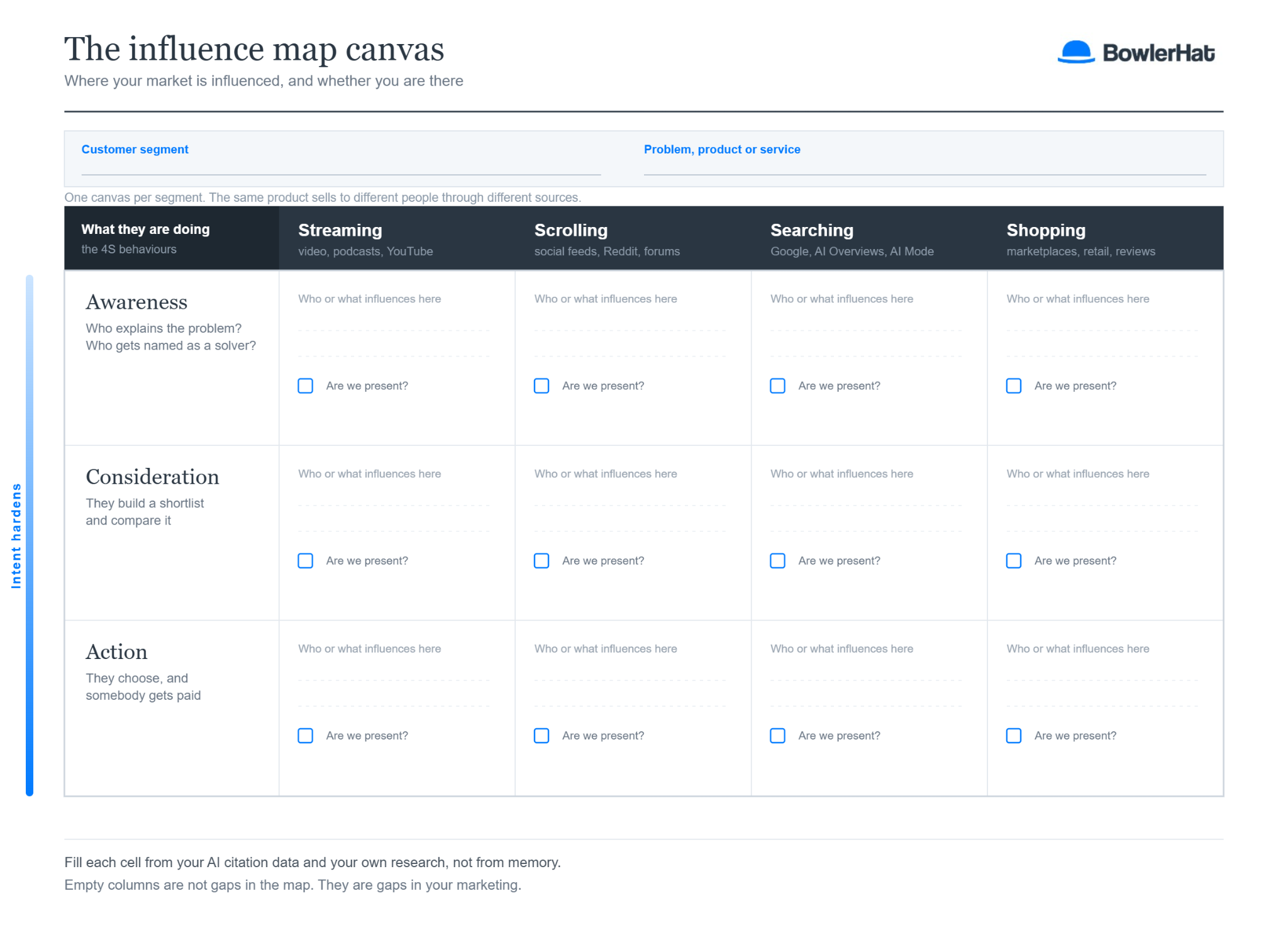
Rows are the funnel stages. Columns are the 4S behaviors — streaming, scrolling, searching, and shopping.
Now dig in. Look at the competitors your research surfaced. Consider your customer and the platforms they use. What are those competitors doing on each platform? What shows up in search? Videos? Reddit threads?
You’re the customer now. What would make you stop scrolling? What would convince you one vendor beats another?
Carefully consider the customer segment you’re mapping out and the platforms they favor. AI is great for this research if you’re unsure.
In each cell, write two things: the sources that influence this moment, and whether you’re present in them.
One page, and you’ve mapped the territory — and, more importantly, your gaps.
SEO: Three layers, in order of difficulty
Google’s AI answers are grounded in Google’s index, so SEO still matters. This is Search Engine Land, so I won’t labor over how SEO works — just how it slots together from an AI perspective.
Layer 1: The business you actually are
Cyrus Shepard analyzed over 400 sites that won and lost visibility across recent updates. Five characteristics predicted the winners:
- Offers a product or service: 70.2% of winners, 34.6% of losers.
- Allows task completion: 83.7% of winners, 50.2% of losers.
- Proprietary assets: 92.9% of winners, 57.1% of losers.
- Tight topical focus: 75.9% of winners, 61.3% of losers.
- Strong brand: 32.6% of winners, 16.1% of losers.
None of those are SEO tactics. They’re business decisions. Google has moved from rewarding “good content” toward rewarding what an AI can’t reproduce — and an AI can reproduce an article far more easily than a booking system, a proprietary dataset, or 10 years of narrow expertise.
It’s correlation data, but the message is hard to miss: You can’t put SEO lipstick on a pig of a business. A great product will almost market itself. A poor one will resist the world’s best marketers.
In 25 years, I’ve found most businesses do have something distinctive. They just do a terrible job of saying so. Before you start SEO work, ask honestly whether you bring anything genuinely better to market — and fix that first.
Layer 2: Is your site legible?
This layer has one job: Make it impossible for a machine to misunderstand you.
A page for every service, product, and location you want to be found for. Each page answers the obvious questions itself: what this is, who it’s for, what it costs, what it isn’t, what happens next, and why it beats the competition.
Then make relationships clear. A hierarchy reflecting how the business actually works. Internal links connecting related things. Your company, services, and locations are named identically everywhere.
Your homepage matters more than ever, because people increasingly arrive via a warm brand search after seeing you cited. And publish your work — galleries, portfolios, case studies, testimonials. This is the long tail done credibly, rather than spinning up micro location pages.
Then hygiene. Crawlable and fast. Clean HTML. Answers near the top rather than under 400 words of preamble. Passages that still make sense lifted out of context, because that’s exactly what happens to them. Structured data, because it supplies context in a wildly out-of-context world.
Layer 3: Being talked about elsewhere
Ahrefs studied 75,000 brands to find what predicts appearing in AI Overviews. Backlinks — the thing SEO has chased since the beginning — barely registered. What tracked far more closely was simply how often a brand gets talked about across the web, linked or not. YouTube mentions tracked higher still.
The spread is brutal: The top quarter of brands by mentions hoover up more than 10 times the citations of the quarter below.
Off-page SEO has been drifting toward digital PR for years. AI has accelerated it. Yet another study has come out now claiming the power of links again (hey, this is SEO), and I don’t think anyone sensible would dispute that — but quality and relevance are key.
One caveat: This is the Wild West. Studies point the way, but you must do your own research — which is precisely why the analysis stage comes first.
These three layers build on each other, and most businesses fail at the first. An excellent business with poor SEO will beat a poor business with excellent SEO. Strategic failings never show up in a technical audit.
The industry’s trusted source for essential news and analysis.
Sign up for our newsletter to receive exclusive insights and updates directly to your inbox.
- Daily breaking news
- Expert analysis from industry veterans
- Join over 200k subscribers
- Covering SEO, PPC and AIO
Content: What to publish and what to stop
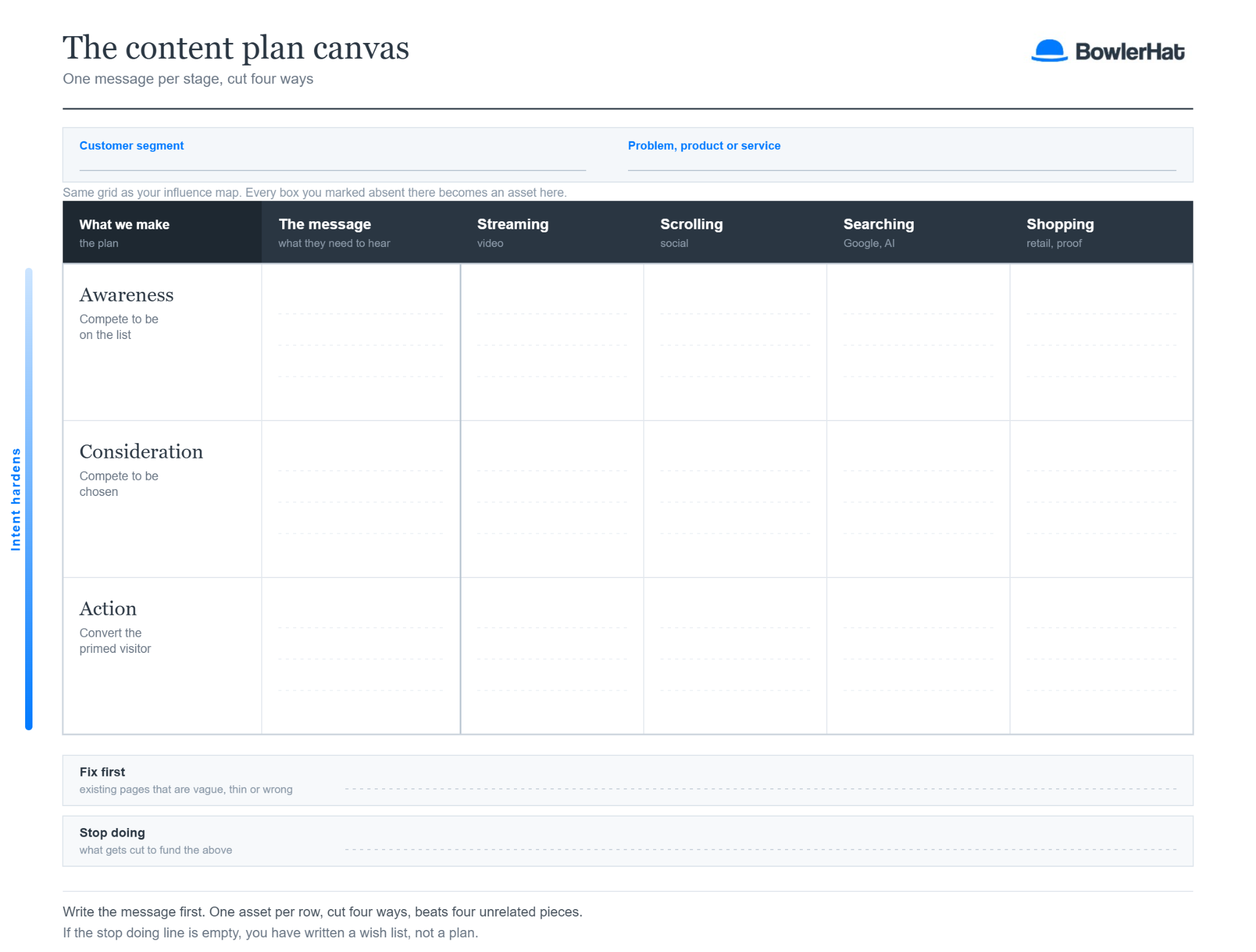
Your influence map is the research that shows where you are absent. The next step is to turn those gaps into a content plan [PDF].
Start with the message column
The row decides what you say. Someone at the consideration stage needs to hear the same thing whether they’re watching YouTube or reading an AI Overview.
Awareness: Compete to be on the list
Educational messaging. Name the problem, explain why it happens, set out how it gets solved. Your role is teacher, not vendor. The credibility comes from explaining it better than anyone else, and the reward is being named alongside the answer.
Consideration: Compete to be chosen
Differentiating messaging. Who you suit, who you don’t, what makes you the right pick, and the evidence behind it. Vague positioning has always been weak. Now it’s invisible, because a machine can only weigh you on what you’ve actually committed to.
Action: Convert the primed visitor
Reassuring messaging. What they get, what it costs, how long it takes, what happens next. No persuasion needed — they arrive convinced. The job is removing friction before they go and find the answers somewhere easier.
Write these before anything else. If you can’t state what someone needs to hear, nothing to the right of it will save you, and remember that the strategy beats the tactics in this environment!
Then fill the four behavior columns
Work down the message column, then across the rows.
Take one good content idea and present it for each behavior. A case study in your action row becomes long- and short-form video for streaming, image statistics for scrolling, a detailed post for searching, and a proof point tied to a CTA for shopping.
Once you have one genuinely good asset, the ways to present it are almost endless. The content plan puts that process on rails so you don’t get lost.
Use the content plan to turn the gaps from your influence map into specific content. For each cell, work from the message you need to communicate and adapt it to the behavior.
Each column has rules:
- Streaming wants a person and a story. Nobody streams a spec sheet.
- Scrolling wants one idea, understood in two seconds, sound off.
- Searching wants the direct answer near the top, in a passage that survives being lifted out of context.
- Shopping wants proof at the moment of decision. Specifics, comparisons, numbers.
Three frameworks do most of this work.
- The Value Proposition Canvas helps you formulate the messages.
- They Ask, You Answer generates content ideas across cost, problems, comparisons, reviews, and best-in-class.
- SCAMPER produces the variations once you have one strong asset.
These three tools help to put the heavy-duty creative work here on rails.
The two strips underneath
Fix first
An AI can only repeat and summarize what it can read. Before making anything new, go through your homepage, service pages, and case studies, and make them specific. Named sectors. Named locations. Real numbers. Pricing. And what you’re not a fit for — oddly powerful, because no competitor bothers to publish it.
Stop doing
The biggest immediate win is nearly always subtraction. The 40 thin posts nobody reads. The keyword you rank first for that delivers three clicks a month. The channel you maintain out of habit. Each is budget not going into the handful of things that would move the needle. Be honest about what’s working, and resist throwing good money after bad.
Put ASC into practice
Read back over the three steps, and very little of it is AI trickery. Be a business worth recommending. Say clearly what you do and who it’s for. Publish what only you could publish. Turn up where your market already is. Stop what never worked.
What’s changed is that a machine now sits between you and your customer, reading what’s written about you and summarizing it into a recommendation. It can’t be flattered or swayed by keyword density. It can only work with what’s actually there.
Analysis tells you where you actually stand. SEO makes the business legible, but the business beats the site, and the site beats the audit. Content turns the gaps into a plan: three messages, one asset per row, cut four ways.
The practical sequence is simple:
- Pick one customer segment and one problem, product, or service.
- Write 20 prompts across awareness, consideration, and action.
- Run them in AI Mode, Gemini, and ChatGPT. Record whether you were mentioned, who else was, and what got cited.
- Set a baseline with a visibility tool, and check the Generative AI report in Search Console.
- Fill in the influence map.
- Sanity check the business: product, task completion, proprietary assets, topical focus, brand.
- Make the site legible: a page for everything you sell, clear hierarchy, consistent naming, then hygiene.
- Get talked about where your market already is.
- Write your three messages. Don’t proceed without them.
- Pick one strong asset per row and cut it four ways.
Run the same 20 prompts again in 90 days and see what moved. Things change fast enough that nobody’s advice survives contact with the market — mine included.
The technology is new and the pace is faster than ever, but people are still people. Know your market. Be genuinely good at a small number of things. Understand where influence happens, be there, and don’t be afraid to blow your own trumpet.
AI is doing the research people once did and making the recommendations that drive real business. The question is whether it’ll recommend you.
Explore more on
Editorial disclosure
Contributing authors are chosen for their expertise and work under the oversight of the editorial staff. Search Engine Land is owned by Semrush. The contributor was not asked to mention Semrush; the opinions expressed are their own.
About the author