Google Error Allowed BP To Violate Ad Guidelines
It’s well known to many at this point that BP has been advertising on Google to get its public relations message out. Today, it turns out that some of those ads have been violating Google’s guidelines — in particular, a rule that requires showing people the site they’ll be going to when clicking on an ad.
BP has been targeting many oil spill related terms over the past few weeks, including “oil spill” itself. But over at WebmasterWorld, it was noticed that the “display URL” in BP’s ad for “oil spill” didn’t match the site the ad actually took people to.
Here’s how BP’s ad targeting oil spill looked:
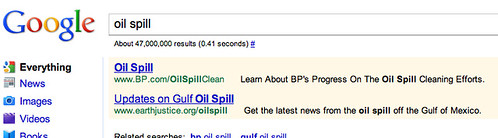
See how the ad was showing this URL:
www.BP.com/OilSpillClean
That’s where it’s supposed to be taking someone who clicked on the ad. Instead, the ad lead over here to BP’s YouTube channel:

The practice of showing a different display URL than the actual destination URL (or site domain) is against Google AdWords display URL policy and shouldn’t be allowed. So what happened? A Google spokesperson emailed us that this was a mistake:
Our Display URL policy for AdWords text ads requires that an ad’s display URL match its destination URL. In this case, due to a combination of human and system error, the mismatch was not flagged. The error is being corrected.
It’s a relatively small error, and one that has slipped by in the past for ads by other companies, large and small. But that hasn’t been so frequent, recently. Plus, with all the attention on BP’s Google ads over the past month, it’s surprising that it wasn’t caught.
It also happens just a day after YouTube announced a special event on its site, in conjunction with PBS Newshour, to take questions live and have them answered by BP’s CEO in charge of the Gulf clean-up operation. To be absolutely clear, BP itself was not promoting that event with its ads nor sending people to where it will happen on YouTube’s CitizenTube channel. Instead, BP was sending people to its own YouTube channel.
Currently, the BP ad for “oil spill” no longer leads to YouTube but instead to the Gulf Of Mexico Response area on the BP.com site.
Explore more on
Add Search Engine Land as a preferred source on GoogleEditorial disclosure
Search Engine Land is owned by Semrush. We remain committed to providing high-quality coverage of marketing topics. Unless otherwise noted, this page’s content was written by either an employee or a paid contractor of Semrush Inc.
About the author