If Google Is The New Microsoft, Facebook Is The New Google
One can guess that Egypt’s Hosni Mubarak probably doesn’t “Like” Facebook anymore, the website that now topples governments. (I apologize but I couldn’t resist.) Back in the US the Facebook enemies or, more precisely, “frenemies list” is also growing says a piece in the the Wall Street Journal. The article discusses Facebook’s broad ambitions and […]
One can guess that Egypt’s Hosni Mubarak probably doesn’t “Like” Facebook anymore, the website that now topples governments. (I apologize but I couldn’t resist.) Back in the US the Facebook enemies or, more precisely, “frenemies list” is also growing says a piece in the the Wall Street Journal.
The article discusses Facebook’s broad ambitions and how the social site competes with a growing number of companies as it reaches out into more and more areas:
As the seven-year-old company ramps up its hiring and adds new features to its social network, it is disrupting the businesses of established companies like Yahoo Inc. and Google Inc. and putting even more Internet firms on notice. Facebook, which has more than 600 million users and was valued at $50 billion in a recent funding round, is grabbing online-advertising from Yahoo, Myspace and others.
Among the companies named in the article that are now in the Facebook frenemies camp are Google, Microsoft, Zynga, eBay/PayPal, Yahoo, Groupon, Apple, MySpace, Yelp, AOL, Twitter and others.
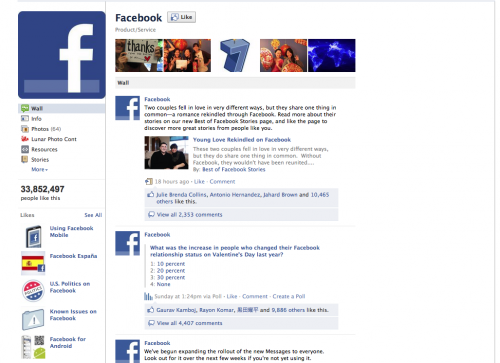
While Google in many ways has taken the place of Microsoft (certainly in the anti-trust attentions of Europe), Facebook has now moved into the hot/feared space that Google occupied for a number of years.
It’s “natural” and predictable that concern arises as companies become powerful and disruptive. That’s what happened with Google and it’s happening increasingly with Facebook.
Facebook’s explicit ambition is to inject itself into the center of all “conversations” happening online, between people and between brands, institutions and their customers and users. And that will inevitably be “disruptive” to many established companies and ways of doing business.
So far most companies have happily adopted Facebook as a social or “conversational” marketing platform and publishers have leveraged Connect to extend their visibility and reach. But over time that could shift if Facebook is seen as asserting its interests or its brand too strongly. In addition the privacy controversies that have dogged Facebook for several years are likely to gain renewed attention as formal privacy regulations and legislation emerge in 2011 or 2012.
How would Facebook Ads perform if users are given the option to “opt-out” of all targeting for example? That’s probably going to be required at some point. And many users remain somewhat confused about who sees what and what gets transmitted to third parties via Connect and instant personalization.
Facebook is a revolutionary platform, much more than Google in some respects. For example, a small mobile security firm Gemalto just put Facebook on a SIM card enabling nearly all mobile handsets that don’t already access Facebook to access Facebook. There are 5 billion mobile subscribers in the world. Effectively that’s now Facebook’s “addressable market.”
As the company moves toward an IPO in 2012 and then starts to ramp up monetization (as public companies inevitably must) it will almost certainly encroach on more companies and their models — just as Google has.
Contributing authors are invited to create content for Search Engine Land and are chosen for their expertise and contribution to the search community. Our contributors work under the oversight of the editorial staff and contributions are checked for quality and relevance to our readers. The opinions they express are their own.

Related stories
About the author