What is the Google Local Pack? How to rank in the 3-pack

The Google Local Pack is a small set of local business listings that typically appear above Google’s organic listings when the intent of a search is perceived as local. Alternate terms include “3-pack” and “Map pack.” The actual number of listings in each search engine result page (SERP) feature can vary, but the unifying element is that the results feature information about businesses in a specific geography.

Because of its outstanding influence on consumer behavior, achieving high visibility in Google local packs is a core local search marketing goal. Large studies like this one from SOCi find that businesses that earn visibility in Google’s local packs earn 126% more traffic and 93% more user actions like calls, clicks, and requests for driving directions than those that haven’t earned one of the top three local ranking positions.
Today, we’ll familiarize you with the basics of Google Local Packs, how they work, how to optimize for them, troubleshoot them, and how to track your performance.
We’ll also answer important local pack FAQs to help your local businesses become as prominent as possible utilizing this incredibly powerful Google feature.
What is the Google Local Pack?
Perhaps no other aspect of Google has undergone more dramatic changes or more confusing rebranding since Google first began integrating specialized local business information into its search engine results in 2004.
With the beta release of Google Maps in 2005, the company recognized that it had a significant opportunity to become a key component of local consumer journeys. Over the past two decades, it has continuously invested in connecting with local business owners and publishing their information.
Change is the one constant in Google’s local ecosystem. Its localized results have gone by a bewildering number of names and nicknames in 20 years (local packs, map packs, local 3-packs, hamburger packs, snack packs, etc.) in the local search engine optimization (SEO) industry.
The interface via which business owners create and manage their listings in Google’s environment has likewise undergone multiple rebrands, including the Google Local Business Center, Google+ Local, and Google My Business (GMB). It can be confusing, but don’t worry. This guide will teach you everything you need to know about Google’s local packs.
The current terminology for a local business listing is the Google Business Profile (GBP), which is most commonly managed via the New Merchant Experience (NMX) dashboard that appears when a listing owner or manager searches for “my business” while logged into their associated Google account.
In brief, Google Local Packs are primarily made up of information and media drawn from Google Business Profiles, but this is not always the case, as you’ll see in the following examples.
Visual examples of current Google Local Packs
We currently tend to see two main types of local packs: those labeled Places and those labeled Businesses.

This first example of a Google Local Pack for dentists in San Rafael is what we might think of as fairly standard. It’s labeled “Places,” and contains:
- Three local results
- Fairly rich information, including business names, average star ratings and review counts, primary business categories, street addresses, phone numbers, partial open hours information, and links for website directions and to companies’ websites
- An interactive map
- A “More places” link, which, if clicked, takes the searcher to the “local finder” interface containing further local business listings
- Some of the entries have additional features, like a scheduling button or a mention of onsite services
Compare the above to the next screenshot:

While still labeled as “Places” and featuring many of the same details, the inclusion of a featured image next to each listing significantly changes the look.
Note, too, the presence of the bonus snippets of text as the last line of each entry. These are known as “local justifications.” In this particular example, these local justifications are quotes from reviews that the businesses have earned. They state things like, “Great prices and very nice guy,” “Incredible selection and reasonable prices,” and “Excellent service, great products.”
Local justifications can impact click-through-rates (CTR) and can be pulled from multiple sources. For an in-depth look at these influential snippets, take a look at The current state of Google local justifications.
Now, let’s look at a slightly different local pack for local schools:
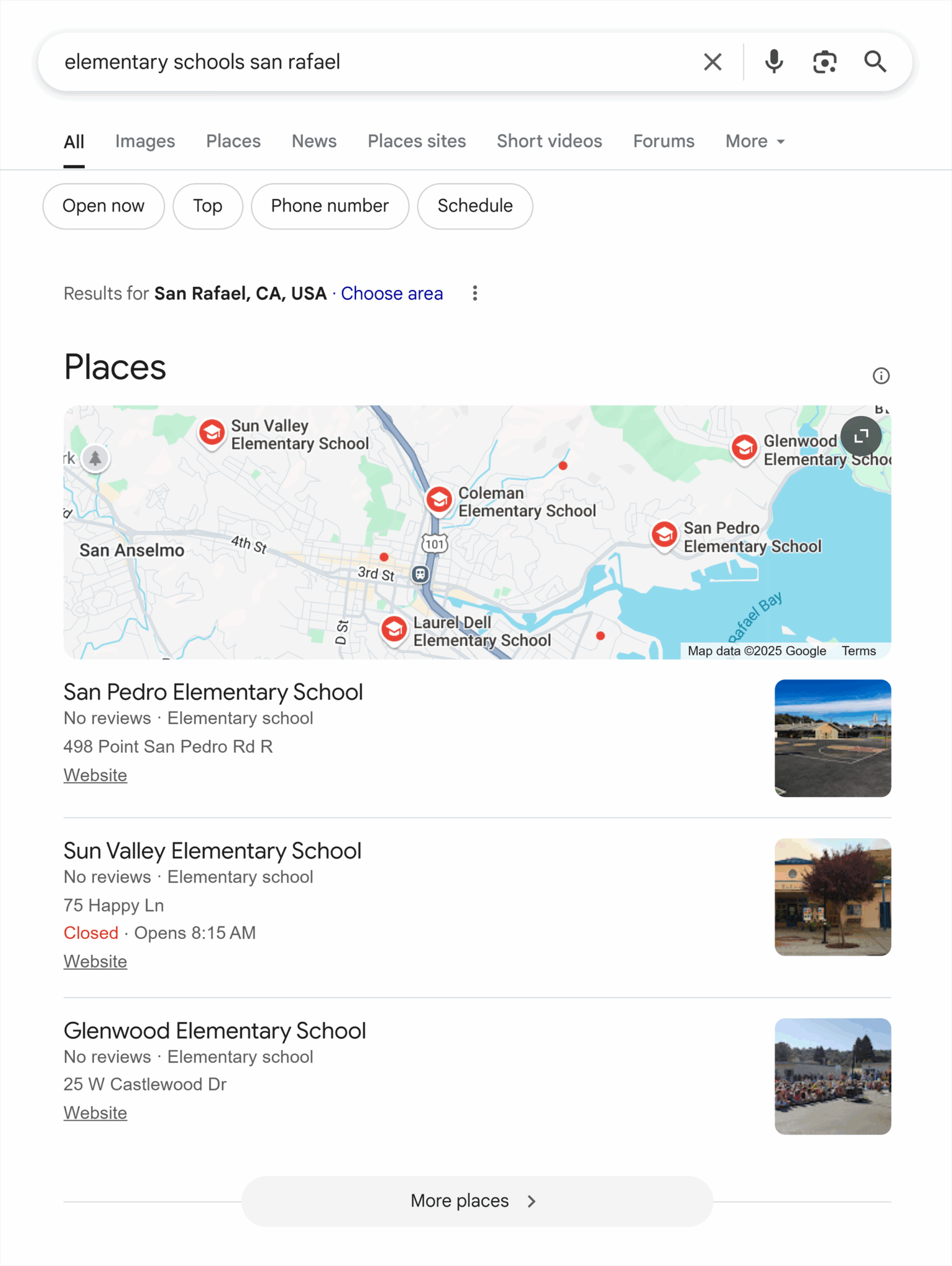
While still labeled as a “Places” pack, these results for nearby elementary schools immediately look pared down in comparison to the last two examples. There is very limited contact information, and very few rich features.
In fact, it wouldn’t be surprising to see the reviews element entirely removed from these packs in the near future, given Google’s recent announcement that it will stop featuring review information in association with school listings. Soon, local packs for schools could, and probably will, look quite different.
Let’s look at just one final example:

This Google Pack is a newer example of what these local results can look like. This set of listings is labeled “Businesses”—somewhat confusingly, as ⅔ of the examples we looked at above were also clearly businesses. Like the pack labeled “Places,” clicking on the “More Businesses” link will take you to the local finder. This should not be confused with a different type of Google result which some call a “Local Service Ads” pack. It is labeled with a “Google Verified” stamp and looks like this:

This is a completely separate feature stemming from Google’s paid Local Service Ads program, and is not considered a typical local pack.These Local Service Ads-based packs are most common for service providers like plumbers, mold remediators, housekeeping services, etc.
How many listings do local packs contain?
Local packs sometimes contain fewer than three listings, and they also sometimes expand to include paid ads.
Do you need to worry about which type of local packs appear for your community?
Short answer: no. You do not have control over which pack label Google has decided to display for a user’s search.
The SEO toolkit you know, plus the AI visibility data you need.

How to rank for Google Local Packs
Check which pack variants are appearing for your important searches
Search for your brand and keyword phrases to get a good sense of the kinds of packs Google is returning for you on both desktop and mobile devices. This way, you’ll know whether you need to focus mainly on GBP optimization to appear in packs labeled “Places,” and “Businesses,” or whether you’ll also need to invest in Google’s Local Service Ads Program because the results labeled “Google Verified” are dominating your market.
Optimize your GBP to compete
You want your listing to be as fully-featured as possible so that your site has all of the information Google might display in any Place pack variant. Get specific details on optimizing your GBP below.
How Google Local Packs work
Let’s take a deeper look at how Google Local Packs work and what this can mean for your business.
What is the relationship between Google Business Profiles and Local Pack rankings?
The information Google displays in each pack can vary fairly significantly, as we’ve seen above. However, the majority of information featured in the packs comes directly from a business’s Google Business Profile. Fields like contact information, online reviews, ratings, and photos are drawn from the GBP, but it’s important to understand these two additional points:
A business doesn’t control all elements of its GBP. For example, a business doesn’t control the reviews and photos its customers upload to its listing, though they can influence them with review requests.
Likewise, a business can’t control GBP elements like the “Popular times” feature, which Google draws from aggregated and anonymized data they pull from users who have opted into being tracked by Google Location History.
That doesn’t mean, however, that a business has no influence on these factors, they are just more limited. For example, a business could influence this feature, to some degree, by offering specials during specific hours (like a happy hour or senior shopping morning).

Many of Google Business Profile’s fields are open to public editing suggestions and must be continuously monitored for accuracy. This information can be changed by:
- Well-meaning members of the local community who may or may not know correct information about a business.
- Ill-intentioned spammers who are editing listings with the goal of harming a business’s reputation and rankings. These bad actors can move the Map pin, suggest edits that feature incorrect information, and leave fake negative reviews and ratings.
While not everything that appears in local packs can be controlled, keen management of a business’s GBP is the primary means of influence.
How do local packs differ from Google’s organic results?
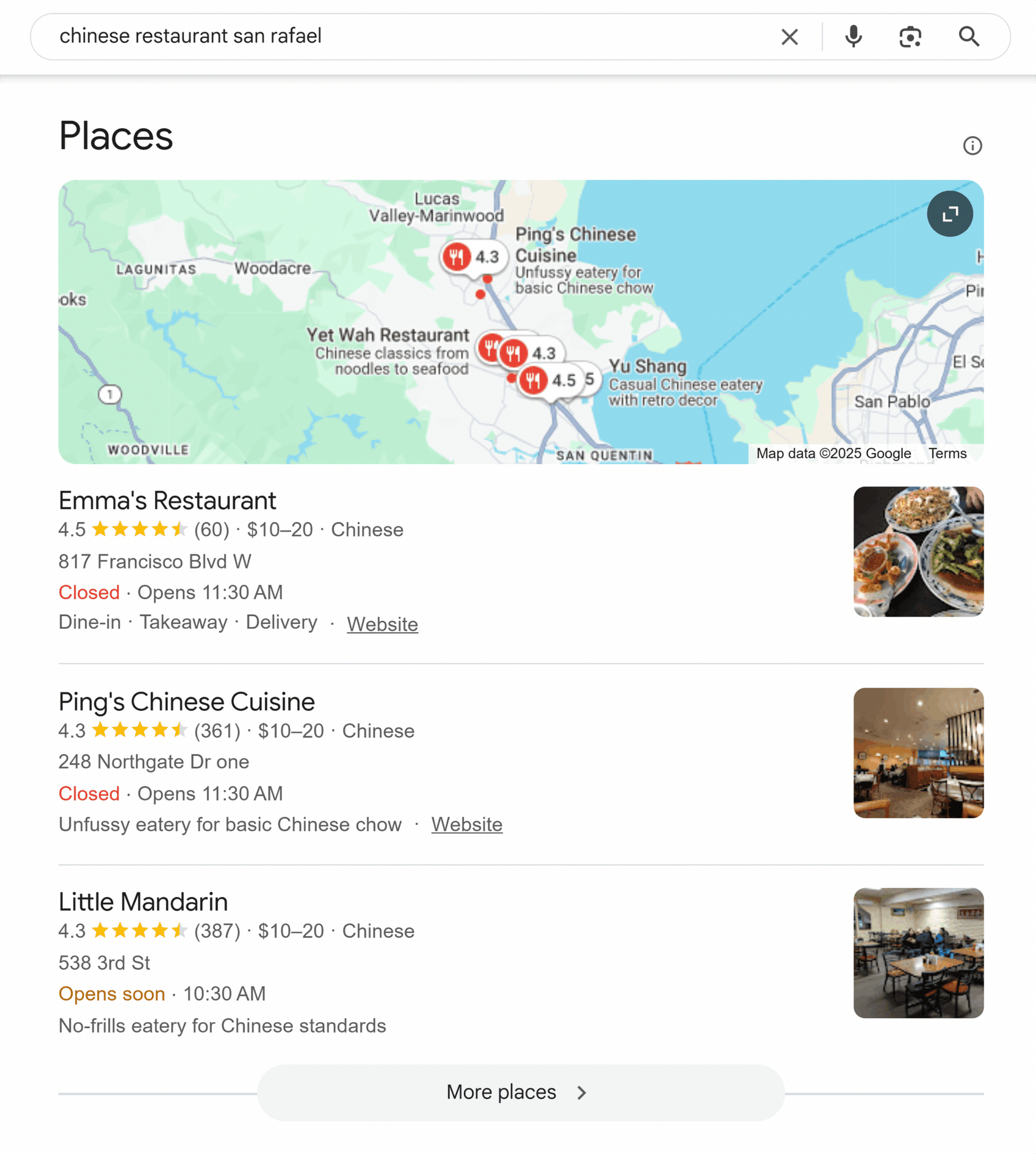
The above screenshot illustrates Google’s typical response to a local-intent query like “Chinese restaurants San Rafael.” Most commonly, the local packs are placed above the organic results and, while there may be overlap in the information these two distinct data sets contain, they are not the same. Key differences include:
- When a local pack listing is clicked on, it typically brings up more Google-based information for the searcher, like the Google Business Profile or a Local Service Ads listing. See the following example:

- By contrast, when an organic search engine result entry is clicked (like this one shown below for Yet Wah Restaurant), this takes the user directly to the business’s own website.

- While the authority of a local business website has long been considered an influence on local pack rankings, the order in which a business appears in one interface will not necessarily match the order in the other.
In fact, recent local SEO news is buzzing with the concept of the “diversity update”, which may be challenging older concepts of the impact of organic rankings on local rankings and vice versa. Early testing appears to suggest that Google is trying to diversify its local and organic search results so that the businesses featured in the local packs aren’t then duplicated in the organic results below it.
You can read some initial theories about this here.
What are Google Local Pack ranking factors?
Local pack ranking factors are any element, activity, or practice that influences the position a business achieves in Google’s local pack environment. Google uses a secret, proprietary calculation known as an algorithm to determine the order in which businesses are ranked in its system.
While the exact number and nature of factors within this local algorithm are known only to Google, SEOs and local business owners are able to theorize about ranking factors based on studying local search engine results over time.
A foundational local pack ranking factor that every local business marketer needs to bear in mind is this: there are no static #1 local pack rankings.
Local pack results are highly customized to the location of the searcher, meaning that a potential customer on one side of town is not going to see the same results as someone on the other side of town.
To see this in action, try taking a trip around town and performing the same search in Google at various locations. You’ll see the entries in the Google Map Pack shift based on your changing location.
Because there are no #1 rankings, your primary goal for Google Map Packs should be learning how to make a business as visible as possible to as many searchers in your geographic market as possible, while remembering that there is no way to rank #1 for everybody.
Which local pack ranking factors are believed to be the strongest today?
You can approach this important question from two key directions: what Google says and what SEOs believe based on practical, real-world experience.
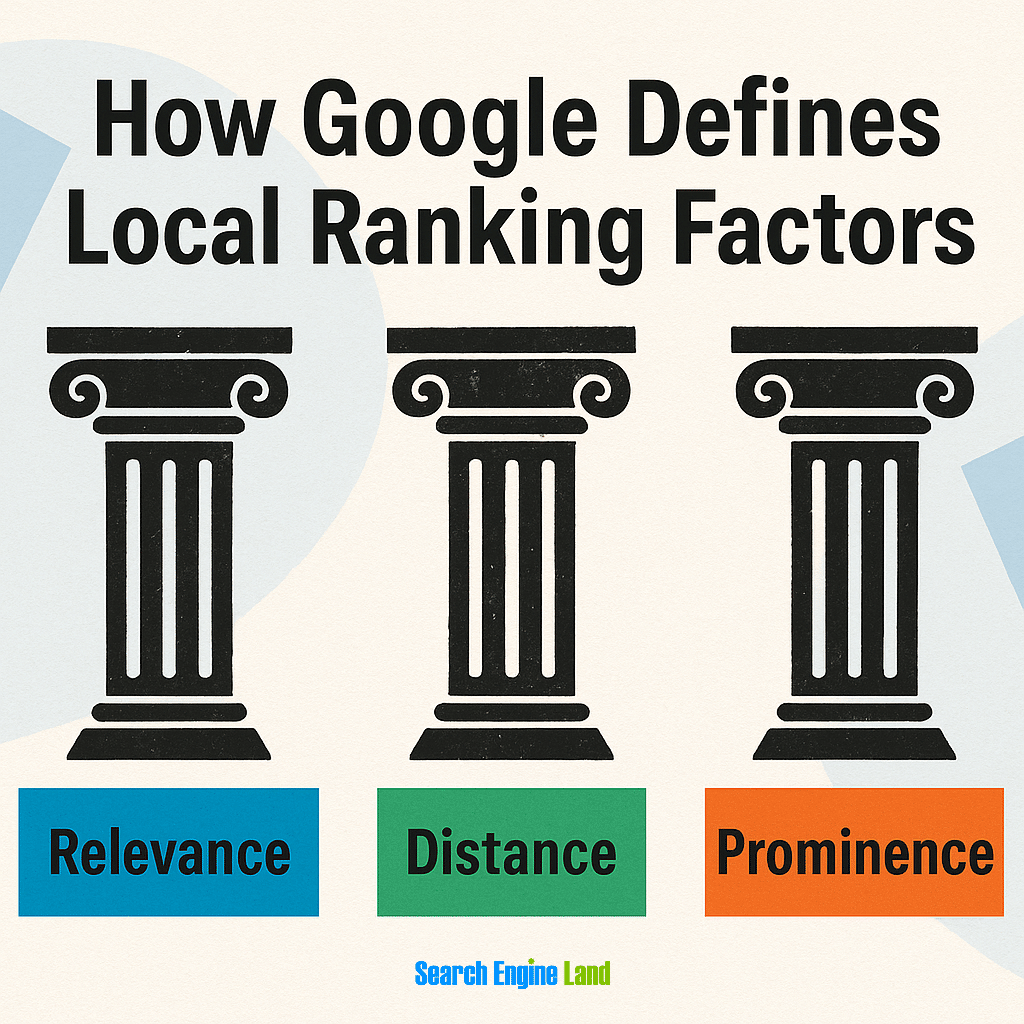
The best place to begin understanding local pack ranking factors is to start by reading Google’s own document, How to improve your local ranking on Google. In it they point to three ranking factors as having an impact on how businesses rank in their local system. Here is how Google defines these factors:
- Relevance
Relevance refers to how well a local Business Profile matches what someone is searching for. To help Google better understand your business and match your profile to relevant searches, be sure to add complete and detailed business information. - Distance
Distance weighs how far each potential search result is from the location term used in a search when choosing which ultimate results to display. If a user doesn’t specify a location in their search, Google will instead calculate distance based on what they do know about that user’s location. - Prominence
Prominence refers to how well-known a business is. Some places are more prominent in the offline world, and search results try to reflect this in local ranking. For example, famous museums, landmark hotels, or popular store brands are likely to be prominent in local search results.
Prominence is also based on the holistic information that Google has about a business from across the web, such as links, articles, directories, and local citations. Google review count and average star rating may also factor into local search ranking.
More ratings and positive reviews can improve a business’s local ranking. A business’s position in web results is also a factor, which means that maintaining SEO best practices can also be an important aspect for ranking in the Google 3-Pack.
Once you’ve read Google’s own documentation, your understanding of local pack ranking factors will be enhanced by reading the findings of surveys and studies published by the local SEO community. Some popular sources for ongoing research include SterlingSky and GatherUp.
One of the most respected annual surveys is Whitespark’s Local Search Ranking Factors Survey, which polls the opinions of local SEOs to discover which factors they are finding that have the most apparent correlation with improved local rankings. The most recent edition of this survey lists the following as the ten most influential local pack ranking factors:
- Primary GBP category: The first category selected when creating a Google Business Profile
- Keywords in GBP business title: Whether the name of a business includes the keywords that match those being used by searchers
- Proximity of address to the point of search: How close a business is to a searcher at the moment they perform their search
- Physical address in city of search: Whether a business address falls inside or outside of Google’s mapped borders of a given city
- Removal of spam listings through spam fighting: Whether a business is actively reporting spam listings to Google to clear its playing field of ineligible or misleading GBPs
- High numerical Google ratings: The average star rating a business has achieved on the basis of all its ratings on its Google Business Profile
- Additional GBP categories: The other categories a business has chosen, apart from its primary category
- Quantity of native Google reviews: The sheer number of reviews a business has earned on its GBP since it was created
- Verified GBP: Whether the business has claimed and validated their ownership of their GBP
- Proximity of address to centroid: How close the address of a business is to the point on the map that Google considers either the center of that particular city (by searching the city name and seeing where Google places that name on a map) or the center of a particular business district (for example, a part of town that features something like an auto dealership row or a medical park
What is the real-time influence of local packs on user behavior?
Here, we get down to the main reason that local SEOs and business owners obsessively study local SEO results and factors: becoming highly visible in them has a direct and demonstrable impact on local consumer journeys. Here is a short list of ways in which being prominent in local packs can influence user behavior i.e. how people interact with online features and offline businesses:

- Google Local Pack enables users to connect with local branches of businesses they are searching for by brand name.
- Google Local Pack also helps users discover brands when doing non-branded searches for nearby goods and services.
- Ranking in Google Local Pack drives clicks to brand websites, clicks to call the business, and requests for driving directions. All of these are theorized to influence rankings and can lead to transactions; some local packs feature further actionable elements like booking functionality.
- The rating/review portion of local packs can send a strong signal of trust to users, influencing them to choose one business over another and playing a vital role in overall brand reputation.
- The image portion of local packs can attract users to explore a brand’s GBP and spend more time with it—another potential ranking factor.
- Local packs not only influence users who are on the verge of a transaction, but also provide a useful way for users to research the resources of businesses or communities they plan to visit in the future.
- When local packs bring users to Google Business Profiles, they open the door to a variety of brand-consumer interactions, including asking and answering Q&A’s, reviews and responses, direct messaging, and booking appointments.
In sum, local pack visibility is so valuable because the public has adopted Google’s local system as a way to navigate their local landscape, discovering, evaluating, interacting with, and choosing businesses they wish to patronize.
Common Google Local Pack ranking issues (and fixes)
An ongoing question in local SEO is and always will be, “How can I keep improving?” Troubleshooting a lack of performance or a sagging ranking can be a big task. Here’s a list of common local pack ranking problems to consider:
Issue #1: Your competitor(s) is consistently ranking higher than you
The most thorough way to investigate a local ranking issue is via a full competitive audit. A competitor is besting you, but why? Take a deep-dive into all possible metrics in which a competitor may be pulling ahead. An audit will typically turn up information such as:
- The competitor has a higher average rating
- The competitor has better category listings
- The competitor has reviews that are more recent, or a higher velocity of reviews
- The competitor has a name that more closely matches core search phrases
- The competitor has a more authoritative website that has earned more links and mentions than yours
- The competitor’s address is closer to a targeted audience
It might also be necessary to conduct a competitive audit to understand why your business appears to be filtered out at the automatic zoom level of the Map, and, therefore, seemingly invisible in the local pack rankings unless a user zooms in.
This is quite common and is often caused by one business being in close proximity to a competitor who a) shares categories and b) is stronger across a variety of ranking factors. The only fix for this scenario is to build up the metrics in which they’ve outdistanced your business so that Google becomes convinced that your business is the superior result and should not be filtered out.
Issue #2: The listing has become unverified, disabled, or suspended
Here’s what to know about these three GBP statuses:
- Unverified: The business listing is still visible in search, but Google has lost trust in the business’s GBP and the page owner won’t be able to respond to reviews, add photos, or write updates until all information is reverified.
- Disabled: The listing is still visible in search, but Google suspects guideline violations and has removed owner access to review responses, photo uploads, and updates.
- Suspended: The listing is in the same state as a disabled listing, but it is also no longer visible in search.
If your business’s listing has become unverified, it’s essential to gather information that proves the validity of the business. For an in-depth analysis of what, why, and how, Darren Shaw’s walk-through of how to succeed at getting reverified is a great resource for understanding the issue and fixing it.
If the business’s listing has become disabled or suspended, it’s necessary to take the steps outlined in Google’s own documentation to seek remediation.
Issue #3: Google updates and bugs
Google constantly tweaks its results and, occasionally, releases major core updates. If you notice a sudden drop in local pack rankings, you should always:
- Check the SEO publications you trust for news of an update
- Check the Google Business Profile Help Community to see if others are reporting a similar sudden drop
Google also sometimes experiences bugs that can temporarily impact Google Business Profiles and ranking order.
In either case, a best practice is to gather information from reliable sources and then give it a week or two to see if the situation resolves without having to take any action.
Google may announce that they are working to fix a known bug or important news may be released about how to respond appropriately to a major update. Resist the urge to panic; change is a constant in local search and you can only respond appropriately to it when you have access to all of the information.
How to track Google Local Pack performance
This is a business you’re marketing, so of course the key indicator of improved local pack performance is an increase in sales. Fortunately, multiple tools exist to help understand visibility within the geographic market and how consumers are interacting with your specific digital assets. Here is a quick rundown of popular local metrics to track and useful tools to help you.
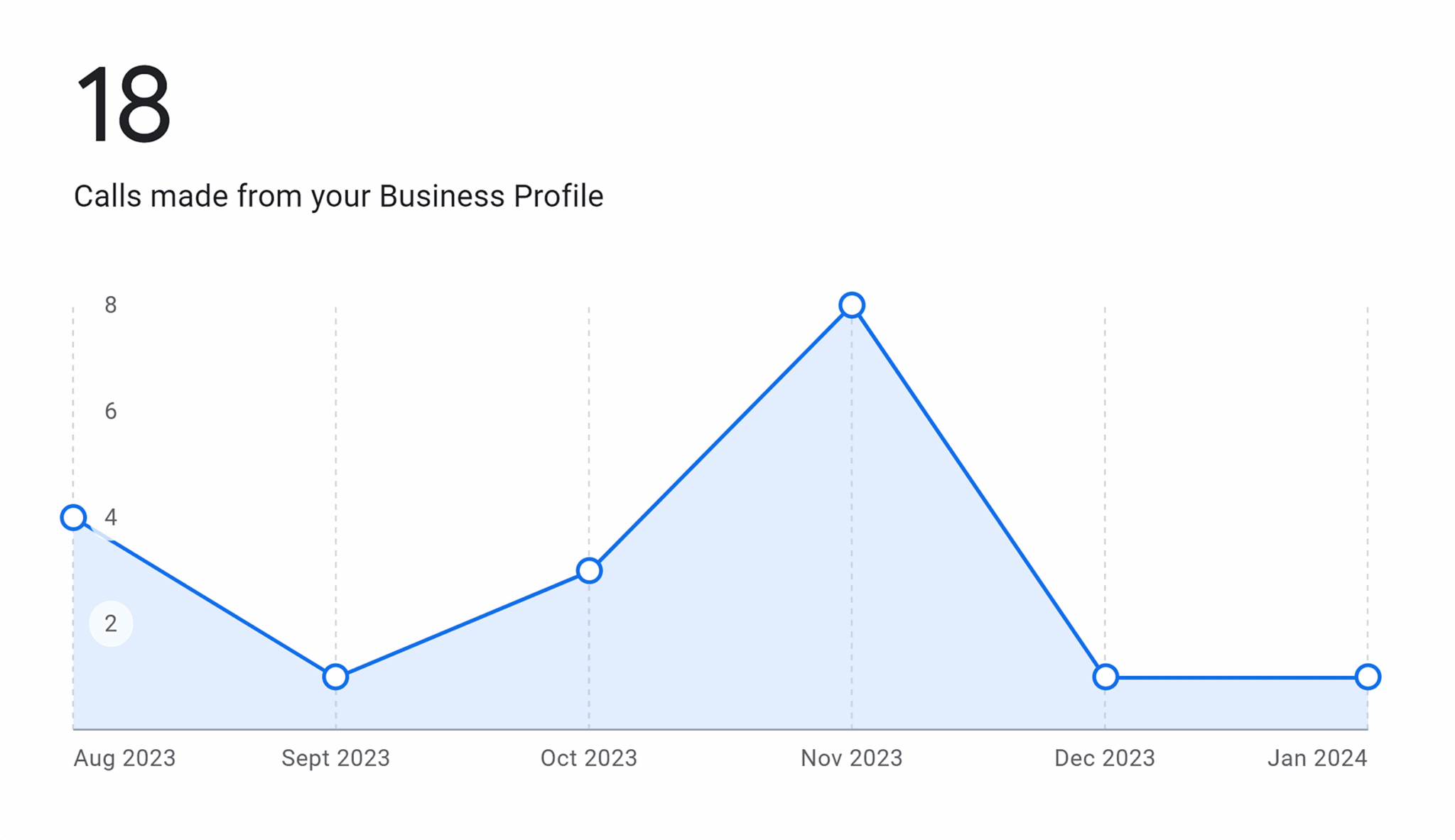
GBP Insights
The performance tab of your New Merchant Experience dashboard that automatically comes with your GBP listing reports on:
- Clicks to your website from your Google Business Profile
- Clicks-to-call to your listed phone number from your Google Business Profile
- Requests for driving directions to your locations from your Google Business Profile
- Views of your Google Business Profile
- Bookings
Map and pack rankings
There are many useful tools that will allow emulation of a customer’s location and see how you are currently ranking in Google Maps and local packs. Popular choices include:
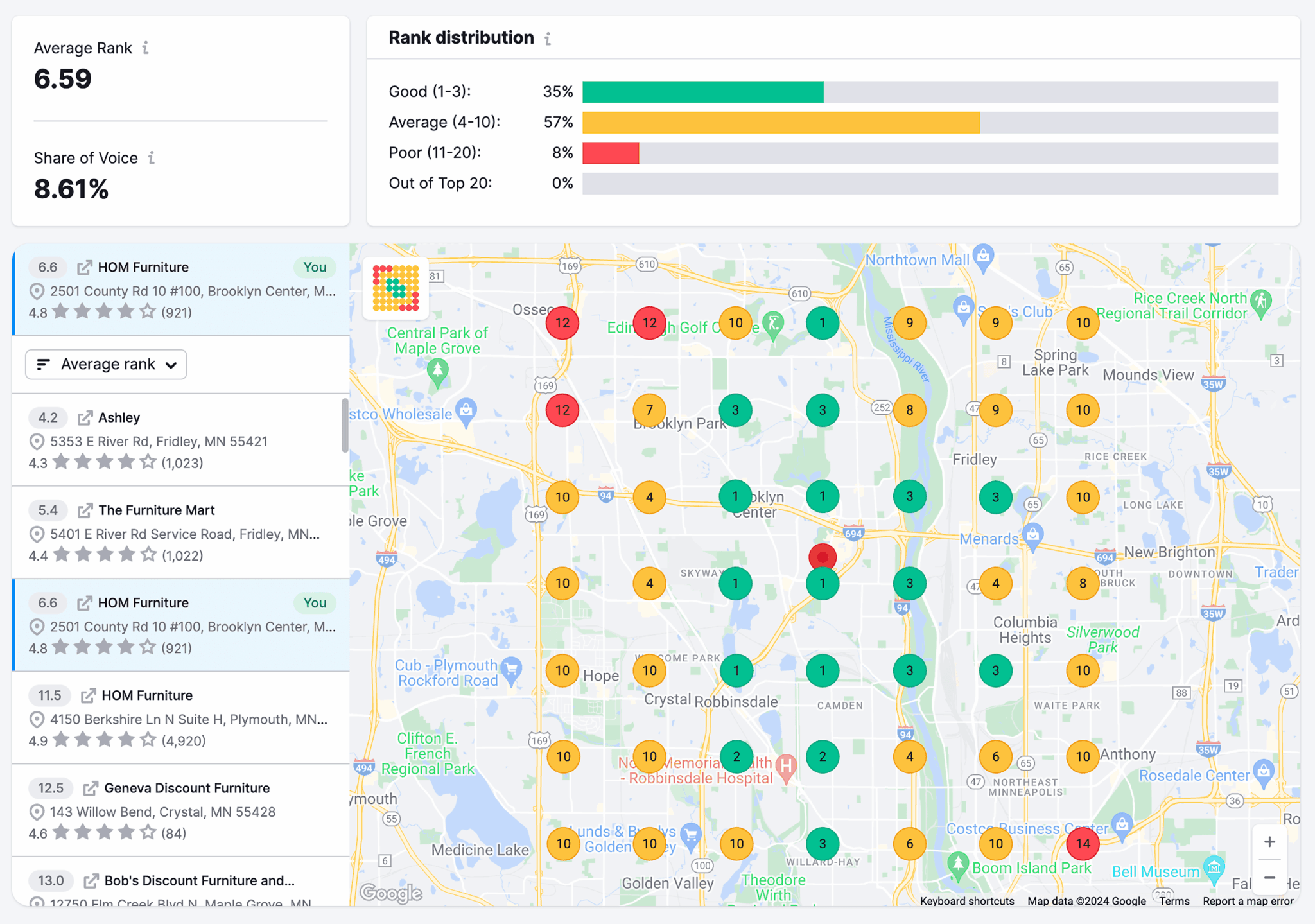
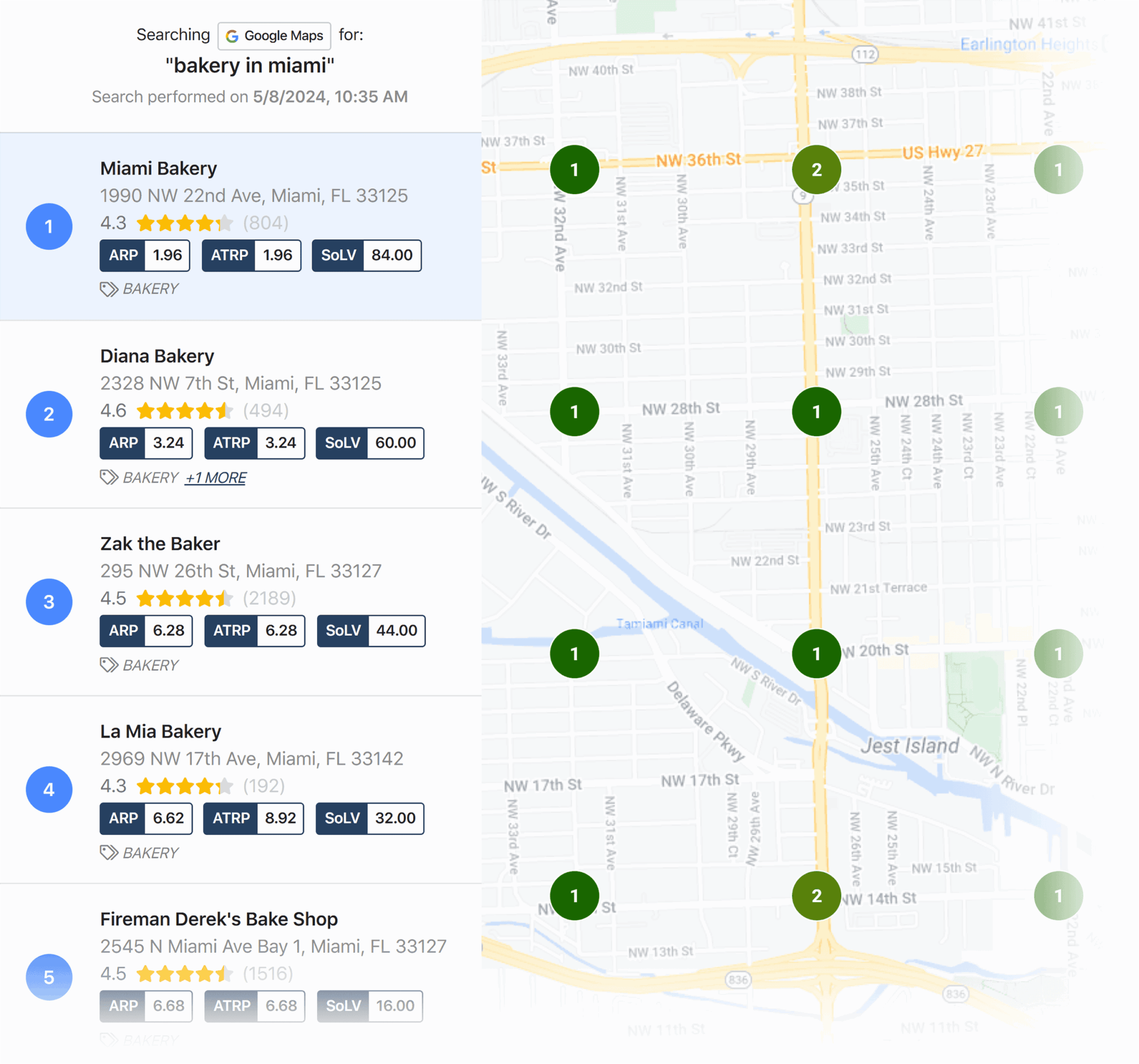

Each tool has its own layout and features, ensuring that there is a good fit for most business cases.
UTM tracking
Urchin Tracking Module (UTM) tracking codes are parameters you can add to URLs to track the performance of various digital assets, like fields of your Google Business Profile. Used in conjunction with Google Analytics, adding UTM tracking to your Google Business Profile website links, product listings, updates, menus, and other features can give you an abundance of insights into how users are interacting with your listing and which features are performing best for your business.
This can help you decide where to budget marketing resources. We highly recommend watching Claire Carlisle’s in-depth tutorial on implementing UTMs in your GBPs for enhanced business intelligence as well as reading Joy Hawkins’ advanced tutorial on unlocking local SEO insights from Google Search Console.
It’s important to remember that local tools have their limitations. While insight gains can help make for smarter marketing decisions, be sure those aren’t getting lost in the data. Invest in tools that deliver actionable reports that are implementable and always keep your eye on the core success metrics of:
- Customer satisfaction
- Conversions
- Sales
- Customer retention
- Customer referrals
Google Local Pack FAQs
In this final section, let’s take a look at some common local pack ranking questions to make sure you have all the answers you need to hit the proverbial floor running.
Q: How long does it take to rank in the local pack?
A: There is no time-based obstacle to achieving high-level pack visibility once your listing has been created and verified. A brand new business can enter a market with a low level of competition and immediately rank well. The more competitive the market, however, the longer it will take for you to accrue certain ranking signals like review volume and velocity.
Q: Can service area businesses show up in the local pack?
A: Yes. Service area businesses have an equal opportunity to create local business listings, but this comes with a major caveat. If the service area business does not have a staffed physical office, Google requires that its address be hidden on its GBP. Unfortunately, businesses with physical addresses commonly outrank those with hidden addresses.
Track, optimize, and win in Google and AI search from one platform.
Q: What’s the best time to post on Google Business Profile?
A: The highest-performing Google Updates (formerly known as Posts) tend to focus on special offers. The offer will run for the length designated, so simply be sure to post in advance of open hours on the day that the offer begins.
Q: Can I have a Google Business Profile without a physical address?
A: No. You must have some sort of address, even if it’s a home address, to create and verify your GBP. If you have privacy concerns, you can hide the address of a home-based business to minimize the chances of random people showing up at your house, thinking it’s a location that’s open to the public.
Q: Can I create a Google Business Profile for a co-working space?
A: It depends. If there is a staffed physical office that is open during stated business hours, answers its own phone lines, and has visible street-level signage, you may well be able to create a GBP. However, if you lack any of these assets, you should not create a GBP for a co-working space as it will be considered ineligible by Google.
Next step: Multi-location SEO
If you’re a business owner or marketer with multiple locations, you’ll be hoping to achieve high Google Local Pack visibility across multiple neighborhoods, towns, or states. Fortunately, there are tools and strategies that can help you with this task which might feel overwhelming or impossible.
Now that you’ve familiarized yourself with basic information about Google’s local packs, you’re ready to move on to learning about undertaking this work for chains and franchises. Read Multi-location SEO: Boost Visibility for Each Location.
Explore more on
Editorial disclosure
Search Engine Land is owned by Semrush. We remain committed to providing high-quality coverage of marketing topics. Unless otherwise noted, this page’s content was written by either an employee or a paid contractor of Semrush Inc.
About the author