What is AI SEO? How artificial intelligence is changing search optimization
Discover how AI is revolutionizing SEO — from smarter keyword research to automated content strategies. Learn what AI SEO is and how it boosts rankings and results.
AI is reshaping how people search and how brands get discovered. Search engines now pull answers directly from AI models, draw from multiple sources at once, and prioritize clear, authoritative entities over simple keyword matches. This shift has created a broader discipline: AI SEO.
As AI-generated answers, multimodal result blocks, and conversational search experiences become part of everyday discovery, the factors that determine visibility are expanding. Brands can appear in traditional SERPs, in synthesized AI summaries, or inside chat-based answers, often without a direct click from the user.
For marketers, this means visibility is no longer defined by rankings alone. Getting seen depends on clearly structured content, consistently defined entities, and the ability of AI systems to reliably extract and represent information across different surfaces.
This guide explains how AI is transforming search behavior, how retrieval models evaluate content, and how to build a visibility strategy that works across both classic search engine results pages (SERPs) and AI-powered environments.
What is AI SEO?
AI SEO is the process of making your content discoverable, extractable, and trusted across AI-powered search experiences. It builds on SEO fundamentals — helpful content, technical strength, semantic structure, and authority — but develops them further to align with the way AI systems interpret, summarize, and surface information.
Instead of optimizing only for ranking, AI SEO also optimizes for retrieval and citation within AI-generated answers. It considers how AI systems evaluate entities, extract passages, and choose which sources to reference when generating responses across:
- Google AI Overviews and AI Mode
- Bing Copilot
- Perplexity
- ChatGPT with browsing
- Other emerging AI-driven discovery tools
Within AI SEO, new terminology has also emerged. Concepts like generative engine optimization (GEO), answer engine optimization (AEO), and discussions about how large language models interpret or reference brand information all describe specific behaviors in how AI systems surface content.
The SEO toolkit you know, plus the AI visibility data you need.

But they’re not standalone approaches. They’re different angles of the same evolution, and AI SEO is the discipline that brings them together.
In short:
- Traditional SEO optimizes for organic rankings.
- AI SEO optimizes for visibility across all AI-influenced search experiences.
AI SEO doesn’t replace SEO. Rather, it complements and expands it, giving marketers a unified approach to visibility in both classic SERPs and AI-powered environments.
Why AI SEO matters
Search is changing. Modern search algorithms have grown exponentially more complex, with Google now using over 200 ranking factors and making thousands of algorithm adjustments annually. At the same time, users increasingly encounter AI summaries, multimodal result blocks, and conversational interfaces before they reach traditional organic listings on the SERPs.
These experiences pull information from multiple sources at once and reward content that is clear, structured, and semantically consistent. As a result, visibility now depends not only on how pages rank, but also on how well AI systems can interpret and reference them.
AI SEO matters because it blends classic SEO strengths with the realities of AI-powered retrieval:
- Better pattern recognition: AI-supported analysis helps teams identify signals like semantic gaps, unclear entity relationships, and inconsistent terminology that can be difficult to detect manually. This leads to clearer content and more reliable decision-making.
- Deeper understanding of user questions: Generative engines reveal the types of explanations, definitions, and factual details users expect. Teams that understand these patterns can create content that aligns more closely with emerging search behavior.
- Faster diagnosis of changes: AI-augmented monitoring can highlight unusual shifts in visibility or user behavior earlier than traditional monitoring methods, allowing teams to adjust content or technical foundations sooner.
- Stronger cross-surface visibility: Search no longer happens in one place. Content may appear in traditional SERPs, AI-generated summaries, chat interfaces, or multimodal result blocks. AI SEO helps ensure consistent, accurate representation across these touchpoints.
- Clearer guidance for content quality: AI systems tend to favor pages with concise explanations, accurate definitions, and strong entity clarity. AI SEO helps teams prioritize the improvements that matter most for modern retrieval.
As search engines continue integrating AI into their interfaces, the distinction between “SEO” and “AI SEO” becomes less about separate tactics and more about expanding what visibility means.
The evolution of SEO in the age of AI
SEO has evolved through major shifts in how search engines interpret information and how users expect to find it. The move from keyword-matching to intent-understanding, and now to AI-powered retrieval, reflects a broader transformation in how search works.
From keywords to intent
Traditional SEO operated on a relatively straightforward premise: identify high-volume keywords, include them in specific densities throughout a page, build backlinks containing those terms, and improve rankings. The strategy was often formulaic: include keywords X times, build Y links, and watch rankings climb.This keyword-centric approach favored quantity over quality and exact matching over relevance.

AI search engine optimization, however, prioritizes understanding user intent and delivering relevant, comprehensive, high-quality content. Modern search engines like Google use natural language processing to understand the context behind queries, allowing them to serve results that answer the searcher’s actual question — not just pages that contain matching keywords.
For example, when someone searches “apple nutrition,” Google now understands they’re likely looking for nutritional information about the fruit and not Apple Inc. products.

Rise of AI-powered search
Search engines have undergone a dramatic architectural transformation, incorporating sophisticated AI systems at their core. This shift extends far beyond simple algorithm updates to fundamentally change how search works.
Key AI technologies now powering search include:
- RankBrain (2015): This machine-learning system helps Google interpret queries it has never seen before by connecting them to similar known queries. RankBrain influences all Google searches and can modify results based on user interactions, effectively learning which search results best satisfy specific intents. This system now processes over 15% of Google’s 8.5 billion daily searches (Google, 2024).
- BERT (2019): Bidirectional Encoder Representations from Transformers (BERT) processes natural language by inferring the meaning of words from the context provided by the other words around them, recognizing subtle linguistic nuances that earlier algorithms missed.
- MUM (2021): Multitask Unified Model (MUM) is 1,000 times more powerful than BERT and can understand information across 75 languages and multiple content formats simultaneously. These systems significantly improved the accuracy of search results for complex queries, with MUM capable of answering multidimensional queries that once required eight separate searches (Google I/O, 2023).
- AI Overviews and SGE (2024): Google’s AI Overviews, part of its broader Search Generative Experience (SGE), use generative AI to provide direct answers to complex queries by synthesizing information from multiple sources. As of March 2025, AI Overviews are triggered in approximately 13.14% of all Google search queries, nearly doubling from 6.49% in January 2025.
These advancements represent a shift from retrieving documents to interpreting information. Search systems increasingly pull insights from across the web, evaluate which sources are most reliable, and synthesize explanations at scale.
Generative engine optimization (GEO)
As AI-generated answers become more common across search experiences, a new focus area has gained attention: generative engine optimization (GEO). GEO refers to the practices that help content appear in AI-generated summaries, answer panels, and synthesized responses across systems such as Google AI Overviews, Bing Copilot, Perplexity, and ChatGPT’s browsing experience. AI SEO represents the broader practice of optimizing content for AI-driven search visibility. GEO sits within AI SEO and is focused specifically on making content easy for generative systems to select, extract, and synthesize into an answer.
The fundamental difference between traditional SEO and GEO lies in the objective:
Pro tip: While traditional SEO aims to rank a webpage in search results, GEO seeks to have your content selected as a source for AI-generated answers, effectively positioning your brand as the authority that informs AI responses.
GEO isn’t a standalone strategy. It represents one part of the broader AI SEO toolbox; specifically, creating content that aligns with how generative systems retrieve, interpret, and combine information when constructing answers.
Unlike traditional ranking systems, generative engines tend to:
- Pull information from multiple sources simultaneously
- Heavily rely on entity clarity and factual precision
- Favor clearly structured, extractable passages
- Synthesize insights rather than listing individual links
This means GEO emphasizes:
- Strong entity definitions (clear names, attributes, and relationships)
- Factual accuracy and internal consistency
- Concise, self-contained explanations
- Structured formats such as lists, steps, or short factual blocks
- Clear signals of expertise and trustworthiness
The goal isn’t to “write for the model,” but to present information in a way that is easy for generative systems to reliably interpret. Because AI answers behave differently from traditional SERPs, GEO helps ensure your content remains visible when search engines summarize information rather than displaying a linear list of pages.
As AI Overviews, answer boxes, and chat-based search interfaces become standard, GEO has grown in importance. For many marketers, it represents the natural evolution of featured snippet optimization: broader in scope, more dependent on semantic clarity, and increasingly essential as AI-generated answers shape user decisions.
Answer engine optimization (AEO)
Answer engine optimization existed before GEO and has been a core concept in traditional search, originally focused on winning featured snippets, instant answers, and voice-assistant responses. The environment has evolved, but AEO still refers to strategies that increase direct-answer visibility, both in legacy SERPs and modern AI-powered interfaces.
The core distinction is scope:
- SEO seeks to rank.
- AEO seeks to answer.
Instead of competing for a top-10 blue link, AEO prioritizes concise, verifiable responses that engines can surface with minimal user interaction. As AI platforms expand, the meaning of AEO has broadened to include both snippet-style visibility and AI-generated answer placement.
Unlike GEO (which targets generative synthesis), AEO is rooted in answer extraction: making information clear enough to be lifted directly from the page.
AEO relies on:
- Question-aligned content and FAQ structures
- Factual clarity, definition blocks, glossaries
- Schema for question/answer context
- Plain-language phrasing that reduces interpretive friction
AEO remains one of the foundational pillars inside both SEO and AI SEO, especially for brands where precision answers drive user decisions (pricing, requirements, ingredients, technical specs, return policy details, etc.).
Large language model optimization (LLMO)
LLM optimization refers to the practices that make content discoverable, retrievable, and accurately citable inside large language model AIs, such as ChatGPT, Gemini, Claude, and Perplexity.
If GEO determines whether your content is selected for AI-generated answers in search, LLMO helps determine whether that content should become part of the model’s internal knowledge and be retrievable during generation. The objective isn’t to rank or answer: It’s to become part of what the model references when generating responses. Same ecosystem — different layers of influence.
LLMO emphasizes:
- Entity clarity and semantic grounding
- Citation reliability and provenance
- Structured, self-contained facts that models can safely reuse
- Clean architecture and crawl accessibility
- Source consistency across domains and formats
Because LLMs synthesize across multiple sources, visibility often occurs without a page visit. In this context, LLMO supports AI SEO by ensuring content is extractable, accurate, and model-friendly at the knowledge level, not just at the SERP level.
In the world of AI SEO, the processes of GEO, AEO, and LLMO are utilized alongside traditional SEO fundamentals — not instead of them. Without solid technical health, structured information, and well-defined entities, AI visibility has nothing stable to anchor to. The framework below shows how these layers work together inside AI SEO.

The rise of zero-click search
Zero-click search has become a defining feature of the new search landscape. As featured snippets, knowledge panels, and AI-generated answers provide information directly on the results page, users increasingly find what they need without clicking through to a website.
According to a 2024 study by Rand Fishkin of SparkToro, 58.5% of Google searches in the United States ended without a click. This means that users found the information they needed directly on the search results page without clicking through to a website. In the European Union, the figure was slightly higher at 59.7%.

This change impacts how SEO success is measured. In a zero-click environment:
- Organic traffic may decline even when visibility increases
- Impression share, brand presence, and placement within AI-generated answers become important signals
- Content quality, clarity, and authority influence whether your information is surfaced at all
- Top-of-funnel informational queries are the most affected, while branded and transactional searches remain more stable
A study by Amsive found that branded keywords are less likely to trigger AI Overviews, and when they do, they receive an 18.68% increase in CTR on average
This highlights the uneven impact of zero-click behavior and reinforces why AI SEO focuses on visibility across both SERPs and AI-generated experiences rather than traffic alone.
Core components of AI SEO
AI SEO blends the foundational elements of search optimization with the requirements of AI-powered retrieval. While the discipline continues to evolve, five components form the core of effective AI SEO today:
- Entity clarity and consistency: AI systems rely heavily on entities: people, brands, products, and concepts. Clear naming, unambiguous definitions, and consistent relationships help both search engines and generative models understand what your content is about and how it connects to broader topics.
- Clear, structured, extractable content: Generative engines favor content that is precise, well structured, and easy to interpret. Self-contained explanations, clean formatting, and strong semantic structure increase the likelihood that models will use your content in summaries and answers.
- Topical depth and genuine expertise: Modern search rewards content that demonstrates real understanding. AI SEO prioritizes comprehensive coverage, contextual explanations, and accurate insights that signal subject-matter expertise across a topic — not just keyword matching.
- Strong technical foundations: Crawlability, internal linking, rendering, and structured data still matter. Technical health ensures that search engines and AI systems can access, parse, and correctly interpret your content.
- Holistic visibility measurement: Rankings alone no longer reflect performance. AI SEO requires monitoring visibility across traditional SERPs, AI-generated answers, citations, brand mentions, and emerging search surfaces. Measuring accuracy and representation across these environments is now essential.
Together, these components create a unified approach to visibility across both classic and AI-driven search experiences, helping brands remain discoverable as search systems continue to evolve.
9 tips to optimize for AI
AI SEO is not a collection of hacks. It is the practical application of solid SEO fundamentals that allow your website to compete in a search landscape where AI-generated answers, summaries, and new interfaces play a growing role.
Focusing on semantic structure, schema markup, and topical authority will put you ahead of the game for both Google and AI search. With that in mind, here are nine strategies that will boost your performance in AI and traditional search alike. They don’t need to be followed in a specific order and can be implemented either individually or as a set, depending on specific needs and goals.
1. Prioritize semantic search and structured content
Modern search engines and AI systems understand content contextually rather than through simple keyword matching. Implementing semantic optimization increases both traditional rankings and AI visibility.
Implementation strategy:
- Develop comprehensive topic clusters that cover all aspects of a subject. Folloze found that shifting from narrow pages to in-depth topic clusters resulted in ranking for 68% more long-tail keywords year over year across their content library.
- Use natural language and conversational tone that mirrors how people actually communicate. Content written in natural language improves comprehension and usability, which are key drivers of user engagement across digital experiences, including search and voice-based interfaces.
- Implement a clear, consistent heading structure with one H1 for the overall page, followed by H2s for main topics and H3s for subtopics. AI systems heavily weight heading structure when determining content relevance, with properly structured content being more likely to appear in responses.
- Create information-rich tables, lists, and comparison sections that present data in easily digestible formats. Well-structured data presentation is essential for both users and search engines. Tables, bulleted lists, and comparison grids help break down complex information into scannable, accessible chunks that boost usability, comprehension, and engagement.
Example: Instead of creating a page stuffed with the keyword “best running shoes,” create comprehensive content with clear headings for different categories (trail running, marathon training, etc.), comparison tables, and naturally written sections that address common questions runners have when searching for shoes.

2. Implement and optimize schema markup
Structured data gives search engines explicit context about what appears on a page. It supports entity understanding and helps systems interpret relationships between elements. Today, it also plays a role in how AI systems classify, summarize and reuse information: Clearer schema markup makes it easier for AI models to extract meaning, connect entities, and generate more accurate answers.
Implementation strategy:
- Implement core schemas for all content types: At minimum, use Article, Product, FAQPage, HowTo, or VideoObject schemas for the appropriate page types.
- Extend schema with detailed properties: Don’t just implement basic schema — include all relevant properties. Implementing complete, well-structured schema markup improves eligibility and consistency for rich results, as Google recommends including all relevant properties rather than relying on minimal implementations.
- Create entity connections through schema: Use properties like “mentions,” “about,” and “sameAs” to establish entity relationships. Use an entity-first optimization framework to clearly connect entities and help search engines better understand context, authority, and relevance, which is increasingly important for knowledge panels and AI-generated answers.
- Implement nested schema structures: Combine multiple schema types (e.g., FAQPage within Article) to provide maximum context.
Example: If an ecommerce site selling kitchen appliances implements Product schema that specifies prices, availability, ratings, and features, this helps search engines create rich results and enables AI systems to reference specific product attributes when answering user queries about blenders or coffee makers.
3. Target long-tail and conversational queries
AI-powered search leans heavily on question-based queries and follow-up intent. Content that mirrors how people actually ask for information is easier to match, extract, and summarize.
Implementation strategy:
- Conduct AI-powered query analysis to identify the exact phrasing and structure of long-tail queries in your niche. Collect real questions from search data, site search, and sales and support conversations.
- Create dedicated FAQ sections that directly address common questions in the exact language users ask them. Well-structured FAQ blocks help surface your content in AI-generated overviews. Use real user phrasing to ensure your answers directly match how people phrase their queries. Embedding FAQs with proper semantic structure (e.g., heading tags or FAQ schema) improves crawlability and enhances your chances of being pulled into AI responses or voice assistant answers.
- Optimize for question cascades, the follow-up questions users typically ask after initial queries. Modern search behavior, especially in conversational AI and voice search, often involves multi-step questioning. After an initial query like “What is schema markup?” users frequently ask follow-ups like “How do I implement it?” or “Does it improve SEO rankings?” Structuring your content to anticipate these cascades and using internal links, progressive Q&A sections, or contextual headers not only increases engagement but also improves your content’s utility and ranking potential across multiple query stages.
Example: A financial advisory firm can create content addressing specific questions like “How should I allocate my 401(k) in my 40s with two children in college?” rather than just targeting broad terms like “retirement planning” or “401k tips.”

4. Create first-party, expert-level content
Google’s E-E-A-T (Experience, Expertise, Authoritativeness, Trustworthiness) guidelines and AI citation preferences heavily favor original, expert content with clear credibility signals. Both search engines and AI systems are increasingly able to distinguish genuine expertise from superficial content.
Implementation strategy:
- Showcase first-hand experience through case studies, original research, and documented processes. These elements not only demonstrate your expertise but also build trust with your audience by providing tangible evidence of your capabilities. Case studies, in particular, showcase how your product or service effectively addressed a client’s specific challenge. They provide potential customers with relatable scenarios, allowing them to envision similar success with your offerings. Moreover, original research positions your brand as a thought leader by delivering unique insights that are valuable to your industry peers and audience.
- Include proprietary data and original insights that aren’t available elsewhere. Leveraging proprietary data and generating original insights can significantly differentiate your content in a saturated digital landscape. By presenting information that is exclusive to your brand, you offer unparalleled value to your audience. Such exclusive content not only enhances your credibility, but it also increases the likelihood of earning backlinks and media coverage as others reference your unique findings. This, in turn, boosts your SEO and AI SEO performance, positioning your brand as an industry authority.
- Implement robust author credentials that establish relevant expertise for the topic. With the explosion of AI-written content online, search engines are increasingly looking for signals of real human insight and authorship to determine credibility. Verifiable authorship makes your content stand out as trustworthy in a sea of generic AI material. Pair it with author and Person or Organization schema to boost visibility and help search engines and AI-generated answer panels better attribute expertise.
Example: A dermatology clinic could publish in-depth articles written by board-certified dermatologists, including case studies from their practice, original research, and professional insights not available elsewhere. When users ask AI about specific skin conditions, this content is more likely to be cited as an authoritative source.
5. Make content extractable for generative engines via GEO
Optimizing for generative answers does not mean writing for a specific model. It means presenting key information in a way that is easy to lift, quote, and summarize correctly.The goal is to make sure that important explanations make sense when read in isolation, without the rest of the page.
Implementation strategy:
- Implement clear, standalone answer blocks at the beginning of content sections. Structuring your content to include concise, standalone answer blocks at the beginning of sections can enhance visibility in AI-generated responses. By providing immediate, clear answers to potential user queries, you increase the likelihood that AI systems will recognize and extract this information for summaries or featured snippets.
- Use authoritative language patterns that signal confidence and expertise. Phrases like “Research demonstrates that…” or “Experts recommend…” convey confidence and establish your content’s credibility. This tone may influence AI systems to perceive your content as trustworthy and authoritative, increasing its chances of being cited in AI-generated answers.
- Include numerical data and statistics with clear attribution. Incorporating well-sourced numerical data and statistics into your content can improve its educational value and reliability. Clearly attributing these figures to reputable sources not only builds trust with your audience but also aids AI systems in identifying your content as a valuable resource for factual information.
Example: A travel site can create a guide to visiting Japan that begins each section with a direct answer to common questions (e.g., “The best times to visit Tokyo are late March to early April for cherry blossoms or October to November for autumn colors”) before expanding with supporting details. This format makes it easy for AI to extract clear answers.

6. Use internal linking to build context and relationships
Strategic internal linking has always been — and will always be — a pillar of SEO. It creates a semantic network that helps search engines and AI systems understand topical relationships, establish content authority, and recognize your site’s domain expertise.
Implementation strategy:
- Implement topic clusters with hub-and-spoke models. Organize your website content into clusters, where a central pillar page comprehensively covers a broad subject, and multiple spoke pages delve into specific subtopics. This structure improves your site’s topical authority and user navigation. By interlinking these pages, you signal to search engines the depth and breadth of your content on a particular subject, which can positively impact your rankings.
- Use contextually relevant anchor text that clearly communicates topic relationships. When creating internal links, employ descriptive and contextually relevant anchor text that accurately reflects the content of the linked page. Avoid generic phrases like “click here” or “read more.” Instead, use specific terms that provide clear context, aiding both users and search engines in understanding the relationship between pages.
- Create reciprocal linking relationships between related content. This means that if Page A links to Page B, ensure that Page B also links back to Page A. Such reciprocal linking reinforces the connection between topics, distributes page authority more evenly, and can improve the overall crawlability of your website.
Example: A cooking website can create a comprehensive guide to pasta making, with internal links connecting to related content about Italian cuisine, specific pasta types, sauce pairings, and cooking techniques. This network of content signals to AI systems that the site has depth of expertise on the subject.

7. Regularly refresh and refine existing content
Content freshness has become a critical factor, particularly for topics where recency matters. Both search engines and AI systems increasingly favor up-to-date information over stale content, even when the older content has stronger traditional SEO signals.
Implementation strategy:
- Implement a data-driven content audit cycle that identifies update priorities based on performance metrics, competitive position, and freshness needs. By systematically assessing your content, you can identify which pieces are underperforming, outdated, or misaligned with your current marketing goals. Utilizing tools like Google Analytics and Google Search Console can provide valuable insights into content performance, helping you make informed decisions about updates, repurposing, or removal.
- Prioritize updates based on “freshness decay” analysis that considers topic volatility in the SERPs and competitive update frequency. Prioritize updates for content that covers rapidly evolving topics or industries where information changes frequently. Regularly reviewing and updating such content ensures it remains accurate and valuable to your audience. Evergreen content may require less frequent updates but should still be periodically reviewed to maintain its quality and accuracy.
- Focus on substantive updates that add new information, examples, or data while solving a specific problem. This could include incorporating new research findings, updating statistics, adding case studies, or expanding on existing information to provide deeper insights. Superficial edits, such as minor wording changes or date updates, are unlikely to significantly impact search rankings or user engagement. Instead, substantial enhancements demonstrate to both users and search engines that your content is authoritative, up to date, and worthy of higher visibility in search results.
Example: A tech review site shouldn’t just publish new smartphone reviews. It should also update existing buying guides quarterly with new models, price changes, and feature comparisons. This ensures the content remains current and useful, increasing the likelihood it will be referenced in AI-generated responses about current smartphone recommendations.
8. Maintain strong technical site health
Technical SEO is still the foundation that allows both search engines and AI systems to access and correctly interpret your content. Optimize Core Web Vitals to meet or exceed Google’s thresholds. The critical metrics to optimize are:
- Largest contentful paint (LCP): This metric measures loading performance. Aim for LCP to occur within 2.5 seconds of when the page first starts loading.
- First input delay (FID): This assesses interactivity. Strive for an FID of less than 100 milliseconds.
- Cumulative layout shift (CLS): An evaluation of a page’s visual stability while loading, your website should maintain a CLS score of less than 0.1.
- Interaction to next paint (INP): Introduced in 2024, INP measures responsiveness. Target an INP of less than 200 milliseconds.
Improving these metrics can lead to better rankings and enhanced user satisfaction.
- Implement dynamic rendering for JavaScript-heavy sites to ensure complete crawling. JavaScript-heavy websites can pose challenges for search engine crawlers, potentially leading to incomplete indexing. Dynamic rendering addresses this by serving a static HTML version of your content to crawlers while delivering the full JavaScript experience to users. This ensures that all content is accessible and indexable, regardless of a crawler’s JavaScript capabilities.
- Create optimized crawl paths for priority content through strategic internal linking and XML sitemaps:
- Strategic internal linking: Use descriptive anchor text to link related pages, guiding crawlers through your site’s hierarchy.
- XML sitemaps: Maintain an up-to-date sitemap that lists all priority URLs, helping search engines identify and crawl them effectively.
For comprehensive strategies on optimizing crawl paths, check out our technical SEO guide.
Example: An online publication can improve page speed by optimizing images, implementing lazy loading, and using efficient coding practices. The faster load times improve user experience and make it easier for search engines and AI crawlers to efficiently process the site’s content.

9. Create multi-format content (text, video, visuals)
Search is increasingly multimodal. Text, images, video, and other formats all influence how topics are understood and which assets are surfaced in different contexts. Make sure to reuse the same core facts and definitions across formats to keep signals consistent.
Implementation strategy:
- Develop integrated content strategies that leverage each format’s unique strengths. Multimodal content, blending text, video, images, and interactive formats, is now essential for competing in an AI-enhanced search environment. Users engage more deeply with diverse media, and search engines now reward content that delivers value across multiple formats, specifically:
- Text drives context and crawlability.
- Images enhance understanding and increase inclusion in visual search (e.g., Google Images, Lens).
- Videos keep users on page longer and are frequently surfaced in SERPs and AI Overviews.
- Interactive elements (calculators, sliders, quizzes) improve user experience (UX) signals like time on site and engagement.
- Create format-specific optimizations rather than simply repurposing content:
- Video optimization: Implement structured chapters, closed captions, transcripts, and keyword-rich descriptions. Wistia offers comprehensive guidance on video SEO best practices, including how to optimize videos for better search engine visibility.
- Image optimization: Include descriptive filenames, alt text, structured captions, and schema markup.
- Infographic optimization: Provide text-based captions, embed structured data, and include complete contextual explanations.
Example: A gardening website can enrich its written guides with step-by-step instructional videos, seasonal planting calendars, and plant-identification infographics. This multi-format approach ensures the content is valuable across different platforms and can be referenced by AI for various types of queries.
9 Common mistakes in AI SEO
As AI-powered search evolves, many marketers unintentionally apply outdated assumptions or misinterpret how generative engines work. Here are the most frequent pitfalls, and why they hold teams back.
1. Treating AI SEO as a separate discipline
AI SEO isn’t an experimental add-on. It’s the continuation of SEO fundamentals across AI-powered search experiences. Treating it as something separate leads to fragmented workflows, inconsistent messaging, and duplicated efforts.
2. Over-focusing on keywords instead of clarity and structure
Generative systems rely on semantic understanding, not keyword density. Ambiguous explanations, unclear entities, or long unstructured paragraphs make content harder for models to interpret, extract, or cite.
3. Publishing high volumes of AI-generated content without improving factual precision
Generative engines reward accuracy over volume. Content that contains vague statements, weak sourcing, or inconsistencies is less likely to be used in AI answers, even if it ranks in traditional search.
4. Optimizing only for rankings, not for answer inclusion
A page can rank well but still be ignored by generative systems. AI SEO considers extractability, clarity, and authority. All factors that influence whether your content appears in AI-generated summaries.
5. Ignoring entity signals
Brands, products, and topics must be clearly and consistently defined. Weak entity clarity leads AI systems to infer incorrect relationships or skip your content altogether.
6. Treating AI Overviews as “win or lose” moments
Appearing in an AI Overview or similar feature doesn’t always translate into clicks, and absence doesn’t necessarily mean your content isn’t influencing the SERP. This means measuring when and how your content appears — cited or uncited — in AI answers, validating that the information stays true to your source, and monitoring whether your influence increases over time even if traffic doesn’t follow the same trend. AI SEO requires measuring visibility, mention share, and accuracy. Not just traffic.
7. Trying to “write for the models”
Shortcuts or model-specific formulas rarely work for long. AI systems evolve quickly. Clear, expert, well-structured information remains the most reliable long-term strategy.
8. Neglecting UX and technical fundamentals
Slow, cluttered, or poorly structured pages reduce visibility across all surfaces. AI-driven experiences still rely on the same technical and UX signals that underpin modern SEO.
9. Skipping regular content updates
AI-powered search changes fast. Pages that aren’t refreshed can lose context, relevance, or accuracy, making them less likely to be surfaced or referenced.

How to measure AI SEO success
AI SEO changes how visibility works, but it also changes how success is measured. Traditional metrics like organic traffic and rankings still matter, but they no longer capture the full picture. AI-powered search introduces new surfaces, new answer formats, and new forms of visibility that don’t always translate into clicks.
Here’s how to evaluate whether your AI SEO efforts are working.
Visibility across AI-generated answers
One of the primary signals of AI SEO impact is how often your content appears in AI-generated responses, whether in Google AI Overviews, Bing Copilot summaries, Perplexity answers, or ChatGPT’s browsing results.
Look for:
- Inclusion in AI answer summaries
- Citations or references to your content
- Consistency of representation across different AI systems
Even when clicks don’t follow, this visibility shapes brand perception and influences user decisions.
Pro tip: You can monitor AI visibility signals using platforms that track mentions, SERP appearances, and entity extraction. Semrush One is one option that consolidates AI-era SEO metrics such as visibility, citation patterns, and brand reference frequency.
Mention share and entity-level presence
AI systems rely on entities, and understanding how your brand entity appears in AI search results is essential.
Assess:
- How often your brand or product is mentioned
- How accurately it’s described
- Whether key attributes are surfaced correctly
- How often AI systems prefer your information over competitors’
Improved clarity and authority often lead to better representation in AI-driven results.
Passage-level extractability
AI systems pull concise, factual, self-contained statements. Pages with clearly structured passages are more likely to be used in generative answers.
Success indicators:
- Your content getting quoted or paraphrased in AI responses
- Specific paragraphs getting repeatedly extracted
- Structured blocks (e.g., definitions, lists, steps) appearing in answer summaries
This helps reveal which parts of your content AI models rely on most.
Accuracy of brand and product representation
AI systems can misinterpret outdated, inconsistent, or ambiguous information. Monitoring representation is essential for brand safety and user trust.
Check for:
- Factual correctness
- Clarity of your product’s value proposition
- Accurate comparisons against alternatives
- Alignment between your source content and the AI-generated summaries
Consistent accuracy indicates strong AI SEO foundations.
AI-influenced traffic and conversions
Not all AI visibility results in clicks, but when it does, it matters.
Track:
- Users coming from AI-assisted features
- Traffic patterns after AI answer inclusion
- How users behave on site after arriving through AI surfaces
- Whether your content supports mid-journey discovery and conversions
AI visibility can influence branded searches, direct traffic, and assisted conversions.
Combined SERP + AI visibility
The future of search is hybrid. A page might appear in classic rankings, AI-generated answers, image packs, or other formats, each contributing to discovery.
Holistic measurement includes:
- Traditional rankings
- AI answer presence
- Long-term SERP stability
- Cross-surface visibility for the same query
This provides a more realistic picture of how your content performs across the entire ecosystem.
Continuous improvement signals
AI SEO is iterative. Look for signs that your updates are improving clarity and authority over time:
- Better inclusion in AI answers
- More precise model interpretations
- Reduced misattribution or misinformation
- Faster adoption of new or updated pages by AI systems
These indicators help you understand whether your optimizations are moving the needle.

Tools and technologies in AI SEO
AI SEO is supported by an evolving ecosystem of tools that help marketers understand how their content is interpreted, structured, and surfaced across modern search experiences. While familiar categories remain essential (e.g., crawling, analytics, content evaluation, and keyword intelligence), tool use is shifting toward clarity, structure, semantics, and cross-surface visibility.
These tools don’t “optimize for AI” automatically. Instead, they provide the insight needed to understand how content is performing across both classic SERPs and AI-assisted environments, helping teams make faster, more informed decisions about what to improve.
AI SEO workflows typically draw from four categories of tools:
- Content and semantic analysis tools: These platforms help teams evaluate clarity, structure, entity coverage, and semantic gaps. They are often used to analyze competing pages, identify missing concepts, check terminology consistency, and compare drafts against top-performing content.
- Technical SEO and crawling tools: Crawlability, rendering, speed, and internal linking still shape how search engines and AI systems understand a site. Crawlers like Screaming Frog help diagnose structural problems, monitor indexation, detect rendering issues, and validate performance signals.
- Entity and topic understanding tools: AI-powered search relies heavily on entities. Tools in this category help marketers examine how clearly a topic, brand, or product is defined; whether related entities are covered; and where terminology may be inconsistent or ambiguous.
- Emerging AI visibility monitoring tools: This is a newer category focused on AI-generated answers, tracking how often brands appear in AI Overviews, Copilot responses, Perplexity answers, and similar surfaces. These tools typically analyze question patterns, entity strength, or extractability signals. The category is still developing, but it reflects growing interest in how generative systems surface information.
AI SEO increasingly depends on understanding how content is interpreted, not just how it ranks. This is where full-suite platforms like Semrush One become strong options.
How Semrush One supports AI SEO
While no tool can fully and completely optimize content for AI-generated answers, Semrush One offers a reliable intelligence layer that brings traditional SEO data and AI visibility insights into one connected workflow. Instead of separating “AI search” from “classic SEO,” it consolidates entity signals, content clarity insights, keyword and competitive data, technical audits, and emerging AI visibility metrics into one platform.

Semrush One supports AI SEO through:
- Entity and topic understanding: Identifying the concepts, attributes, and relationships that define a topic or brand.
- Content clarity and site structure insights: Highlighting opportunities to improve semantic depth, internal linking, and factual precision.
- Technical performance monitoring: Surfacing crawl, speed, and rendering issues that influence how systems interpret content.
- Hybrid visibility tracking: Combining classic KPIs (e.g., rankings, traffic, and backlinks) with signals tied to AI-assisted search experiences.
As AI-powered search grows, Semrush One provides a unified view of performance across traditional and emerging discovery surfaces. Regularly refreshed data, expanding visibility metrics, and cross-toolkit workflows help marketers spot patterns, diagnose changes, and make informed decisions in a hybrid search landscape.
Track, optimize, and win in Google and AI search from one platform.
The AI SEO framework: A practical model for modern visibility
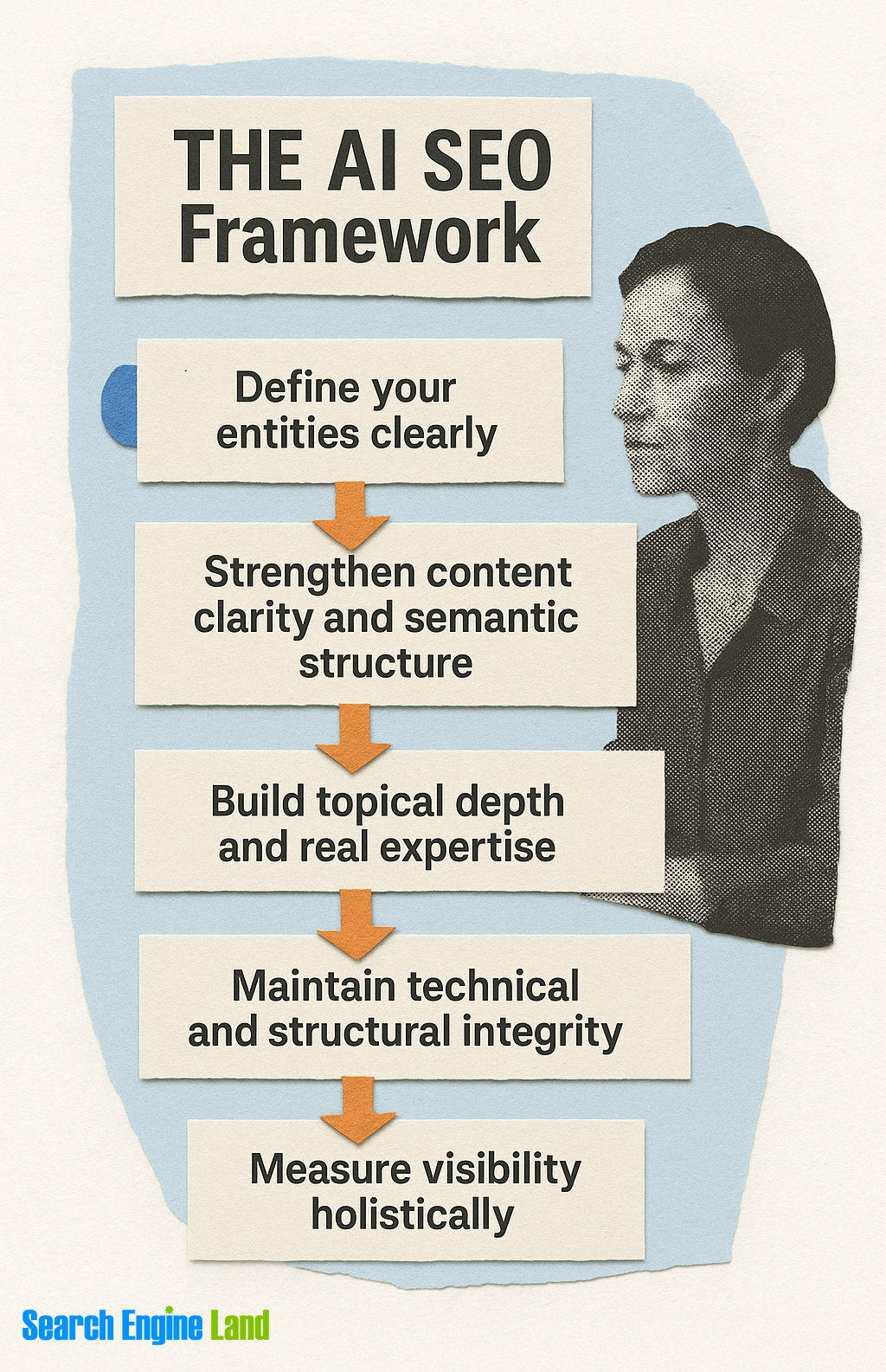
AI SEO doesn’t replace the foundations of search. It builds on them, expanding what it means to be discoverable, understandable, and trustworthy across both classic SERPs and AI-powered search experiences. The framework below brings these ideas together into a simple, practical structure teams can use when planning, creating, or updating content.
This model focuses on five core pillars: clarity, structure, authority, accuracy, and measurement.
1. Clarity: Clearly define your entities
Since AI systems rely heavily on entities, clear definitions make your content easier to interpret and more likely to be referenced.
Focus on:
- Consistent naming
- Clear descriptions of concepts or products
- Relationships between entities (e.g., “X integrates with Y,” “A is a type of B”)
- Reducing ambiguity by explaining terms directly
- Reinforcing the same facts across multiple pages
2. Structure: Strengthen content clarity and semantic structure
Generative engines pull information from concise, self-contained passages. Content that’s clear and well-structured is easier to extract and use in AI-generated answers.
Prioritize:
- Short, focused paragraphs
- Definition blocks for key concepts
- Step-by-step logic for processes
- Factual statements that can stand alone
- Well-labeled sections and clear headings
- Helpful comparisons and contextual explanations
3. Authority: Build topical depth and real expertise
AI models favor sources with strong domain relevance and expertise. This goes beyond E-E-A-T. Depth, specificity, and practical insight help AI systems understand which content deserves to be referenced.
Develop:
- Deep-topic pages that cover a subject comprehensively
- Expert insights (internal or external)
- Consistent editorial standards across similar pages
- Content that shows real experience, not generic summaries
- Original research or examples, when possible
4. Accuracy: Maintain technical and structural integrity
Even in an AI-driven search environment, technical SEO still matters. Clean site architecture helps search engines and AI systems crawl, parse, and evaluate your pages.
Ensure:
- Fast-loading pages
- Renderable content (no hidden or blocked elements)
- Logical internal linking
- Clear navigation patterns
- Proper use of structured data
- Up-to-date sitemaps and strong indexation health
5. Measurement: Measure visibility holistically
AI SEO success isn’t just rankings. It’s a blend of traditional metrics and new indicators tied to AI-driven surfaces.
Track:
- Inclusion in AI-generated answers
- Brand or product mentions across AI platforms
- Passage-level extraction (which sections models use)
- Accuracy of representation
- SERP performance and stability
- Shifts across both classic and AI-assisted search experiences
- Freshness impact after content updates
This broader measurement approach helps teams understand not only where they appear but how their information is being interpreted — and whether updates are improving clarity, accuracy, and visibility.
Ultimately, the framework gives teams a unified way to approach discoverability across the evolving search landscape, balancing traditional SEO strengths with the new demands of AI-powered retrieval.
Benefits of implementing AI SEO
Organizations that adopt AI SEO see advantages not only in efficiency, but also in clarity, visibility, and adaptability across evolving search experiences. AI doesn’t replace strategy or expertise, but it strengthens the signals that matter most in an environment where content is interpreted across multiple AI-driven systems.
Efficiency
AI streamlines time-consuming SEO tasks, allowing teams to focus on strategic initiatives. A survey by Influencer Marketing Hub found that 17% of marketers save over 10 hours weekly using AI tools for SEO tasks.
Accuracy
AI provides data-driven insights, reducing guesswork in SEO decision-making. A study by seoClarity revealed that 64.48% of SEO professionals prioritize the accuracy and reliability of AI-generated insights over other factors when selecting AI solutions.
For example, AI tools can analyze millions of SERPs in real time to pinpoint ranking patterns, something traditional manual analysis would miss or misinterpret due to sheer scale. This allows SEOs to identify exactly which content elements (like headings, internal links, or word count) correlate with higher rankings in specific niches.
Big data analysis
AI excels at processing and analyzing large datasets, uncovering insights that would be challenging to detect manually. According to Capgemini’s research, 62% of marketers utilize generative AI for data analysis, 60% for personalized customer experiences, and 56% for search engine optimization.
For instance, AI can sift through millions of keyword combinations, user signals, and performance metrics to identify high-converting content patterns. This is something that would be nearly impossible to uncover through manual analysis alone.
Scalability
AI tools enable the efficient scaling of SEO efforts across extensive web properties. SeoProfy’s 2025 report indicates that 82% of enterprise SEO specialists plan to invest more in AI, highlighting its role in managing large-scale SEO operations.
For example, AI can analyze thousands of pages and automatically generate tailored content briefs, helping teams optimize massive content libraries with speed and consistency that would be impossible to achieve manually.
Adaptability
AI enhances adaptability to algorithm changes by quickly analyzing and responding to new trends. Influencer Marketing Hub’s benchmark report notes that 49.2% of businesses reported improved rankings following algorithm updates due to the implementation of AI tools.
Future trends shaping AI SEO
AI SEO continues to evolve alongside rapid changes in search experience design. Several developments are likely to shape how brands approach visibility in the coming years.
Visual and video SEO
AI tools enhance our ability to optimize images and videos for search engines. As search becomes more visual, technologies like computer vision, which allows machines to “see” and interpret the content of images, allow search engines to understand image content better. This means that elements like objects and text within images increasingly contribute to how content is indexed and ranked.
Personalized search experiences
AI enables personalized content delivery by analyzing user preferences and behavior in real time. In ecommerce, it’s increasingly used to tailor product recommendations, streamline search experiences, and enhance customer engagement.
Predictive intent recognition
AI is getting better at anticipating what users need before they fully express it. Content that addresses the complete user journey, from initial question to final decision, may perform better as search engines evolve toward understanding not just what users ask, but why they’re asking.
Accuracy and trustworthiness
Concerns around AI hallucination may push search engines to prioritize highly reliable content. Teams that focus on precise, well-supported explanations will be more likely to appear in AI-generated answers.
Hybrid search experiences
The line between traditional search and AI-generated answers will continue to blur. Users will expect concise explanations, visual insights, and direct answers supported by links for deeper exploration.
Making SEO work in an AI-driven future
AI SEO is an evolution of search: grounded in the foundations of SEO, improved by new ways users discover information, and shaped by the growing role of generative engines.
The organizations that succeed will be those that pair strong editorial expertise with clear, structured, accurate content that AI systems can interpret and trust. By applying the methods outlined in this guide, you’ll be better positioned to thrive in both traditional SERPs and AI-powered environments.
A practical first step is to review your most impactful pages and assess whether they offer clear definitions, concise explanations, and strong topical depth. Improving clarity and structure in your existing content can create immediate gains across search surfaces.
Search will continue to evolve, but the core goal remains constant: helping users find what they need. Whether through AI-generated answers or classic search results, the brands that invest in accuracy, clarity, and usefulness will continue to lead.
Get started on your AI journey by learning more about AI prompts.
FAQs about AI search
What’s the difference between SEO and AI SEO?
Traditional SEO focuses on ranking pages in organic SERPs. The subset of AI SEO expands this by optimizing for visibility across AI-generated answers, where models summarize information instead of providing a list of links. The foundations are the same — clarity, technical health, and authority — but the outputs are different. AI SEO prioritizes how content is interpreted, extracted, and represented by AI systems.
How can I make my content more “AI-ready”?
To make your content more AI-ready, focus on:
- Clear definitions and explanations
- Strong entity consistency
- Concise, extractable passages
- Factual statements with supporting context
- Structured layouts (e.g., headings, lists, steps)
The goal is to make information easy for AI systems to accurately interpret.
Do keywords still matter in AI SEO?
Yes, keywords still matter in AI SEO but differently. Keywords still help search engines understand intent, but AI SEO relies more on semantic clarity, topical depth, and entity relationships than on keyword repetition. Keyword research remains useful, but it’s one input among many.
Will AI SEO replace traditional SEO?
No, AI SEO won’t replace traditional SEO. Traditional SEO remains critical. AI SEO builds on the same foundations — technical health, clarity, accuracy, and authority — while expanding how visibility works across AI-driven experiences. Both matter, and most organizations will need a hybrid approach.
How to optimize for AI search?
To optimize for AI search, SEOs should focus on creating content with high information gain — meaning it adds unique value beyond what’s already on page one. AI-generated results prioritize synthesis, so content that introduces fresh perspectives, proprietary data, or deeper context is more likely to be surfaced.
Structuring content clearly with semantic HTML, FAQ sections, and concise summaries helps AI extract relevant information more easily. It’s also essential to optimize for entities and relationships using schema markup and natural language that aligns with how people search. Avoid redundant content that merely echoes competitors; instead, aim for originality and clarity.
Finally, monitor AI Overviews or similar SERP features regularly to understand what types of answers are being highlighted and refine your strategy accordingly. Semrush Enterprise AIO helps track brand mentions, sentiment, and competitors to understand how you’re performing in AI search.
What is generative engine optimization?
Generative Engine Optimization (GEO) is the practice of optimizing content to be featured in AI-generated answers — like Google’s AI Overviews or ChatGPT responses — rather than just ranking traditionally in the SERPs. Success with GEO hinges on maximizing information gain, which means offering original insights, structured data, and high-trust signals that AI models prioritize when summarizing content.
Clear formatting, concise answers, and schema markup all help make your content easier for generative engines to parse and reference. Tools like Enterprise AIO can streamline this process by identifying content gaps, helping structure high-performing outlines, and ensuring your pages are aligned with AI summary formats. Unlike traditional SEO, GEO focuses on making your content the source AI wants to cite. As AI reshapes search behavior, GEO is becoming an essential layer of modern SEO strategy.
How do you perform generative engine optimization?
To perform Generative Engine Optimization (GEO), start by identifying topics where AI summaries appear — these are high-value targets. Then, focus on information gain: Offer unique insights, proprietary data, or expert analysis that goes beyond what’s already on page one. Structure content with clear headers, concise answers, and semantically rich formatting so AI systems can easily parse and extract information. Incorporate schema markup and entity-rich language to help LLMs understand context and relationships.
Use tools like Semrush Enterprise’s AIO to understand how you perform vs. competitors and where there are opportunities for your brand to step up its LLM presence. Finally, continuously test and refine by observing which types of content get cited or surfaced in AI outputs — and adapt accordingly.
What are the top generative engine optimization strategies for AI visibility?
Top generative engine optimization (GEO) strategies focus on making your content the type AI models choose to summarize or cite. First, prioritize information gain — offer unique data, perspectives, or frameworks that aren’t already dominating the SERP. Use structured content (clear headers, bullet points, and concise summaries) to improve extractability for AI systems.
Implement schema markup and entity-rich language to strengthen contextual understanding. Regularly audit AI-influenced SERPs to identify what types of content get featured and reverse-engineer successful patterns. Tools like Semrush One can help surface these patterns and guide content development tailored for generative engines. Ultimately, GEO success comes from creating content that feels authoritative, fresh, and AI-ready.
What is the best SEO solution for AI visibility?
The best SEO solution for AI visibility is one that blends traditional optimization with a generative-first mindset. As AI-powered summaries and overviews reshape the SERP, SEOs need tools that emphasize information gain, entity optimization, and extractable content structure. Semrush One is built for this shift because it lays out your brand’s AI visibility and sentiment alongside your competitors’, so you can pinpoint opportunities to maximize your brand impact. Features like SERP intent analysis, topic clustering, and schema guidance make it easier to create content that ranks and gets cited by AI, with real-time tracking of AI search data. The goal isn’t just to win a blue link — it’s to be the source behind the summary.
About the Author