Compete: Yes, Google Hits New Search Share High

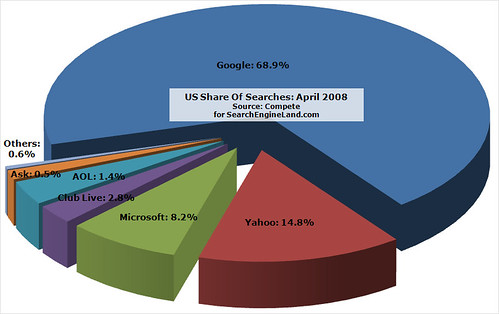
Compete makes it a quadfecta! No real surprise, the latest search engine
share stats
out from Compete show Google has hit a new high — just as did previous
stats out this month from
Hitwise,
Nielsen and
comScore. Plus, an
interesting look at how much search traffic Microsoft’s Live Search Club
generates.
NOTE: ON THE PIE CHART ABOVE, AOL’S LABEL IS SHOWN OVER THE "ASK" SLICE AND THE ASK FIGURE SHOULD BE 3.5%.
THE PIE SLICE PROPORTIONS THEMSELVES ARE CORRECT. SORRY I DON’T HAVE TIME TO FIX
THE LABELS NOW!
Here’s the rundown for April 2008:
- Google: 68.9%
- Yahoo: 14.8%
- Microsoft: 8.2%
- Ask: 3.5%
- Live Search Club: 2.8
- AOL: 1.4
Whoa! What’s Live Search Club?
Microsoft On Search
Gains & Live Search Club covers this program that allows people to win
prizes for searching and how it spiked up Microsoft’s traffic after it was
launched — plus the debate over whether these are "real" searches. That debate
caused Compete to exclude them from its monthly figures.
Now Compete has added them back in and broken them out, so everyone can see
how much they contribute. I’ll be revisiting this more in the future. But first, let’s look at
the trend over time. Here’s the past year’s worth of data:
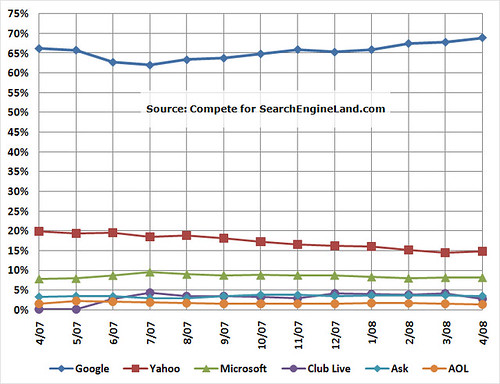
Google, as said, hits a new high. Yahoo sees a slight rise for the first time
in months. Microsoft remains pretty much flat.
Now look at this:

That’s the percentage of search share happening on Microsoft’s regular search
sites versus through Live Search Club.
Now in both Indiana
Jones Search: Indy Meets Microsoft Live Search and
Hey Microsoft: Bribing
Searchers Is Fine; Frustrating Them Is Not!, I’ve covered how Microsoft
claims the gaming programs do indeed generate loyal, regular users. Yet in the
chart above, after the spikes in June and July 2007, the program doesn’t appear
to have helped with general search share at all. It stays flat, even later in
the year when Live Search Club’s own share rises.
I talked with Microsoft a little bit about this oddity yesterday. They
explained that the percentage of regular users generated out of the program is
very tiny — not enough to boost regular share. But they also said that the
lessons learned about building loyalty will be helpful for the more mainstream
loyalty program they have launched as part of
Live Search Cashback.
We’ll see!
Normally I’d also show the number of searches on each service, in addition to
market share. However, Compete has revised all of its figures to include Live
Search, so I don’t have the data quickly at hand to do a trend chart. Next time.
Caveat Time!
As a reminder, my general rules when evaluating popularity stats:
- Avoid drawing conclusions based on month-to-month comparisons. Lots
of things can cause one month’s figures to be incomparable to another month.
It’s better to see the trend across multiple months in a row.
- Avoid drawing conclusions based on one ratings service’s figures.
Each service has a unique methodology used to create popularity estimates.
This means that ratings will rarely be the same between services. However, a
trend that you see reflected across two or more services may give you faith in
trusting that trend.
- Consider Actual Number Of Searches: While share for a particular
search engine might drop, the raw number of searches might still be going up
(and thus they might be earning more money, despite a share drop). This is
because the "pie" of searches keeps growing, so even a smaller slice of the
pie might be more than a bigger slice in the past.
Explore more on
Editorial disclosure
Contributing authors are chosen for their expertise and work under the oversight of the editorial staff. Search Engine Land is owned by Semrush. The contributor was not asked to mention Semrush; the opinions expressed are their own.
About the author