Chat rate is the new CTR for AdWords message extensions

Google rolled out its click-to-message AdWords extension in October 2016. Similar to call extensions, message extensions allow users to message a business directly from the ad.
Now the company is announcing formal reporting for messaging. It will be available in the next few weeks in the US, the UK, Canada, France, Brazil and Australia. Users of message extensions will need to turn on message reporting in account settings.
Three primary metrics will be captured:
- Chat rate: This is analogous to CTR (impressions vs. actual messaging interactions).
- Start time: When users tend to interact with you via messaging. Google says this metric will help with dayparting.
- Number of messages exchanged within a single chat session: Google says to use this metric to evaluate which ad creatives are driving the most engagement.
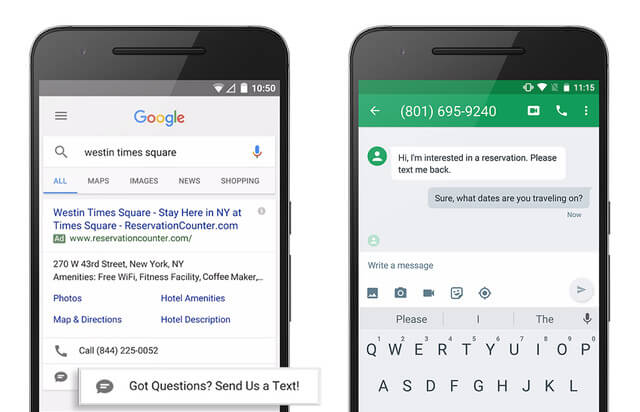
Each session will be charged as a click.
The number displayed in the ad will be a Google call-forwarding number, which is how the company is able to track the above metrics. “Whenever possible, Google forwarding numbers will share the same area code or prefix number as your business,” Google says. If a local number isn’t available, however, an 800 number will be used. Call-tracking industry data shows that local numbers significantly outperform toll-free numbers in terms of user response rates.
It’s not clear whether or how bots can get hooked up to messaging extensions, but this will likely happen in the near term — especially for brands that field lots of volume or for basic scheduling requests.
Google offers a best practices guide for message extensions.
Explore more on
Editorial disclosure
Contributing authors are chosen for their expertise and work under the oversight of the editorial staff. Search Engine Land is owned by Semrush. The contributor was not asked to mention Semrush; the opinions expressed are their own.
About the author