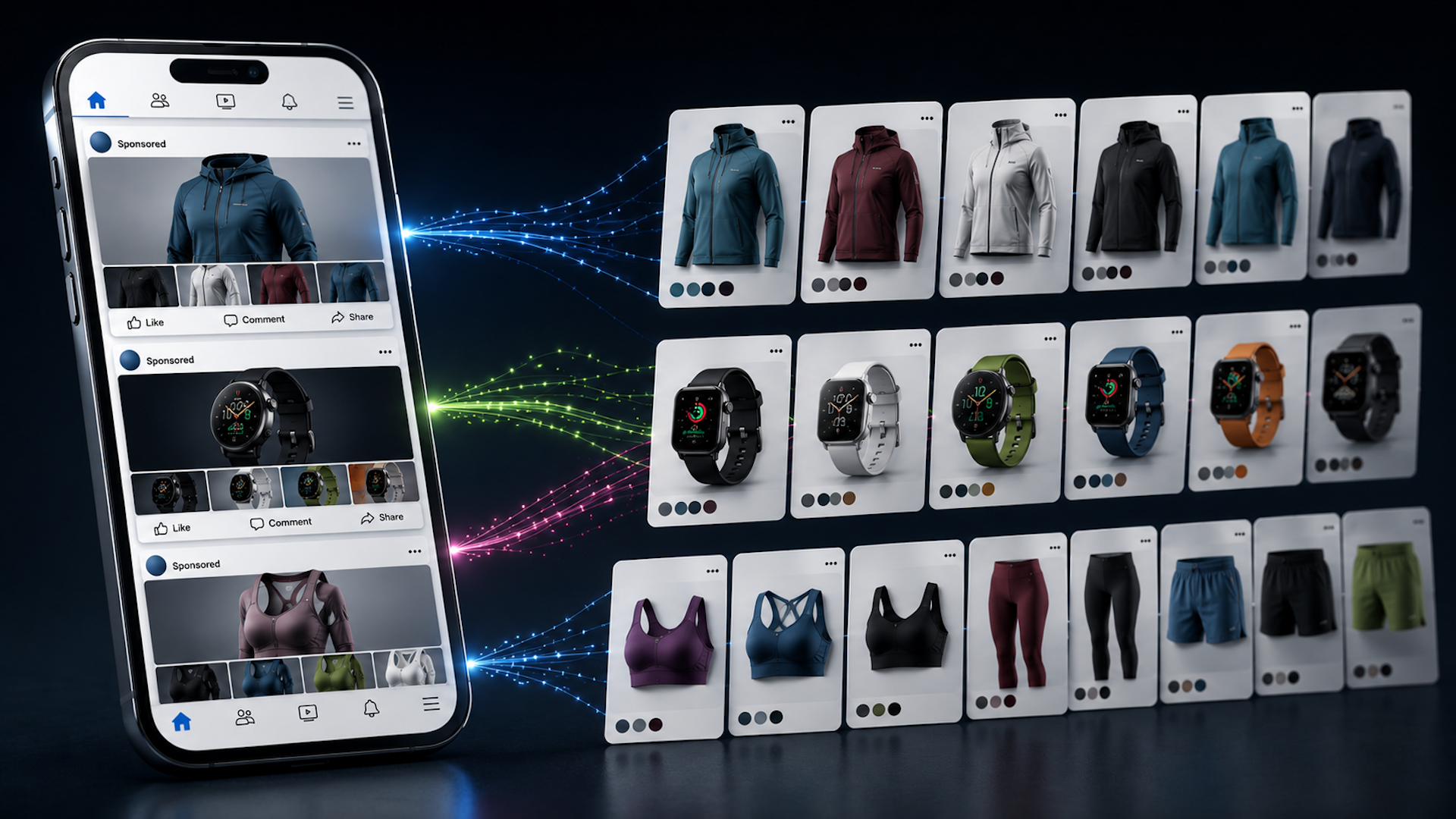
How to revive overlooked ecommerce SKUs with Performance Max
When products stop getting traffic, they also stop building the signals Google needs to serve them. This automated approach breaks the cycle.
With large ecommerce catalogs, it’s common for products to fall through the cracks. It’s not because they’re bad products or out of stock. They simply stop getting the visibility they need to perform.
As Google’s algorithms optimize toward products with the strongest historical performance, lower-volume SKUs can slowly lose impression share. Less traffic leads to less conversion data, which compounds the issue. Before long, those products are stuck in what I call SKU purgatory.
Instead of letting those products collect dust, my team built a process to bring them back to life, leveraging Performance Max to help with some of the heavy lifting. Let’s look at what it takes to resurrect zombie SKUs, how to implement the campaign, and why it works so well at scale.
Meet the zombie campaign
Zombie SKUs aren’t a new concept, and thankfully, it’s quite simple to understand why this happens and do something proactive to fix it.
My campaign of choice is typically Performance Max (PMax) because this is exactly where Google’s automation can be used to our advantage. PMax can find additional pockets of opportunity and demand that Standard Shopping may not be uncovering. Sometimes that’s all a neglected SKU needs.
When a SKU falls below certain performance thresholds, rather than leaving it inside its existing Standard Shopping campaign, where it continues to receive little to no traffic, we automatically move it into a dedicated zombie SKU Performance Max campaign.
The goal isn’t to force spend on poor-performing products. It’s to give overlooked products another opportunity to compete.
Once those products begin generating impressions, clicks, and even conversion data again, Google’s understanding of them improves. If they prove themselves, they earn their way back into their original campaigns.
Uncover the keywords, ads, landing pages, and strategies driving your competitors’ paid search success—and find your next opportunity to outperform them.
How to automate a zombie SKU campaign
Before I started using PMax, I usually found zombie campaigns were more trouble than they were worth because of the time-consuming manual work required to move SKUs in and out of the campaign.
The key was to remove the manual work.
With help from our awesome data team, we built custom logic in BigQuery that continuously identifies what qualifies as a “zombie SKU.” The exact thresholds are customized for each business, but the goal is the same: identify products that have effectively stopped receiving meaningful opportunity.
Here’s how the process works:
- BigQuery evaluates every SKU using our custom logic.
- Eligible zombie SKUs are exported to a Google Sheet.
- Feedonomics (our feed management tool) reads that sheet and automatically applies a custom label of “zombie SKU.”
- Google Ads uses that custom label to include those products in a dedicated Performance Max campaign.
- Those same SKUs are excluded from their original Standard Shopping campaigns to avoid overlap.
- Once a SKU no longer meets the zombie criteria, the custom label is automatically removed, and the product returns to its original campaign.
The entire process runs automatically with very little manual work.
Dig deeper: Ecommerce PPC: 4 takeaways that shape how campaigns perform
Breaking the performance feedback loop
One of the biggest challenges with large product catalogs is that Google’s machine learning naturally gravitates toward products that already have strong performance signals.
That’s great for efficiency, but it can also create a feedback loop where the “rich get richer.” Top-performing SKUs continue to receive traffic, while products with little historical data struggle to gain momentum.
A zombie campaign works because it interrupts that cycle.
Rather than permanently writing off those products, it provides those SKUs with a dedicated environment where they can generate additional performance signals. Performance Max can help breathe life back into these SKUs through its reach.
Not every SKU comes “back to life,” and that’s OK. Some products truly don’t have the demand, but we’ve found plenty that simply needed another chance to collect impressions, clicks, and conversion data before becoming competitive again.
The chart below highlights the early results from a zombie SKU campaign I’m testing for a client.
| Period | SKUs | Clicks | Impressions | Cost | Conversions | Conversion Value | ROAS |
| Pre-zombie campaign launch | 13,829 | 0 | 0 | $0.00 | 0 | $0.00 | 0.00% |
| Post-zombie campaign launch | 13,829 | 1,617 | 198,774 | $5,072.17 | 24.42 | $5,161.70 | 101.77% |
In just two weeks, more than 13,800 previously overlooked SKUs began generating impressions, clicks, and even conversion data after receiving little to no opportunity beforehand. Rather than allowing these products to remain stagnant, the campaign gives them a chance to build the performance signals Google’s algorithms rely on when determining future serving opportunities.
It’s also important to view these results through the lens of the campaign’s objective. Unlike our core Shopping campaigns, the primary goal of the zombie campaign isn’t to maximize return on ad spend (ROAS) or drive significant sales volume. Instead, it’s to generate enough impression, click, and conversion data for underperforming SKUs to graduate back into our Standard Shopping campaigns.
Once a product no longer meets our zombie criteria, it’s automatically removed from the campaign and returned to its original Shopping campaign, making room for the next set of overlooked products.
The next step is measuring whether the additional impression, click, and conversion history improves overall performance after the SKUs are reintroduced into their original Standard Shopping campaigns.
Automation makes it scalable
The biggest advantage isn’t the Performance Max campaign itself. It’s the automation.
Without BigQuery, Feedonomics, and custom labels, maintaining thousands of products would require constant manual review. Instead, products flow between campaigns based on their performance, with successful SKUs returning to the campaigns where they belong.
For large ecommerce catalogs, it’s an efficient way to make sure promising products don’t quietly disappear simply because Google’s algorithms stopped prioritizing them.
Dig deeper: Performance Max reporting for ecommerce: What Google is and isn’t showing you
Give overlooked products another chance
Giving overlooked products an opportunity to build performance history is more valuable than letting them sit with little to no visibility.
Early results from our client’s campaign show that this approach can generate impressions, clicks, and conversion data for products that weren’t previously serving.
The next phase is measuring the impact on our Standard Shopping campaigns as those SKUs graduate back into the original campaign structure.
Contributing authors are invited to create content for Search Engine Land and are chosen for their expertise and contribution to the search community. Our contributors work under the oversight of the editorial staff and contributions are checked for quality and relevance to our readers. Search Engine Land is owned by Semrush. Contributor was not asked to make any direct or indirect mentions of Semrush. The opinions they express are their own.
About the Author