Your CRM might be your most underrated keyword research tool


Keyword research normally starts in several familiar places:
- Google Search Console.
- Semrush.
- Google Keyword Planner.
- Google Ads search terms.
These tools are essential. They show what people search for, how often they search for it, and how competitive the terms are.
But they miss one important layer: How do your most qualified prospects describe their problem?
That information often sits elsewhere — in the customer relationship management (CRM) system.
If you work in B2B marketing, especially with long sales cycles and high-ticket products, CRM data can reveal questions, objections, and terminology that traditional keyword research tools often don’t surface.
Search tools show demand. The CRM adds commercial context.
Search volume doesn’t equate to commercial value
Traditional keyword research often prioritizes metrics such as:
- Search volume.
- Keyword difficulty.
- Cost per click (CPC).
- Rankings.
- Traffic potential.
These metrics are excellent for identifying demand. In the example below, Semrush surfaces related searches for “PelviPower,” including price, cost, reviews, and purchase-oriented terms, alongside indicators such as search volume and CPC.
But those numbers don’t tell us which topics actually matter in conversations with qualified buyers.

Demand is only part of the picture.
A high-volume keyword may generate mostly informational traffic, while a much smaller term may relate to a question that repeatedly comes up during serious sales conversations.
In niche B2B markets, low search volume doesn’t necessarily mean low business value. A keyword might only get a few dozen searches per month, but if one of those searches comes from a clinic or medical practice seriously considering a high-value purchase, that traffic can be quite valuable.
That’s why keyword research shouldn’t just ask, “How many people search for this keyword?”
Keyword research should also ask, “Do our best prospects talk about these topics?”
Dig deeper: A complete B2B SEO strategy
The CRM contains the language of real buyers
Your CRM can reveal patterns that keyword research tools can’t.
In the example below, recurring objections around price, competition, and space limitations appear across different prospect types and acquisition channels. When the same themes repeatedly surface in sales conversations, they become useful inputs for both SEO and content strategies.
A recurring price objection may point to the need for stronger content written about investment, financing, or business value. Frequent competitor mentions may justify comparison content, while space-related concerns could call for implementation or product-specification pages.
These may not be the highest-volume search topics, but the data in the CRM shows they matter when real prospects evaluate a purchase.

Sales conversations can reveal content gaps
If your sales team repeatedly hears the same question, but your website doesn’t answer it clearly, that can be more than just a sales issue — it could be a search opportunity.
Imagine that your prospects repeatedly ask questions like:
- “How long does implementation take?”
- “What training is included?”
- “How does this technology compare with another solution?”
- “What does the investment cost?”
Those questions can become:
- FAQ content.
- Landing-page sections.
- SEO topics.
- Comparison pages.
- Google Ads keywords.
- Ad copy.
The CRM doesn’t replace keyword research. It helps decide which topics deserve attention.
The industry’s trusted source for essential news and analysis.
Sign up for our newsletter to receive exclusive insights and updates directly to your inbox.
- Daily breaking news
- Expert analysis from industry veterans
- Join over 200k subscribers
- Covering SEO, PPC and AIO
Validate CRM language with search data
When a topic repeatedly appears in the CRM, check whether the same language also appears in search behavior.
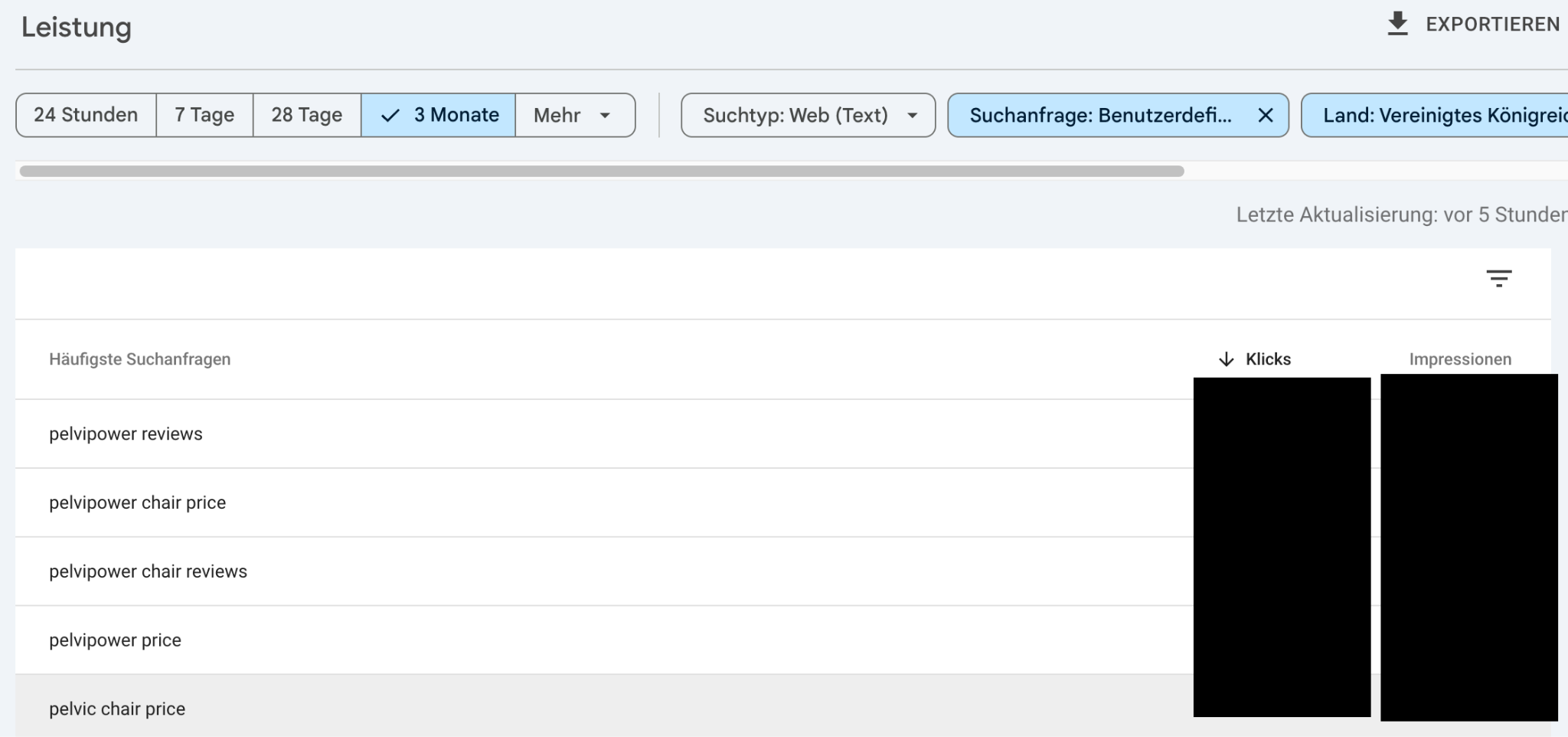
Google Search Console is particularly useful because it shows the real queries already generating impressions and clicks.
In the example below, two themes that appear during the sales process — price and reviews — are clearly visible in organic search behavior. Queries such as “pelvipower chair price,” “pelvipower price,” and “pelvipower reviews” show that these are not merely sales objections or questions. Rather, they are topics prospects actively research before making contact or deciding to buy.
That data creates a useful workflow:
- CRM insight → Search demand → Content opportunity
If the same question repeatedly appears in both sales conversations and search data, it substantially strengthens the case for creating or improving content around that topic.
The best opportunities sit at the intersection of CRM and search
Not every CRM question deserves a dedicated SEO page. Some topics might be too specific, have no search volume, or only matter after a purchase.
CRM-derived ideas should be evaluated across three areas:
- Frequency: How often does the question appear in sales conversations?
- Search volume: Do people search for the same or similar topics?
- Commercial relevance: Does the question appear in conversations with qualified prospects?
The strongest opportunities sit in the area where all three questions overlap. A topic doesn’t need huge search volume if it consistently appears among serious buyers.
In B2B, relevance can matter more than scale.
Dig deeper: 5 B2B content types AI search engines love
Lost deals can be especially useful
Closed deals tell you what worked. Lost deals, conversely, can indicate what information was missing.
Recurring reasons for lost opportunities may include:
- Price concerns.
- Lack of proof.
- Competitor comparisons.
- Unclear implementation.
- Questions about support.
- Uncertainty around the business case.
If the same objection appears repeatedly, marketing should pay attention.
Some of those questions can be answered before the prospect ever speaks with sales.
That may mean creating a stronger FAQ, improving a product page, publishing a comparison article, or clarifying the business case on a landing page.
Good SEO generates traffic and reduces uncertainty before the sales conversation even begins.
Explore more on
Editorial disclosure
Contributing authors are chosen for their expertise and work under the oversight of the editorial staff. Search Engine Land is owned by Semrush. The contributor was not asked to mention Semrush; the opinions expressed are their own.
About the author