Google publishes guidance for text disclaimers in Search ads

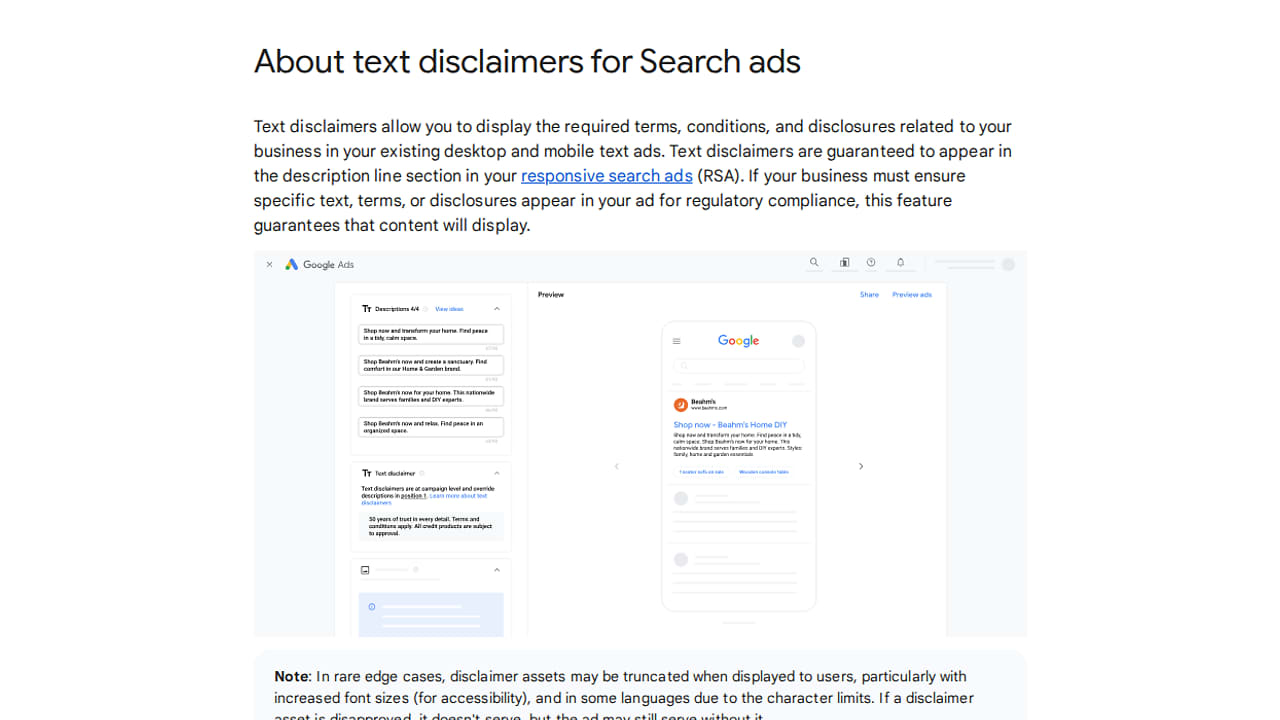
Google published a new Help Center page for text disclaimers in Search ads, providing advertisers with guidance on a feature that lets required terms, conditions and disclosures appear directly within Search ads.
The feature is available globally and supports campaigns using AI Max.
What’s new. The new documentation explains how advertisers can create and manage text disclaimer assets in Google Ads.
According to the Help page:
- Text disclaimers are available to all Google Ads advertisers worldwide.
- Disclaimers must be added after campaign creation through the Assets menu.
- Each disclaimer can contain up to 90 characters.
- The feature is compatible with AI Max campaigns.
Google also notes that if a disclaimer asset is disapproved, the associated ad will continue serving without the disclaimer rather than stopping delivery.
Why we care. Many advertisers operate in regulated industries where legal disclosures are mandatory. Having dedicated disclaimer assets provides a cleaner way to include required messaging without sacrificing headline or description space. However, advertisers should be aware that disclaimer assets override any pinned Description Line 1, which could affect how carefully structured Search ads are displayed.
The bigger picture. As Google introduces more AI-powered campaign features, it’s also expanding the supporting tools advertisers need to remain compliant. The addition of AI Max compatibility suggests Google intends disclaimer assets to work consistently across both traditional Search campaigns and its newer AI-driven experiences.
Worth noting. The Help page also states that disclaimer text may be truncated in certain situations, such as when larger font sizes are used or in some languages.
Bottom line. Google’s new Help documentation provides long-awaited guidance on text disclaimers for Search ads, clarifying how advertisers can add legal disclosures while continuing to use AI Max and other modern Search campaign features.
First spotted. The documentation was first highlighted by PPC specialist Hannah Gillespie.
Explore more on
Add Search Engine Land as a preferred source on GoogleEditorial disclosure
Search Engine Land is owned by Semrush. We remain committed to providing high-quality coverage of marketing topics. Unless otherwise noted, this page’s content was written by either an employee or a paid contractor of Semrush Inc.
About the author