Marketing attribution guide: Models, tools & best practices


You send out emails, you run ads, you post on social media, and you optimize your website to capture organic search traffic. Thanks to your efforts, you’re making sales or getting leads!
That’s great, but do you know which of your marketing efforts are actually driving those sales or leads? If you did, you could spend more of your marketing budget on the channels that are working the best—the ones driving the biggest return on investment (ROI).
To figure out which of your traffic channels are your biggest winners, you need marketing attribution. Learn how you can spend your budget where it results in the biggest ROI, resulting in more sales, bigger wins, and faster growth.
What is marketing attribution?
Marketing attribution is the process of identifying which marketing touchpoints (all the ways a customer interacts with a company before buying) lead to a conversion. It assigns credit to channels like email, social media, or paid ads based on their role in a customer’s decision.
Accurate attribution helps optimize budgets, improve campaign performance, and ultimately grow your business faster.
Marketing attribution can be tricky to understand and set up correctly, but this guide breaks it down for you and makes things much clearer. You’ll figure out which attribution model fits your business, how to prove the value of upper-funnel activities like SEO and content marketing, and how to use attribution data to make budget decisions.
The SEO toolkit you know, plus the AI visibility data you need.

Why attribution matters so much
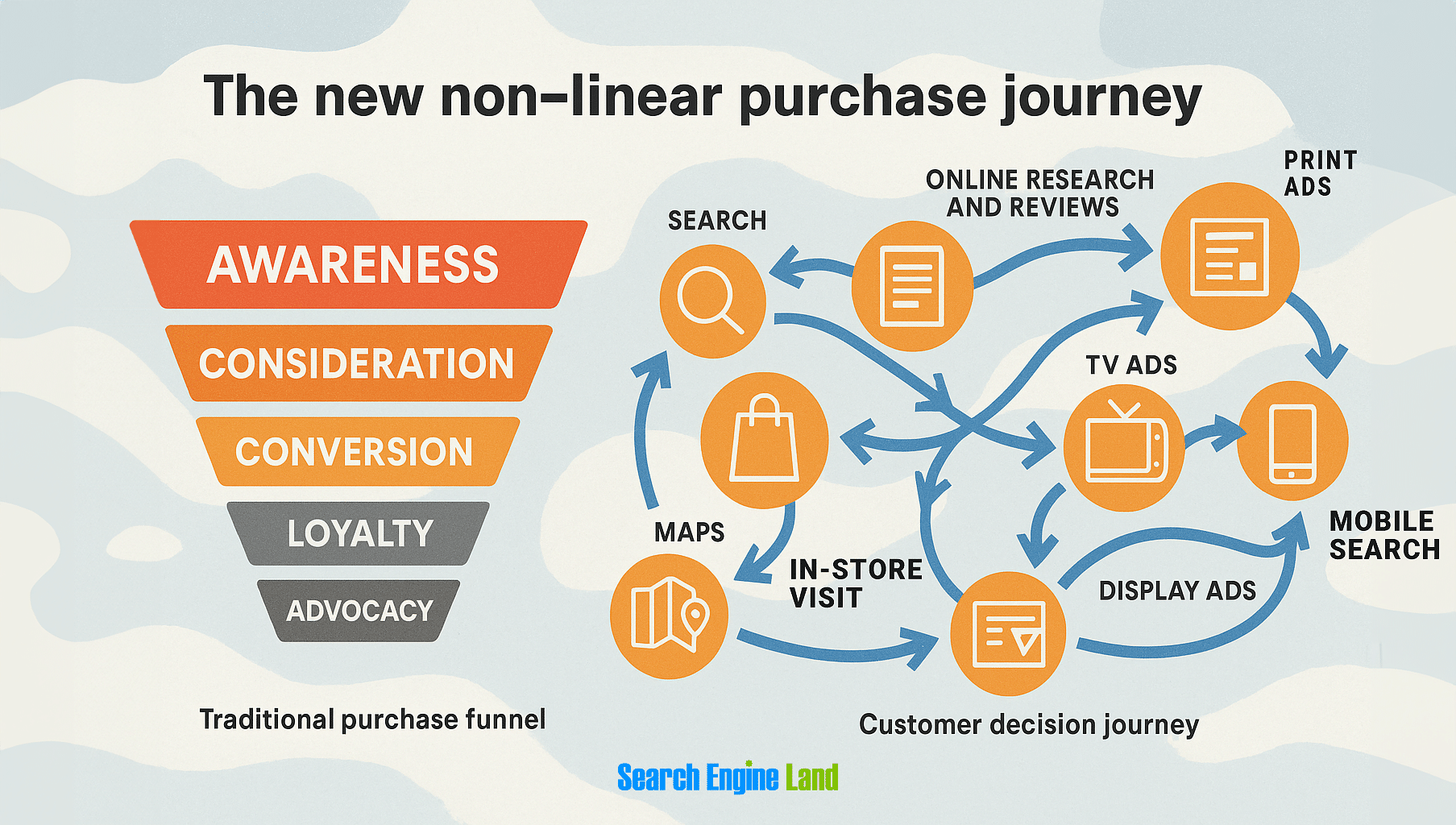
The customer journey is more fragmented and complex than ever before.
Modern buyers research extensively, switch between devices, and take weeks or even months to make purchasing decisions. Today’s customers will often interact with your business across multiple channels (social media, email, ads, etc.) before converting.
Why take the time to attribute your sales or leads to the right channels? There are three main reasons.
1. Attribution helps you allocate your budget strategically
Without understanding which channels are driving your conversions, marketing teams might waste budget on campaigns that feel productive—like social ads or reels that rack up thousands of views —but don’t actually drive results. Attribution helps you double down on what works and do less of what doesn’t.
2. Attribution helps you optimize campaigns to perform better
When you know which channels and touchpoints lead to conversions, you can optimize the entire customer journey rather than just your individual campaigns.
By setting up the right attribution model, you’ll discover which content types support conversions, which channels work best together, and where prospects tend to drop off in the journey.
3. Attribution helps you create reports that show clear wins
Today’s marketers, SEOs, and small business owners need to master attribution, not just analytics. When you can run reports that show clear wins instead of just numbers that don’t actually mean much, you can align your entire business behind what drives the most growth.
Business owners, marketers, and SEOs who master attribution will be able to prove the value of their marketing efforts, optimize their strategies based on actual performance data, and build campaigns that work together rather than compete for credit.
Why businesses need attribution
Now that you understand why attribution still matters, let’s look a little deeper at why businesses absolutely need attribution in order to be successful with their digital marketing efforts.
Drive cross-team alignment
Attribution helps unite marketing, sales, and finance teams. It’s a single source of truth that everyone can use to measure success and make decisions, so there are no more debates about which activities matter most.
Marketing teams can show how their activities support sales goals, while sales teams can understand which leads are most likely to convert based on their journey patterns.
And for finance teams, attribution gives more straightforward ROI calculations they can use for budget planning and performance evaluation. When the marketing team can show how every dollar spent generates measurable returns, budget conversations get much easier.
Justify budget allocation beyond last-click metrics
Some businesses rely on last-click attribution, which gives all credit to the final touchpoint before conversion.
Say Google Analytics shows that you got a conversion (or “key event”) via an organic social click from Facebook. With last-click attribution, Facebook gets all the credit.
However, what if the visitor clicked on your website first from search results and signed up for your email list, then clicked a few of your emails and read through some of your website content, then finally clicked one of your posts on Facebook and converted via that click?

Although the user in that scenario originally found you via organic search, the conversion is attributed only to Facebook.
For many businesses, this is a common scenario. Last-click attribution tends to severely undervalue channels like SEO, social media, and content marketing that typically reach your audience higher in the funnel.
Attribution models that account for the full user journey (which we’ll dive into shortly) show the true value of these supporting channels, helping you justify a budget for the types of tactics that build awareness and nurture users over time.
Increase performance through better decisions
When you can attribute sales and leads to the right channels, you can make better creative, targeting, and spending decisions.
For example, say you’re running LinkedIn ads. Maybe people are clicking on them but aren’t converting immediately.
Without attribution, you might assume these ads aren’t working and cut the budget. But an attribution analysis reveals that people who click your LinkedIn ads often return through organic search and direct visits before converting.
Thanks to the right attribution, you’ve figured out that LinkedIn is actually driving valuable top-of-the-funnel awareness.
With this insight, you can optimize your LinkedIn creative to focus on awareness rather than immediate conversion, adjust your targeting to reach prospects earlier in their buyer journey, and keep or increase your budget for a channel that’s actually contributing to your sales.
Types of attribution models

Different attribution models assign credit to touchpoints in various ways. Understanding the strengths and limitations of each type will help you choose the right model for your business needs.
Attribution models can be broken down into three different groups: single-touch, multi-touch, and algorithmic/data-driven.
Single-touch models
Single-touch models assign 100% of the credit to one specific touchpoint in the customer journey, such as the first or last way a customer interacted with your site before converting.
For example, a customer might click on your Facebook ad and then leave your site without converting, but come back later by typing your brand into organic search. A single-touch model would give all the credit to either the Facebook ad or organic search and ignore the other touchpoint altogether.
While these models lack sophistication, they’re simple to set up and can be useful in specific situations where sales cycles are short and not a lot of channels are involved.
For instance, an e-commerce site with products that aren’t super costly and are often impulse purchased would have a short sales cycle (think Target, Walmart, and Amazon). Low-cost subscriptions have a shorter sales cycle, too (think Spotify, Netflix).
The most common single-touch models are first-click and last-click attribution.
First-click attribution

First-click attribution gives full credit for a conversion to the first marketing interaction a customer had with a business or brand. It assumes the initial touchpoint, such as an ad or blog post, started the customer journey and therefore deserves 100% of the attribution value.
This type of attribution works well for businesses focused on brand awareness campaigns or those with very short sales cycles, where the first touchpoint strongly influences the final decision. It’s valuable for measuring the performance of top-of-funnel activities like content marketing, SEO, and social media advertising.
However, first-click attribution completely ignores nurturing activities that help convert prospects into customers. If you have a longer sales cycle or complex buying process, this model will undervalue your middle and bottom-funnel marketing efforts.
Last-click attribution

Last-click attribution gives full credit for a conversion to the final marketing touchpoint before a purchase. It assumes the last interaction, such as a paid ad or direct visit, was the deciding factor in the customer’s decision to convert.
This is the default model in many analytics platforms and remains popular because it’s simple to understand and connects marketing activities directly to revenue.
Last-click attribution works best for businesses with short sales cycles, direct-response campaigns, or situations where you want to understand which channels are most effective at closing deals. It’s also useful for measuring the performance of bottom-of-the-funnel activities like retargeting campaigns and promotional emails.
The major limitation of last-click attribution is that it completely ignores all the touchpoints that helped nurture your user throughout the top and middle of your funnel. This model can really undervalue awareness-building channels like SEO, content marketing, and social media.
Multi-touch models
Multi-touch attribution models assign conversion credit across each of the marketing touchpoints that helped lead to the sale or other conversion. These models assign value based on each interaction’s role in the customer journey, providing more conversion details than single-touch attribution.
If the customer found you via organic search, visited your site a second time via social media, then converted during a direct visit, each of those channels would get some credit.
These models are better suited for longer sales cycles, where the consumer isn’t usually purchasing right away. Some examples of companies with longer sales cycles would be higher-cost subscriptions and enterprise tools like HubSpot, Ahrefs, or Salesforce.
According to 6sense, marketers are more likely to use a multi-touch approach than either first- or last-touch, which are used equally. Let’s find out why so many marketers see these models as superior.
Linear attribution model

A linear attribution model gives equal credit to every touchpoint a customer interacts with before converting.
For example, if a user sees three ads and then converts, each ad gets 33% of the credit. This model values all interactions equally, regardless of when they occurred in the buyer journey.
Linear attribution works well when you want to value all marketing activities equally and don’t think (or don’t have data to show) that some touchpoints have more influence than others.
The main drawback of linear attribution is that it treats all touchpoints as equally valuable, which isn’t super realistic. The first touchpoint (which creates awareness) and the final touchpoint (which drives conversion) typically deserve more credit than touchpoints in the middle of the journey.
Of course, that’s not always true! Linear attribution could be right for you if your touchpoints are equally as influential.
Time decay attribution model
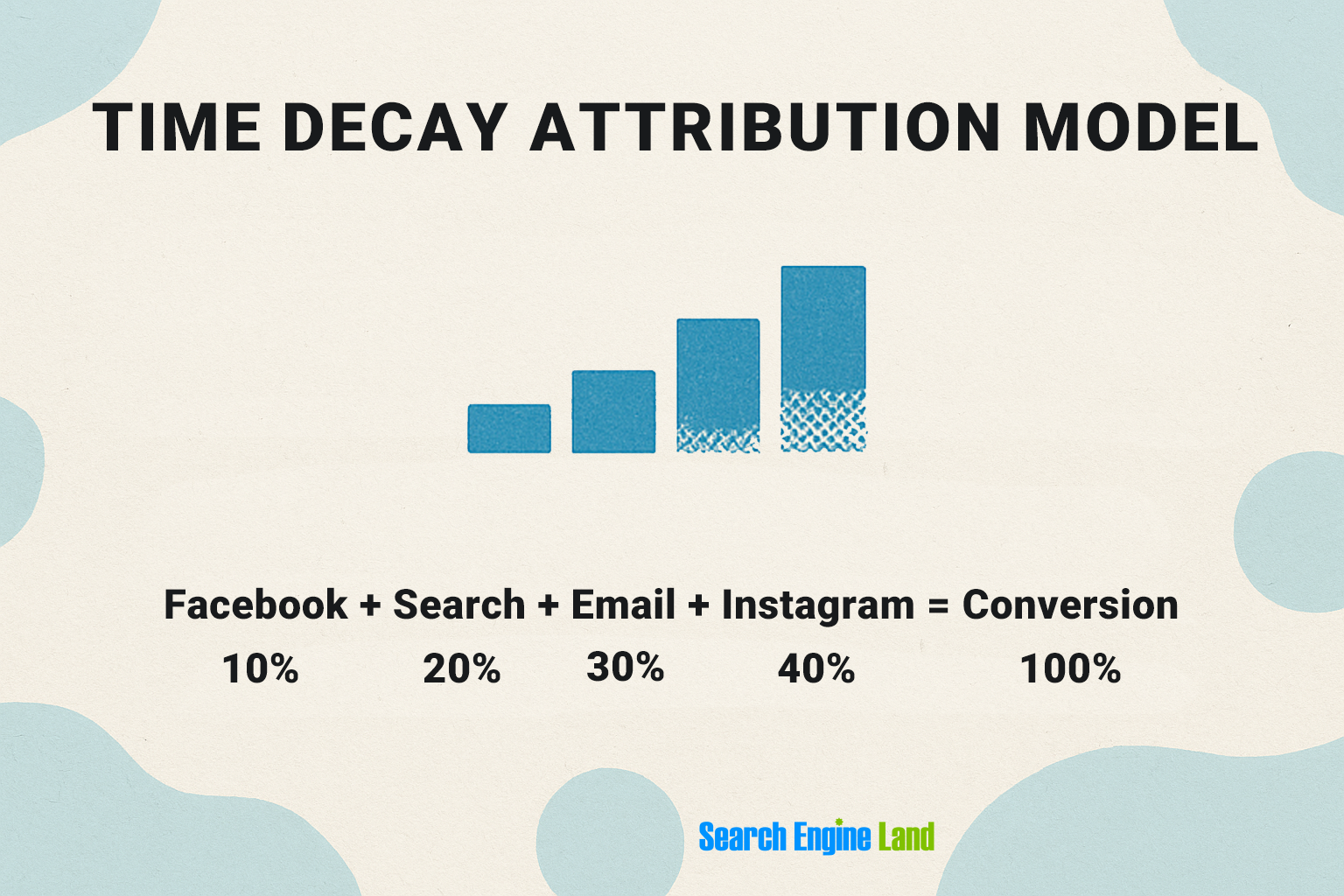
The time decay attribution model gives more credit to marketing touchpoints that occur closer to the final conversion. The most recent touchpoint receives the most credit, with earlier touchpoints receiving progressively less credit based on how far back they occurred.
That means time decay attribution works well for businesses where the final touchpoints tend to be more influential in driving the sale or conversion. If you run a lot of remarketing campaigns and other bottom-of-the-funnel campaigns, the time decay model might be a good fit.
However, time decay attribution can undervalue important top-of-the-funnel touchpoints that create awareness and interest. If your business relies on content marketing and SEO to attract prospects who convert later, this model might not give those campaigns appropriate credit.
U-shaped (position-based) attribution model

U-shaped (also called position-based) attribution gives 40% credit to both the first and last touchpoints in a buyer’s journey and splits the remaining 20% equally among the middle interactions. This model focuses on the importance of initial engagement and the final conversion while acknowledging intermediate steps in a small way.
Position-based attribution works well for businesses with longer sales cycles, where both the first and last touchpoints play crucial roles. It’s effective for measuring the combined impact of awareness campaigns and conversion-focused activities.
The limitation of U-shaped attribution is that it may not accurately reflect the true influence of middle touchpoints, particularly in complex B2B sales cycles where multiple decision-makers engage with different content throughout the evaluation process.
W-shaped (full-path) attribution model

W-shaped (also called full-path) is similar to the U-shaped model, but it adds a third milestone: the lead creation event. This model gives 30% credit each to the first touch, lead creation, and final conversion touchpoints, with the remaining 10% distributed among other interactions.
This attribution model works well for B2B businesses with distinct lead generation and lead nurturing campaigns. That’s because it recognizes the importance of marketing activities that convert anonymous visitors into known leads, which is often a critical milestone in the sales process.
For example, let’s say someone clicks a Google Ad to visit your website for the first time. They click around, but leave without completing any lead or conversion events.
The second time they visit is via organic search. This time, they download a report you have on your site by filling out a form. They’ve officially become a lead, so organic search gets the 30% credit for being the lead creation step.
They visit a third time by typing your URL into their browser (a direct visit) and finally convert by signing up for your free trial. They’ve just converted, so the direct channel gets the 30% credit for being the final conversion touchpoint.
The limitation of W-shaped attribution is that it almost completely ignores other important steps in your funnel. For example, maybe a salesperson reached out via email after the user downloaded the report and answered a few questions, making the user feel confident enough to start the free trial. With W-shaped attribution, that important step gets hardly any credit at all.
Algorithmic & data-driven attribution models

Algorithmic attribution uses machine learning to assign credit based on customer behavior and path data. Data-driven attribution builds on this by analyzing actual conversion paths and distributing credit based on the impact each touchpoint had on the outcome. Both models replace fixed rules with evidence-based calculations that adapt as you go.
It’s sort of like done-for-you attribution: The models analyze patterns in your conversion data to understand which combinations of touchpoints are most likely to result in conversions. And they don’t just analyze once. Instead, they continuously analyze your data and adjust how much credit they give each touchpoint based on actual user patterns.
In short, these models use machine learning to dynamically assign values to your conversions and different touchpoints along the user journey.
How will you know when to switch to algorithmic attribution models?
Attribution is an example of where AI and machine learning can make a really big, positive impact on your business. Unless you have a very simple funnel, algorithmic and data-driven models are most likely going to provide the most accurate look at which channels and campaigns are actually working to grow your business.
Here’s what you need in order to make the switch from rule-based models to algorithmic ones:
- Sufficient conversion volume to train machine learning algorithms effectively
- Complex customer journeys with many touchpoints and channel interactions
- The technical resources to implement and maintain data-driven attribution
- Rule-based models that have been tested, resulting in the need for more sophisticated attribution insights
Your attribution model should align with your business characteristics, sales cycle, and strategic priorities.
| Attribution model | Funnel length | Deal complexity | Channel diversity | Best fit description |
| First-click | Short | Simple | Low | Great for brand awareness, SEO, social ads; not ideal for long nurture paths |
| Last-click | Short | Simple to moderate | Low to medium | Useful for measuring direct conversions, email, retargeting |
| Linear | Medium | Moderate | Medium to high | Works when touchpoints are of roughly equal importance |
| Time decay | Medium to long | Moderate | Medium | Good for long nurture cycles with emphasis on closing activities |
| U-shaped (Position-based) | Long | Moderate to complex | Medium to high | Balances early discovery and final conversion well |
| W-shaped (Full-path) | Long | Complex | High | Ideal for B2B with lead creation as a major milestone |
| Data-driven/algorithmic | Any (prefers long) | Any (prefers complex) | Any (prefers high) | Best for businesses with enough data and varied buyer journeys |
SEO-specific attribution challenges
It can be tough to show the full value of SEO because it often plays a role early in the customer journey, and that impact gets overlooked in many attribution models.
Here are a few of the challenges we see when proving the value of SEO.
Organic search as an assist touchpoint
SEO often results in more assist touchpoints rather than the final conversion touchpoint. Prospects might discover your brand through organic search, but then convert through a direct visit, branded search, or email click, leaving SEO without proper credit for its role in the customer journey.
Plus, organic search often appears multiple times throughout the customer journey instead of just once. Someone might read many of your articles at different times via organic search before searching your brand name to convert.
In fact, according to Focus Digital, the average touchpoints needed per sale for the organic search (SEO) channel is nearly 10.
The traditional attribution models struggle to account for this multi-touch journey.
SEO influences branded search and direct traffic
One of SEO’s most important but least visible benefits is its influence on branded search volume and direct traffic. When your SEO efforts improve your visibility for relevant keywords, they often lead to increased brand awareness that drive branded searches and direct website visits.
Many businesses see significant increases in branded search traffic and direct visits after successful SEO campaigns, but traditional attribution fails to connect these metrics to the SEO activities that drove them. This makes SEO appear less valuable than it actually is.
Dig deeper: This is becoming even more true as AI Overviews and search tools like ChatGPT Search get more popular. A study by Siege Media showed that homepage traffic is up 10.7% from AI Overviews and LLMs.
Cross-device tracking challenges
Modern customers routinely switch between devices throughout their buyer journey. A visitor might discover your company through organic search on their phone, research your solutions on their work computer, and finally convert on their tablet at home.
This device-switching creates attribution gaps that affect all marketing channels, not just SEO. Most attribution models have a hard time connecting these disconnected interactions, leading to incomplete data that can’t “see” the channels involved in awareness and research at the top of the funnel.
Are you having these three problems when tracking the value of your SEO and content work? Let’s take a look at how to overcome them.
How to find the attribution value of SEO
You can combine Google Search Console (GSC), Google Analytics, and an attribution platform to help determine the value of your SEO. Here’s how.
Step 1: Start with Google Search Console to measure discovery
How do people discover your site through organic search? In GSC, click on the “Search results” tab to see what queries are bringing organic visitors to your site.

In addition to the top queries that led to clicks to your site, click on the “Pages” report tab to see which pages on your site are attracting the most organic traffic.

GSC shows how SEO drives top-of-the-funnel traffic, which is where most attribution blind spots begin. If a page ranks well and attracts clicks, it’s creating awareness, even if conversions happen later through another channel.
Step 2: Use Google Analytics 4 (GA4) to track pages + engagement
GA4 helps you understand what users do next after they’ve clicked to your site from search. Take a look at your “Landing Page” report under the Engagement menu.

Now, add another dimension to your report by clicking on the blue plus sign.

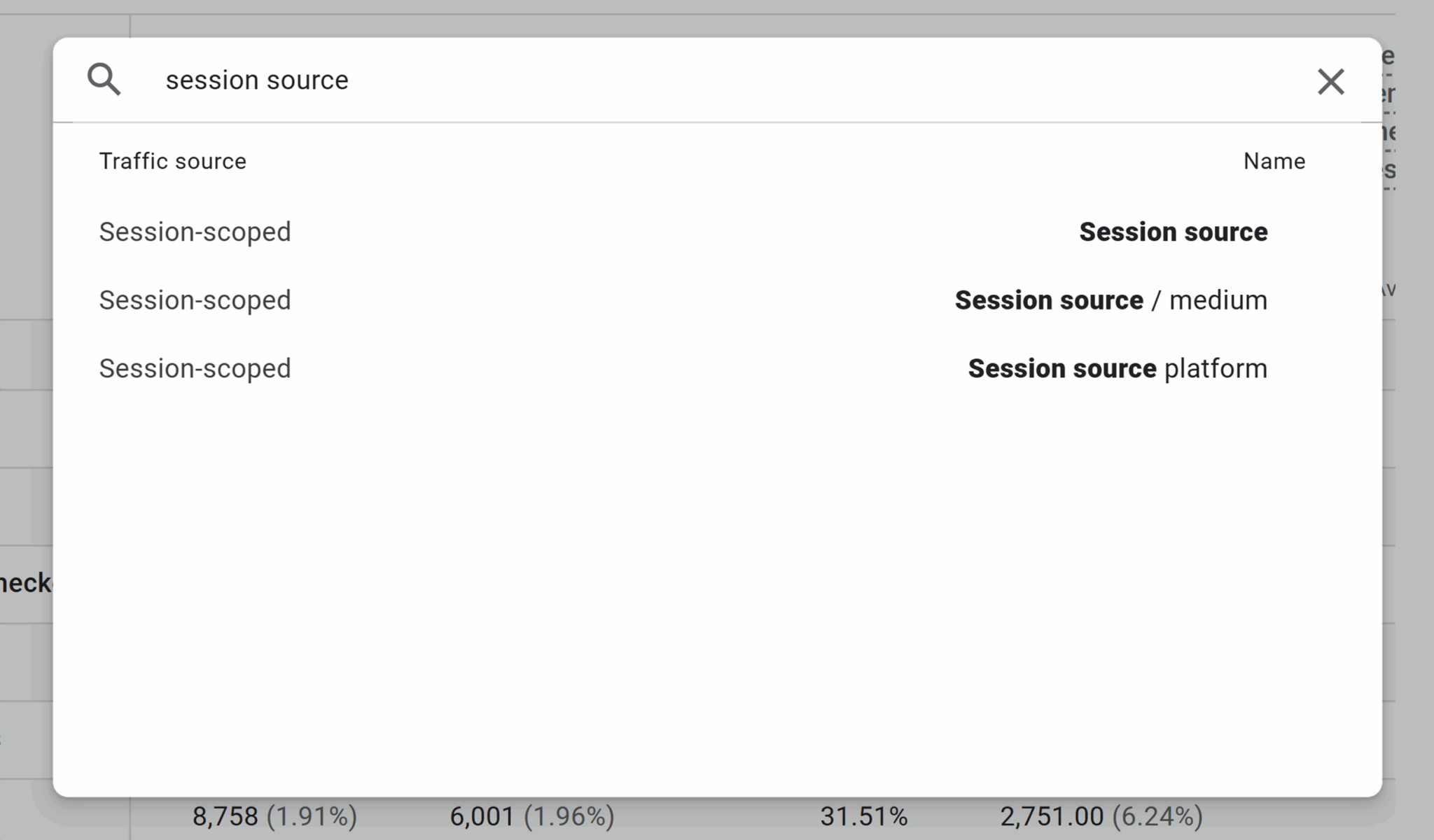
Then, search “session source” and click on “Session source / medium” to add it to your report.
Finally, type “organic” into the search bar and hit Enter to see your organic landing pages.
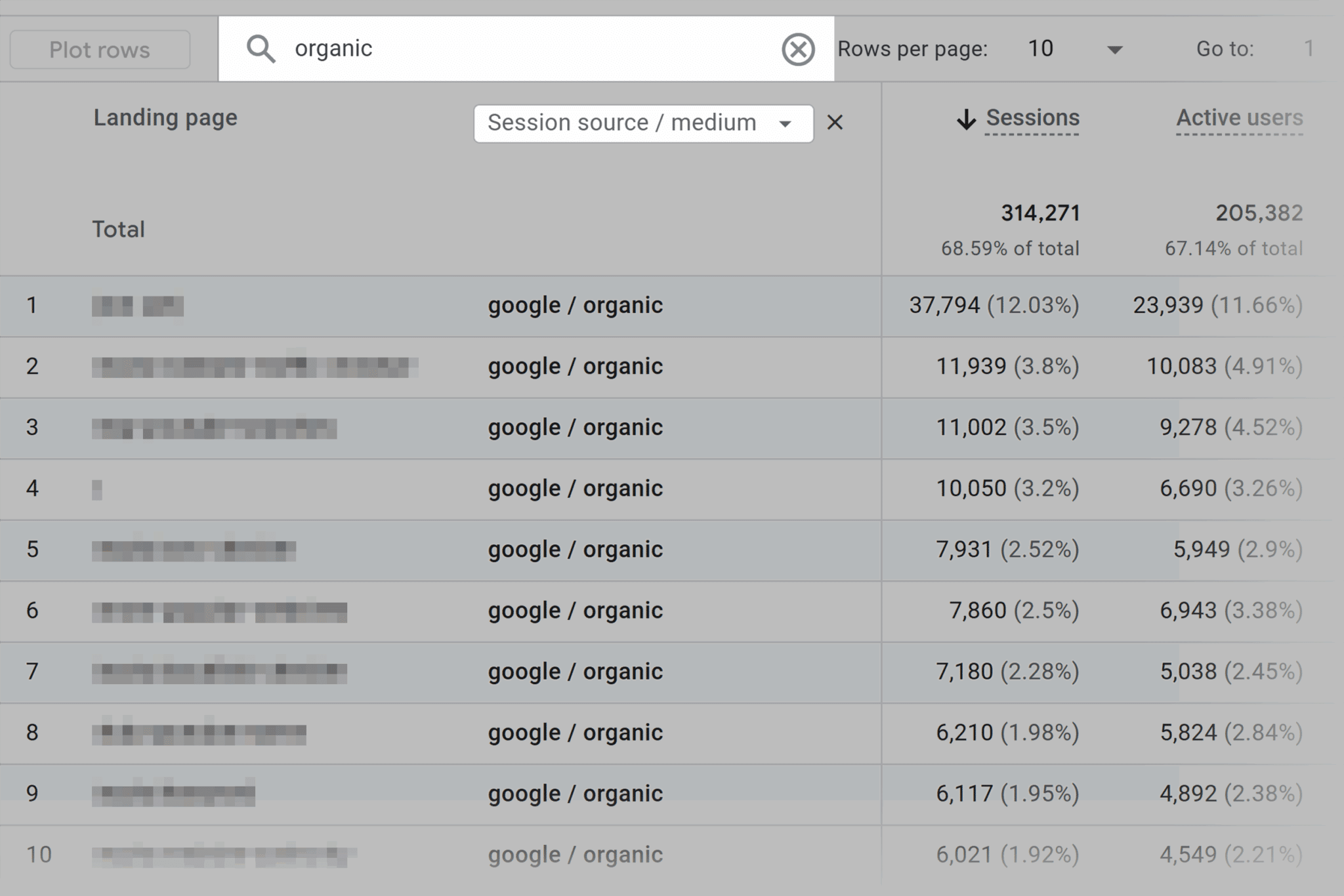
You can use this report to look at your top organic landing pages and see:
- The average engagement time when a visitor landed on that particular page
- Each page’s conversion rate
- How many of the landing page visits were from new or returning users
- Which organic search engines sent traffic to your top landing pages
While this is useful information, it still doesn’t quite show you the whole picture.
Step 3: Connect an attribution platform
To really dial in the analytics on your SEO efforts, consider using an attribution platform like HubSpot or Ruler Analytics. These platforms help you surface SEO’s true influence by tracking the entire customer journey—from first touch to conversion—and showing where SEO played a role.
This is helpful especially when interactions influenced by SEO show up multiple times, assist conversions, or drive brand searches and direct traffic later.
If you have an attribution platform, use it to look for SEO’s influence as a first or middle touch, or to identify patterns where SEO appears early in journeys that convert later.
For example, in Ruler Analytics, you can set up data-driven attribution and use your attribution report to see the impact of channels where SEO played a role.

Build your attribution framework
Ready to choose how you give credit to all of your various marketing efforts? Here’s how to get started with building your own attribution framework.
Step 1: Align stakeholders on attribution goals
Before selecting attribution models or setting up tracking, you need clear agreement throughout your organization on what you’re trying to achieve with attribution analysis.
Different stakeholders often have different priorities. Marketing teams might want to prove the value of marketing campaigns (especially awareness-building ones), sales teams might focus on understanding which leads are most likely to close, and finance teams might prioritize clear ROI calculations for budget planning.
Start by interviewing your stakeholders to understand each team’s questions and priorities. Common attribution goals include:
- ROI optimization: Understanding which marketing investments generate the highest returns so you can allocate budget to the right campaigns at the right time
- Customer acquisition cost (CAC) analysis: Calculating the true cost of acquiring customers through different channels and touchpoints
- Customer journey optimization: Identifying friction points and optimization opportunities throughout the entire funnel and customer experience
- Channel performance evaluation: Understanding which marketing channels work best individually and in combination with each other
Get explicit agreement and document the goals everyone agreed on before moving forward with your attribution framework.
Track, optimize, and win in Google and AI search from one platform.
Step 2: Select and customize your attribution model
Your attribution model should align with both your business’s characteristics and your stakeholder’s goals. Don’t feel constrained to use a single model! Many businesses might benefit from using different attribution models for different purposes.
For example:
To figure out the best way to allocate your marketing budget, you could use a U-shaped model that values both awareness creation and conversion campaigns.
For your sales team, though, you might want to use last-click attribution to understand which touchpoints at the bottom of your funnel are most effective at closing deals.
And then, to figure out your optimal content strategy, you might try linear attribution to ensure all of your nurturing activities (like SEO and top-of-the-funnel content) receive appropriate credit.
You could even consider creating custom attribution models that reflect your specific business logic. You don’t have to go with an out-of-the-box model!
For instance, if you know that visitors who view your live online demo are more likely to convert, you can create weighted attribution models that give extra credit to that high-value interaction.
Step 3: Identify key channels and touchpoints
If you really want your attribution to work effectively, you need a clear definition of which channels and touchpoints you want to track. Start with your primary marketing channels, but also consider offline touchpoints (such as print ads sent to a certain number of households or word-of-mouth referrals) that influence online conversions. For example, you can put QR codes on print media, ask word-of-mouth referrals where they first heard of you, or use specific URLs for referrals from offline advertising.
Digital channels to track:
- Organic search (broken down by keyword categories or landing pages)
- Paid search (branded vs. non-branded)
- Social media (organic and paid)
- Email marketing (segmented by campaign type)
- Direct traffic
- Referral traffic
- Display advertising
- Video advertising
- Influencer marketing
- Video/YouTube marketing
Offline touchpoints to consider:
- Trade shows and events
- Direct sales outreach
- Print advertising
- Radio and TV advertising
- Word-of-mouth referrals
- In-store/retail interactions
The key is choosing all of your top touchpoints but keeping it practical. Tracking too many touchpoints can make your attribution analysis overwhelming and difficult to use.
Step 4: Map attribution logic to your funnel
B2B and B2C businesses need different attribution methods because they have totally different customer journeys and decision-making processes.
Here are a few things to keep in mind:
B2B attribution considerations
- B2B purchases often take weeks or months, with many touchpoints across multiple channels. You need models that capture early awareness and nurturing steps, along with the ones closer to conversion.
- Having multiple decision-makers on a buying team (marketing, finance, leadership, etc.) means you need to track each of those personas
- The higher your deal values, generally the more sophisticated attribution modeling you need
- With fewer conversions and higher deal values, it’s critical to track quality over quantity. Attribution should connect to pipeline and revenue, not just traffic.
B2C attribution considerations
- B2C purchases often happen quickly, especially in ecommerce. Attribution models like last-click, time decay, or data-driven can often show meaningful insights.
- Typically just one or two people make the decision, so attribution models can often be simpler. Tracking individual sessions or paths is usually enough.
- Attribution should be weighted toward conversion events like purchases, sign-ups, or downloads
- A lot of ecommerce shopping is done across different devices, which creates additional cross-device tracking challenges
Map your attribution logic to reflect how customers actually move through your funnel, not just how you wish they would behave.
Start with a pilot program that tracks attribution for your most important customer segments or product lines. This allows you to test and refine your framework before rolling it out across your entire organization.
Once you have reliable attribution data, use it to optimize your marketing strategy campaign by campaign. Look for patterns in high-converting customer journeys and create campaigns that replicate them.
Attribution is an ongoing process, not a one-time thing. Customer behavior evolves, new marketing channels emerge, and your business priorities change over time. Review and update your attribution framework regularly to ensure it continues providing actionable insights that drive the best possible marketing decisions.
Do you use Google Analytics? Take a deep dive into Google-Analytics-specific attribution in Your guide to Google Analytics 4 attribution.
Explore more on
Editorial disclosure
Search Engine Land is owned by Semrush. We remain committed to providing high-quality coverage of marketing topics. Unless otherwise noted, this page’s content was written by either an employee or a paid contractor of Semrush Inc.
About the author