AI Overviews vs. featured snippets: What the data says about CTR, traffic, and conversions

Comparing AI Overviews and featured snippets may seem like a fool’s errand, given that AI Overviews have grown to dominate a large part of Google search results.
However, featured snippets haven’t been completely eliminated yet. Understanding where, when, and why each type of search engine results page (SERP) feature appears can help you optimize your content for one or the other — or both.
This guide looks at how AI Overviews and featured snippets differ, which one is better for different types of organic visibility, and how you can optimize for the type of visibility you want.
High-level differences between AI Overviews and featured snippets on Google
The biggest differences between AI Overviews and featured snippets involve how each one looks, how they cite sources, and how users can interact with them.
Appearance and location
Both AI Overviews and featured snippets can appear in several places:
- At the top of the search results
- In People Also Ask (PAA) answers
- In Knowledge Panels
Sometimes, they appear near each other to provide distinct answers.
This example shows answers to different PAA questions about Boston cream donuts. One answer uses an AI Overview that cites multiple pages, while the other uses a snippet that pulls text directly from a cited page.

Source citations
AI Overviews, Google’s ai-generated summaries, use more than one source to synthesize an answer to a query, while featured snippets use a quote from a single source to provide an answer.
When deciding how to best respond to a query, Google will try to provide the best answer it can for the query or sub-query. It’ll then generate an AI Overview or quote a snippet from a relevant page based on whichever it deems the best way to handle the question.
Since featured snippets pull from a single source, the only way users can interact with them is to click on that source.
But because AI Overviews use more sources and aren’t limited to text that appears on a single page, they tend to be longer and more detailed. This changes how users can interact with them.
In particular, AI Overviews:
- Can often expand to show their more in-depth content
- Contain multiple links to cited sources, which users can click to learn more about a specific part of the response
- May allow users to engage AI Mode for continued conversation and follow-up questions
With these high-level distinctions in mind, let’s look at some of the more technical ways to compare them.
How AI Overviews and feature snippets stack up: A data-driven comparison
We’ve compiled the data to highlight the major differences between AI Overviews and featured snippets:
- There are way more AI Overviews these days than featured snippets
- When they appear together, they often contradict each other
- The expansion of AI Overviews may impact some industries (like science and travel) more than others
- Search intent seems to have some impact on which type of answer appears (though it’s getting blurrier)
- Query sentiment (good, bad, or neutral) also helps decide which type of answer shows up
- The pool of sources seems to be different for AI Overviews versus featured snippets, but there’s plenty of overlap
AI Overviews appear far more often than featured snippets
In the last few years, Google has preferred AI Overviews over featured snippets.
In 2025, the number of AI Overviews surged to cover nearly 25% of all searches by midyear, though that pulled back to around 16% by November.
Likewise, anecdotal evidence from SEOs points toward a shifting landscape, and at least some SEO professionals consider AI SEO to be the new featured snippet capture.
But what data backs up the idea that AI Overviews are replacing featured snippets?
One group of researchers found that when looking at a group of 1,508 baby care and pregnancy-related queries, AI Overviews appeared in 84% of results, according to a study published on arXiv.
Featured snippets, however, appeared only in 32.5% for the same set of queries. About 22% of these queries included both an AI Overview and a featured snippet.

If this holds for other query categories, then AI Overviews are likely to appear roughly 2.5 times more often than featured snippets.
That’s strong evidence to indicate that Google may be slowly phasing out featured snippets, or at least significantly downplaying their presence in the SERPs.
But featured snippets aren’t dead yet. And as it turns out, there are some queries where they still show a significant presence.
When AI Overviews and featured snippets both appear, they contradict each other
AI Overviews and featured snippets often contradict each other when they appear together in the same search results. To put it another way, if these two SERP features were siblings, they’d be the kind that argue over everything.
According to the arXiv study, in the 322 queries where AI Overviews and featured snippets appeared together, they were inconsistent in their full answers about a third (32.3%) of the time.
Interestingly, when looking at only the highlighted portions of each feature — the text that Google emphasizes as the most significant part of the answer — inconsistency rose to 40.7%.
The researchers categorized these contradictions as follows:
- Binary contradictions: These are basic disagreements where one said yes and the other said no, or one said true and the other said false. For example, in one query about whether it’s safe to eat feta cheese while pregnant, the AI Overview stated it’s unsafe while the featured snippet said it’s safe to eat some dairy products, including feta. These were relatively rare according to the researchers, but they still occurred occasionally.
- Numeric mismatches: In the study, these were mostly related to time differences. For example, in one query the AI Overview stated that babies can start eating cereal at around six months old, while the featured snippet said they can typically start eating various foods by the time they’re seven or eight months old.
- Other problematic mismatches: This is a catch-all category that covers additional discrepancies, such as interpreting the question differently or emphasizing different risks or benefits of a behavior. For example, one query returned an AI Overview that stated it was safe for babies to sleep with a pacifier. The featured snippet warned that they should be at least three to four weeks old with a settled breastfeeding routine before sleeping with a pacifier.
The researchers didn’t look specifically at the accuracy of AI Overviews versus featured snippets. However, they did look at whether those features included references to safeguard cues like consulting with a medical professional or other expert.
Unfortunately, the study found that the vast majority of both AI Overviews (89.4%) and featured snippets (92.8%) don’t include safeguard cues.
While AI Overviews are becoming more accurate, the lack of safeguard cues combined with the frequent discrepancy with featured snippets can lead to confusion for searchers. This makes it more important than ever to ensure that content in Your Money or Your Life (YMYL) spaces contains appropriate cautions and citations.
AI Overviews and featured snippets affect industries differently
The growth in AI Overview coverage has likely impacted some industries on an uneven basis.
There’s little recent data that looks at both AI Overviews and featured snippets across industries. But you can look at separate studies to draw some inferences, with an eye toward gaining a better understanding as time goes on.
A 2025 Semrush study provides data from November on which industries have been most affected by AI Overviews.
The top five industries impacted by AI Overviews are:
- Science
- Computers and electronics
- People and society
- Health
- Travel

There are no studies of a similar scale that review the current impact of featured snippets across industries.
However, a 2020 Semrush study preserves how things stood before AI Overviews entered the search landscape. Interestingly, three industries (travel, computers and electronics, and science) were also in the top five of categories that formerly triggered featured snippets.
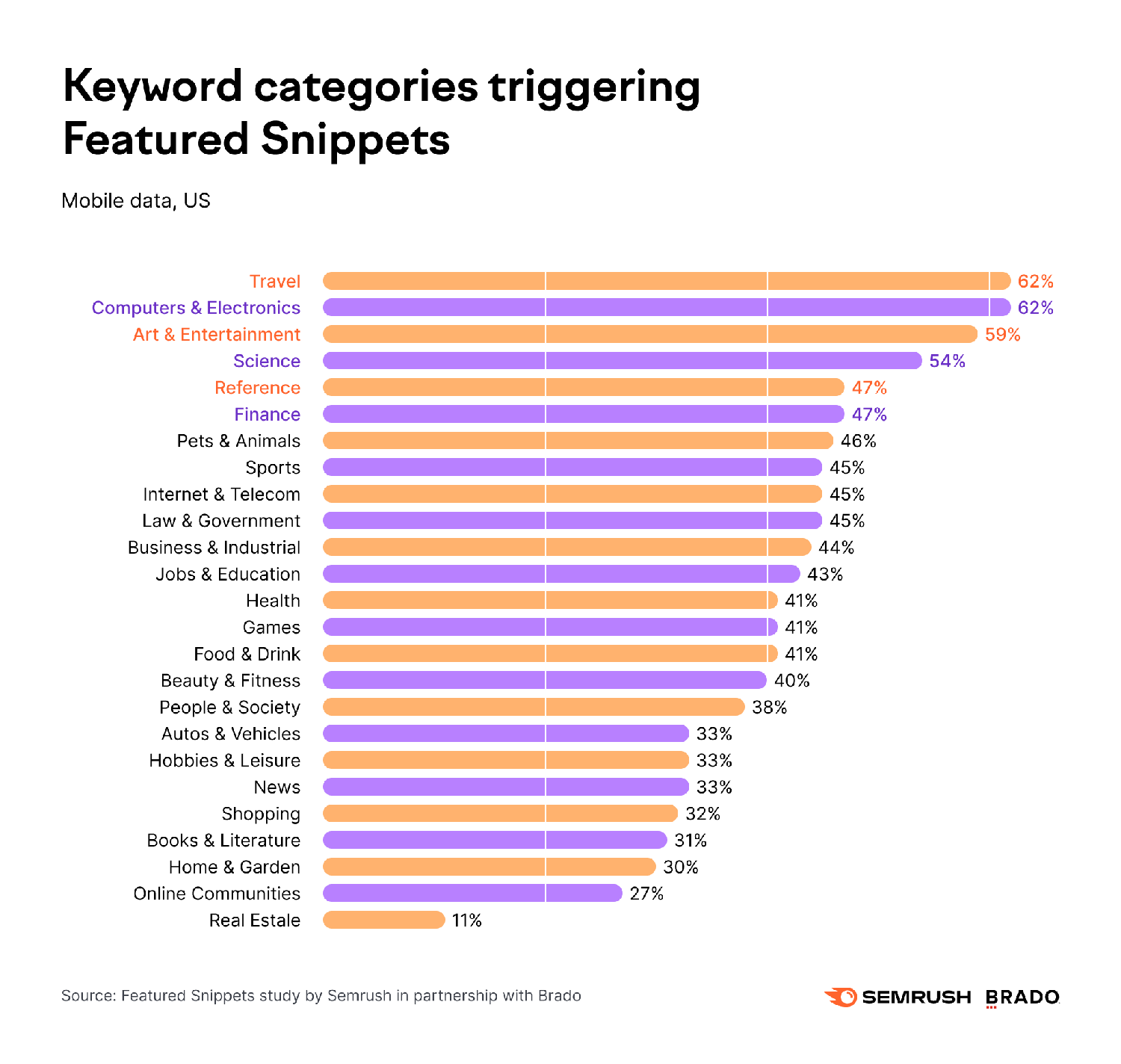
It’s reasonable to speculate that AI Overviews are replacing or appearing alongside featured snippets in industries where the largest impact has been documented.
Likewise, it’s entirely possible that queries in industries like arts and entertainment still see a lot of featured snippets, given the much lower impact of AI Overviews in those areas.
It’s important not to draw too strong of a conclusion here. But it’s worth considering revisiting your content if you’re in an industry that’s experienced a greater impact from AI Overviews.
Query type impacts the appearance of AI Overviews and featured snippets
Both AI Overviews and featured snippets appear for informational queries, but AI Overviews seem to display more consistently across all query types.
Featured snippets are often used to provide clear-cut, factual answers for informational queries, such as:
- Definitions and short explanations
- Small data-driven tables
- Ordered lists, like short processes or procedures
- Unordered lists of options or examples
While featured snippets can appear for commercial queries (e.g., product comparisons) and even transactional queries, they’ve historically shown up less frequently for those search intents.
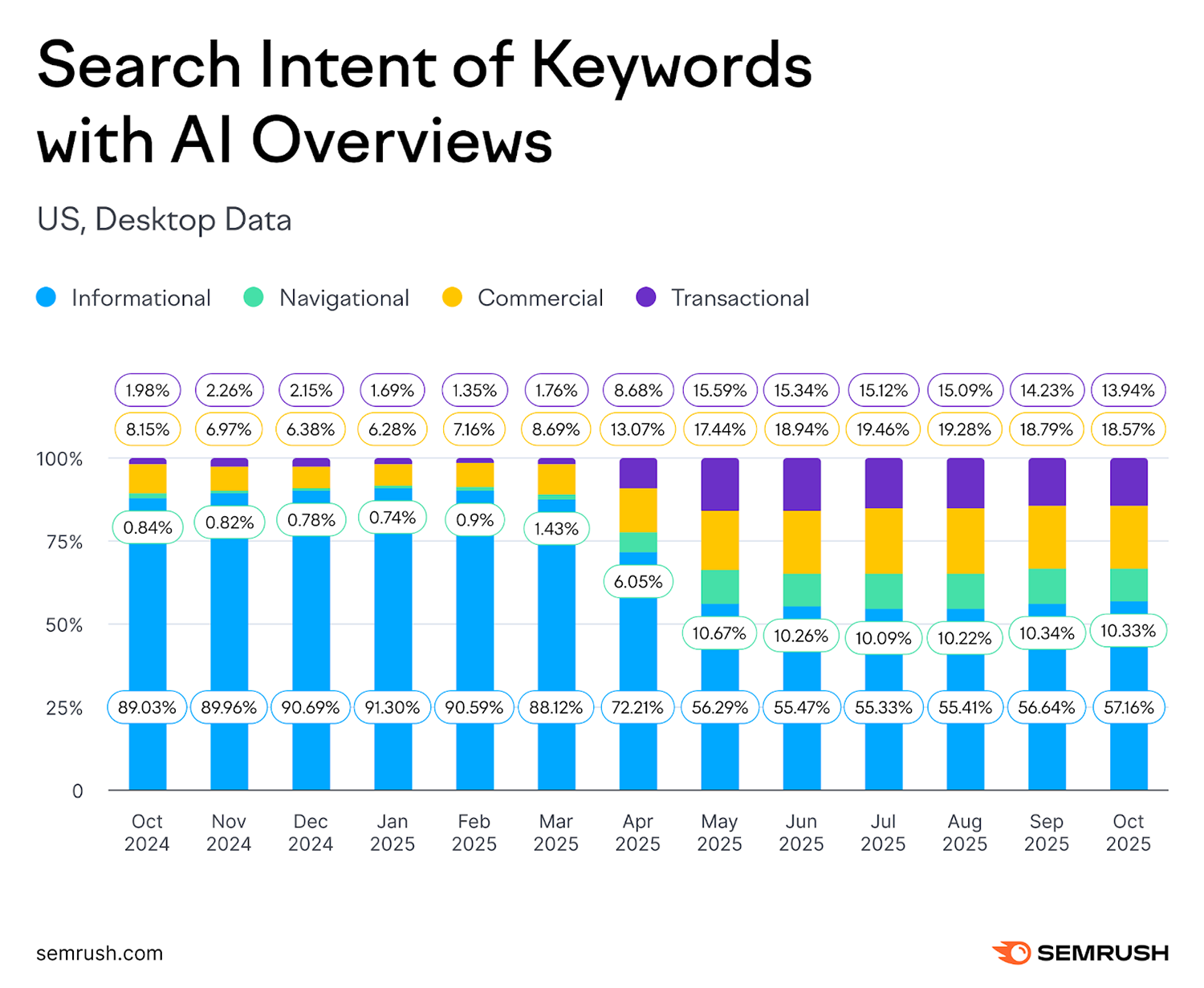
Initially, AI Overviews also focused primarily on informational queries. However, from October 2024 to October 2025, Semrush data shows a marked increase in the coverage of AI Overviews across queries with navigational, commercial, and transactional intent.
The arXiv study on infant- and pregnancy-related queries reflects similar query type trends.
The researchers broke their queries into six categories:
- Binary: Questions looking for a clear binary yes/no, true/false, or similar answer, such as “is a boston cream donut healthy?”
- Wh*: Questions looking for a definition, direction, or some kind of identification, usually starting with words such as “who,” “what,” “where,” “which,” and “whose.” For example, “what is a boston cream donut?”
- When: Time-related questions starting with “when,” like “when is the best time to eat a boston cream donut?”
- How-to: Questions that start with “how to” and that look for steps to complete a process or task. One example might be: “how to make a boston cream donut.”
- How + adjective/adverb: When followed by a modifier, “how” often indicates a quantity, degree, or extent, such as: “how many donuts can I eat before I get sick?”
- Why: Questions starting with “why” indicate a desire to know some underlying cause or provide an explanation for how something works, like “why are boston cream donuts so tasty?”
When comparing the appearance of AI Overviews versus featured snippets, the researchers discovered some fascinating results:
- Featured snippets appeared in only 15.7% of “why” queries but showed up in 35.5% of “when” queries
- AI Overviews showed up 80–92% of the time across all categories
- Both featured snippets and AI Overviews showed up most frequently in “when” queries
While AI Overviews appeared relatively steadily across query types, featured snippets fluctuated more depending on the type of question provided.
This is likely due to the generative aspect of AI Overviews. “Why” questions rely heavily on interpretation and synthesis, and it may be harder to find reliable explanations to cite directly for featured snippets. AI Overviews, however, can rely on multiple sources to generate an answer.
Query sentiment impacts AI Overview and featured snippet appearance
Query sentiment affects the appearance of AI Overviews and featured snippets in search results, but featured snippets see a much greater impact.
The arXiv study on baby and pregnancy queries included neutral, positive, and negative questions. For example:
- Neutral: Can infants have juice?
- Positive: Is it safe for infants to have juice?
- Negative: Is it unsafe for infants to have juice?
The study found that featured snippets appeared almost twice as often for negative queries than for neutral queries (48.41% vs. 24.84%). Positive queries triggered featured snippets a little over 40% of the time.
AI Overviews showed very little, though still statistically significant, difference between negative (86.62%) and neutral (85.99%) queries, with a little lower frequency for positive queries (76.43%).
Interestingly, the researchers didn’t find any significant association between query sentiment and the sentiment of the response in AI Overviews. However, they noted that previous studies had found confirmation bias in responses based on the query sentiment. (They didn’t track response sentiment for featured snippets.)
The researchers don’t attempt to offer any explanation on why queries with negative sentiment seem to trigger featured snippets or AI Overviews more often.
Since Google displays these SERP features only when it determines they’ll be useful to the user, the reason could lie in any of the many ranking factors that the algorithm uses to make such decisions.
AI Overviews cite more and different sources than featured snippets
Since featured snippets cite only a single source, it may seem obvious that they show fewer sources than AI Overviews do. However, generative search results also seem to pull from a different pool of sources than featured snippets.
A few sources surface repeatedly across multiple studies of AI Overviews’ most cited domains by Semrush, Bloom, Peec AI, and Profound.
| Most-cited websites in Google AI Overviews | ||||
| Place | Semrush | Bloom | Peec AI | Profound |
| 1 | Wikipedia | |||
| 2 | YouTube | YouTube | YouTube | |
| 3 | Wikipedia | Quora | ||
| 4 | Medium | Wikipedia | ||
| 5 | YouTube | Amazon | Forbes | Gartner |
| 6 | Quora | G2 | NerdWallet | |
| 7 | NIH | Yelp | Forbes | |
| 8 | Forbes | Yelp | Wikipedia | |
| 9 | Amazon | Medium | BusinessInsider | |
| 10 | Microsoft | IMDb | Techradar | Medium |
It’s hard to come up with a definitive list of sources used in AI Overviews, given the lack of standardization for this type of review across the SEO industry. Some of these studies looked across multiple AI tools, including Google’s AI Mode, and some of the differences are likely due to the types of queries each study focused on.
Nonetheless, some repeated names are worth pointing out:
- Reddit, Wikipedia, and YouTube were listed in all four studies
- LinkedIn and Medium both appeared in three studies
- Google, Forbes, Facebook, Quora, and Yelp each made the top 10 in two of the studies
Current information on featured snippets is harder to come by. Older research, including this study from SISTRIX, show that Wikipedia and YouTube have traditionally been featured, while Reddit was less prominent.
Part of the difference is that AI Overviews don’t necessarily source the top search results, in part due to fan-out queries that look at sub-queries to fill in more details about a topic when generating their reply. Featured snippets, on the other hand, have traditionally come from one of the top results for a specific query.
In the arXiv study on baby and pregnancy queries, researchers also found a disparity between featured snippet sources and AI Overview citations.
In particular, featured snippets came from more business and shopping sites than AI Overviews and organic results included. However, both AI Overviews and featured snippets emphasized health-related sites more than the traditional search listings did.
Which is better for organic visibility: AI Overviews or featured snippets?
In general, AI Overviews offer more opportunities for visibility in the zero-click search landscape. But as with most tradeoffs, there are some big caveats to consider.

When it comes to driving raw clicks, featured snippets win out — when they show up. However, AI Overviews are often better at driving qualified visitors who engage and convert, even though fewer people click the source links.
Here’s a quick summary of our findings across four areas related to organic visibility:
| Metric | Winner | Summary findings |
| Impressions | AI Overviews | AI Overviews appear in far more results than featured snippets (84% vs. 32.5%), and they include multiple citations rather than a single source |
| Click-through rate (CTR) | Featured snippets | Featured snippets can drive up to 35.1% CTR to a single source, while AI Overviews reduce clicks and split them across multiple sources |
| Time on site | AI Overviews | Visitors from AI sources have 23% lower bounce rates, 12% more page views, and 41% longer sessions |
| Conversions | AI Overviews | AI search traffic converts at higher rates than traditional organic traffic |
Better for organic impressions: AI Overviews
AI Overviews are the clear winner when it comes to organic impressions. The problem is that getting into AI Overviews is quite difficult.
As of February 2026, only 97,574 unique domains are cited in AI Overviews, according to a study by SE Ranking, though other estimates have put it as high as 274,000 unique domains. Compared to the 18 million or so domains included in organic search results, that means only about 0.5–1.5% are cited in AI Overviews.
That said, when a domain does get featured, there are far more opportunities for it to appear. That’s because AI Overviews cite multiple sources, whereas featured snippets only show a single source.
In fact, sites that don’t appear in the organic search results for a given query can still be cited in the AI Overview, due to fan-out queries that pull in tangential information. That means those sites have an opportunity for organic impressions even when they’re not directly answering the searcher’s primary question.
There’s also the fact that AI Overviews occur more often than featured snippets. According to the arXiv study, AI Overviews appeared on about 84% of baby care and pregnancy queries, while featured snippets only showed up about 32.5% of the time.
All this to say that if your domain can break through the selectivity barrier for AI Overviews, there’s a great opportunity to boost organic impressions.
Better for CTR: Featured snippets
When it comes to clicks, featured snippets seem to still edge out AI Overviews. But again, there are some caveats to consider.
Historically, featured snippets received a CTR of around 35.1%, according to EngineScout data. Some SEOs claim they can still drive 40% or more CTR.
However, data from Advanced Web Ranking suggests that featured snippets today receive only about 17.7% CTR when no other SERP features are present. The addition of more features reduces that rate in almost every instance.
Meanwhile, the introduction of AI Overviews demonstrated a dramatic decline in overall clicks according to both industry studies and a Pew Research Center study of user behavior.
Yet Advanced Web Ranking data shows AI Overviews receiving about 33.8% of clicks, compared to the 17.7% CTR for featured snippets.

So, what’s going on here?
For one thing, AI Overviews use multiple sources, meaning that clicks are split among those sources. While the overall CTR for AI Overviews might be 33.8%, the CTR for any given link within a generated result will be a fraction of that.
Featured snippets, on the other hand, only have a single source, meaning that all clicks will go to the same page.
Therefore, where featured snippets appear by themselves, they’re likely to drive a better overall CTR than AI Overviews.
When featured snippets appear in conjunction with AI Overviews, the featured snippet is still likely to perform a little better than any individual source within the AI-generated result.
One way to bump up CTR for AI Overviews is to make sure your brand is closely aligned with the products, services, and other entities likely to appear in AI-generated results. Seer Interactive found that when brands are cited in AI-generated results, organic CTR increases by an average of 35% percent.
At the end of the day, both featured snippets and AI Overviews have driven CTR downward as Google pursues its zero-click strategy.
But when push comes to shove, trying to lock down those featured snippets is worth the effort for the searches where they show up.
Better for time on site: AI Overviews
Website visitors who click through from AI-generated results tend to be more engaged than those who click through from featured snippets.
This may feel counterintuitive given that AI Overviews have lower CTRs. But it means that when people do click through, they’re really interested in finding out what’s there.
The increased engagement is significant, according to an Adobe study. In particular, visitors to retail websites from AI sources had:
- 23% lower bounce rates
- 12% more page views
- 41% longer session durations
This guide focuses on Google’s AI Overviews, but it’s worth pointing out that stronger engagement seems to hold true across other AI engines. For example, visitors from ChatGPT, Perplexity, and Gemini have engagement rates between 58% and 62% and higher pages-per-session numbers than Google organic results, according to Seer Interactive.
Ultimately, users looking for only surface-level information are reading AI Overviews without clicking through, leading to a lower CTR. They’re effectively filtering themselves out of the visitor pool.
Those who want deeper insights, however, dig down and really interact with the content.
Better for conversions: AI Overviews
Visitors from AI Overviews appear to convert at higher rates than traditional organic results.
Every study tells a different story, but overall the evidence leans in favor of AI search results sending better-converting traffic to websites.
- Microsoft Clarity found that AI traffic converts at three times the rate of other channels
- Seer Interactive data shows that Google organic traffic had a significantly lower conversion rate (1.76%) than Gemini (3%), Claude (5%), Perplexity (10.5%), and ChatGPT (15.9%)
- Arc Intermedia offers a bit more tempered analysis, with mixed results across industries compared to Google organic conversions
Unfortunately, all of these studies look at AI search across large language model (LLM) platforms. No large-scale studies focus on conversions from AI Overviews, nor do any of them compare their results to featured snippets.
The reason AI Overviews appear to perform better here is the overall higher conversion numbers reported across AI platforms along with engagement filter discussed in the section above.
Finally, it’s worth stating that in the grand scheme of things, both traffic and conversions from AI Overviews are still fairly minimal. As the numbers increase over time, the data is likely to shift.
But even then, it’s very unlikely that featured snippets will win out when it comes to conversion.
Are AI Overviews replacing featured snippets over time?
Over the last few years, AI Overviews have moved into the position zero spot, as well as other places where featured snippets traditionally held sway, such as PAA.
Since they were introduced in May 2023 as part of Google’s Search Generative Experience (SGE), AI Overviews have grown from appearing in a small number of SERPs to dominating more than 80% of search results for some topics.
But enough numbers and percentages — a picture is worth a thousand keywords.
Compare this graph of featured snippets that Search Engine Land has earned over the last two years:

With this one showing the rise of AI Overview results:

While it’s too soon to write off featured snippets completely, there’s a lot of evidence pointing to the idea that Google sees AI Overviews as a more versatile and valuable SERP feature.
Why featured snippets still matter
Featured snippets aren’t completely out of the picture. It’s still important to optimize for them when they appear because they can provide a more direct route for searchers to reach your website than other options.
Some of the specific reasons that featured snippets are still important include:
- Seed data for AI: Snippets may inform what Google includes in AI Overviews, which means your featured snippets could appear as sources for fan-out queries for other searches.
- Factual queries: Featured snippets are triggered more often in queries seeking fact-based answers.
- CTR: Snippets edge out AI Overviews in sending traffic to websites, mainly because they point to a single source
- Authority signals: While it’s nice to be cited by AI Overviews, featured snippets may offer better qualitative signals around expertise and authority, since they single out a specific source as the best one to answer the query.
- Holistic visibility: While AI Overviews appear in a lot of queries, they don’t show up everywhere. Optimizing for queries that still show featured snippets ensures you’re not leaving any visibility opportunities unexplored.
At the end of the day, a comprehensive SEO strategy will cover all available organic ground. Since featured snippets are still present and continue to provide value, they’re still worth pursuing.
How to optimize for AI Overviews
Optimizing for AI Overviews is part of generative engine optimization (GEO). And good GEO is good SEO.
Here’s a quick and not-very-dirty list of things you can do to improve your chances of appearing in AI Overviews:
- Build brand authority: The simple fact is that the more your brand aligns with the principles of experience, expertise, authority, and trust (E-E-A-T), the more likely your website will be to appear in AI Overviews (along with a lot of other SERP features)
- Boost your technical SEO: Make sure your site’s performance and infrastructure provide a conducive experience to both users and Googlebot
- Tighten up on-page SEO: When it comes to performing at the top, details matter. Double and triple check all the essential on-page SEO elements to make sure you’re sending the right signals.
- Get some backlinks: Link building has changed a lot over the years, but like featured snippets, it hasn’t gone away. Build content that generates a natural backlink profile, and reach out to a few relevant, high-authority domains to see if they’ll cite you.
- Seek out AI Overview opportunities: Do keyword research to see where AI Overviews are showing up. Then, write content that better answers the main query and fan-out queries than the current sources.
Dig deeper: AI Overviews optimization guide: How to rank in generated results
How to optimize for featured snippets
Since featured snippets are specific quotations pulled from a single page, there are a few things you can do to try and capture these SERP features.
- Put the answer first: Always start with the most important information at the top of the article or section, and then add explanation and detail below
- Use declarative language: Clear, direct sentences win the snippet. Save the flowery language for your novel.
- Format your content: Use lists (ordered and unordered), tables, and headings to present your content in a way that’s easily readable by both humans and bots
- Add the appropriate schema: Some schema markup (FAQ and HowTo schema) is especially good for appearing in SERP features like featured snippets
- Provide better answers: Look for gaps in current featured snippets and write content that better fits the search intent
Dig deeper: Featured snippets: How to win position zero
How to optimize for both AI Overviews and featured snippets
Gaining both AI Overviews and featured snippets is totally achievable with attention to detail and a focused strategy.
Many of the considerations for capturing one or the other apply to going after both. Here’s the combined list with emphasis on optimizing for both types of SERP features:
- Build your brand: Seriously, a trustworthy brand is worth more than its weight in gold font when it comes to brand visibility in both AI search and traditional SERPs.
- Stay focused: Keep your answers up front and on point. Nobody wants a 3,000-word essay on your grandma’s favorite walnut tree before you get to the recipe.
- Write clearly: Use common words and phrases, and keep your sentences simple. If you absolutely have to include some industry jargon, define it clearly the first time you use it.
- Match content to form: A wall of text is rarely helpful. Chunk your content using informative subheadings. Use bullets, tables, and short paragraphs to make scanning easy for visitors.
- Hone technical signals: Make sure everything is running smoothly and securely, and double check your page speed and Core Web Vitals.
- Review page elements: Optimize title tags, meta descriptions, images, headings, and other on-page essentials for the topic the page covers.
- Enhance discoverability: Use interlinking to connect content clusters and point users and crawlers to new content. Perform outreach to send off-page signals and referral traffic.
- Use structured data: Structured data helps Google associate your page and site with relevant entities.
- Proactively seek out opportunities: Look for gaps in keyword and content coverage, and then fill them with new or updated content that builds topical authority.
If you get through all this, try debugging your SEO to see if there’s anything else you can do to improve your chances of capturing AI Overviews and featured snippets.
Get good data to capture both AI Overviews and featured snippets
Studies and analysis offer a realistic set of data to understand the state of the larger landscape. But to really succeed, you need data that will help you monitor your site’s visibility in AI Overviews, featured snippets, and elsewhere.
If you’re not sure what to look for, check out our guide on measuring zero-click search. Also check out how to interpret SEO data and anomalies to make sure you’re measuring the right things in the right ways.
When you’re ready to dive into the data, try Semrush to see where your site appears in AI Overviews and featured snippets — and where you could be showing up.
Explore more on
Editorial disclosure
Search Engine Land is owned by Semrush. We remain committed to providing high-quality coverage of marketing topics. Unless otherwise noted, this page’s content was written by either an employee or a paid contractor of Semrush Inc.
About the author