

CPM Definition
CPM is an ad pricing model used to buy advertising space, most commonly for display advertising or paid social.
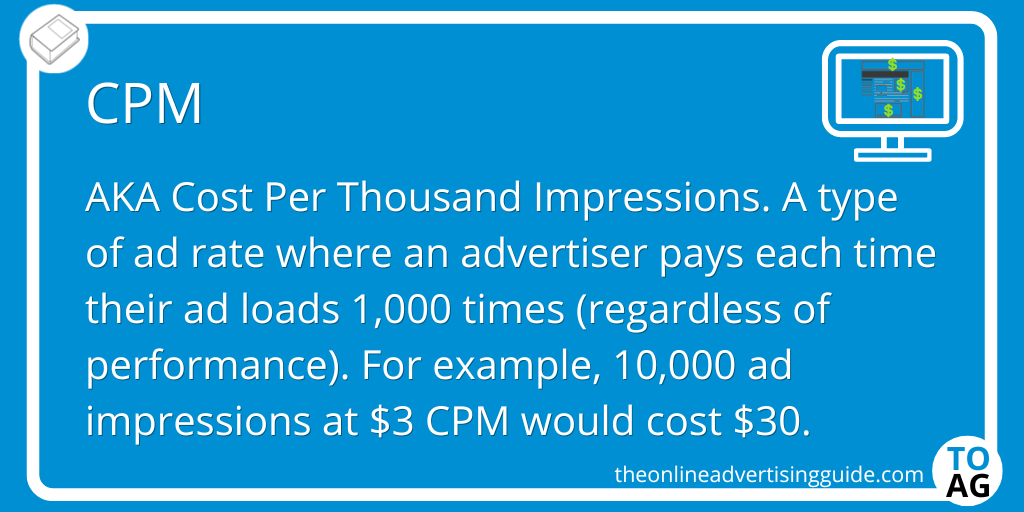
It is the amount an advertiser pays per 1,000 ad impressions. Typically for this ad pricing model, a specific amount of ad impressions is booked at a set CPM price (rather than working on a pay-as-you-go model).
CPM advertising is the best deal for website owners (in most cases) as you are simply selling ad space, and it doesn’t matter whether anyone clicks on the ads or buys because of them. Consequently, it’s also usually the worst type of deal for advertisers.
CPM Definition
CPM stands for cost per thousand (as M is the roman numeral for 1,000). It is one of the three most common ad pricing models used along with CPC and CPA.
The impressions referenced are ad impressions – which means one load of an ad. The equation can also be used for page impressions, although that is far less common.
This ad pricing model is the basis of valuing all ad inventory. This is because the best way to compare campaigns (which are using a variety of different pricing models) is to work out an eCPM for each one.
eCPM stands for Equivalent Cost Per Thousand and means using the CPM formula to work out the CPM cost of non-CPM campaigns.

The History of CPM
CPM banner advertising was launched in 1995. This was the same year the Internet Advertising Council (now the IAB) launched.
This fairly easy-to-understand ad pricing model coupled with easily scaleable ad-serving technology meant everyone could get in on the online advertising game. CPM advertising forecasting only depends on inventory levels.
Consequently, this meant website owners could now predict how much money they could make fairly easily.
Of course, they weren’t taking into account problems like fill rate or latency, which is why over-estimations of potential profitability were commonplace at the time. This is probably what led to the great dot-com crash, but that’s another story.
Fun Fact
CPM is often reported by other sites as standing for Cost Per Mille.
However, the people at The Online Advertising Guide think they might have accidentally made up this definition on an early version of this site!
We have since found older sources referring to the M in CPM being there as the roman numeral for 1,000, however, we have never found someone who said it stood for Cost Per Mille before we first did (in 2012).
CPM Formula
The Cost Per Thousand equation is calculated as:
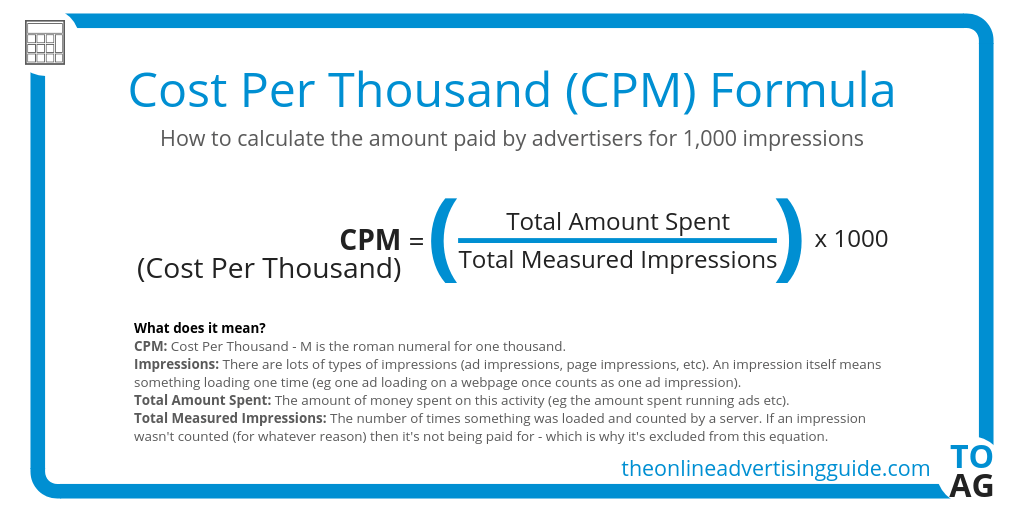 Click to enlarge
CPM = (Ad Spend ÷ Ad Impressions) x 1000
Alternate Equations
You can also calculate it in the following ways (as well as by using this calculator):
- Ad Spend multiplied by 1,000. Then divide the result by Ad Impressions.
- Weird version: CTR multiplied by CPC multiplied by 1,000
Technical Information
While CPM is the amount paid by advertisers it is not the amount received by websites. RPM (Revenue Per Thousand) is a website’s revenue equivalent.
The difference occurs because of the associated ad-serving fees and costs from an ad campaign.
Note: CPM is still often casually used as meaning the same thing as RPM. Always check what someone is referring to if you are confused.
 Click to enlarge
Average CPM Rate
There don’t appear to be any official benchmarks, but unofficially people generally quote between £1-£6 (or approx. $1.50 to $10) for display ads.
Not to be confused with
CPVM – Cost Per Viewed Thousand. This is where viewed impressions are used instead of ad impressions (viewed impressions are ones that were definitely on-screen).
CPV – Cost Per View. This is the price per individual view of something (usually a video). If this was used for display advertising, it would mean paying for each individual ad impression, rather than per 1,000 ad impressions.
RPM – Revenue Per Thousand. This is the amount of revenue a website receives per 1,000 impressions, rather than the amount an advertiser pays. The difference is detailed in the “Technical Information” section above.
eCPM – Equivalent Cost Per Thousand. While this is essentially the same metric, the difference is that this is a measure used to compare non-CPM campaigns, and is not an ad pricing model but a metric.
Summary
Find out more
- CPM Calculator
- TikTok CPM Calculator
- YouTube CPM Calculator
- Advice for Website Owners
- Advice for Ad Buyers
Back: Ad Pricing Guide
New on Search Engine Land