International SEO execution: Keyword research, link building & UX that converts

Most international SEO strategies fail not because of poor planning but because of poor execution. Businesses pour resources into scalable technical foundations: multi-market architecture, hreflang, and international sitemaps. But those structural investments often stall because they’re not paired with the kind of tactical precision that reflects real search behavior, local authority signals, and cultural UX expectations.
The brands that win internationally are the ones that master that execution layer.
Beauty brand Gisou saw a 1,365% surge in global organic traffic after strategically optimizing product pages, content, and backlinks for each target market in different countries. Groupe SEB, a major household appliances company with 150 countries and 200+ websites, increased local visibility and user engagement through a comprehensive SEO overhaul that aligned technical fixes, content strategy, and localization.
In Part 1 of our international SEO guide, we covered the foundations of international SEO: how to structure your site, use hreflang correctly, and choose between subdirectories, ccTLDs, or subdomains.
In this second part, we move beyond setup to focus on the execution tactics that actually drive international growth with your specific target audiences.
You’ll learn:
- How to conduct keyword and topic research that reflects real-world user behavior in each target market
- How to build localized authority through region-specific link building
- How to align UX with cultural expectations to improve conversions across borders
These are the three pillars where international success is either built or blocked.
How to do keyword research for international SEO
International keyword research mistakes can cost businesses significant revenue and wasted resources during expansion.
The main issue?
Businesses assume that translating high-performing keywords from their primary market will unlock success in new ones.
But this approach translation almost never works. Why?
- People don’t express needs the same way across languages or cultures
- Search behavior shifts based on market maturity, device preference, and local competitors
- Even within the same language, terminology and user expectations vary dramatically
Traditional keyword research is also evolving rapidly.
With AI-driven search experiences becoming the norm, topic expertise and semantic SEO now often outweigh exact keyword targeting.
That’s why effective international keyword and topic research requires a deep understanding of how search patterns, intent, and terminology can vary even between countries that share the same language.
The SEO toolkit you know, plus the AI visibility data you need.

Why direct translation rarely works
Direct translation assumes that user intent and search behavior remain consistent across markets throughout the greater global audience.
But this approach typically fails.
Why? Because it ignores fundamental differences in how people express needs, cultural search patterns, and local competitive dynamics that shape keyword usage.
Keyword localization isn’t just about language. It’s about psychology, regulation, economics, and user context.
People search the way they speak—not the way you translate.
Below are five core ways these differences show up and why localization requires more than just translation.
1. Same language, different terms
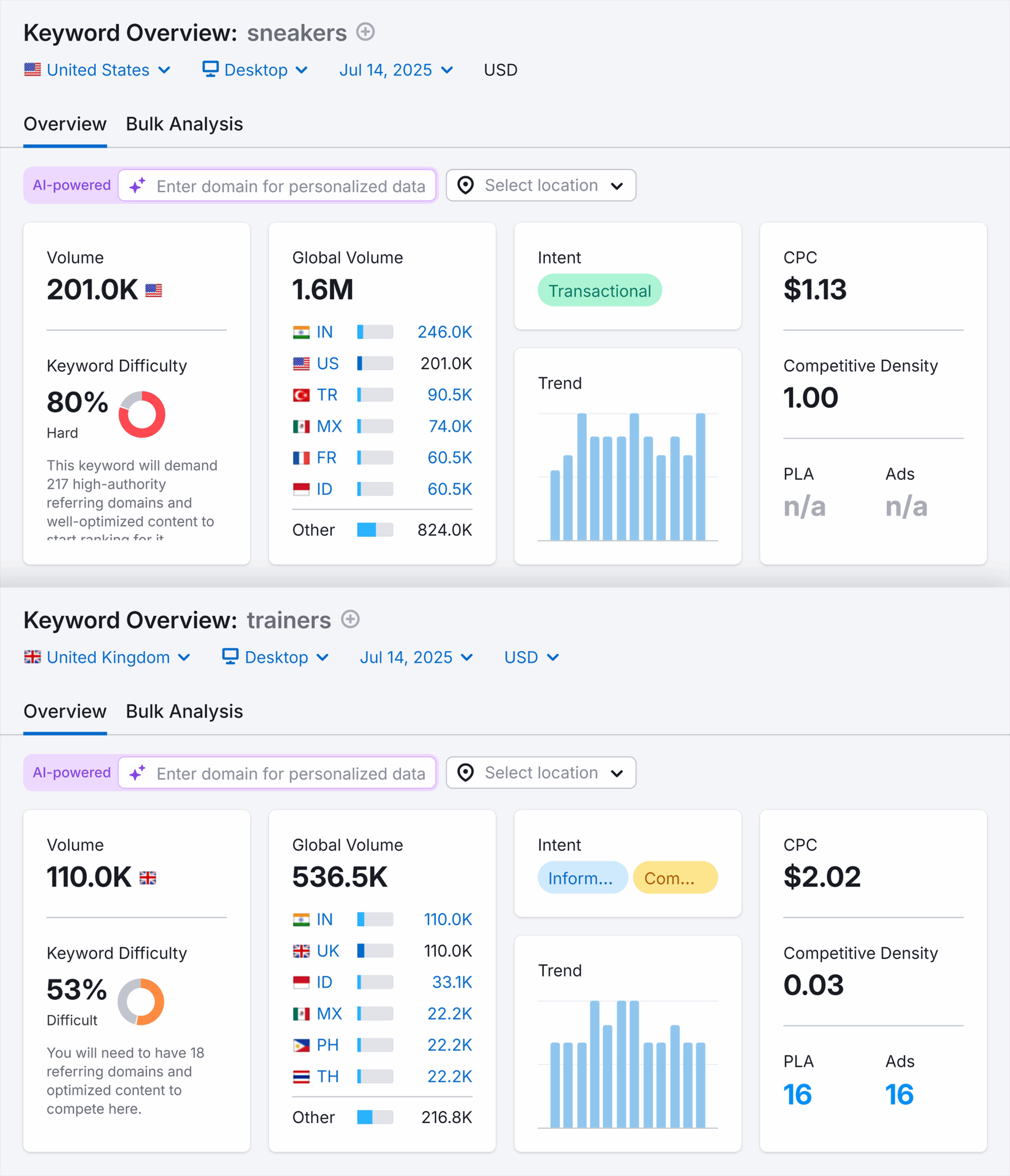
Searchers in the US look for “sneakers,” while in the UK they type “trainers.” A campaign optimized only for “sneakers” will miss a large percentage of qualified users in other English-speaking markets.
2. Different language, different terms
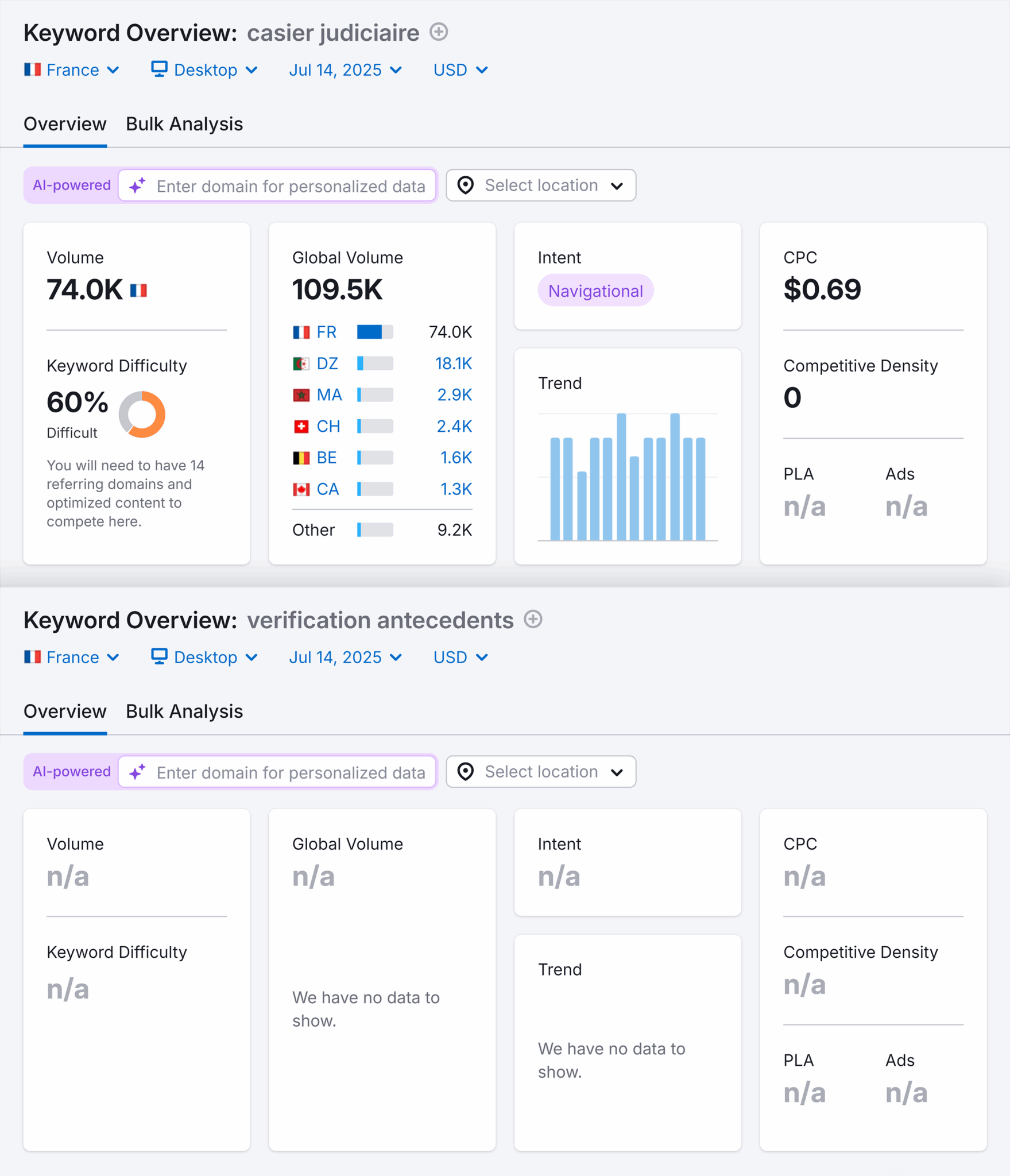
When targeting different languages, keyword equivalence rarely exists. A literal translation often fails to capture how users actually express the same concept.
For example, an English campaign targeting “background check” won’t resonate in France unless it uses the locally understood term “casier judiciaire” (criminal record), which reflects the legal and cultural framework users recognize. Direct translations like “vérification d’antécédents” may sound accurate but lack real search volume or relevance.
3. Cultural patterns shape how users search
Search behavior isn’t just linguistic. It’s cultural. The way people frame queries reflects local values, habits, and preferences. For example:
- In Germany, users tend to favor long-tail, information-dense queries, often reflecting a cultural preference for thorough research.
- In Japan, searchers commonly use different character sets based on tone and context—katakana for foreign brands, kanji for formal queries, and hiragana for more casual intent.
4. Search intent is shaped by regulation and seasonality
Local laws, tax deadlines, and shopping cycles all influence when and how people search. These patterns vary dramatically across countries.
- In Germany, GDPR-related tools and privacy-focused keywords show strong search volume
- In the US, searches for “tax prep software” typically spike in Q1, peaking around April
- In India, users often look for installment options, cash-on-delivery, or budget pricing reflecting local ecommerce norms
5. Local competitors shape keyword norms
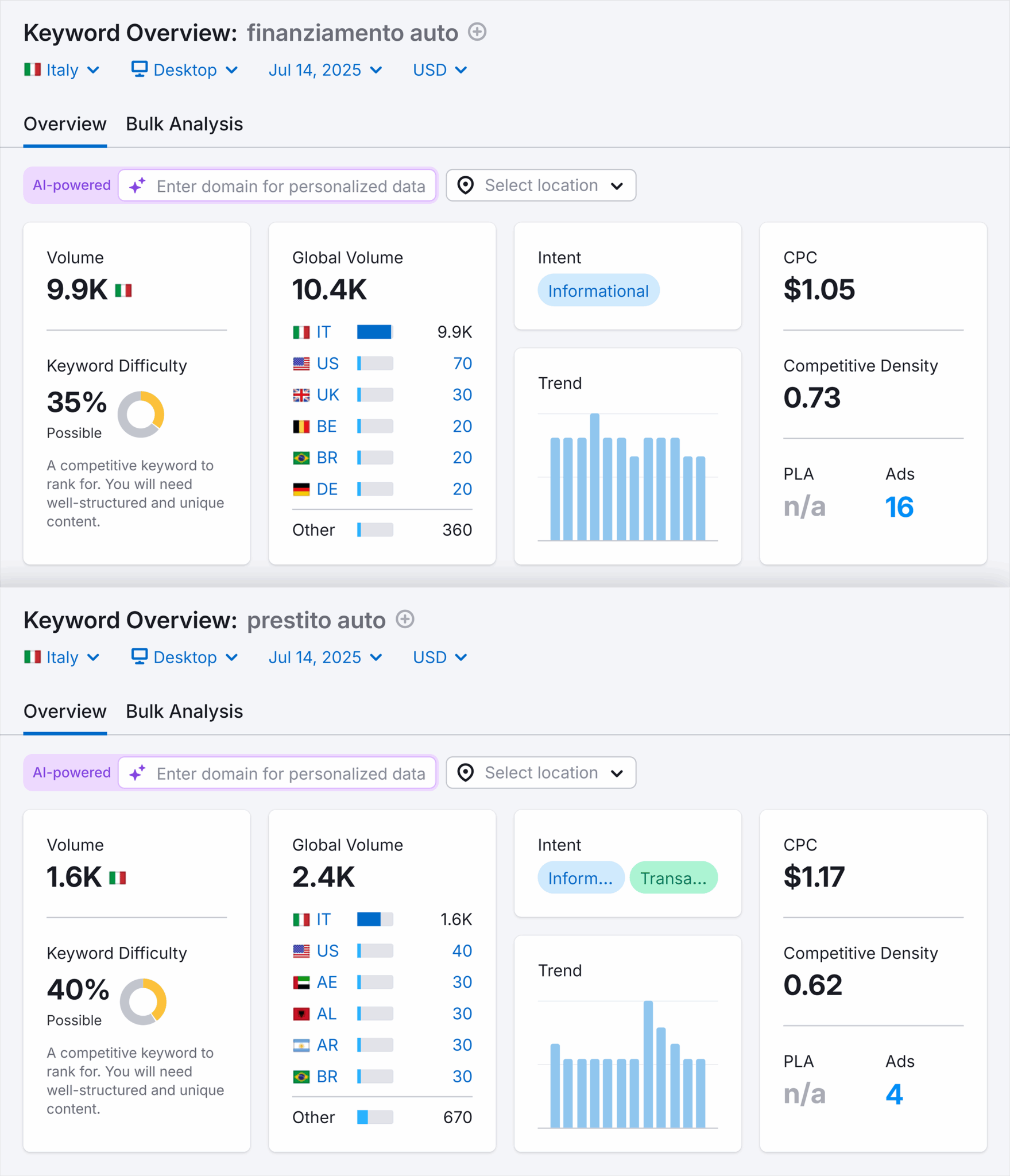
If an Italian bank optimizes for “prestito auto,” the more literal translation of “car loan,” it may fail to capture meaningful traffic because users in Italy typically search for “finanziamento auto.”
Regional search behavior is often driven by how people naturally talk, not how terms translate.
Understanding localized search behavior differences
International keyword research isn’t just about terms. It’s about understanding how people think, behave, and shop differently.
Cultural preferences, economic conditions, and local market dynamics fundamentally shape how people search for products and services across different markets.
Economic factors drive search pattern variations
In emerging markets or critical economic situations, users frequently search for budget alternatives, payment plan options, and local delivery methods. Developed markets show higher search volumes for premium features, expedited delivery, and brand-specific queries.
Different markets show distinct search behavior patterns based on economic priorities:
- Price-sensitive markets (e.g., Brazil, India, Mexico): Higher search volume for terms including “cheap,” “budget,” “affordable,” and payment plan options
- Premium markets (e.g., Switzerland, Norway, Luxembourg): Greater focus on luxury, premium features, and expedited services in search queries
- Value-conscious markets (e.g., Germany, Japan): Increased searches for comparison terms, reviews, and detailed product specifications

Cultural preferences influence search language
Business cultures vary in their communication styles, which affects how users construct search queries. In formal business environments like those in South Korea or the United Arab Emirates, users often rely on technical, detail-oriented language. In contrast, countries like Brazil or Portugal may lean toward more casual, conversational phrasing even in professional contexts.
When conducting keyword research, pay attention to these patterns:
- Formality level: Professional terminology vs. casual, conversational language
- Query length: Detailed, descriptive queries vs. abbreviated search terms
- Language complexity: Technical jargon vs. everyday language for the same concepts
Pro tip: Test both formal and casual variations of your target keywords to identify which resonate better in each market.
Mobile-first markets show different search patterns
Markets with high mobile internet usage like India often show different search characteristics.
Consider these factors when researching keywords:
- Device limitations: Mobile users may use shorter queries due to typing constraints
- Voice search influence: Markets with high voice search adoption may favor natural language queries
- Local search intent: Mobile users frequently include location-based terms
Use mobile-specific keyword research to identify opportunities that desktop research might miss.
Local events and regulations create search opportunities
Seasonal patterns and local events generate predictable search spikes that vary by country:
- Tax seasons: Different filing deadlines create opportunities for financial and business content. In the US, searches for “tax filing software” spike in March and early April. In the UK, those queries peak in January ahead of the self-assessment deadline, while in France, “déclaration d’impôts” surges in May.
- Local holidays: Cultural celebrations drive searches for related products and services. Around Lunar New Year, searches in Vietnam and China for gift boxes, red envelopes, and travel packages skyrocket. In Mexico, día de muertos makeup and altar ideas trend heavily in late October.
- Regulatory changes: New laws or compliance requirements generate information-seeking searches. When Germany introduced new electric vehicle subsidies, queries like “E-auto Förderung” and “Förderung beantragen” spiked as users sought eligibility info and application guides.
- Economic events: Local market conditions influence search behavior for financial products. During inflation surges in Argentina, searches for “how to protect savings” and “buy USD online” increased significantly. In India, RBI rate changes drive seasonal interest in “home loan EMI calculator” and “fixed deposit rates.”
Take action: Monitor Google Trends for your target markets to identify these seasonal opportunities.
Tools and methods for international keyword research
Effective international keyword research requires a multi-layered approach combining automated tools with human insights. The goal is to uncover not just what people search for, but how they think about and express their needs in each market.
Start with native SERPs, not keyword tools
Use Google.com with proper location and language settings to access local search results.
Important: While Google has retired country-specific domains (google.co.uk, google.de, etc.) and redirects them to google.com, you can still access localized results.
Here’s how:
- Set your location in Google Search settings to the target country
- Change your language preferences to match local usage
- Use a VPN to simulate searching from the target country (optional)
- Add location parameters to your searches (e.g., searching from “London” or “Berlin”)
This approach reveals interesting insights:
- Autocomplete suggestions reflecting real user queries in that market
- “People Also Ask” questions showing local information needs
- Related searches indicating semantic keyword relationships
- Local competitor content strategies and terminology choices
- SERP features specific to that market (local packs, knowledge panels, etc.)
Note: This helps you find semantically related terms that may not show up in keyword tools but are crucial for topic coverage.
Use Google Keyword Planner with precise location targeting
While Google Keyword Planner is designed for paid search campaigns, it can still offer valuable insights for international SEO if configured correctly. The key is to use its precise location and language targeting features to surface search behavior in specific markets.
Configure location settings to specific countries and cities, not broad regions. Set language preferences to match local usage patterns. This reveals actual search volumes and seasonal trends for specific markets.
Key configuration steps:
- Select specific countries, not regions (e.g., choose Germany, not Europe)
- Match language settings to local preferences (e.g., German for Germany, not English)
- Examine historical data to identify seasonal search patterns
- Review suggested keywords for local terminology differences
Leverage advanced keyword research tools with international capabilities
Tools like Semrush and Serpstat provide country-specific keyword databases that offer insight into search volumes, competition levels, and SERP features across different markets.
Advanced international SEO features to use:
- Keyword gap analysis: Compare your current rankings against local competitors
- SERP feature analysis: Identify opportunities for featured snippets, local packs, and knowledge panels
- Competitor content analysis: Examine top-performing content themes in target markets
- Search volume trends: Identify growing keyword opportunities and declining terms
Use Semrush’s Keyword Magic Tool to surface localized keyword variations and evaluate competition across specific languages and countries but remember that these datasets aren’t always perfect. Use them directionally and supplement with local SERPs where possible.
Analyze local competitor strategies systematically
Identify the top 5-10 organic competitors in each target market through manual SERP analysis. Many tools miss local competitors that don’t rank internationally.
Here’s a simple competitor analysis framework to guide your research:
- Content gap analysis: Identify topics they cover that you don’t
- Keyword opportunity identification: Find keywords they rank for that you could target
- Content format preferences: Determine whether local markets prefer guides, lists, videos, or tools
- Technical implementation: Examine their site structure, internal linking, and user experience approaches
Work with in-country SEOs or native speakers
Keyword tools can’t localize for you.
They reveal raw data but only native speakers can interpret cultural nuance, regional intent, and local language patterns. To avoid mismatched keywords and missed opportunities, you need native insight layered on top of tooling.
In-country SEOs can:
- Interpret local search behavior and language nuances
- Anticipate seasonal trends and culturally specific buying cycles
- Navigate regulatory environments and compliance needs
- Leverage local relationships (media, influencers, link partners)
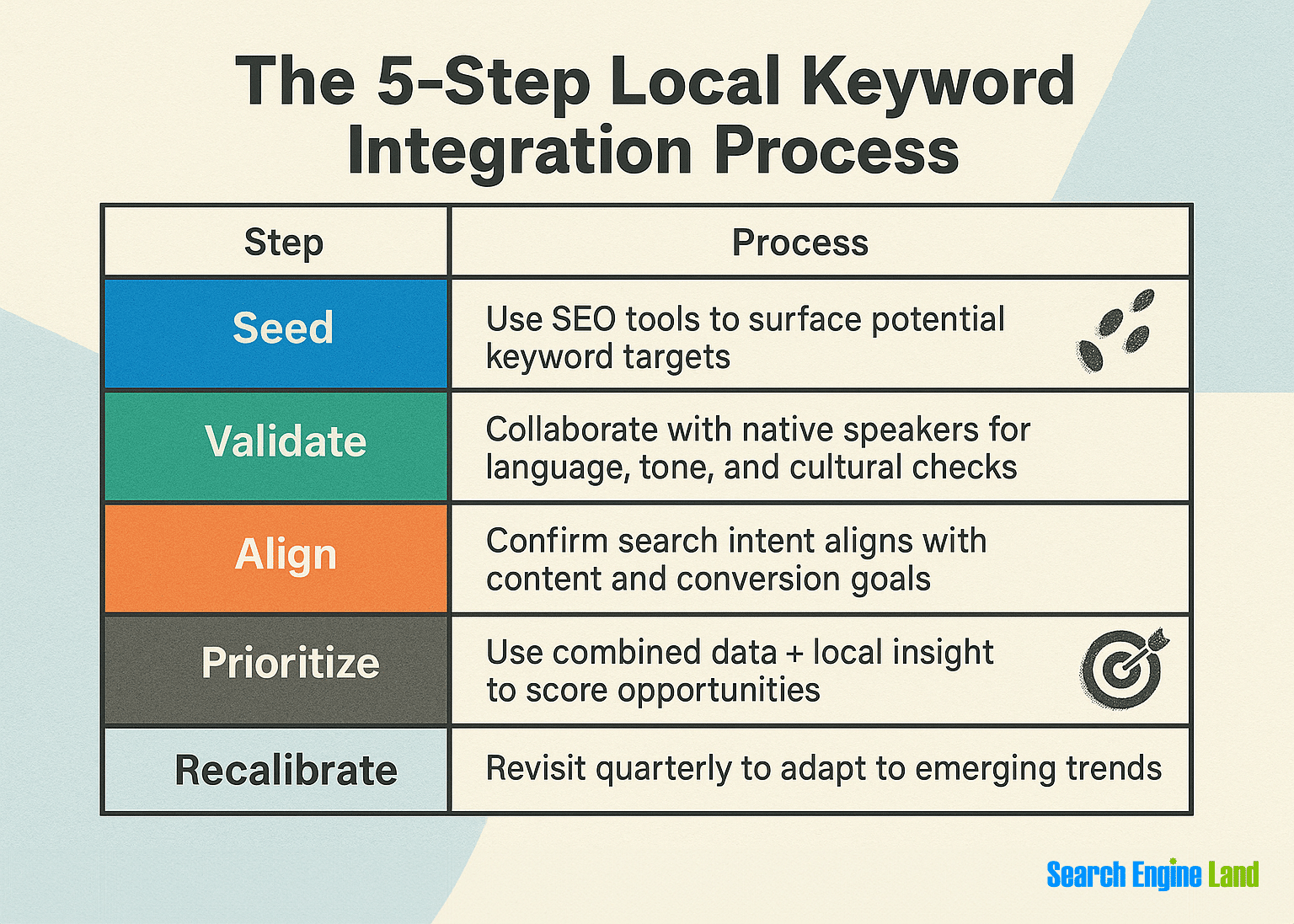
The key to working with in-country SEOs is to run every keyword through a validation filter:
- Check cultural fit: Ensure there’s no unintended meaning or offense
- Test naturalness: Confirm that phrasing matches how locals actually speak
- Verify intent: Make sure search goals align with your business objectives
- Assess local competition: Review the SERP for dominant players and formats
- Plan ongoing monitoring: Regular reviews to identify emerging opportunities and changing patterns
Pro tip: Bring local experts in early. Don’t use them just to “double-check” translations—treat them as strategic partners. Tools give you data. People give you context.
Consider local market research and user interviews
Direct feedback from users in your target market provides insights no tool can replicate.
Ask questions like:
- How do they search for your product or service category?
- What terminology feels most natural or trustworthy?
- What information do they need during the research and decision process?
- Which competitors are they aware of, and how do they differentiate between them?
Also consider partnering with internal teams like business intelligence, market research, sales, or customer support. These teams often have access to market-level insights—such as purchasing behavior, customer pain points, or regional trends—that keyword tools alone won’t surface.
Look for patterns in:
- Common pre-purchase questions or objections
- Region-specific customer feedback
- Product usage or search trends by geography
These insights can inform not only keyword strategy, but also content themes, messaging tone, and conversion optimization at the local level.
Pro tip: Keyword research also reveals what not to localize.
International keyword research isn’t just about spotting high-volume opportunities—it also shows you where not to spend your time. Low or no search volume in a target market—despite strong performance domestically—can signal cultural mismatch, regulatory friction, or different user priorities. That “negative data” is just as valuable: it helps you avoid wasting time localizing content that won’t perform. Run the same keyword across five countries and compare search volume, intent, and SERP layout. You’ll almost always uncover key differences that should inform your localization strategy.
Dig deeper: 15 SEO localization dos and don’ts: Navigating cultural sensitivity
International link building strategies that work
International link building isn’t just domestic outreach at scale. What counts as authority in one region may mean little in another. To succeed globally, you need to rethink link equity culturally, linguistically, and algorithmically.
Success depends on understanding regional trust signals, building relationships with local influencers and publications, and adapting outreach to reflect local norms. In every sense of the phrase, you must build your local audience, wherever your brand may go.
Map the local authority ecosystem first
Each market has its own ecosystem of trusted domains and they may not align with global authority metrics.
Example: A site with high authority internationally may carry less weight in Japan than a modest but trusted local trade magazine.
Authority mapping framework:
- Government and institutional sources: Identify authoritative government sites, educational institutions, and regulatory bodies
- Media landscape analysis: Map major news publications, industry magazines, and influential blogs
- Trade associations and professional organizations: Find industry-specific authority sources
- Local business directories and review platforms: Identify trusted local citation sources
- Cultural influencers: Understand which individuals and organizations shape opinion in your industry
Understand local content and link preferences
Search intent and linking norms vary by culture. Tailor your link-worthy assets accordingly.
Example: German editors may expect two to three credible citations in every article, while Brazilian sites may prefer short videos or infographics paired with local case studies.
Content preferences by region:
- Germany: Data-driven content, in-depth technical guides
- Japan: Consensus-focused content citing multiple experts
- Nordics: Minimalist, fact-based content with clear value
- Latin America: Visual formats and culturally relevant storytelling
- UK: Long-form, well-sourced analysis
- US: Trend-based content and fresh insights
- Australia: Practical, actionable guides
Build relationships with local media
Strong outreach starts with understanding local networks, not just scraping contact lists.
Media relationship development strategy:
- Map 15–20 key publications in your industry.
- Research editors and journalists and what they cover.
- Engage first, pitch second. Comment, share, and build rapport.
- Lead with value using exclusive data, localized insights, and expert quotes.
- Maintain relationships even when you’re not actively seeking coverage.
Collaborate with local thought leaders and influencers
Micro-influencers often provide better ROI than macro-influencers in both B2B and B2C contexts, especially in smaller markets where industry communities are tight-knit.
Influencer identification criteria:
- Relevance: Aligned with your industry
- Local credibility: Respected in the region
- Engagement: Real discussions, not vanity metrics
- Content fit: Shares consistently in your niche
- Network reach: Tied into local media or communities
Smart partnership Ideas:
- Co-branded research
- Joint content series
- Event sponsorships
- Expert commentary swaps
Tip: Use BuzzSumo or SparkToro with region filters to build these lists.
Don’t duplicate link profiles across international markets
Using the same link tactics in every country is a shortcut to irrelevance or worse, looking manipulative.
Risks of a one-size-fits-all approach:
- Cultural misalignment: Tactics that work in one culture may appear inauthentic in another.
- Competitive disadvantage: Local competitors understand their market’s linking preferences better.
- Missed opportunities: Focus on familiar tactics prevents discovery of market-specific opportunities.
- Algorithm penalties: Templated international link building approaches can appear unnatural to search engines—especially if they ignore local context or result in repetitive patterns across markets. While not explicitly penalized, they may reduce your credibility or fail to deliver meaningful authority signals.
How to develop market-specific link strategies
Each country needs a tailored link mix. Here’s a rule of thumb for proportionality:
Optimal link distribution by market type:
- Mature markets (US, UK, Germany, Spain): 70% local / 20% regional / 10% global
- Emerging markets (Brazil, India, Mexico): 80% local / 15% regional / 5% global
- Niche markets (Nordics, Belgium, Portugal): 60% local / 30% regional / 10% global

Avoid cross-market content duplication
Don’t just translate blog posts and content. Create distinct content strategies for each market to make sure they address:
- Local industry challenges: Speak to region-specific problems and regulatory requirements
- Cultural relevance: Incorporate local examples, case studies, and cultural references
- Competitive differentiation: Position against local competitors rather than global ones
- Language nuances: Adapt tone, idioms, and structure, not just words
Pro tip: Track link profiles by country using tools like Ahrefs or Semrush and benchmark against local competitors not global ones.
Dig deeper: How you can deal with decentralization in international SEO
How link equity flows across international site structures
Understanding how link equity flows across different international architectures is critical: it shapes both your link building strategy and your site structure decisions. The structure you chose in Part 1 (ccTLD, subdirectory, or subdomain) determines how effectively authority compounds across markets.

ccTLD
ccTLD implementations (example.de, example.fr) treat each domain independently. Links pointing to your German site don’t directly benefit your French site’s domain authority. This approach requires:
- Market-specific link building: Each ccTLD needs its own comprehensive link building strategy
- Higher resource requirements: More time and budget are needed to build authority across multiple domains
- Local expertise necessity: Success demands deep understanding of each market’s link ecosystem
- Advantage in trust signals: Users often trust local ccTLDs more than global domains
Subdirectory
Subdirectory implementations (example.com/de/, example.com/fr/) share link equity across all international sections. Links to any section benefit the overall domain authority, making link building more efficient:
- Compound authority building: Success in one market benefits all international sections
- Resource efficiency: Link building efforts have multiplicative effects across markets
- Simplified strategy: Single domain approach reduces complexity in authority building
- Potential cannibalization risk: Requires careful hreflang implementation to prevent market confusion
Subdomain
Subdomain implementations (de.example.com, fr.example.com) fall between ccTLDs and subdirectories. Some authority sharing occurs, but subdomains are treated more independently:
- Partial authority sharing: Some domain authority benefits flow between subdomains
- Moderate resource requirements: More efficient than ccTLDs but less than subdirectories
- Brand consistency: Maintains primary domain association while allowing market customization
- Implementation complexity: Requires careful technical setup to maximize authority flow
Important: If you plan to switch site structures (e.g., ccTLD → subdirectory), conduct a full link equity audit and set up proper redirects to prevent authority loss.
International UX optimization best practices
Technical SEO and content localization may drive traffic. But without UX that resonates across cultures, that traffic won’t convert.
International audiences evaluate trust, relevance, and credibility through a local lens. The same design, copy, and layout that work in the US might feel confusing, or even suspicious, to users in Japan, Brazil, or Spain.
This section covers how to make international visitors feel like your site was built just for them.
Why international UX can’t be “one global design”
Most brands make the same mistake: they build one master design, translate the text, and assume it’s ready to scale.
But behavioral psychology is deeply local. Visual design carries cultural meaning that impacts both trust and conversion rates:
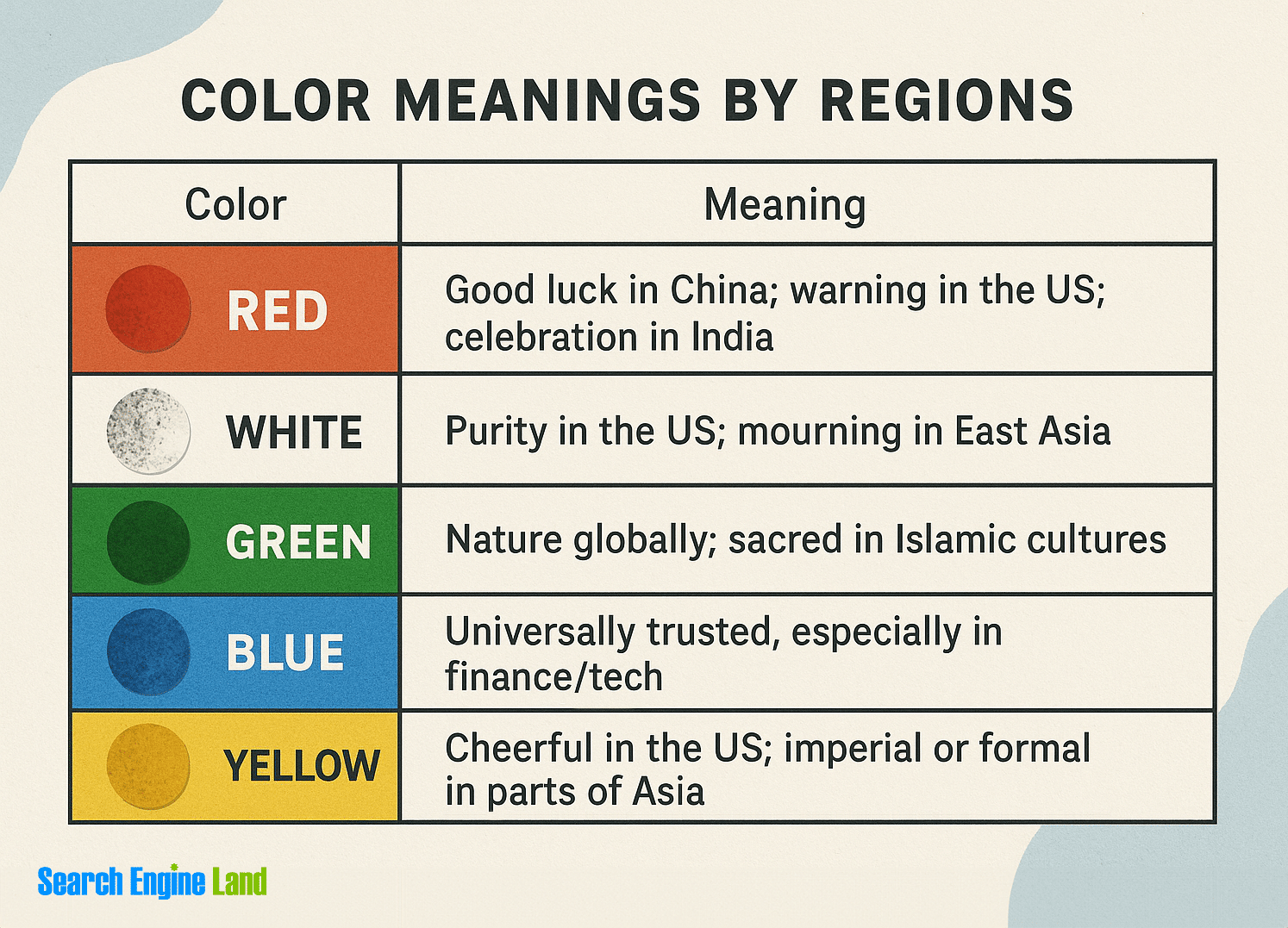
- Color choices signal different emotions
- Layout preferences reflect regional expectations
- Trust-building elements vary by culture
- Payment, tax, and delivery options impact purchase confidence
Note: In international SEO, UX isn’t just a “nice to have.” It directly influences bounce rate, time on site, and conversion—factors Google increasingly weighs via UX signals.
Localized UX elements that matter most
Visual Design & Layout Preferences
Users associate certain aesthetics with professionalism or sketchiness based on cultural norms.
Layout preferences by region:
- German-speaking markets: Prefer detailed information hierarchies, comprehensive specs, and dense layouts
- Scandinavian markets: Favor minimalist design, ample white space, and clean structure
- East Asian markets: Comfortable with information density, consensus-driven testimonials, and multiple payment options
- Latin American markets: Respond well to vibrant visuals, social proof, and family-oriented messaging
- Middle Eastern markets: Require RTL layouts and culturally appropriate visuals
Color psychology is especially important and varies by region:
Currency, measurements, and cultural nuances
Currency and pricing display significantly impacts conversion rates. Proper currency localization removes friction from the purchase process and builds trust with international customers.
Currency implementation best practices:
- Real-time conversion: Update exchange rates at least daily, preferably hourly for volatile currencies
- Local payment methods: Support preferred payment options (Alipay for China, iDEAL for Netherlands, Boleto for Brazil)
- Tax transparency: Clearly display tax calculations according to local requirements and expectations
- Pricing psychology: Adapt pricing strategies to local market expectations
Tip: Research local cart abandonment reasons. Many are UX-related, not pricing-related.
Language, forms, and CTAs
A CTA may be grammatically correct, but if it doesn’t feel culturally natural, it won’t convert.
Key form and language considerations:
- Tone: Many European markets (Germany, France) expect formal language; US and Australia prefer casual tone
- Address fields: Formats differ—Japan uses postal codes first; US puts them last, and UK addresses can involve multiple extra lines
- Name fields: Some regions use a single field; others require separate given/family names
- Scripts and input:
- Support non-Latin alphabets (e.g., kanji, Cyrillic)
- Accommodate RTL languages (Arabic, Hebrew)
- Allow for mobile autofill quirks and localized keyboards
Example: A UK user expects “Postcode,” not “ZIP code.” Small mismatches like this can reduce trust and cause form errors.
International site speed and CDN considerations
Geographic distance introduces latency that can stretch page loads by several seconds especially in mobile-first regions.
Track, optimize, and win in Google and AI search from one platform.
Use a Content Delivery Network (CDN) with strong regional presence to minimize lag and ensure fast, localized delivery.
Recommended CDN options:
- Cloudflare, Akamai: Global reach
- Alibaba Cloud: Best for China (must meet ICP requirements)
- KeyCDN, BunnyCDN: Great performance in Europe and the Middle East
Global CDN configuration checklist:
- Enable geo-routing: Route visitors to nearest servers
- Compress assets: Use Gzip or Brotli
- Minify scripts and optimize images
- Monitor performance by region: Prefer real-user monitoring (RUM) over synthetic tests
- Configure per-folder caching: If using subfolders (/fr/, /es/), set CDN rules accordingly
Mobile-first experiences globally
Mobile usage patterns vary widely. In some markets, over 80% of traffic is mobile; in others, desktop still dominates.
Understanding these differences is essential for both technical and UX decisions.

Optimizing for mobile UX in these regions isn’t just responsive design. It means:
- Shorter text and headings
- Tap-friendly buttons and form fields
- Lazy-loading for large images
- Fast mobile load speeds
Next steps: Scaling your international SEO strategy
International SEO doesn’t end with hreflang tags or ccTLD decisions. Once the foundation is in place, execution at the local level becomes the differentiator through targeted keyword research, culturally relevant backlinks, and UX that feels native, not translated.
Start by choosing one high-priority market. Use clear criteria to guide your focus:
- Business opportunity: Market size, competition level, revenue potential
- Cultural alignment: Brand fit and user expectations
- Competitive landscape: Ability to gain early authority
Then apply three core frameworks:
- Localized keyword research
- Market-specific authority building
- Culturally adapted UX optimization
Don’t wait for perfection.
Launch with strong fundamentals, then iterate based on market feedback and performance data. The most successful international SEO campaigns prioritize learning and adaptation over initial perfection.
In Part 3 of this international SEO series, we’ll cover the next critical steps:
- How to avoid the most common (and costly) international SEO errors
- How to track visibility, performance, and ROI across regions
- How AI, SGE, and non-Google engines are reshaping global search
In the meantime, consider brushing up on your technical fundamentals of auditing underperforming international sections while making the most of Excel for SEO: you’ll need both to scale and move into a deeper strategy.
Explore more on
Editorial disclosure
Search Engine Land is owned by Semrush. We remain committed to providing high-quality coverage of marketing topics. Unless otherwise noted, this page’s content was written by either an employee or a paid contractor of Semrush Inc.
About the author