Writing for SEO: How to write snippet-friendly content that wins in Google and LLMs


The SEO landscape in 2026 demands more than just strong writing skills. You must write with both humans and machines in mind to succeed at writing for search engine optimization—crafting content that’s concise, semantically rich, and structured for maximum extractability.
Whether you want to rank in Google’s featured snippets or be surfaced by LLMs like ChatGPT or Perplexity, your content must answer questions clearly, precisely, and contextually.
In this guide, we’ll walk through the mechanics behind writing snippet-friendly content that performs across platforms.
Understand the dual audience: Humans and machines
In 2026, writing for the web means writing for multiple audiences simultaneously—both human readers and also the algorithms that deliver your content across search engines and AI-powered platforms. This includes Google’s advanced ranking systems, natural language processing (NLP) models, and large language models (LLMs) like ChatGPT, Gemini, and Perplexity.
These systems don’t just crawl your content—they extract, summarize, and repurpose it. If your content isn’t structured in a way that machines can easily interpret, you’re leaving visibility on the table.

Your content must deliver fast, scannable, and authoritative answers to perform well across both Google and LLMs. Readers are impatient, and AI tools are even less tolerant of ambiguity or filler.
Prioritize clarity by front-loading answers and keeping your paragraphs tight. Structure your content using semantic headings (<h2>, <h3>), bullet points, and well-labeled sections. Machines use these signals to identify what each part of your page is about—and to determine whether it qualifies for featured snippets, voice search answers, or AI-generated responses.
For example, consider the query: What is technical SEO? A snippet-optimized response would be:
Technical SEO refers to the process of optimizing a website’s infrastructure so search engines can crawl, index, and render it efficiently.
This sentence works because it’s complete, concise, and self-contained—exactly what search engines and LLMs look for. It defines the term using plain language, includes the core entity (“technical SEO”), and can be easily quoted without needing additional context. That’s the kind of content that ranks, gets quoted in AI tools, and builds your brand’s visibility across the modern search ecosystem.
The SEO toolkit you know, plus the AI visibility data you need.

Start with the answer: The inverted pyramid approach
Clarity and immediacy are essential in today’s search landscape. Gone are the days when you could meander through a warm-up paragraph or tease the reader with rhetorical questions before getting to the point.
Snippet-optimized content—the kind that appears in featured snippets, voice search results, and LLM-generated answers—prioritizes directness. This means answering the core question within the first sentence or two of a section, then elaborating with context, examples, or supporting details. The goal is to help both search engines and users find value fast.
To understand this shift, compare these two examples:
Do you know who you’re creating content for? If not, it’s time to take a step back.
This feels conversational but ultimately vague. It delays the point and provides no concrete value until the reader continues reading. In contrast, the stronger alternative:
To write effective content, you must first define your audience. Knowing their needs and intent ensures relevance and improves your chances of ranking.
On the other hand, this delivers a complete, standalone insight right away. It immediately answers a likely search query (“How do I write content for my audience?”), making it ideal for snippet extraction.
This style of writing mirrors the inverted pyramid used in journalism: lead with the most important takeaway, then add supporting information. For SEO, this structure increases your content’s chances of being pulled into a featured snippet or used as a direct answer in an LLM response. It also builds trust with readers who are scanning quickly and want fast, useful answers.
Tip: Treat every paragraph as if it could be lifted and quoted out of context. Ask yourself: If this section appeared in a Google snippet or an AI summary, would it still make sense? Would it provide real value? If not, revise it until it does. This simple editorial mindset shift dramatically improves your content’s snippet potential.
Optimize for question-based and intent-driven queries
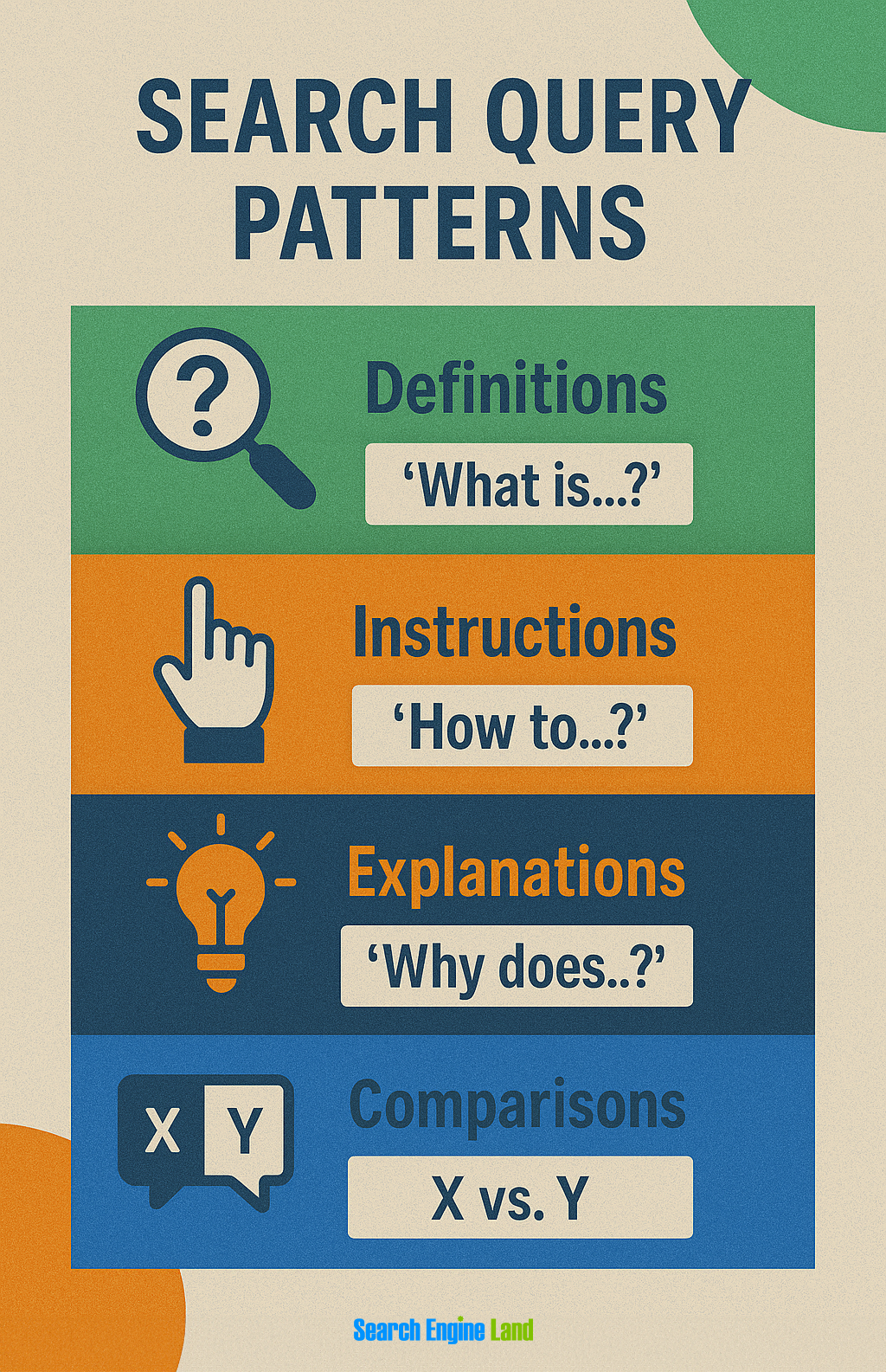
Google’s featured snippets and LLM-generated summaries are often triggered by specific query patterns that reflect a user’s search intent. These include definitions (“What is…”), instructions (“How to…”), explanations (“Why does…”), and comparisons (“X vs. Y”). Each of these patterns corresponds to a predictable answer format that Google can easily extract and display in a snippet. By aligning your content structure with these formats, you increase the likelihood of being featured at the top of the search results and referenced by AI systems.
For example, definition queries like “What is a canonical tag?” should begin with a clear and concise answer:
A canonical tag is an HTML element that tells search engines which version of a page is the preferred one when multiple pages have similar or duplicate content.
This sentence is optimized because it directly answers the question, introduces the term, and explains its purpose—all in one self-contained thought.
Similarly, process-based queries like “How do you improve crawl efficiency?” should list steps in order, using bullets or a numbered list to signal structure. Comparison queries like “Alt text vs. image captions” benefit from side-by-side formatting or a table to clearly differentiate between the two concepts.
Let’s take a practical example: if your target keyword is “how to improve page speed,” an effective snippet-eligible paragraph might read:
To improve page speed, compress images, minify CSS and JavaScript files, enable browser caching, and limit third-party scripts that slow load times.
This answer is concise, instructional, and complete—perfect for snippet inclusion.
By mirroring the language and structure of the query itself, you’re signaling to Google and other NLP systems that your content is optimized to provide fast, useful answers to common search intents.
Use entity-first and semantic SEO strategies
Keyword stuffing—the outdated practice of repeating the same phrase excessively to signal relevance to search engines—is no longer effective and can even harm rankings. In 2026, Google’s algorithms and large language models (LLMs) have evolved to understand entities and semantic relationships rather than relying on keyword frequency.
An entity is a clearly defined concept or object (like “technical SEO,” “search engine,” or “canonical tag”) that search engines can identify and connect to other concepts in a knowledge graph. Instead of looking for exact-match keywords, Google now evaluates how well your content represents and relates entities within a topic cluster.
To illustrate, consider a weak example that relies on outdated keyword repetition:
SEO is important. SEO helps you rank. SEO is about SEO best practices.
While this repeats the keyword “SEO,” it says very little and lacks depth or variety. In contrast, a more semantically rich and entity-based version would be:
SEO involves several components, including content optimization, technical performance, and backlink quality. One of the most foundational aspects is technical SEO, which ensures search engines can access and understand your site.
This version introduces the main entity (“technical SEO”), references related entities (“content,” “backlinks,” and “crawlability”), and helps machines understand how these concepts connect. It’s not just optimized for search—it’s structured for comprehension and context.
This shift to semantic SEO means your content should reflect a topic’s natural ecosystem. Think about how the entities interrelate and cover them holistically instead of repeating a target phrase.
By aligning your content with the way Google builds its knowledge graph, you’re not only improving your rankings—you’re making your content more useful for LLMs, voice assistants, and searchers alike.
Your new guiding principle in writing for SEO: use the keyword AND demonstrate mastery of the topic it represents.
Format content for NLP and snippet parsing
Both machines and users depend on structure to quickly understand and navigate content.
- Predictable formatting provides clear signals about content hierarchy, relationships, and context for Google’s crawlers and natural language processing (NLP) systems.
- Visual structure improves readability and trust for human readers (especially those skimming on mobile or looking for quick answers).
In short, structured content reduces cognitive load and increases extractability, making it more likely to be featured in a snippet or cited by an AI tool.
Use semantic HTML elements purposefully to optimize for both audiences:
- <h2> and <h3> tags help define sections and subsections, signaling topical shifts to both screen readers and search engines.
- Lists formatted with <ul> or <ol> are ideal for how-to content or checklists, allowing Google to extract answers for featured snippets with step-by-step instructions.
- Applying <strong> to key terms or summaries can help highlight the most important information.
Structured data is often enhanced when the formatting itself is semantically meaningful—not just visually styled for users.
Tables, in particular, are powerful tools for comparing entities or concepts. Consider a comparison query like “canonical tag vs. noindex.” Instead of burying the differences in dense text, a table can clarify things instantly:
| Canonical tag vs. noindex | ||
| Feature | Canonical Tag | Noindex Tag |
| Purpose | Consolidates signals | Prevents indexing |
| Affects Crawl? | No | Yes |
| Affects Indexing? | Suggests preference | Blocks entirely |
This format allows users to scan for answers and enables machines to categorize information precisely. This also boosts the chance that your content will be used as a reference point for AI summarizers.
Whether you’re explaining product features, comparing strategies, or outlining pros and cons, structure your content like a blueprint—clear, repeatable, and easy to digest.
Cut the fluff: Write with concision & clarity
Bloat is the silent killer of snippet-friendly content. In the race to sound engaging or persuasive, many writers over-explain, use unnecessary qualifiers, or include fluffy intros that delay the actual value. This kind of padding might feel stylistically rich, but it confuses search engines and frustrates readers—especially those looking for quick answers.
From an SEO perspective, this approach reduces the likelihood that your content will be featured in snippets or selected by LLMs for summarization, because those systems prioritize clarity, concision, and self-contained meaning.
Let’s look at an example:
Content is important, but not just any content. You need the kind of content your audience actually wants to read.
These sentences say very little, even though they sound emphatic. This example lacks specificity and relies on vague encouragement rather than delivering insight. In contrast, consider a stronger version:
High-performing content is aligned with user intent, answers specific questions, and offers immediate value.
This delivers a concrete takeaway. It’s clear, scannable, and conveys practical value in a single sentence. This is the kind of writing that gets extracted by Google for featured snippets and LLMs for response generation.
To make your writing snippet-ready, follow a few key compression principles.
- Keep question-answering paragraphs to one to two sentences, especially when responding to specific search intents. This helps each unit of text function independently and be more easily lifted into snippets.
- Eliminate unnecessary adjectives, adverbs, and hedging phrases like “probably,” “a bit,” or “in most cases.” These weaken clarity and dilute authority.
- Steer clear of marketing clichés. Phrases like “game-changer,” “unlock your potential,” or “in today’s fast-paced world” do little to inform and instead clutter your message.
You make your content more digestible for users and also more accessible for AI systems by stripping away the filler and focusing on precision.
Think of each paragraph as a standalone answer: If someone read it out of context, would it still be useful? If not, fix it or cut it. This approach results in content that’s leaner AND more likely to rank, be quoted, and be remembered.
Adapt to 2026 search behavior and AI consumption
User behavior has shifted dramatically in recent years, and 2026 marks a turning point in how people interact with information online. Rather than typing short, keyword-heavy searches like “SEO backlinks,” users now speak or type in full, conversational queries.
Whether it’s through voice assistants (“What’s the best way to increase backlinks?”), AI chatbots (“How do I fix a redirect chain in SEO?”), or direct prompts to tools like ChatGPT (“Summarize Google’s Helpful Content update in one paragraph”), people expect natural, complete answers that match their tone and intent. This evolution in behavior means that your content must now be optimized for natural language, not just keyword inclusion.
This shift has real implications for content creators. First, your headings and subheadings should mimic the actual questions users ask. These aren’t just useful for structuring content—they also improve your chances of ranking in People Also Ask boxes, voice search results, and LLM-generated answers.
A heading like “What does Google consider helpful content in 2026?” is much more likely to trigger a snippet than something generic like “Google’s content update.” Natural phrasing not only improves readability but also helps Google and AI systems match your content to long-tail search queries.

Second, your content must be written with summarization in mind. AI agents and LLMs frequently extract short, high-quality passages to answer questions, so your writing should be structured in tight, standalone units. Lead with a clear answer and follow up with concise supporting details—no long-winded intros or buried insights. If a section can’t be copy-pasted into a chatbot response and still make sense, it’s time to rewrite it.
In short, the rise of voice search and AI-driven browsing demands a new content standard: conversational, context-aware, and cleanly structured. Writers who adapt to this reality will not only rank higher in search but also become go-to sources for the next generation of AI-powered discovery tools.
Write for LLM visibility and summarization
Large language models (LLMs) like ChatGPT, Gemini, and Claude are increasingly shaping how content is discovered, summarized, and shared online. These models don’t just look for keyword relevance—they prioritize content that demonstrates E-E-A-T: Experience, Expertise, Authoritativeness, and Trustworthiness.
This is the same standard Google uses in its Search Quality Evaluator Guidelines, and it signals that your content was created by someone who knows the topic, can prove it, and provides accurate, valuable information. LLMs are designed to amplify trustworthy sources, meaning that demonstrating E-E-A-T directly affects your visibility in AI-generated responses.
Beyond credibility, LLMs favor content that is clear, structured, and fact-based. Long-winded, speculative, or overly promotional content tends to be skipped in favor of tight, declarative statements.
Think of it this way: an AI assistant needs to find a paragraph that can be confidently dropped into a user’s answer stream. That means writing in short, information-dense blocks with strong topic sentences, well-defined terms, and no hedging language. The more your content sounds like a polished, confident explanation, the more likely it is to be selected and surfaced.
Test whether your content meets this standard by reading your paragraphs aloud—or imagine them being read by an AI assistant in a customer-facing app. Would it sound like a knowledgeable, no-fluff answer? Or would it meander or feel vague?
This sentence works well for both humans and machines:
Google’s Helpful Content System prioritizes content written by people, for people, that demonstrates real-world experience.
Avoid automation for automation’s sake. It’s brief, confident, informative, and requires no surrounding context to make sense. That’s exactly the kind of writing that LLMs extract and amplify.
Ultimately, the new bar for online visibility isn’t just about SEO. It’s about being quotable. If your paragraph can be dropped into a chatbot conversation, summarized in an AI output, or featured as a snippet—all without needing editing or explanation—you’ve won.
The key? Write as if you’re already part of the AI conversation. Because in 2026, you are.
Final tip: Treat every paragraph like a product
In a world dominated by AI-generated summaries and fragmented content consumption, every paragraph must stand on its own.
Think about how readers and machines interact with content today: rarely do they read an entire article top to bottom. Instead, they skim, click, highlight, or rely on AI tools to surface and extract the most relevant snippets. That means any single paragraph may be the only exposure a person—or an LLM—has to your brand or expertise.
Ask yourself: If this one paragraph were pulled into a chatbot, featured in a snippet, or quoted on another site, would it make sense? Would it deliver value?

This is a new kind of litmus test for content quality. A strong paragraph should answer a specific question, provide context without relying on surrounding text, and convey authority. For example, take the sentence:
Internal linking helps search engines understand site structure, distributes link equity, and improves user navigation—making it a foundational technical SEO tactic.
This sentence delivers a complete idea, reinforces expertise, and could be quoted without needing additional framing.
On the other hand, consider something like:
Let’s dive into why this is important for your strategy.
This sentence lacks clarity, specificity, and standalone value—and is unlikely to be surfaced by Google or LLMs.
In 2026, your content is not just competing to rank—it’s competing to be quoted, shared, summarized, and synthesized by platfoms, tools, and users alike.
This shifts the goal of content creation from simple optimization to strategic communication. You’re not writing filler. You’re writing building blocks—each paragraph a potential micro-asset in the digital knowledge economy.
The mantra to guide your writing in this era is simple but powerful:
Write to rank. Write to be quoted.
If you internalize this, your content won’t just be seen—it will be cited, shared, and trusted at scale.
By mastering these strategies, you’re not just writing better content—you’re writing content that commands visibility in the two most important arenas of modern discovery: Google and generative AI.
And that’s how you win in 2026.
Explore more on
Editorial disclosure
Search Engine Land is owned by Semrush. We remain committed to providing high-quality coverage of marketing topics. Unless otherwise noted, this page’s content was written by either an employee or a paid contractor of Semrush Inc.
About the author