From chaos to clarity: How to create content briefs for SEO

Creating a quality piece of content is hard work. Depending on the size of your team, it may involve dozens of hours and several stakeholders. How can you simplify this process and keep everyone on the same page? Easy—just use a content brief.
It’s true that developing a content brief requires some initial effort up front. But they pay tremendous dividends, keeping your content production on track and optimized for success. They’re like a game plan, helping writers, editors, and everyone on your team understand their roles and perform at their best.
In this article, we’ll shine a spotlight on these unsung heroes of content creation, describing their essential components and how easy it is to develop one for your next campaign.
What is a content brief?
A content brief is a document containing instructions and guidelines for creating an article or other piece of written work.
In search engine optimization (SEO), content briefs typically contain details about key marketing objectives and the on-page elements necessary to achieve them. Most also include an outline comprising the various parts of the article, with headers (i.e., H1s, H2s, and H3s) for each topic that needs to be covered.
Although any website can take advantage of SEO content briefs, they’re most common among online publishers and agencies that generate web articles.
Generally, an SEO specialist or content strategist will develop the content brief and share the document with relevant stakeholders, including:
- Writers
- Editors
- Graphic designers
- Content designers
- Content managers
- Project managers
- Clients
On smaller content teams, you may occasionally see writers, editors, and content managers pitch in and help develop content briefs. It’s an essential skill, and everyone on the team can benefit from understanding how to make one.
The SEO toolkit you know, plus the AI visibility data you need.

What’s the difference between a content brief and a creative brief?
Content briefs and creative briefs are similar in purpose and principle. The one key difference is the type of project each pertains to.

For example, SEO content briefs typically guide long-form web content like blog posts, articles, white papers, and case studies. Creative briefs, on the other hand, touch on a broader variety of marketing endeavors, including advertising campaigns, social media campaigns, graphic and web design, and even video storyboarding.
The primary area of overlap is short-form written content like copywriting. While this usually falls under the scope of creative briefs, some companies use content briefs to guide the process—especially when it comes to landing pages.
Choosing the right type of brief is ultimately a matter of preference and what works best for your specific project.
Benefits of writing a content brief
Writing an effective content brief and sharing it with your team has many benefits. Let’s discuss some of the most impactful ways it can improve your day-to-day operations.
Aligns SEO goals with content creation
Crafting an article with SEO in mind requires far more planning and preparation than, say, writing a simple blog post about your family life.
When developing search-optimized content, you must account for a range of factors:
- Keywords
- Search intent
- Intended audience
- Word count
- Title tags
- Meta descriptions
- Schema markup
- and more
Content briefs bring all these elements together, providing clear instructions on applying each to meet broader SEO goals and craft high-quality content. Equally important, a quality SEO brief is a common reference point for writers and stakeholders throughout the content creation process.
Prevents miscommunication between strategist and writer
Poor communication leads to poor performance in just about every industry. But it’s especially relevant in SEO, where miscommunication between a strategist and writer can cause endless back-and-forths and extensive rewrites.
A content brief is a communication bridge linking your planning and production channels. It clarifies an article’s purpose, target audience, and messaging before the first draft is even written. This ensures the writer understands not just what to say but how to apply their efforts within the context of the broader content strategy.
Increases content performance and rankings
Ranking in the search engine results pages (SERPs) requires careful planning around countless on-page and off-page elements that provide context for search engines and ensure a quality user experience. In other words, there are a ton of moving parts. A well-constructed content brief guarantees that each element has been considered and integrated into the process right from the start.
By providing clear SEO direction upfront, a brief helps writers create content that shows up in search engines and resonates with readers—leading to better rankings, longer session times, and higher conversion potential.
Improves productivity
A well-crafted brief streamlines the entire content creation process, allowing your team to work quickly and efficiently.
Content briefs eliminate guesswork and provide a clear roadmap for writers, editors, and everyone involved by outlining key elements like search intent and content structure. They also reduce the time each team member must spend asking for clarification or researching additional information, allowing them to jump right into their assigned tasks.
Components of a good content brief
Think of content brief components like the ingredients in a recipe. You don’t want to go overboard with flavors, but you do want to include all the key ingredients for a delightful dish. Balance is key.
With that in mind, let’s discuss the key ingredients of a successful content brief.
Target keyword(s) and search intent

Most SEO articles revolve around a primary keyword, a word or phrase that serves as the central theme for a piece. Most articles also include secondary keywords, similar words and phrases that provide additional context and clarity.
Why is it important to include these relevant keywords in a content brief?
For one, it allows writers and editors to better understand search intent (the reason a person searches for your primary keyword) and develop an overarching narrative for the article. Plus, it lets your team insert those must-have keywords into the article as it’s being created, establishing a natural flow and smooth reading experience.
SEO title & meta description

An SEO title is the click-worthy headline that appears in the SERPs, while a meta description is the summary of a page’s content that appears under the search title.
They’re both critical for multiple reasons. First, they help search engines like Google and Bing determine an article’s relevance to a search query. They also act as a point of first contact with potential readers. An engaging SEO title and meta description will entice users to click your article and drive organic traffic to your website.
Article type
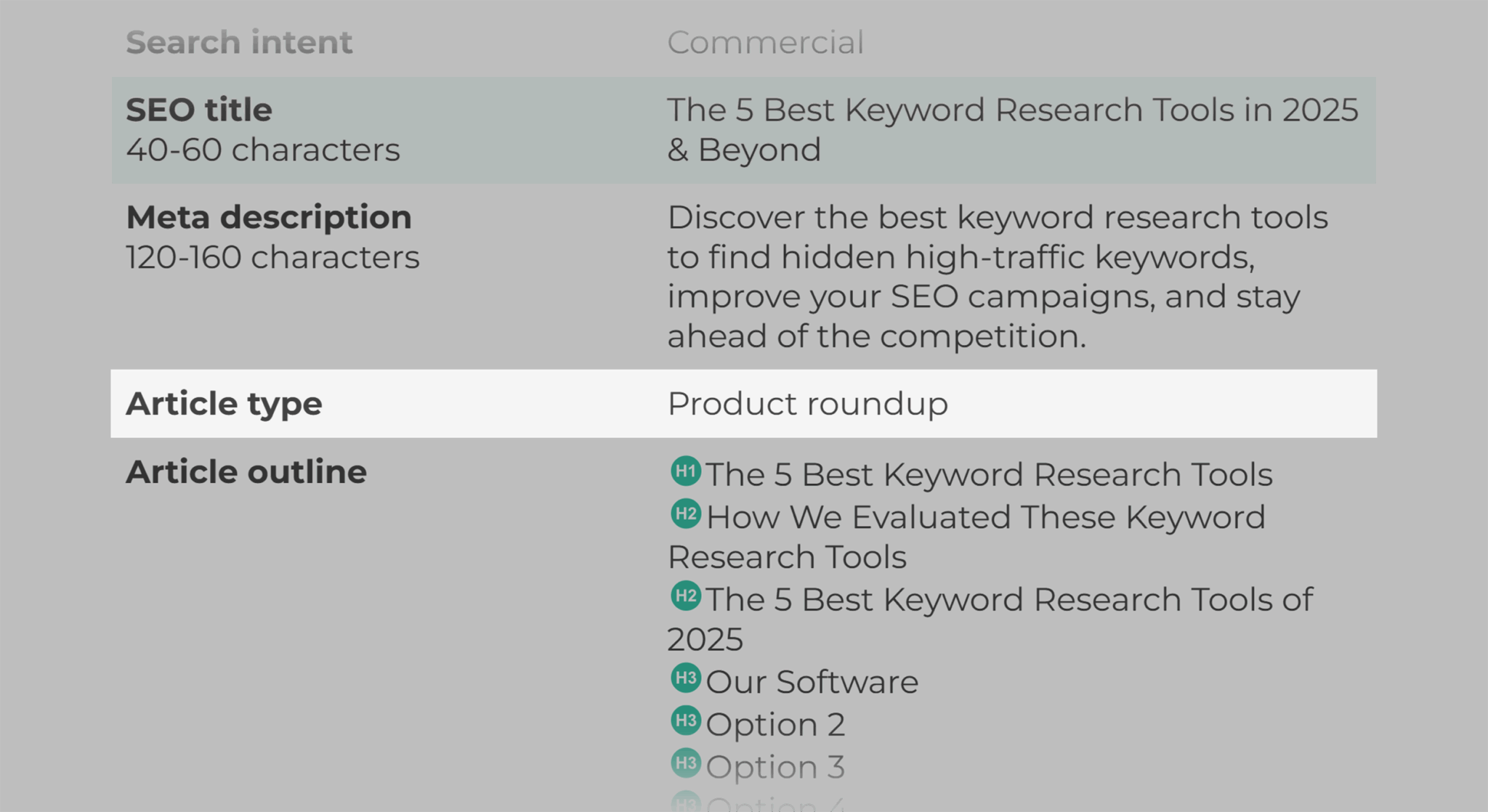
Although every article differs, many websites publish content featuring a standard set of shared characteristics. Here are some of the most common types of articles you’ll encounter:
- Case studies: Detailed breakdowns of real-world results or processes
- Comparisons: Side-by-side comparisons of two or more products or services
- Guides: Comprehensive overviews of specific topics or activities
- Instructionals (how to): Step-by-step instructions for performing specific tasks
- Listicles: Lists (often top tens) of items that fit a particular category
- News: Timely content covering industry developments
- Product roundups: Lists of related products, designed to show a selection of options available
- Reviews: In-depth evaluations of a single product or service, usually based on hands-on testing or detailed research
Why is defining the article type within your content brief so important? Once you’ve identified the kind of article you’re writing, it’s much easier to develop an appropriate structure and help your team format the piece appropriately.
Outline and header structure
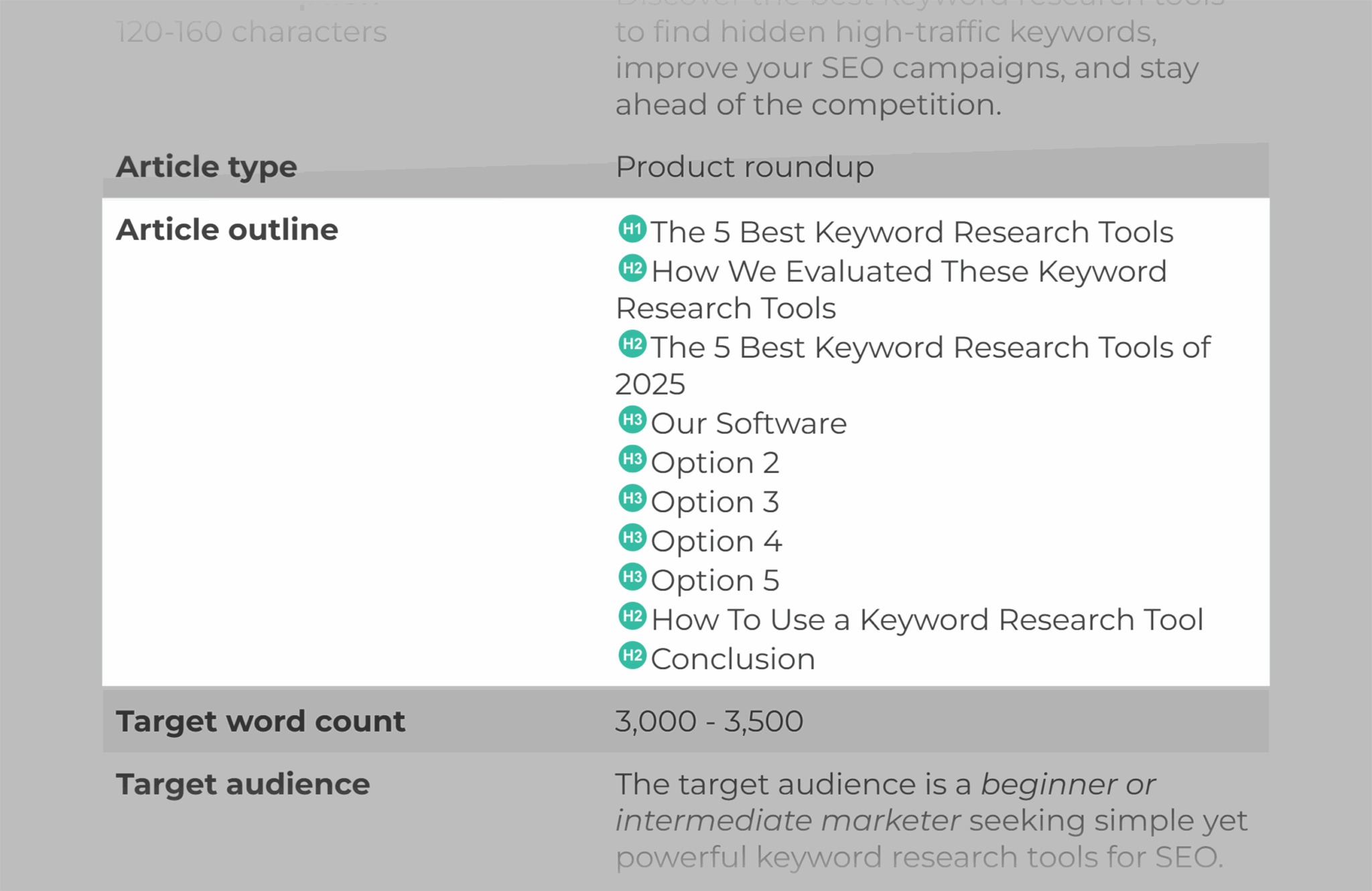
Outlines are key components of quality content briefs. While there are various ways to organize these outlines, they all start with header structure.
Header structure consists of HTML header tags (H2, H3, H4, etc.) containing the “sections” within an article. Take this very section, for instance. This paragraph you’re reading nests under the h3 you see above, which itself nests under a broader H2.
These headers provide a general overview of what’s expected in each section. This keeps writers on topic and ensures adherence to the overall requirements for a piece.
Word count guidance

There’s no “one size fits all” target word count in modern SEO—it varies depending on the topic. An article needs to be long enough to cover a concept adequately but concise enough to remain on topic and keep readers’ attention.
When it comes to including word count in a content brief, it’s often best practice to provide a range. For example, you may mention a target of 2,000 to 2,500 words, with some flexibility should a writer realize mid-way through the creation process that a piece requires more or less detail.
Target audience

SEO content is all about solving readers’ problems. Your company likely has customer personas in mind, and you want to structure your article’s primary keyword and search intent around that audience. This will help you identify what their needs are and what content you produce to meet those needs.
Are you writing about healthy dog treats? Your target audience is probably a health-conscious pet owner who loves their dog and wants to supply them with nutritious, tasty snacks. Are you writing about SEO? Your target audience is probably a marketer (either hobbyist or professional) hoping to rank higher in the search results.
It’s important to determine your artice’s target audience because it tells your writer who they’re talking to. With this information, your writer can speak directly to the audience’s pain points and provide them with the right solutions.
Tone and voice

Casual and conversational, or serious and academic? Depending on the topic and your target audience, there’s a time and a place for both.
With that said, SEO articles tend to use a more informal tone of voice, unless you’re writing for an enterprise audience. Lighthearted conversations are more pleasant and engaging, and that’s what most users expect from web-based content.
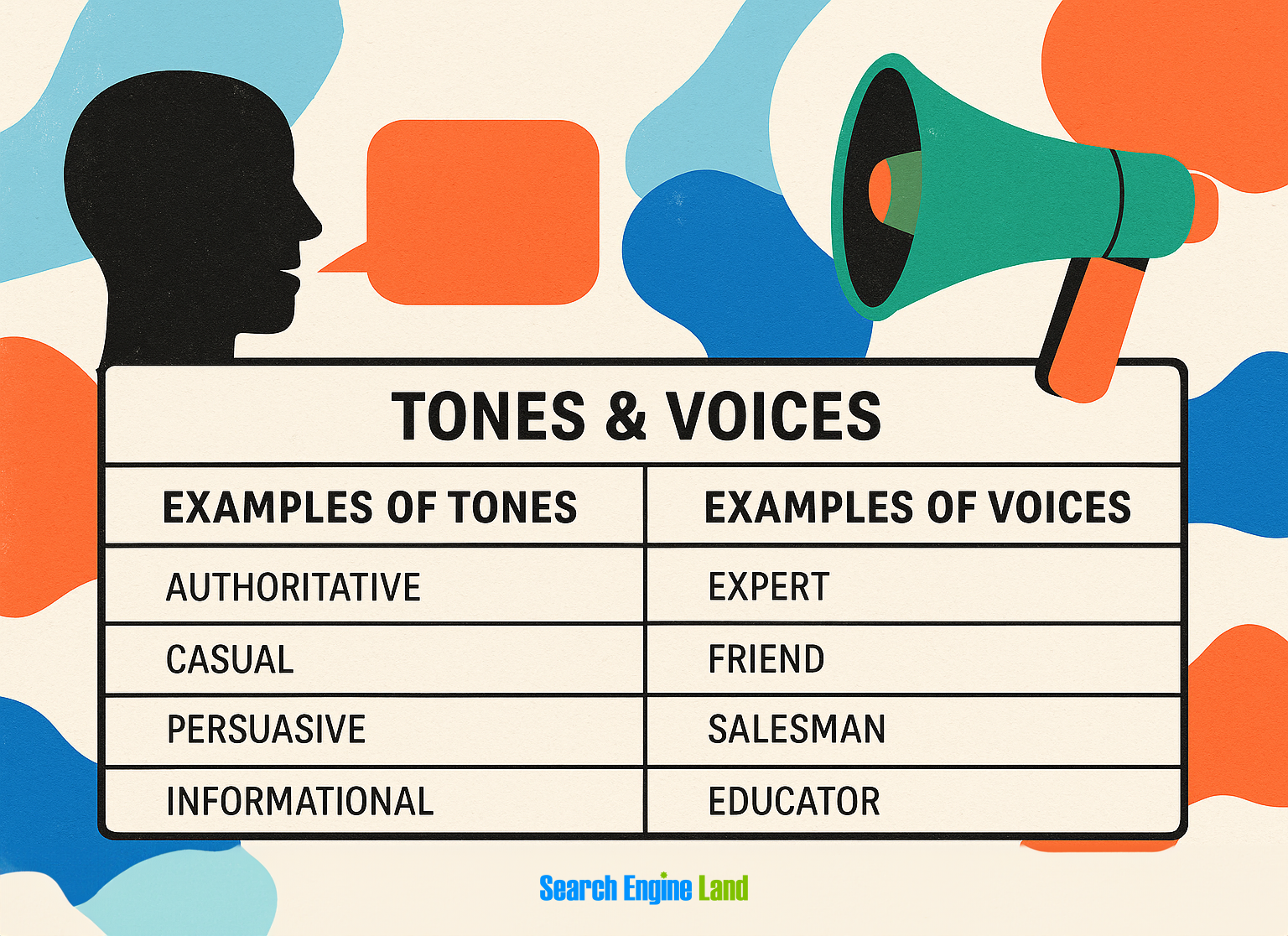
As for voice, that depends more on your brand’s persona. Does your company want to present itself more as a friend or an educator? Perhaps, as is sometimes the case on landing pages, it wants to come across as a salesman?
Here are some common tones (the inflection) and voices (the person) used within SEO articles:
Internal link suggestions

According to a study by Authority Hacker, internal linking profoundly affects your website rankings. In other words, internal linking across your site can make a big difference in the SERPs, making it a cornerstone aspect of your on-page SEO strategy.
Unfortunately, writers, editors, and even publishers often overlook internal linking. Help nudge your team in the right direction by providing a few internal link suggestions within your content brief. Even if the piece needs additional links—or if an editor decides to forego one of your selections—they will set expectations for the content you want to promote.
Competitor references
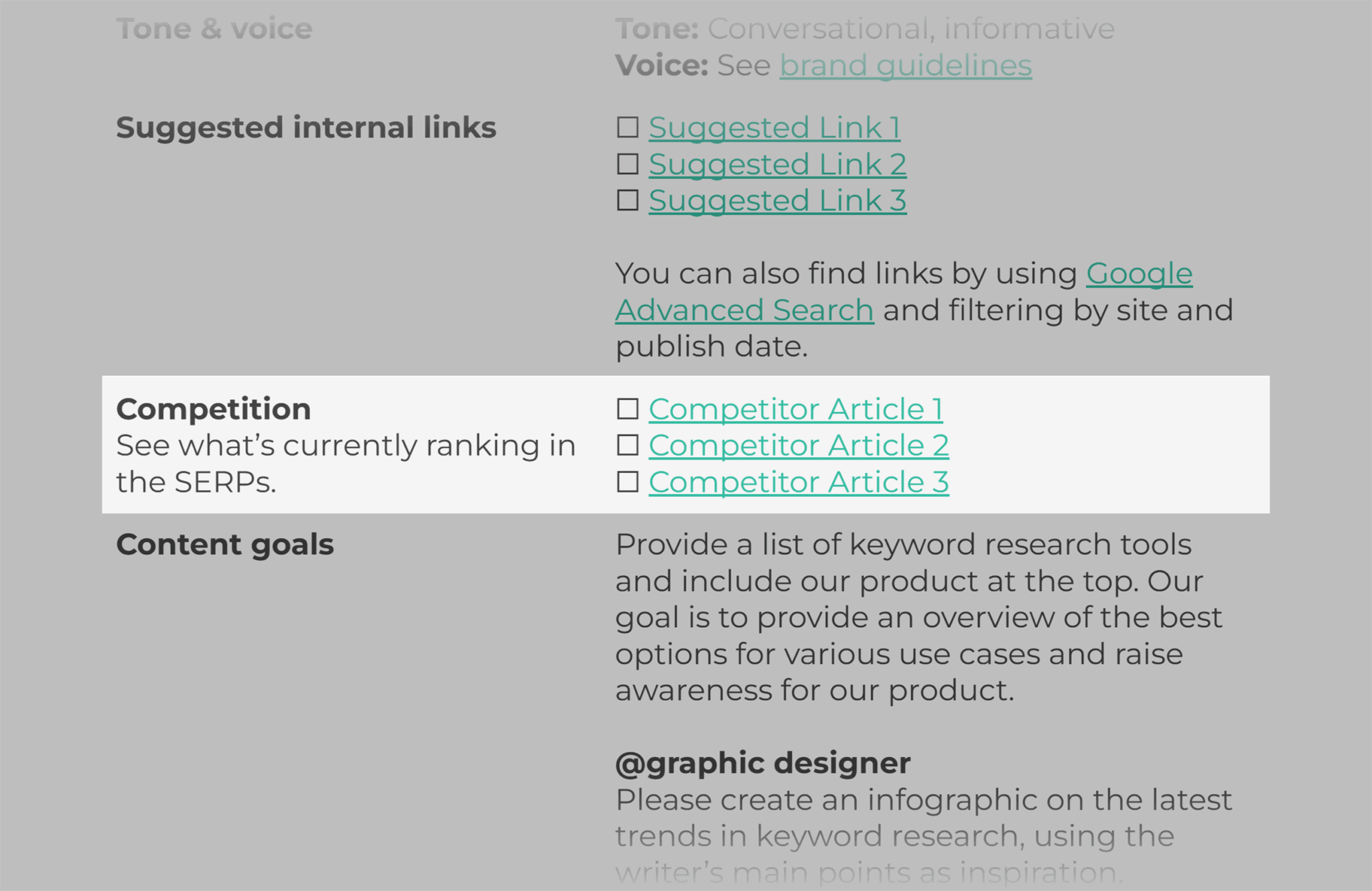
Content already ranking well in the SERPs for your chosen keyword can be a wealth of quality information for everyone on your team. It shows you what’s working regarding discussion points, writing style, overall structure, and much more. It also gives you insight into content gaps and possible improvements.
That’s why we recommend including links to these articles within your brief. Find the ones you want your writer and stakeholders to read and scrutinize so they can learn and implement the lessons.
Content goals and CTA

Why does your website exist? It could be a hobby website you write for fun or monetize via ads. Or perhaps you sell a product or service, and your content is part of a broader marketing funnel.
This is pertinent information for your content brief. Positioning is important, and your writer and content designer should understand what question your article answers and how it supports your website’s overarching goals. Equally important, they need to know what types of calls to action (CTAs) should be included in the piece and how those should be incorporated into the outline.
Notes and extras

The sky’s the limit concerning what you can include in your content brief. If a piece of information would be helpful, please include it!
But be careful not to go overboard, especially on smaller teams. You don’t want to overwhelm your colleagues with too many details. Not to mention, too many expectations and restrictions can hinder the creative process.
Of course, if you’re working within a larger team and everyone uses the brief as a reference, you probably want to be more thorough and account for the full range of responsibilities.
Pro tip: Add callouts to any section within your content brief to indicate that particular information is intended for a specific person or position.
Here are some extra sections you may want to include in your content brief:
- Notes: A dedicated place to provide extra details to various members of your team
- Schema: A section to discuss what types of structured data you’d like to include on the published page
- FAQs: A place to write down common questions and audience pain points, allowing the writer to address these within the content
- Images: A place to link recommended images and corresponding alt tags, giving the content designer a better understanding of what imagery to incorporate and how to optimize it
While these are somewhat common “extra” sections found in content briefs, feel free to mix things up! Every team is different, and your content brief template should reflect what works best for your workflow.
How to create a good content brief
Creating a good content brief takes time—especially your first one. Be thoughtful in your approach and don’t rush the process. Once you master these steps, developing the perfect content brief will become second nature.
Step 1: Preliminary research and preparation
The first step in creating a good content brief? You guessed it: research!
Researching for a content brief is always essential, especially when you know little about the topic. After all, how can you create a quality set of guidelines for others when you don’t even know the basics yourself?
Scour the first few articles in the SERPs to learn more about the topic of discussion. And while you’re here, keep tabs on these articles’ general structure and optimization strategies.
Consider questions like:
- Is there a clear primary keyword? Hint: Look in the URL and article title.
- Who is this article written for and for what purpose?
- What do the headers say, and how is the article structured?
- Are there any obvious content gaps or missing details?
Familiarize yourself with the topic, and take notes in a Google or Word document. This will become the foundation of your brief.
Keyword research
If you haven’t done keyword research for your topic yet, now’s the time! Take what you learned about your topic, and develop some seed keywords (one to three-word phrases) related to the subject matter. Then, head to Search Engine Land’s handy keyword generator for ideas.

In your research document, jot down any that pique your interest. Save these for the next step of this process.
Pro tip: If you’d like to learn more about keyword research, we’ve developed a complete keyword research guide that walks you through the basics.
Prepare your brief document
Feel free to spend as much time as you like learning the subject, scoping out competitor articles, and researching keywords. Once you have a decent grasp on the subject and a healthy list of keywords, it’s time to prepare your content brief.
Above the notes you took when evaluating competitor articles, create a two-column table corresponding to each content brief component we’ve discussed. On the left side of the table, list all the components you wish to include in the brief. You can leave the right side blank for now:

In the following steps, we’ll begin fleshing out the details and developing a comprehensive content brief.
Step 2: Define your keywords and search intent

Since your primary keyword serves as the primary subject of your article, it makes sense to start filling in the details of your brief by choosing one you want to use.
Look through your list of keywords, and find one that gets regular traffic and has a Keyword Difficulty (KD) score appropriate for your website’s Authority Score.
Once you’ve found one you like, you’ll also need to identify the search intent behind the keyword. Remember: search intent is why a person searches for your primary keyword.
There are four primary types of search intent:
| Types of search intent | What is the searcher doing? | Keyword examples |
| Informational | Seeking information | How to start intermittent fasting, what is machine learning |
| Commercial | Researching and comparing products | Best smartphones under $500, top-rated email marketing software |
| Transactional | Going to buy a product | Buy wireless noise-canceling headphones, download Adobe Photoshop trial |
| Navigational | Seeking out a specific webpage | Netflix login, Shopify pricing page |
Match your keyword against this table to uncover its search intent.
Unsure where your primary falls? Consider using Semrush’s keyword research toolkit, which analyzes your keyword and provides the corresponding search intent without all the legwork.
Now is also a good time to add any secondary keywords you found during your keyword research. Determine whether they make sense in the context of your article and add the matching ones into your brief. If not, you can conduct another round of research or forego secondary keywords for this piece.
Step 3: Write an SEO title and meta description
We know that SEO titles and meta descriptions provide context to search engines and act as CTAs for readers who see your article in the SERPs. But how do we write them?
Let’s review the basics of crafting optimal SEO titles and meta descriptions for your content briefs.
How to write an SEO title for a content brief

You want your title to be descriptive and contextual, but also punchy and engaging, piquing your audience’s interest and encouraging them to click through to your page.
How can you achieve these goals? To start, you’ll want your SEO title to be anywhere from 40 to 60 characters long. You’ll also want it to incorporate your primary keyword, preferably at the beginning or near the front of your title. To increase click appeal, consider including the current year, numbers in numerical format (7, not seven), and power words.
What are power words, exactly?
Power words are emotionally charged, attention-grabbing terms that boost click-through rates by making titles more compelling. Words like free, powerful, rare, and magical are all great examples of power words.
Taking all these factors into account, here are some examples of optimized SEO titles across various niches:
- Top 7 Productivity Tools for Remote Workers in 2025
- 2025’s Best Budget Laptops for Students—Ranked & Reviewed
- The Ultimate Guide to Keto Meal Prep: Recipes, Hacks & More
- How to Build a High-Converting Landing Page in 2025
- What Is a KVM Switch? A Clear Definition & Use Cases
You’ll notice that these titles aren’t deceitful about the content. In other words, they aren’t clickbait. But they do provide intrigue and encourage users to check out the full article for more details. Following a similar format for your SEO titles will allow you to enjoy better rankings and performance across your campaigns.
How to write a meta description for a content brief

Meta descriptions may be longer than titles, but they’re usually easier to write. Their purpose is to describe the content within your article and reinforce the SEO title’s proposition.
Like SEO titles, meta descriptions should be descriptive, engaging, and incorporate the primary keyword. Although there’s some wiggle room on target word count, an ideal length is between 120 and 160 characters.
Here are some examples of meta descriptions complementing each of the SEO titles listed above:
- Discover the best productivity tools for remote workers in 2025 to stay focused, organized, and efficient from anywhere in the world.
- Explore the top budget laptops for students in 2025, ranked and reviewed to help you find the perfect device for your studies.
- Master keto meal prep with easy recipes, clever hacks, and tips to lose weight and stay on track—your complete guide to keto success.
- Learn how to build a high-converting landing page in 2025 with step-by-step tips to boost clicks, leads, and conversions.
- What is a KVM switch? Learn how it works, why it matters, and the top use cases for streamlining multi-device control across your setup.
Step 4: Create your outline
Choosing the right article structure is essential for reader comprehension. If content jumps from one topic to the next with no logical flow, readers will get confused and abandon ship, clicking back and visiting the next page in the SERPs.
How can we structure a cohesive outline? Break your content down into bite-sized sections.
For example, most articles feature three primary sections and several subsections, each with a distinct purpose.
There is an introduction, body content, and a conclusion. The introduction and the conclusion are relatively easy to understand. The former captures the reader’s interest and compels them to continue down the page. Meanwhile, the latter offers a recap of the contents, alongside a CTA or further reading.
The body content is trickier. However, you can break it down into similar subheadings, considering the type of article and how you want to present this information to your audience.

For instance, a brand comparison would probably include an H2 section comparing pricing between the options. Perhaps it would look something like:
[H2] Pricing: Apple vs. Samsung Phones
Meanwhile, an instructional how-to article would probably feature an H2 section with nesting H3 headers for each step of the process. It might look like:
[H2] How to Write a Check
[H3] Step One: Date the Check
[H3] Step Two: Jot Down the Payee
[H3] Step Three: Enter the Payment Amount
…
Of course, there is no one-size-fits-all solution. Some articles might be short and sweet with just a few headers total, and some pillar articles might contain header elements nesting through to H6.
No matter which type of article you’re writing, you’ll want to focus on adequately answering the user’s query while helping them broaden their understanding of the topic. Adding primary and secondary keywords into your headers is a natural way to ensure you’re covering all the bases while optimizing the piece at the same time.
Underneath each header, you can also provide guidance about what you expect each section to contain. A sentence or two is fine.
Before we move on, let’s check out some standard headers you can adapt to fit many types of articles:
- What is [topic]?
- Why is [topic] important?
- How does [topic] work?
- When should you use [topic]?
- Benefits of [topic]
- Pros and cons of [topic]
- Common pitfalls of [topic]
- Frequently asked questions about [topic]
- Getting started with [topic]
Remember that your goal is to satisfactorily answer the reader’s query and provide a great experience. Conversions may be your end game, but they are a natural byproduct of delivering an exceptional article. And that requires proper structure.
Step 5: Insert on-page SEO recommendations

You’ve laid a solid foundation, detailing essential information and providing a base outline for the writer. Now it’s time to fill in all the details.
Word count
There is no precise science for determining an optimal word count for articles. However, many marketers use a tool like Semrush or Frase to determine the average length of the top 10 articles in the SERPs and use this number as their baseline.
This approach does make sense. After all, if articles are currently ranking highly for a given keyword, their lengths must be appropriate. However, this metric should serve more as a guideline than a determining factor. Your writer needs to use however many words it takes to accurately and clearly make the important points your piece needs to cover.
Remember that you want to create the best content possible, a piece that covers all the essentials and provides the reader with a delightful experience. Use your knowledge of the topic and your best judgment here. If you’ve noticed a lot of fluff in competitor articles or many content gaps, you can go as low or as high as seems warranted.
Track, optimize, and win in Google and AI search from one platform.
Target audience
To determine your target audience, look at your article’s primary keyword and search intent. Think about the type of person who is likely to type your keyword into search engines and stumble across your page. Then, provide relevant details about this person. For example? If your post is about productivity while working from home, you might say that the target audience is a white collar worker struggling with time management.
If you want to dive even deeper into target audience and messaging angles, you can also create a customer avatar. Customer avatars provide a simple biographical profile describing key details about potential visitors, helping your writer visualize the reader as they’re crafting the piece.
Tone & voice
How do you want to convey your topic?
We discussed earlier the appeal of casual and conversational writing, but it’s not always the best option. You probably don’t want to crack jokes about geopolitical warfare or talk to hardened cybersecurity professionals like a familiar work colleague when writing a serious news article.
See what your competitors are doing, and refer to your brand style guide. Then share these details in your content brief so your writers can position the content accordingly.
Suggested internal links
Finding internal links is pretty straightforward if you’re running a small website on a specific topic. Just scroll back through the past few pages of articles and find some that might boost the credibility of the current piece.
Things get trickier on larger websites. In this instance, we’ve developed a simple trick. Go to Google’s Advanced Search, and set the “site” filter to your domain and the “last update” filter to the past year. Then, type in a keyword related to your topic and see what comes up!
In addition to including specific internal links in your content brief, you can share this trick to help writers and editors find links.
Competition
This step is easy—you’ve already done all the work. Look in your notes from earlier and find the best, most informative articles you scrolled through.
Include links to these pieces within the content brief, mention where they appear in the SERPs, and consider adding a brief note about what made it great. They can serve as inspiration for your writer and content designer.
Content goals
What are the goals of the piece? Are you writing a case study with in-depth statistics that you hope will act as linkbait? That’s important to note! For example, your writer could use this information to determine the depth of research required for the project. And, your graphic designer could use it to decide what infographics would work best for the final article.
List these project goals and provide any relevant information your team might find useful during the content creation process.
Notes and extras
Now’s the time to add the finishing touches to your content brief.
If you decided to include any extra sessions in your content brief (e.g., schema, FAQs, images), go ahead and fill those in.
Go through your notes one last time, see if there are any other findings or recommendations you want to communicate to your team, and then go ahead and clear those out and clean up the document.
Prepare a final polish, and your content brief is ready to go. Now, you’re providing clear, actionable guidelines for your entire team, covering the entire scope of the project and making sure that everyone remains on the same page. Once you’ve mastered your content brief template, consider revisiting your overall content strategy.
Explore more on
Editorial disclosure
Search Engine Land is owned by Semrush. We remain committed to providing high-quality coverage of marketing topics. Unless otherwise noted, this page’s content was written by either an employee or a paid contractor of Semrush Inc.
About the author