

Privacy-led marketing: How to build trust and win in a cookieless era
Future-proof your marketing strategy. Learn how privacy-led marketing balances compliance, customer trust, and performance in a post-cookie world.
Privacy-led marketing is transforming how businesses collect, manage, and use customer data. Its methodology supports collecting user data through transparent, consent-based strategies, rather than invasive tracking, prioritizing user trust while maintaining marketing effectiveness.
Digital marketing has relied on third-party cookies for the past few decades. These have given marketers visibility into a customer’s journey: tracking users across the web, building detailed behavioral profiles, and delivering hyper-targeted ads with surgical precision.
But that method of data collection is ending faster than most marketers realize.
Instead of extracting data through invisible trackers, successful brands are earning information through transparent value exchanges. Rather than relying on sketchy data brokers, they’re building direct relationships with clients grounded in explicit consent.
The old marketing playbook is dead. The unlimited data buffet that has powered digital marketing is closing. Privacy-led data collection is more compliant, effective, and sustainable, and ultimately, more profitable.
Let’s learn how it works.
What is privacy-led marketing?
The evolution from traditional to privacy-led marketing represents a fundamental shift in how brands engage customers at every touchpoint.
Traditional marketing relies heavily on behavioral tracking and broad data collection across awareness, consideration, conversion, retention, and advocacy stages.
But privacy-first approaches embed explicit consent, preference centers, and granular controls throughout the customer journey.
Transparency isn’t just about compliance—it’s a competitive advantage that builds deeper customer trust while maintaining personalization, ensuring that privacy forms the foundation of all marketing decisions.
How traditional marketing works
In traditional marketing, we’ve been conditioned to think data collection comes first, privacy second. Companies vacuum up every possible data point, build elaborate tracking systems, and only worry about privacy when the legal department comes knocking or regulations force their hand.
Privacy has been treated as an annoying speed bump on the road to personalization—something you dealt with because you had to, not because you wanted to.
This is executed through the use of third-party cookies—tracking files created by domains other than the website you’re visiting—which follow users across the web without their knowledge. Behavioral data gets shared between platforms without explicit consent, and companies build detailed profiles of users using information consumers didn’t know they provided.
How privacy-led marketing works
In a privacy-led model, everything changes: Users willingly share their data. Personalization relies on explicit preferences rather than inferred behaviors. Your company respects boundaries while still delivering relevance.
Transparency and user control is built into the DNA of your marketing strategy from day one. This means every decision—including how you segment audiences and which personalization tactics you deploy—gets filtered through the lens of privacy first.
The SEO toolkit you know, plus the AI visibility data you need.

You’re not asking “what data can we collect?”, but rather, “what data should we collect,” and “how can we be transparent about it?”
The benefits of privacy-led marketing
Traditional marketing’s privacy-as-afterthought approach is becoming increasingly untenable because of:
- Browser restrictions
- Regulatory pressures
- Consumer expectations
For example, Safari and Firefox already block third-party cookies by default, and Google plans on deprecating cookies (although they’ve been delaying it for a while).
What’s really powerful about privacy-led marketing is it transforms privacy from a constraint into a differentiator—you’ll stand out from the crowd.
And your customers will trust you because you’ve earned it through transparency. This foundation of trust can compound over time, creating:
- Stronger customer relationships
- Better data quality
- Reduced legal risk
- Improved marketing performance
The collapse of third-party tracking and what comes next
Third-party tracking is the practice of collecting user data across multiple websites through cookies and pixels placed by external companies, primarily for targeted advertising and behavioral analytics.
This decades-old system is now systematically breaking down because:
- Browsers block tracking cookies
- Privacy regulations have tightened globally
- Consumers demand transparency about how their data gets collected and used
Let’s dig into why the old infrastructure is failing and what’s emerging to replace it.
Why the old way of digital marketing is dying
The systematic breakdown of third-party cookie tracking isn’t happening because of one single force, it’s death by a thousand cuts.
Browsers
Browser providers initiated the beginning of the end. Apple’s Safari now blocks all third-party cookies with Intelligent Tracking Prevention, as does Firefox with Enhanced Tracking Protection and Microsoft Edge with Tracking prevention. Google, despite multiple delays to their cookie phase-out, has already implemented features that limit cross-site tracking.

Regulations
The regulatory hammer has fallen even harder, making data breaches illegal by law:
- Fines for breaching the General Data Protection Regulation (GDPR)—the law governing data privacy in the European Union—have exceeded 5 billion Euros in 2025.
- California has expanded data privacy regulations under its California Consumer Privacy Act (CCPA).
- Many other US states have passed their own privacy and data security laws.
Consumer trends
Consumer expectations have shifted even faster than regulations.
With high-profile data breaches—Cambridge Analytica, Equifax—consumers understand how data collection works. They want transparency and control, and they’re voting with their wallets. Many users now check privacy policies before making purchases and delete apps that aren’t transparent.
The benefits of first-party data strategies
First-party data—information collected directly from your customers with their consent—has become the new gold standard. First-party data carries advantages third-party sources can’t match.
Data is far more accurate when it comes straight from the source, the user. Your customers tell you exactly what they want, when they want it, and how they want to engage.
Third-party data degrades quickly—people change jobs, move houses, or shift interests.
First-party data stays fresh because customers update it themselves through account profiles, preference centers, and ongoing interactions.
Plus, you’re not competing with thousands of other advertisers using the same targeting segments.
Building sustainable measurement in a cookieless world
Building these systems requires rethinking data collection from the ground up.
Loyalty programs and gated content gather data slowly over time and create value exchanges where customers willingly share information.
Zero-party data collection through surveys, quizzes, and preference forms takes this even further, as customers will explicitly tell you their intentions and desires.
New tools can help make the transition to a privacy-first landscape smoother:
- Customer Data Platforms (CDPs) unify data across touchpoints
- Consent management platforms ensure compliance while maximizing opt-in rates
- Server-side tag management maintains data quality while respecting privacy boundaries
Core principles of privacy-led marketing
Privacy-led marketing builds customer trust and business value by putting user control, transparency, and data minimization at the foundation of every marketing decision.
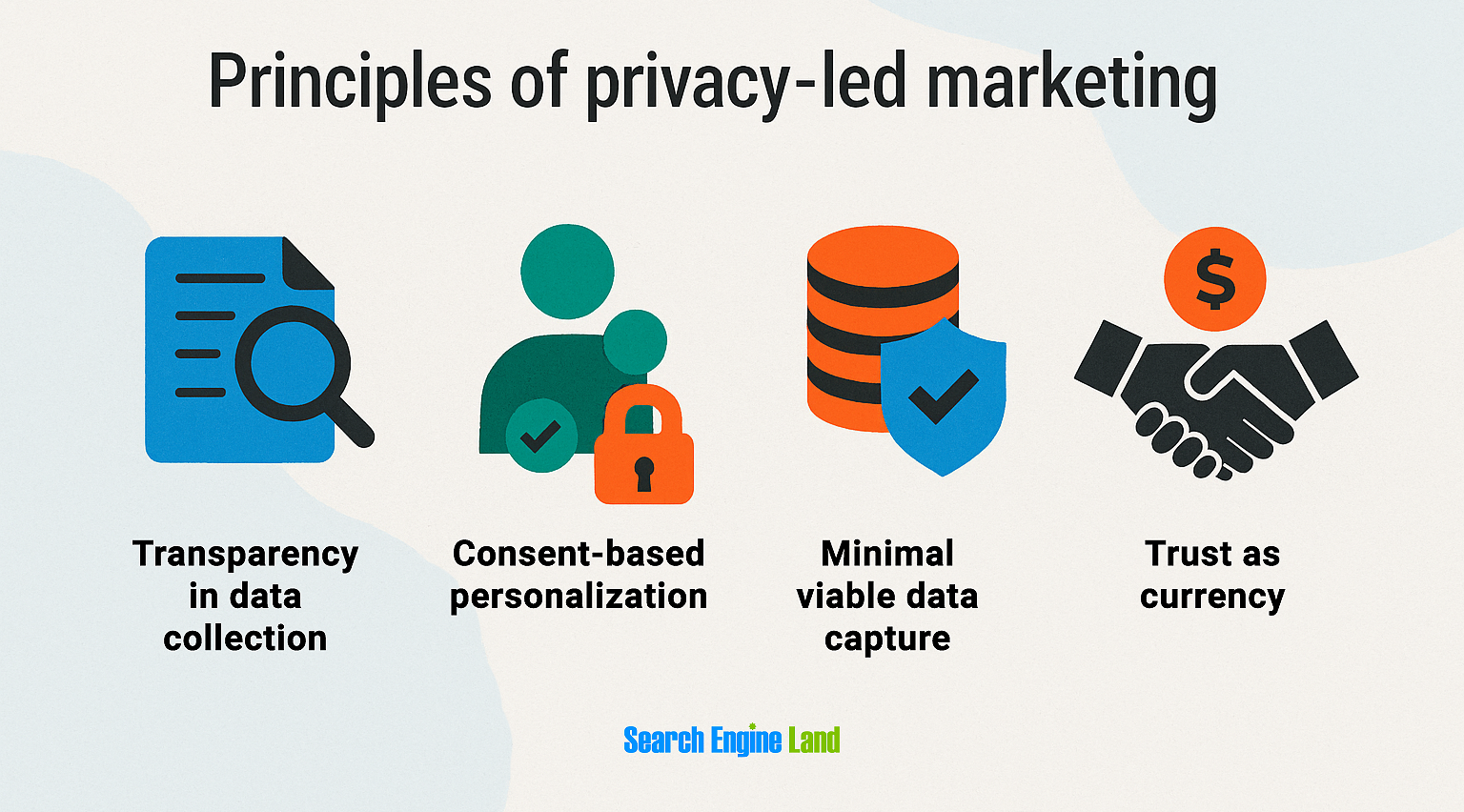
This approach recognizes that respecting customer data preferences isn’t just good ethics, it’s good business.
Here are four fundamental principles of privacy-led marketing about how to collect, use, and think about customer data.
Transparency in data collection
Transparency means telling users exactly what data you’re collecting, why you need it, and how you’ll use it.
And in plain language that anyone can understand, not burying critical information in 30-page privacy policies written by lawyers for lawyers.
Smart companies are discovering that radical transparency becomes a competitive advantage: When you clearly explain your data practices, customers actually appreciate it.
Customers understand the value exchange and make informed choices. And conversion rates often improve when you’re upfront about data collection because trust reduces friction in the buying process.
Here are some simple ways to shift transparency on your site:
- Tell people upfront if you’re sharing data with third parties.
- Explain what cookies actually do on your site.
- Replace wording like “We may collect certain information for various purposes” with “We save your email to send you weekly product updates.”
Consent-based personalization
Customers do want relevant, customized experiences, but only when they explicitly opt in.
It turns out, people are much more willing to share data when you ask nicely and explain the benefits. Nobody wants to feel like they’re being stalked across the internet, but people do want relevant recommendations, personalized offers, and experiences that actually matter to them.
When you implement proper consent mechanisms, you’re building a foundation for better personalization.
Users who actively choose to share preferences provide higher-quality data than anything you could scrape without permission. They tell you exactly what they want, they update their preferences over time, and they engage more deeply because they’ve invested in the relationship.
The best user consent personalization experiences feel like features, not barriers. Each of these interactions adds value while respecting boundaries. For example:
- Quizzes, surveys, and preference centers let users share information gradually over time
- Clothing retailers might ask about style preferences during browsing
- Content platforms can request topic interests after the third article
Minimal viable data capture
Collecting only the information truly necessary to deliver value—nothing more, nothing less—also leads to customer trust.
Companies have hoarded data for years, operating on the principle that more is better—collect everything, figure out uses later.
That thinking is dead. Every piece of unnecessary data you collect increases risk, complexity, and customer suspicion.
Here’s what minimal data capture looks like in practice:
- Ecommerce site asks for your shipping address to send products—but they do not need your birthdate for a one-time purchase
- Newsletter signup requires an email—but they don’t need a phone number
- SaaS free trial needs a way to contact you—but they don’t need to know your company revenue
When you focus on essential data, you get a higher completion rate on signup forms, a reduction in abandonment, and less time spent managing and securing information you don’t use.
Trust as currency
Trust has become as valuable as any financial metric in privacy-first marketing. It directly impacts customer retention, loyalty, and brand perception.
Trust compounds like interest: Each transparent interaction, respected preference, and kept promise adds to your trust account.
Customers share more accurate data with brands they trust. They also forgive occasional mistakes, become advocates, and stick around longer.
On the flip side, a trust violation can devastate a brand instantly.
One sketchy data practice can destroy years of relationship building. A breach of consent can spread through social media in hours. A break in trust can take months or years to rebuild.
The business case for privacy-first marketing
Privacy constraints are forcing marketers to get smarter. Instead of hoarding every data point possible, teams are building genuine relationships with customers who actually want to hear from them.
Privacy investments generate returns
In one survey of organizations, 96% of respondents said privacy investments outweigh the costs.
When you ask for permission and explain value up front, you’re qualifying leads before you even start marketing.
Customers who believe you respect their privacy will spend more, stick around longer, and recommend you to others.
Operational advantages of ethical data practices
Privacy-first approaches also dramatically improve your data quality.
When you’re collecting information with clear consent, you’re getting accurate, intentional data from people who want to engage with your company or product.
Also, your legal risk will plummet because you’ve obtained consent. Plus, there won’t be a need to sweat new regulations or enforcement action.
Some can even use privacy as a product differentiator, commanding premium prices for those services because customers trust them more.
Customer loyalty in the age of data transparency
Transparency isn’t just nice to have—it’s becoming a huge driver of customer loyalty. Research shows 63% of users believe most companies lack transparency about how they use personal data. That’s a massive trust deficit, and it’s creating opportunities for brands willing to be different.
The technical reality of implementing privacy-led marketing
Implementing a privacy-led marketing system can be challenging. It requires:
- Mastering complex technical infrastructure
- Navigating fragmented regulatory landscapes
- Potentially overcoming organizational resistance
Those who push through these barriers will likely see competitive advantages that make the effort worthwhile in the long run.
Navigating the complexity of privacy-enhancing technologies
Privacy-enhancing technologies (PETs) are the technical backbone of privacy-led marketing. They allow you to maintain sophisticated analytics and personalization without compromising individual privacy.
Differential privacy
This PET adds encryption to data sets so you can analyze patterns without exposing individual information. Sounds simple, but calibrating that encryption requires specialized expertise—too much and your insights become meaningless, too little and you’re not protecting privacy.
Federated learning
Instead of centralizing data, models are trained locally from user device activity, with only the insights shared back. Google uses this for keyboard predictions, for example. Implementing it for marketing analytics requires rethinking your entire data architecture.
Homomorphic encryption
This lets you perform computations on encrypted data without decrypting it first. Revolutionary in theory, but expensive in practice. Processing times can be far slower than when working with unencrypted data.
On-device processing
By running analytics directly on user devices and only sending aggregated insights back to servers, you maintain privacy while getting the data you need.
Server-side tracking
Instead of relying on client-side cookies and pixels, server-side implementations give you more control over data collection while respecting user privacy preferences. But the technical lift is significant—you have to essentially rebuild your tracking infrastructure.
Compliance confusion across multiple jurisdictions
Managing privacy compliance laws across multiple jurisdictions has become a nightmare of conflicting requirements.
Each jurisdiction has their own data privacy laws. For example:
- GDPR in Europe
- LGPD in Brazil
- CCPA in California
- CDPA in Virginia
And what happens with edge cases—for example, a California resident traveling to Germany—which law applies? What about data transfers between US and EU offices?
The Schrems II decision invalidated Privacy Shield, complicating data transfers and commerce between the EU and US.
State-level privacy laws are proliferating faster than companies can adapt.
A one-size-fits-all privacy policy won’t cut it. You’ll need dynamic policies that adapt based on user location, with granular consent mechanisms that respect local requirements.
Overcoming organizational resistance and skill gaps
One of the hardest parts of implementing privacy-led marketing to a traditional system is getting your organization to change its mindset.
Marketing teams have built their careers on unlimited data access. Changing course and telling them to work with less data, more restrictions, and different measurement models will likely bring resistance.
Baby steps are important: Start with pilot projects that demonstrate value, then scale successful approaches across the organization. Most importantly, frame privacy as a competitive advantage rather than a regulatory burden.
Your team will need to acquire new skills, all while maintaining campaign performance, to:
- Understand differential privacy
- Navigate consent management platforms
- Interpret privacy regulations
- Rebuild attribution models
Resource constraints can compound these challenges. Privacy transformation requires significant investment in new tools, training, and talent. ROI often takes time to materialize, making it hard to justify budgets when quarterly targets might not be met.
The organizations succeeding at this transformation treat privacy implementation as a strategic initiative, not a compliance checkbox.
Strategies and tactics for privacy-led marketing success
Privacy-led marketing success starts with a systematic approach to transforming your data practices, implementing the right technology stack, and building measurement systems that work without invasive tracking.
The transition may feel overwhelming when you’re staring at years of accumulated marketing infrastructure built on third-party cookies. The starting point is understanding what data your company actually has and why you’re collecting it.
Data audits and consent management
A comprehensive data practice audit is the foundation of any successful privacy-led marketing transformation program. You can’t protect data when you don’t know what you’re collecting.
Think of it like cleaning out a basement you’ve been throwing stuff into for years: You need to map every data flow, even little things like forgotten popup forms and analytics tags your predecessor added three years ago.
This is about understanding your actual data ecosystem and building a sustainable foundation for growth.
Start by documenting every touchpoint where you collect customer information. Your marketing team probably knows about the main forms and purchase flows, but what about that chatbot on your support pages? The exit-intent survey someone set up last quarter? The retargeting pixel from that agency campaign two years ago?
Your audit checklist should cover:
- Data inventory mapping
- Consent mechanisms review
- Third-party processor agreements
- Retention policy documentation
- Access request procedures
Most companies discover they need to redesign their consent flows entirely, moving from buried checkbox disclaimers to clear, granular choices that respect user preferences.
Many will discover that they’re collecting far more data than they realized, potentially without clear legal basis. You need to document what you’re collecting and why—legitimate interest, contractual necessity, or explicit consent. If you can’t justify it, you shouldn’t be collecting it.
Clear privacy policies written in plain language need to explain what you’re doing with customer data. And internal guidelines ensure everyone in the organization understands the new rules.
The goal is to build genuine transparency that customers can understand and appreciate.
Choose the right tools for sustainable data collection
There are many tools to help manage privacy-compliant marketing, and picking the right ones requires understanding your specific needs.
The key is integration. Your privacy-compliant tools need to talk to each other and share consent signals.
Google Analytics 4
GA4 is the baseline for most organizations, though its privacy features require careful configuration to actually deliver on compliance promises. It’ll help with server-side implementation, IP anonymization, and consent mode integration—not exactly plug-and-play territory.
GoZen Forms AI
For actually gathering valuable first-party data, specialized tools like GoZen Forms AI offer built-in privacy features that traditional form builders lack. These platforms handle consent management, data minimization, and retention policies automatically, reducing the compliance burden on your team.
Customer data platforms
CDPs have evolved to become the central nervous system of privacy-first marketing. Modern CDPs like Segment or Tealium warehouse data and enforce consent choices across your entire stack, ensuring that opted-out users stay opted out everywhere. The good ones include built-in privacy vaults that automatically anonymize or delete data based on your retention policies.
Consent management platforms
Tools like OneTrust or Cookiebot go beyond simple cookie banners, providing granular consent orchestration across all marketing tools. They handle many aspects, including preference centers and automated data subject requests, turning compliance from a manual nightmare into an automated workflow.
Behavioral analytics tools
Platforms like Plausible or Fathom Analytics deliver insights without any personal data collection. They prove you can understand user behavior patterns without tracking individual users.
Build privacy-friendly measurement frameworks without cookies
The combination of these approaches often delivers better results than traditional cookie-based attribution. They force you to focus on meaningful business metrics like customer lifetime value, incremental lift, and media efficiency, rather than vanity metrics.
Marketing Mix Modeling
MMM is making a massive comeback, and it’s about time. This method uses statistical analysis to understand how different marketing channels contribute to sales without tracking individual users.
Feed the model your spending data, sales data, and external factors like seasonality, and it can tell you what’s driving results.
MMM can be more accurate for understanding true incrementality than last-click attribution. It’s aggregated, privacy-safe, and accurate when done right.
Contextual measurement
This approach analyzes the environment where ads appear rather than the people viewing them. You place ads based on content relevance and measure performance through aggregated metrics.
Contextual targeting often outperforms behavioral targeting because you’re reaching people when they’re actually thinking about your topic.
First-party data enhancement
Even though you’re not tracking users across the web, you can enrich the data they willingly share. When someone creates an account, progressive profiling gradually builds a richer picture through voluntary interactions. Each email preference updated, survey completed, or product review submitted adds depth without tracking.
Server-side measurement
By moving tracking from the browser to your own servers, you maintain first-party data relationships while respecting user choices.
First-party data as a foundation for trust
Here are some ways to actively bring customers into the conversation about how their data is used:
- Loyalty programs: These build a relationship with a customer over time, and any information they give is them saying, “I trust you enough to share this.”
- Gated content: When someone trades their email for your industry report or webinar access, they know exactly what they’re getting. No hidden trackers, no surprise retargeting campaigns six months later.
- The preference center approach: Actually ask customers “How often do you want to hear from us?” “What topics interest you?” “Which channels do you prefer?” to bring them into the fold.
Zero-party data: The voluntary goldmine
Zero-party data is information that customers intentionally and proactively share with a brand, including:
- Preferences
- Purchase intentions
- Personal context
- Info on how they want to be recognized by the brand
Zero-party data is like having customers tell you their wishlist. No guessing games, no inference engines. The beauty of zero-party data is that it is accurate and relevant in ways that tracking isn’t.
When someone completes your style quiz, answers your survey, or fills out their personalization preferences, they’re giving you insights that are both current and contextual. A customer telling you they’re shopping for sustainable products beats any amount of behavioral tracking trying to infer the same thing.
Quizzes have become the secret weapon here. For example, a skin care brand can use them to recommend products based on skin type and concerns answered in a quiz. A fitness company can use them to create personalized workout plans.
Surveys work differently but equally well. Post-purchase surveys asking “Why did you choose us?” or “What problem were you trying to solve?” give you insights that no third-party cookies can.
Progressive profiling through surveys—asking one or two questions at different touchpoints—builds rich profiles without overwhelming customers.
Every preference voluntarily shared makes your personalization more effective without a privacy concern.
What’s coming next in the privacy-first marketing evolution
Privacy-first marketing is accelerating into uncharted territory where artificial intelligence, regulatory enforcement, and consumer expectations converge to reshape digital marketing.
Now, the name of the game is proactive innovation, to turn privacy constraints into marketing advantages.
Incorporating AI with responsibility and respect
AI can make marketing more private, not less, depending on how you use it.
Using AI responsibly in marketing means enhancing customer experiences and insights while protecting privacy through anonymization, synthetic data, and transparent practices.
Other AI-based tactics include:
- Differential privacy: This adds mathematical noise to data in ways that protect individuals while maintaining statistical accuracy. This allows you to run sophisticated analyses without ever touching raw personal data.
- Predictive modeling: Instead of tracking individual journeys, AI analyzes patterns across anonymized cohorts to predict trends, identify opportunities, and optimize campaigns.
- On-device AI processing: This keeps data where it belongs—with the user. Instead of sending data to the cloud for analysis, AI models run directly on users’ devices.
Privacy-preserving analytics
Artificial intelligence is flipping the script on what’s possible with anonymized data, enabling sophisticated customer insights without ever touching personally identifiable information.
AI systems can identify patterns, predict behaviors, and personalize experiences using encrypted data that never exposes individual users. Complex attribution models can be run on data that’s been encrypted but still yields actionable insights.
Industry standardization efforts are picking up steam too. Major tech players are collaborating on frameworks like Private Aggregation API and Attribution Reporting API, creating shared standards that’ll make privacy-preserving analytics accessible to businesses of all sizes.
Regulatory trends and enforcement patterns
The regulatory landscape just shifted into overdrive with the European Data Protection Board’s November 2024 guidance explicitly requiring consent for tags and pixels that collect user data.
Regulations on data privacy are expected to ramp up across the globe, as lawmakers catch up to consumer demands.
Consumer expectations and market differentiation
Privacy has crossed the threshold from nice-to-have to essential.
Young consumers especially treat privacy as a baseline expectation that influences every interaction with a brand. They’ll actively choose privacy-respecting alternatives even if it means paying more or accepting fewer features.
Platforms built with privacy at their core—not bolted on as an afterthought—are capturing market share.
Premium brands may even position privacy as a luxury feature, while mass-market players treat it as an operational necessity. Both approaches work.
Track, optimize, and win in Google and AI search from one platform.
Companies trying to have it both ways—talking privacy while maintaining invasive practices—face immediate backlash when inconsistencies surface.
Privacy-first companies can also focus resources on innovation and user experience, and not worry about adopting the new strategy or regulations changing.
Build a competitive advantage in the privacy-led future
Privacy-led marketing is one of the most underutilized competitive advantages in digital marketing today. It offers organizations that embrace it now a chance to build trust while competitors scramble to catch up.
Think of privacy-led marketing as your organization’s immune system against future disruption. While others panic about cookie deprecation, you’ll have already built direct customer relationships. When new regulations drop, you’ll adapt in days while competitors need months.
Most importantly, when customers choose who to trust with their data, you’ll be the obvious choice.
Want to learn more about digital marketing and how to transition to a privacy-led future? Start with our guide on digital marketing basics.
About the Author


