Peter Drucker warned us. Positionless Marketing is the answer
In turbulent times, structure, not talent, limits marketing performance. Positionless Marketing removes that constraint.
Five days compressed into five minutes. Six weeks into six days.
These aren’t marginal improvements. They’re what happens when marketing organizations remove the structural barriers that prevent talented people from acting at the speed of customer behavior.
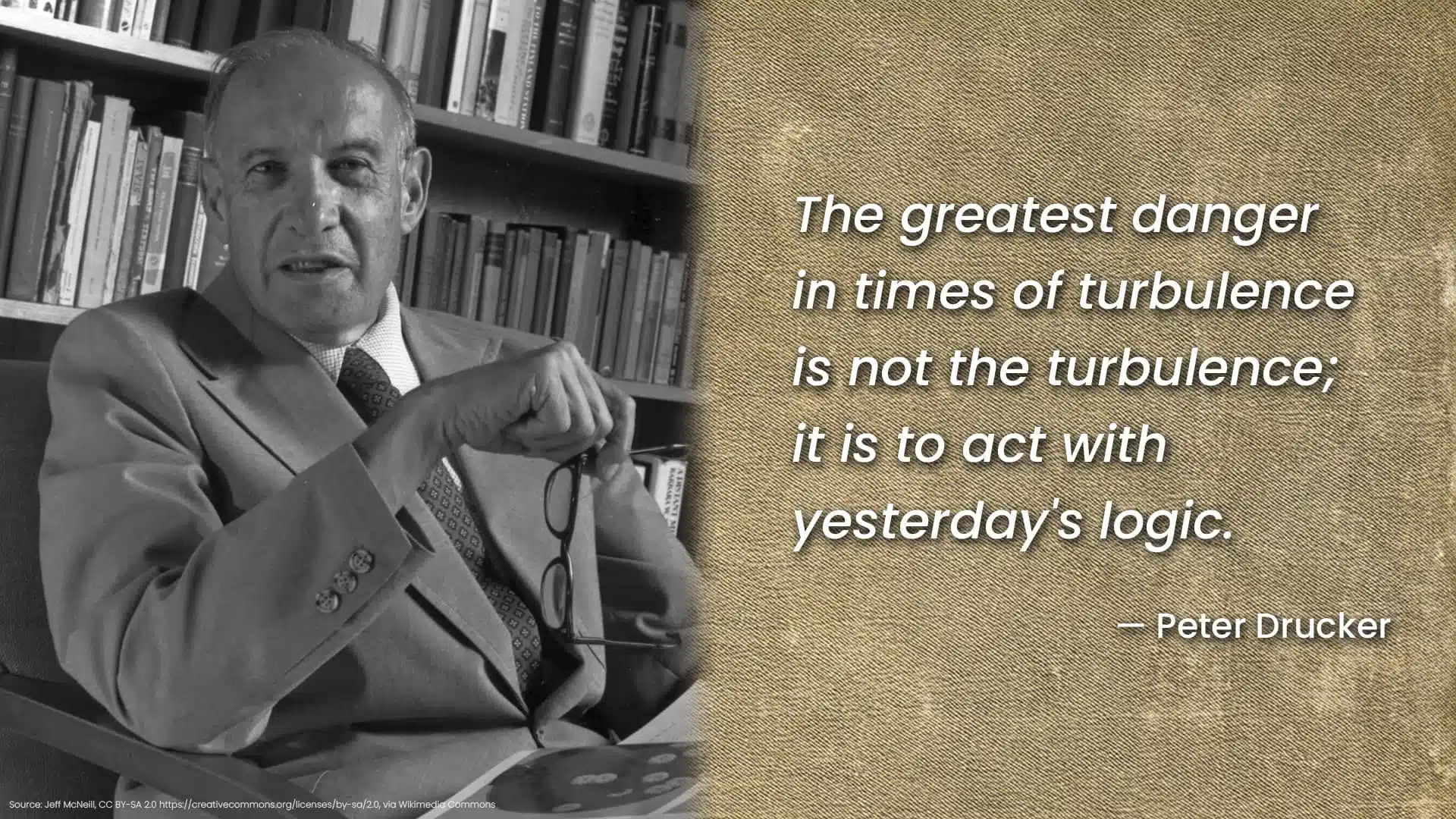
As Peter Drucker, the father of modern management, warned in “Managing in Turbulent Times,” “The greatest danger in times of turbulence is not the turbulence; it is to act with yesterday’s logic.”
Markets are volatile. Customer behavior shifts in real time. Channels are always on. Yet many marketing organizations still operate with structures designed for a slower world, and the cost is measured in missed moments.
Drucker identified the real constraint: Structure limits performance
One of Drucker’s most enduring ideas was that organizational structure matters more than individual capability. Smart people trapped in the wrong system will still underperform.
Consider a global gaming operator that required seven teams to launch a single campaign. Planning cycles stretched to six weeks. As their Global Head of Customer Marketing put it: “We needed seven teams and six weeks to send a single campaign.”
This wasn’t a talent problem. When insights live with analysts, creative execution lives with designers and activation depends on engineers; value is lost in the handoffs. Decisions slow. Context degrades. Moments pass.
Drucker warned against this fragmentation. He believed knowledge workers needed both clarity of purpose and freedom of action. Positionless Marketing removes the structural barriers that prevent that freedom.
From knowledge work to moment-based execution
At one of the largest iGaming companies in the U.S., campaign execution took five days. In an environment where players place bets, browse products or show signs of disengagement in real time, five days is an eternity. The opportunity to act appears and disappears almost instantly.
By consolidating customer data, orchestration and execution, eliminating the handoffs that killed momentum, they reduced campaign execution to five minutes. A 99% reduction in cycle time.
This reflects what Drucker always advocated: decisions made close to the action, by the people with the most context. Positionless Marketing enables marketers to move from insight to action without waiting on approvals or cross-functional workflows.
The impact goes beyond speed. They can now more easily direct a meaningful percentage of spend to their most deserving players. It means better decisions, executed immediately.
From management by objectives to execution by outcomes
Drucker introduced “management by objectives” to align organizations around outcomes rather than tasks. Over time, marketing drifted back toward task completion: build the campaign, launch the asset, measure later.
The global gaming operator’s transformation brought this philosophy full circle. After restructuring around Positionless principles, they reduced campaign time from six weeks to hours, and sometimes a single day.
But the real shift was accountability. In the past, they had shared responsibility, which really meant no responsibility. Now, a single marketer owns a campaign from end to end. They build it. They launch it. They learn from it.
The objective is no longer to send a message; it’s to drive a response. Not to launch a journey, but to change behavior. Not to complete a process, but to create value in the moment.
As Drucker put it in “The Effective Executive,” “Efficiency is doing things right; effectiveness is doing the right things.” Positionless Marketing prioritizes effectiveness by enabling marketers to decide and act without delay.
Real-world evidence: Organizations moving at the speed of interaction
The pattern repeats across industries. Organizations adopting Positionless Marketing principles see similar results:
Campaign execution cycles collapse from days to minutes. Teams shrink from seven to one. Planning horizons compress from weeks to hours. But the outputs improve — more personalized, more relevant, more effective.
These aren’t technology wins. They’re structural transformations. Organizations have moved from assembly-line marketing to empowered execution — from dependency to ownership.
What changed? They stopped organizing around functions (data, creative, activation) and started organizing around outcomes. They gave individual marketers the authority and tools to move from insight to action without handoffs.
They became Positionless.
Technology as an amplifier of judgment, not a replacement
Drucker was clear that tools should support human judgment, not replace it. Technology’s value lies in speed and scale, not wisdom.
The organizations succeeding with Positionless Marketing embody this principle. AI provides prediction and recommendations. Automation removes friction. But judgment on what to do, when to do it, and why remains with the marketer.
With all customer data and orchestration tools in one place, marketers don’t need to wait for engineers to target lists, analysts for insights, or creative teams for content assets.
Strategic judgment is now enabled by technology, not replaced by it. This is why Positionless Marketing isn’t about doing more work. It’s about enabling better decisions to be executed immediately. In Drucker’s terms, it makes the knowledge worker productive.
The evolution Drucker anticipated but could not fully describe
Drucker foresaw flatter organizations, faster decision-making and greater autonomy. What he could not anticipate was a world where customers are always connected, channels are always on, and relevance expires instantly.
In that world, insight without execution is wasted potential. Structure without flexibility is a liability. Specialization without ownership creates bottlenecks.
Positionless Marketing is the next logical step in Drucker’s philosophy. It gives marketers what knowledge workers were always meant to have: Immediate access to information, clear authority to act, and accountability for outcomes rather than tasks.
What was once an assembly line requiring seven teams has become something a single marketer can own end-to-end.
As Drucker warned, the greatest danger in turbulent times is continuing to operate with yesterday’s logic. Marketing teams that still rely on yesterday’s assembly-line structures will continue to miss today’s moments.
From philosophy to practice
If Drucker defined what knowledge workers need to be effective, Positionless Marketing defines how marketers can finally work that way in real time.
It replaces waiting with action. Five-day workflows become five-minute responses.
It replaces handoffs with ownership. Seven-team processes become single-marketer executions.
It replaces process-driven execution with moment-driven relevance allowing brands to move at the speed of a consumer’s interaction.
The question is no longer whether marketing organizations need to change. It’s whether they’ll change before their competitors do.
The knowledge worker Drucker envisioned is no longer just informed. In marketing, they are finally empowered to act. They are Positionless. To see the examples referenced in this article: go to case study 1, and here case study 2.
Topics on this page
Opinions expressed in this article are those of the sponsor. Search Engine Land neither confirms nor disputes any of the conclusions presented above.
About the Author