Super Bowl Commercials 2013 Edition: For Search Visibility, Most Brands Bought AdWords Too
Super Bowl commercials aren’t typically about direct purchases. Brands run them to create awareness and buzz and to make us feel all soft and fuzzy towards them through our adorable-foal/hot actor reunion-induced tears (thanks a lot, Budweiser!). For the last five years, I’ve tracked where advertisers are trying to send viewers, where those viewers are […]
Super Bowl commercials aren’t typically about direct purchases. Brands run them to create awareness and buzz and to make us feel all soft and fuzzy towards them through our adorable-foal/hot actor reunion-induced tears (thanks a lot, Budweiser!).
For the last five years, I’ve tracked where advertisers are trying to send viewers, where those viewers are actually going, and in particular, if advertisers are taking full advantage of the furious searching that happens post-game. Both Google Trends and Yahoo data show that even as we turned to Twitter in droves, we also, as in past years, flocked to the search engines.

Google Trends: Super Bowl Sunday 2013
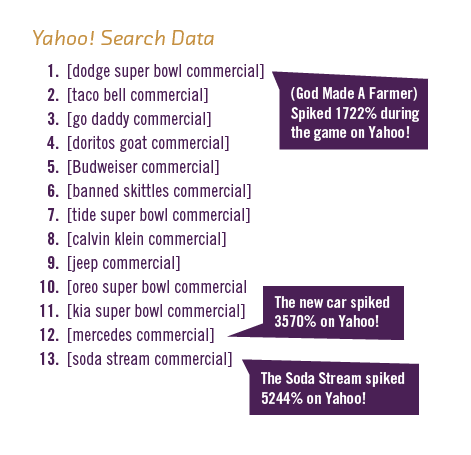
Yahoo Search Data: Super Bowl Sunday 2013
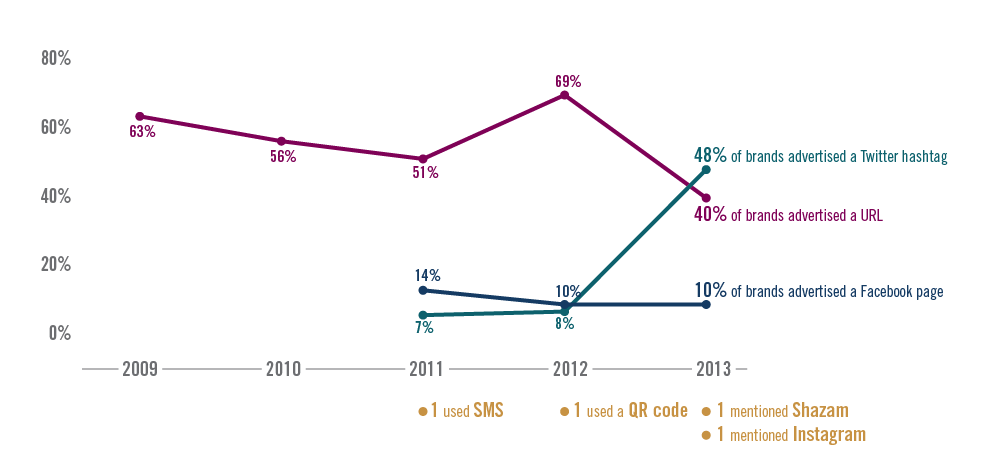
Last year brought a record high of brands advertising their own websites. This year, that trend was down, replaced by hashtags. If the goal of a Super Bowl is to get people talking about you, how better to encourage that than to give a little nudge and a way for those talking to find each other. (You can find the full infographic with these images on my site, Nine By Blue.)
But, brand confusion crept in online. Many online versions of the commercials sent viewers to different places than the TV versions, and the paid search ads sent searchers somewhere different still. Several brands had one owned site ranking in unpaid results, two different sites showing up in paid search results (at the same time!), and a different site still advertised in the ad.

Many sites are better than none, as in the end, your potential customers are finding you… somewhere. But this structure is not an ideal way to built up long term search value (to take full advantage of the engagement and links that a Super Bowl commercial brings), and it seems impossible to measure success. Is no one going to the special microsite built just for the commercial because they didn’t find the commercial engaging? Or, is it because no one knows the microsite exists?
Search Visibility
This year, those searching for Super Bowl advertisers could mostly find them! The majority of brands bought paid search ads for their names, and half bought paid search ads for their advertised taglines. Every single advertiser other than Fast and Furious 6 had a website that ranked in the unpaid search results.
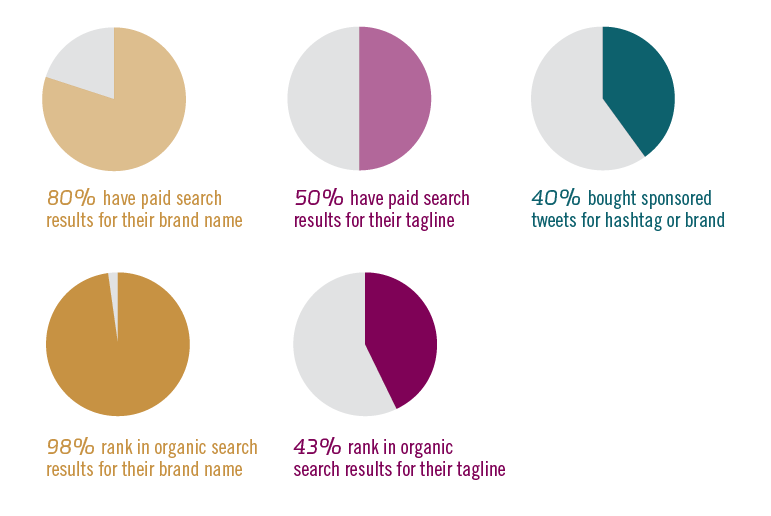
Brands were harder to find for those searching for taglines. Half of the advertisers did realize someone might search for those though, and bought Adwords, which is much better than past years.
Paid Search
Eighty percent of brands bought AdWords for branded searches and 50 percent bought AdWords for commercial taglines, but where were these ads sending people?
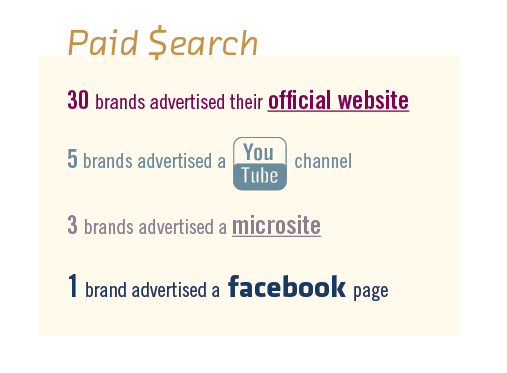
Mostly, the ads were sending people to an official site. This was great, although I’m giving some brands a little too much credit, as in some cases, these ads seemed to be part of long-running AdWords campaigns unrelated to the Super Bowl. This became more apparent when ads for both the official site and a microsite or YouTube URL showed up. The agency (or department) managing the Super Bowl commercial may not have been talking to the agency (or department) managing the regular AdWords spend. That can result in a company bidding against itself, paying more than it has to for ads, and confusing searchers.
How’s The Searcher Experience?
Let’s take a closer look at a few brands.
Dodge Ram Trucks
The Ram truck ad was popular among viewers and generated a lot of search volume. Google Trends showed that it was one of the most popular searches on Sunday, and Yahoo told me that it was the most searched for commercial.
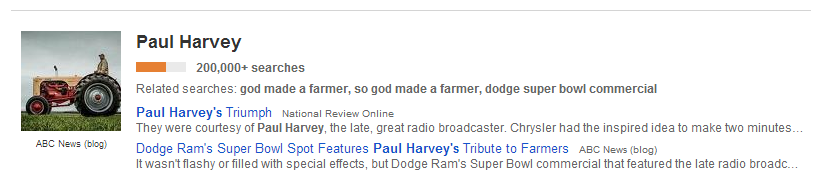
But, after doing related searches, I ended up totally confused. Is a Ram a Dodge? Are Ram trucks and Dodge trucks different?

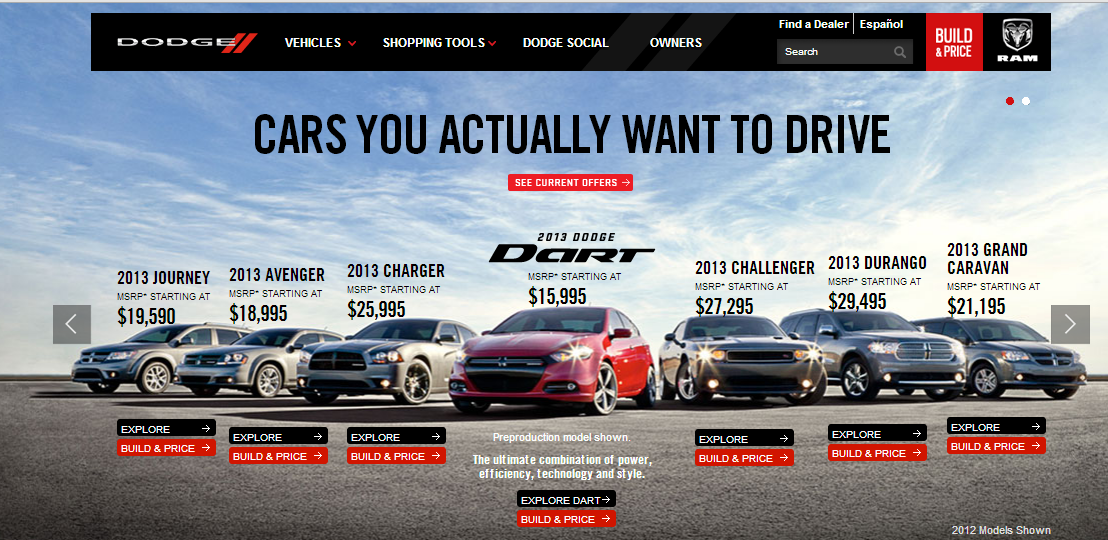
The paid search results for [ram trucks] show no less than four ads that could be the official site (and three that say they are). The first result — www.ramtrucks.com — is, in fact, the best place to send Super Bowl searchers.
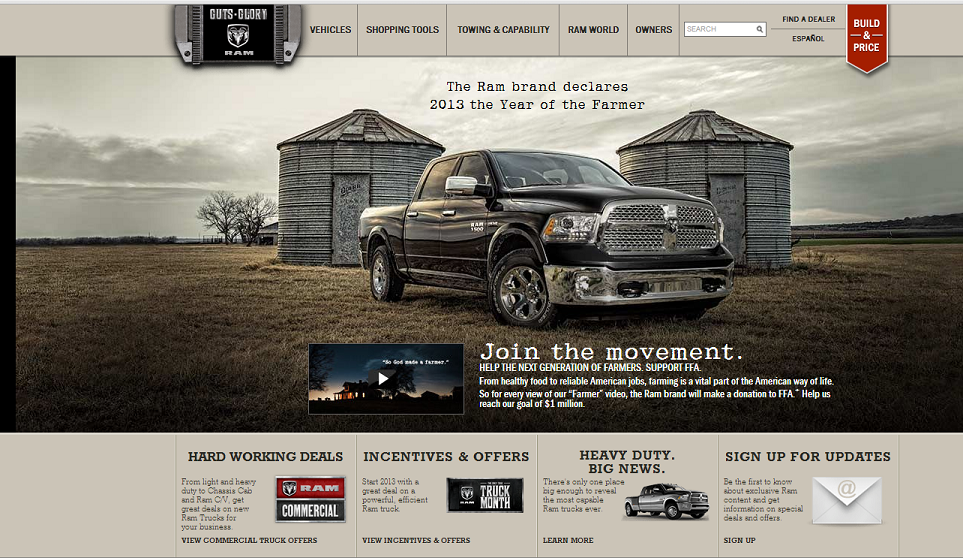
It ties in perfectly with the commercial, lets you watch it again, and showcases the trucks. Dodge is advertising www.dodge.com against the [ram trucks] search, and its website doesn’t even show Ram trucks. If you didn’t know Dodge owned Ram, then you’d think it was a competitor, swooping in and trying to lure potential customers away.
Mercedes Benz
Mercedes may also have had uncoordinated campaigns going as a search for [Mercedes] showed a paid search ad for mercedesbenz.com, and a search for [Mercedes CLA] (the car advertised in the commercial) showed a paid search ad for the page within the mercedesbenz.com site created for the commercial.
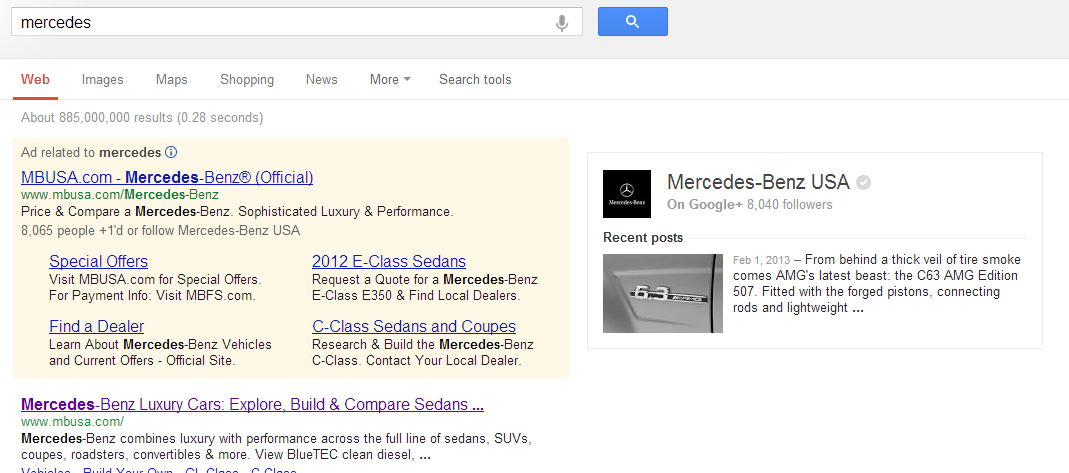
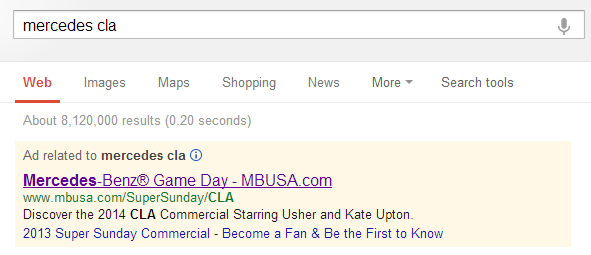
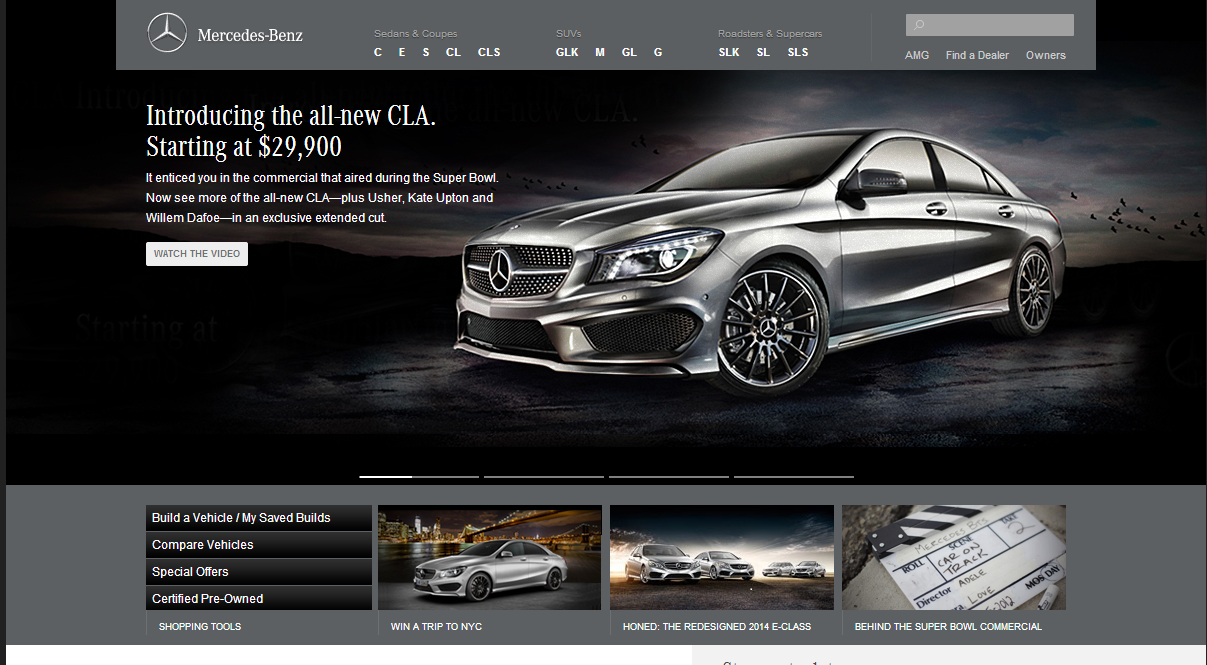
I can’t be too hard on them, though. To their credit, the home page features the ad and links to the Super Bowl page, and the Super Bowl page itself is actually on the mercedesbenz.com domain and not on a separate microsite (that has to be maintained separately and has to start from scratch for search engine indexing and ranking). They’ve also got a Google+ page with recent posts, which makes their Google search results look even better for their brand.
Volkswagen
Volkswagen had great intentions, and in many ways, great follow through. They released the ad early and got people talking and they included a hashtag that helped build buzz on Twitter.
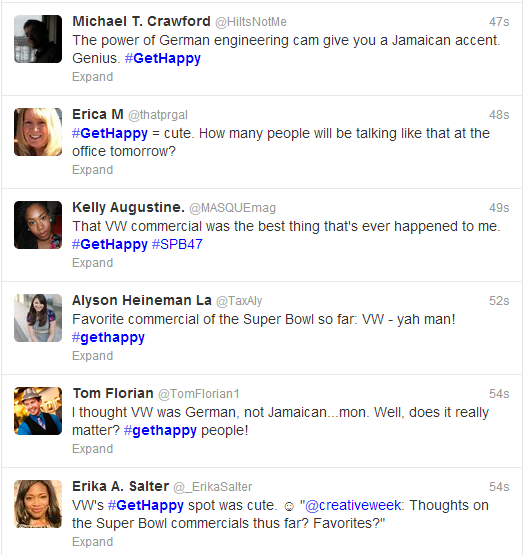
But then things get confusing.
A search for [vw] returns what are likely regular branded AdWords, unrelated to the Super Bowl commercial.
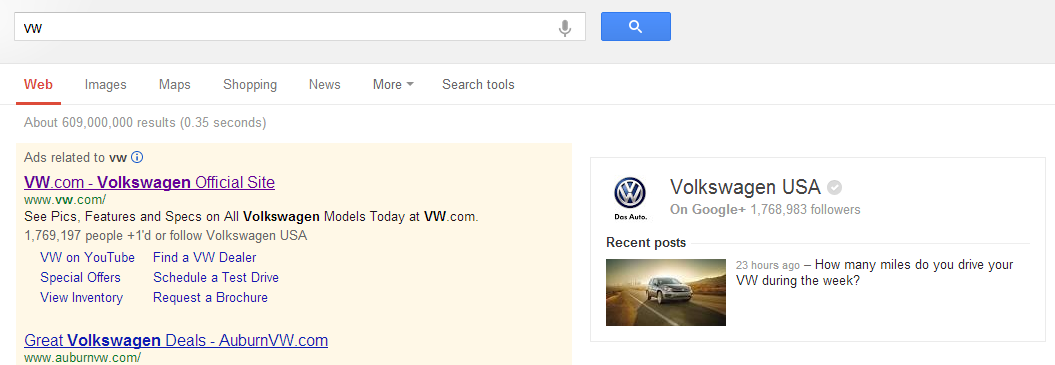
As with Mercedes, that’s not too much of a problem, since the home page features the commercial.
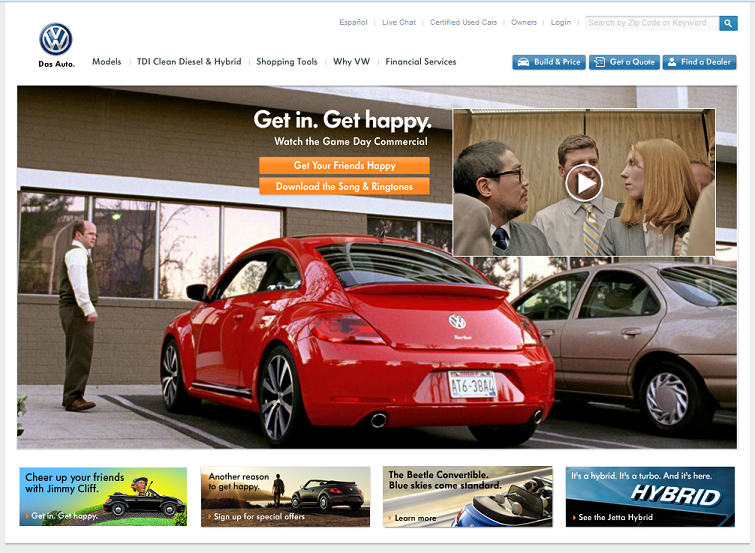
Searches for variations for the tagline (“get happy” and “get in get happy”) brings back an ad with a display URL of www.vw.com/gameday (which 404s if you type it in directly) that redirects to the home page. Totally fine, except that [get happy] doesn’t return VW in the unpaid results, and something peculiar happens in the unpaid results for [get in get happy]. A microsite shows up!

Look, I totally get the reasons brands have to use microsites. It may be utterly impossible to get the content onto the main site due to technical reasons or bureaucratic red tape.
But why invest so much into a separate site and then not advertise it? Maybe because it’s broken. When I try to load the microsite with Chrome, I just get a guy in a Beetle, with a directive to click on his head. Doing so, however, does nothing. That doesn’t make me get happy.

The full site loads for me in Firebox, but apparently requires a Facebook login (although that’s not clear until you start trying to use it). I’m still not happy.
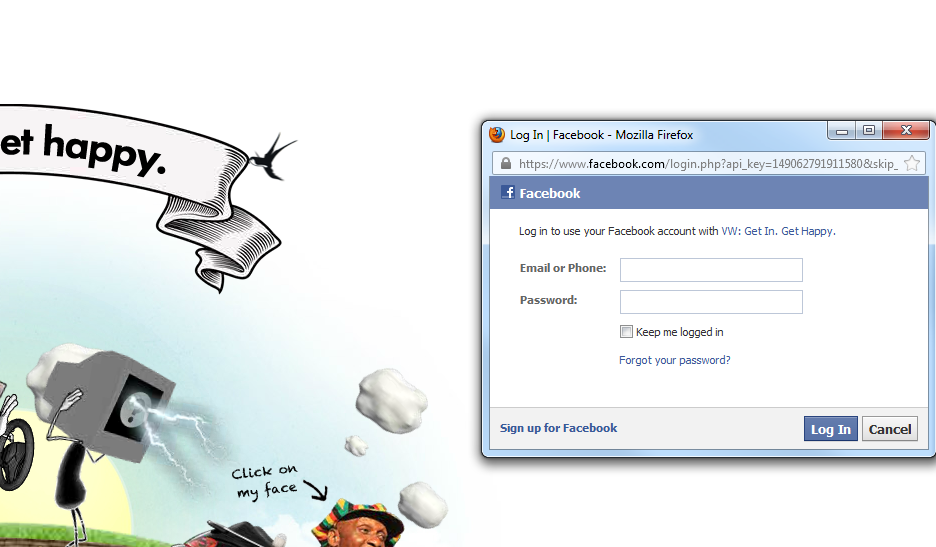
And the videos (both the commercial and a funnier video that shows YouTube famous sad people getting happy) play in an overlay with no way to share them. Now, I’m sad.

Huyndai & The Secret Microsites
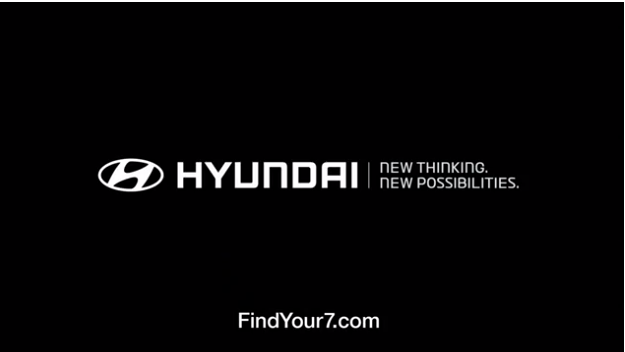
Hyundai has an even more secret microsite, as they don’t seem to be advertising it anywhere anymore. When the #pickyourteam commercial aired online before the Super Bowl, it advertised a microsite: www.findyour7.com. But when it aired on TV, it showed a hashtag instead: #pickyourteam. It makes total sense to drive online viewers to a website and TV viewers to an active discussion, but why use two different phrases?
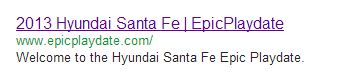
They also put together a microsite for another of their ads: www.epicplaydate.com, but they didn’t advertise this anywhere but in the paid search ad that appears for [hyundai santa fe] (even though both the #epicplaydate and #pickyourteam ads were for the Santa Fe). The paid ad for [epic playdate] searches is for hyundaiusa.com. As is the ad for [#pickyourteam] searches. (Searches for [pick your team] didn’t trigger an ad for me).

Confused yet?
Of course epicplaydate.com doesn’t rank in unpaid results for [epic play date] and findyour7.com doesn’t rank for well, [pick your team] because the microsites have similar problems as Hyundai’s microsite during the 2009 Super Bowl: they don’t actually have the words in the page that people are searching for.
In the case of epicplaydate.com, if you have JavaScript disabled, all you see is “loading.” Oddly, that’s not what Google sees, as the cache version of the page is full of everything about the Hyundai Santa Fe (other than the words “epic playdate”) and claims to be for allnewsantafe.com (which 302 redirects to epicplaydate.com) so some weirdness is going on that requires some additional digging.

www.findyour7.com does rank for [find your 7]. If only anyone knew to search for it.
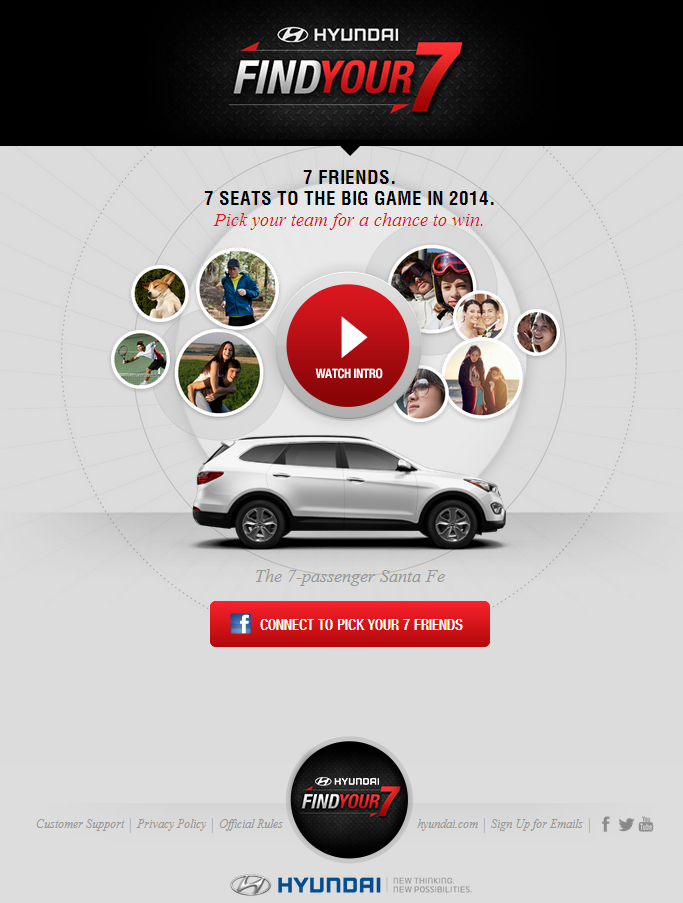
The website doesn’t mention the Super Bowl commercial. Maybe they realized that the commercial only had six kids on the team. And he only had to pick five.
Contributing authors are invited to create content for Search Engine Land and are chosen for their expertise and contribution to the search community. Our contributors work under the oversight of the editorial staff and contributions are checked for quality and relevance to our readers. Search Engine Land is owned by Semrush. Contributor was not asked to make any direct or indirect mentions of Semrush. The opinions they express are their own.
About the Author