ROI Calculator (Return On Investment)

Find out if your campaigns are actually profitable with this digital marketing ROI Calculator. [Jump to the calculator]
Proving that a marketing campaign was worthwhile can be difficult for many reasons (see below). Proving which marketing campaign was the most worthwhile can be even harder.
By measuring Return on Investment you can find out if you are generating a profit from your campaigns in a quick and simple way. You can also use ROI to understand which of your marketing activities generates the most profit.
Index
Click on the links below to jump to the associated section
ROI Calculator
Work out your marketing ROI as well as derive how much you would need to earn to hit a specific Return on Investment.
Feel free to experiment with different scenarios in order to help you better understand this metric.
ROI Definition
ROI stands for Return on Investment. It is a way to measure profitability (and not just profit).
ROI means the amount of money you get back from an investment relative to the amount of money you put into it. It is different to profit, which is simply the amount spent subtracted from the amount earned.
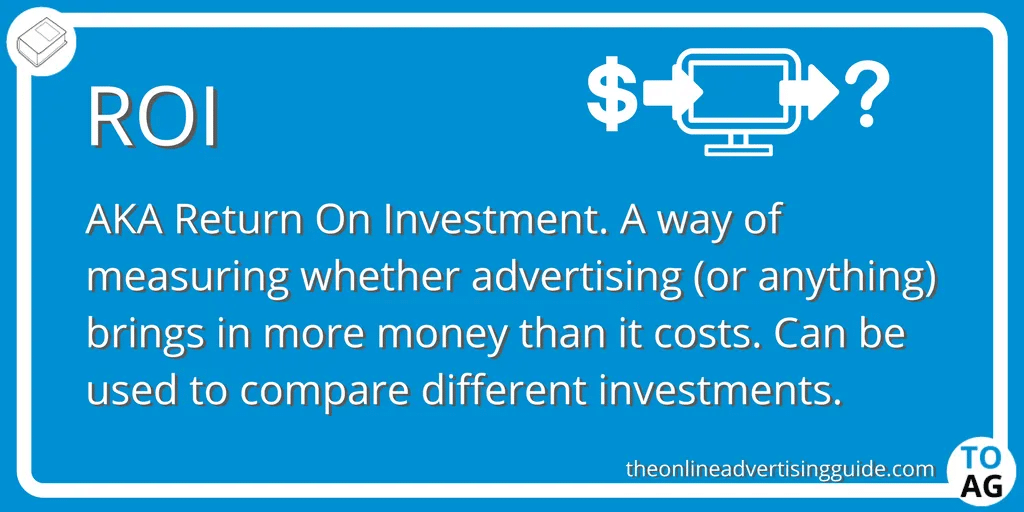
What Does ROI Mean?
In the simplest terms, a positive ROI means your campaign earned more than it cost. A negative ROI means that your campaign cost more than it earned.
ROI is a measure of profitability, but it goes a step further and creates a scale of profitability. You can use ROI to work out the profit per the amount spent. This answers the question:
“How much profit can I earn per pound/dollar/euro etc spent on this campaign?”
It is a useful measure in online advertising to not just see whether a marketing activity is profitable, but how profitable. In the below formula, Amount Spent should encompass all expenditures – not just what was directly spent on running ads.
To work out the amount of money you earn back from just running a specific set of ads, you should use our ROAS calculator instead. For calculations involving many campaigns and/or channels, our ROI Calculator can help.
Note: Not all marketing activity needs to be measured based on ROI. Organic Social media (for example) is traditionally more of a branding activity, so calculating a direct ROI for it would be inappropriate.
ROI Formula
The equation for Return on Investment is as follows:

ROI = (Amount Gained – Amount Spent) ÷ Amount Spent
What Is A Good ROI for Marketing?
For a marketing campaign to be considered financially successful, it has to have a positive ROI. This means you need to have earned back more than you spent. Using the above calculator it means having an ROI above 0.
This is a very low goal to set for yourself, however. Most people say that the minimum benchmark for an ‘acceptable’ ROI is 100% (or 2:1). This would mean that you have doubled your investment.
For a good campaign, you have to do better than this, however. Accepted wisdom on marketing ROI says that getting back 5x your investment (having an ROI of 500% or 5:1) is a good goal. If you get 10x or more back from your investment (an ROI of 1,000% or 10:1) then your marketing campaign can be considered excellent.
Please note: I have personally seen many paid search and retargeting campaigns get an ROI of around 2000% (20x return on spend). While this is great, you have to keep in mind that marketing campaigns targeting people who are already likely to convert are going to have high ROIs. A cold outreach campaign on the other hand might very well struggle to break even to start with.
Why Is Marketing ROI Difficult to Calculate?
Marketing ROI is difficult to calculate because it is both hard to work out everything that went into the campaign, and also hard to work out what you received as a result.
To calculate the amount spent on a campaign you can simply tally all related invoices. If you want to be really accurate, you could also estimate the time which members of staff spent on the campaign and work out the cost of that.
However, if you were being really accurate you would also add in the opportunity cost. Opportunity cost is the value that could have been generated if you were doing something else instead of working on this campaign. That can be very difficult.
Because of this, ROI calculations often underestimate the actual amount spent. In turn, this makes the ROI you get from any such calculations an overestimate.
Unfortunately, the problem also goes the other way – it is often quite difficult to work out exactly what you got from a marketing campaign.
Reasons why ROI is difficult to calculate
- Attribution: marketing is traditionally very hard to attribute results to. If someone clicks an ad and buys immediately then you can say that ad caused the sale. But what if they have heard a radio ad for the product every day that week too? Shouldn’t the radio ad get some credit? There are multiple attribution models out there, and none of them is perfect.
- Indirect Effects: Your marketing campaign might not have caused sales, but it may still have raised the profile of your company meaning you will get more sales in the future. Branding effects are very hard to put a direct value on or attribute a direct cause to. Having a popular brand is a massive benefit to any organisation though.
- Long-Term Value: Creating brand loyalty, or selling items that need renewing can mean that a sale today also generates more revenue in the future. Accounting for lifetime value can totally change how you see marketing. However, LTV models can often be difficult to calculate and implement. This is especially true for new organisations or products.
- Unmeasurable Value: Marketing campaigns always have unintended effects, and a lot of the time you will have no idea these happened, and may not be able to assign a value even if you did. For example, someone writing down your phone number, volunteering for an event, or downloading a guide. Your organization might track and value these things, but probably not perfectly.
Alternative ROI Equations
There is another way to calculate ROI. At first glance it seems simpler, however, it has another calculation built into it, which is why I favour the above formula. The other equation for ROI is based on the fact that:
Net Profit = Amount Gained – Amount Spent
Therefore you could substitute profit into the above equation to get:
ROI = Net Profit ÷ Amount Spent
ROI is also sometimes expressed as a number as opposed to a percentage. When this is the case, do not multiply by 100 in the above formula to get the final result.
Find out more
Back: Ad Calculators
Explore more on
Editorial disclosure
Search Engine Land is owned by Semrush. We remain committed to providing high-quality coverage of marketing topics. Unless otherwise noted, this page’s content was written by either an employee or a paid contractor of Semrush Inc.
About the author


