57% Of Americans Have Googled Themselves: Pew Study
The Pew Research Center has released a deep study today that paints an interesting picture of how U.S. adults use the Internet — search engines, in particular — to track their online reputations. One of the primary takeaways that contradicts previous research is that more than half of adult Internet users have “Googled” themselves. The […]
The Pew Research Center has released a deep study today that paints an interesting picture of how U.S. adults use the Internet — search engines, in particular — to track their online reputations. One of the primary takeaways that contradicts previous research is that more than half of adult Internet users have “Googled” themselves. The study doesn’t actually use that terminology, but you get the point.
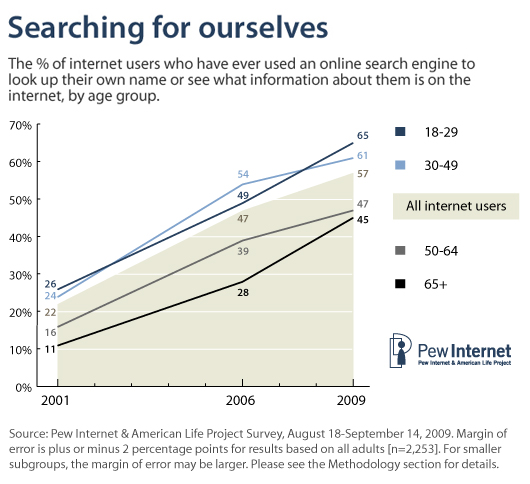
According to Pew’s research, online reputation monitoring via search engines increased between 2006 and 2009:
- 57% of adult Internet users now use search engines to find information about themselves online, up from 47% in 2006
- 65% of young adult Internet users (ages 18-29) said they had searched for results connected to their name online, up from 49% in 2006
- 46% of Internet users search online to find information about people from their past, up from 36% in 2006
- 38% have sought information about their friends, up from 26% in 2006
There’s also an important business element revealed in the study: 44% of online adults have searched for information about someone whose services or advice they seek in a professional capacity. This question wasn’t asked in 2006, so there’s no comparable benchmark data.
What do people find when they “Google” themselves?
- 63% say they find at least some relevant material connected to their name
- 31% of self-searchers say that most of the results on the critical first page are actually about them
- 62% say the first page of results is mostly about someone else with a name very similar or identical to theirs
What about age, reputation, and privacy?
As you might expect, replies to a survey on this topic differ when you slice up the data based on age. Young adults, aged 18-29, are most active in managing reputation online by limiting the amount of personal info available online, by changing privacy settings on social networking sites, deleting comments posted online, and removing their name when tagged to photos. Young adults do all of these things more frequently than older social media users. (Part of that, to be frank, may be greater awareness among younger folks that such tools are available.)
In light of Facebook’s privacy problems, it’s worth noting that younger users are also less trusting of social networking sites (SNS):
When asked how much of the time they think they can trust social networking sites like Facebook, MySpace and LinkedIn, 28% of SNS users ages 18-29 say “never.” By comparison, a smaller segment of older users express such cautious views; 19% of SNS users ages 30-49 and 14% of those ages 50-64 say they never trust the sites.
The survey was conducted via telephone between August 18 and September 14, 2009, of 2,253 adults, age 18 and older. You can download the report here.
Contributing authors are invited to create content for Search Engine Land and are chosen for their expertise and contribution to the search community. Our contributors work under the oversight of the editorial staff and contributions are checked for quality and relevance to our readers. The opinions they express are their own.

Related stories
About the author