Google Releases Page Speed Report In Webmaster Tools

In the wake of page speed becoming a ranking factor in 2010, Google has announced a new labs feature in Google Webmaster Tools.

The new feature is the “Site performance” report under the “Labs” section of the tool. The site performance basically shows you how fast your site loads compared to other sites. It also shows you, over time, if your site is getting faster or slower, with a nice graph. Google also lists out specific pages and their load time and then provides tips on how to improve those pages on a per page basis.

Here is a screen shot of one of the site performance reports that I am a webmaster over:
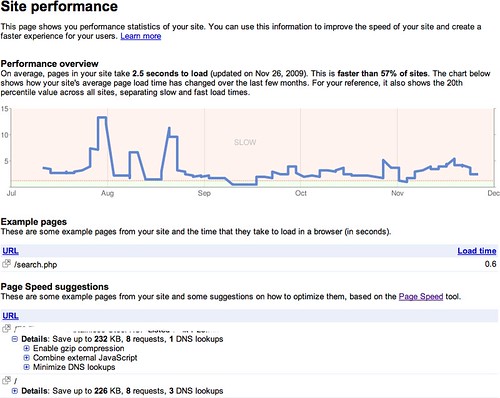
Site Performance in Google Webmaster Tools

Related Topics: Google: SEO | Google: Webmaster Central | Top News


About The Author: is Search Engine Land's News Editor and owns RustyBrick, a NY based web consulting firm. He also runs Search Engine Roundtable, a popular search blog on very advanced SEM topics. Barry's personal blog is named Cartoon Barry and he can be followed on Twitter here. For more background information on Barry, see his full bio over here.


SMX - Search Marketing Expo

SearchCap: Get all the top search stories emailed each day!

Name: Company: Email:

Like This Story? Please Share!

Other ways to share:

Like Our Site? Follow Us!

Search Engine Land on Google+

LinkedIn over 34,000 members
Subscribe to Our Feed! 78,740 subscribers take our RSS feed
 

Comments

5 Comments on Google Releases Page Speed Report In Webmaster Tools

Tim Cohn,

Bummer for WordPress hosted blogs.


Darrin Ward,

I find it interesting that some of mine are highlighting the Google Analytics ga.js and urchin.js files as something that needs improvement. Apparently Google doesn’t support gzip requests to them (but at least they should be cached by the browser). They should compress them though. The ga.js file is 23.51 KB uncompressed. Compressed it would be 9.81 KB, for a 58% saving.


Bruce Keener,

I was shocked at the results for my site, when it showed 23 seconds. I eliminated calls to jquery (I had used the one available via Google) and my mint.js calls, and ran it again. It sampled a slightly later period (ending at Nov 30th … not sure when the first one ended), with a result of 15 seconds. As with Darrin’s chart, most of the load times are low, but there are some huge 30+ sec peaks from time to time. And, as with Darrin, Google recommends improving its own code.

A huge puzzle to me as I have been running PageSpeed on FireFox for a few weeks, and not seeing anything to indicate results so bad. Up until a week or so ago, I used the Thesis Theme, which is fairly light, although it does not cache the css files. Now I am using Carrington. Both themes had Pingdom load times of less than 5 seconds. And, I am using Tiger Technologies for hosting, which seems to me to have good performance.

I guess I have some work to do, but am really puzzled by how high the load times are. I wonder if it counts load times for Google Adsense ads? I’ve noticed recently that the ads are not loading sometimes.


mkorukmez,

Shoot yourself in the foot !

That’s what Google Doing at the moment.One of the suggestion is keeping DNS lookup minimum.here is what google suggest to one of out site:
Minimize DNS lookups
The domains of the following URLs only serve one resource each. If possible, avoid the extra DNS lookups by serving these resources from existing domains:

* URLhttp://www.google-analytics.com/ga.js

Does Google Suggest us not to use their own products or another experiment like fading pages ?


Bruce Keener,

After talking at length with tech support at my hosting provider (Tiger Tech … Great folks, very helpful), I am convinced that the Google Site Performance data for my site is complete hogwash. I wrote a blog post about it while I was still upset, and then modified it (corrected it) this morning: http://www.keenerliving.com/blogging-platforms-simplicity-and-speed

In my case, it appears that Google might be seeing some of the mp3 files I have on my site (I have dozens of mp3 recordings of me playing the guitar, for readers to listen to), and that they are including the downloading of these in the stats. Given that a typical of these mp3′s is 2MB, this could be impacting my data significantly. I do not know that this is why the Google data is so wrong, but I know it is wrong. I’ve done enough performance tests on my site to know it is better performing, by far, than Google’s data suggests and that it loads almost as quickly as a static site.

I hope Google gets the bugs worked out on this before they put into their rating process.


Get Our News, Everywhere!

 
  • Advertise With Us
 

Click to watch SMX conference video

Join us at an upcoming SMX event:

Search Engine Land produces SMX, the Search Marketing Expo conference series. SMX events deliver the most comprehensive educational and networking experiences - whether you're just starting in search marketing or you're a seasoned expert.

SMX Site » | SMX Difference » | SMX News »


Learn more about search marketing with our free online webcasts and webinars from our sister site, Search Marketing Now. Upcoming online events include:


Search Engine Land Periodic Table of SEO Ranking Factors

Get Your Copy
Read The Full SEO Guide