Jul 9, 2009 at 3:17pm ET by Danny Sullivan
Just in from Hitwise, the first month-to-month figures since the launch of Bing. And the figures show Bing has both gained and dropped in the same month. Confusing? Yes it is!
Here are the month-to-month figures, percentage of searches each search engine handled in the United States:
You can see that from May to June, Google’s up to 74.04%. Yahoo’s up, to 16.19%. And Bing? Down! It dropped from 5.64% in May to 5.25% in June.
Despite this, Hitwise put out its emailed release saying “Bing Growing at 25 Percent Rate in June 2009.” How’s that work? Let’s go to the second chart, week-by-week growth in May:
Here you can see that in the beginning of the month, Bing had a 4.3% share. By the end, it had risen to 6.71% share. Over the month, Hitwise says this is a 25% gain.
The question is, will Bing maintain that type of share through an entire month? We’ll know when July figures come out. The bigger question is whether Bing will maintain that type of share when Microsoft’s ad spending ramps down.
Meanwhile, over at Mashable, there’s been plenty of buzz over the fact that Bing is “now” bigger than Digg, Twitter or CNN. That lacks the proper perspective. Look at this chart:
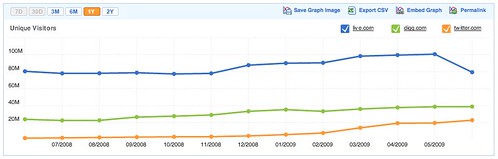
That shows Live.com having more traffic than two of those players (and yes, it also has more than CNN, too). Live.com was Bing. IE, “Bing” has always been bigger than those other players, it seems.
For some more prespective on the early numbers, see my past post, Bing: comScore sees Gains; Compete Sees Same Old, Same Old
Share, Bookmark & Discuss This Article
More:
Keep Updated: News Via Email | News Via RSS Feed | News Via Twitter
See more stories like this in the Members Library! Check out the Features: Analysis, Stats: Compete, Stats: Hitwise, Stats: Popularity, Top News sections of the Members Library where this story is filed. Members also get access to exclusive video content, a members-only weekly & monthly newsletter, plus more. Check out all the benefits!
TOP STORIES
SEARCH NEWS BRIEFS
FEATURES & ANALYSIS
RECENT COMMENTS
Stay on top of all the search news with our daily summary, the SearchCap newsletter. View a sample ›
Search Engine Land produces SMX, the Search Marketing Expo conference series. SMX events deliver the most comprehensive educational and networking experiences - whether you're just starting in search marketing or you're a seasoned expert.
SMX Web Site » | SMX Difference » | SMX News »
Join us at an upcoming SMX event:
Learn more about search marketing with our free online webcasts and webinars from our sister site, Search Marketing Now. Upcoming online events include:
Featured sites from our Blogroll
Become a premium member today and receive:
Very nice post about Bing.com Danny, I’ve been interested myself in doing some research on Bing’s growth (or lack there of) from a visitor’s point of view. It’s strange timing we decide to write the same type of article at the same time :)
Check out my analysis of bing’s performance:
http://ryanpark.me/2009/07/bing-com-dead/
I’ve been playing with Bing since launch and I find it’s much too like Google. Where’s the differentiation? I’ve tried some of the “revolutionary” features, but I just can’t be bothered to begin learning a new engine that’s losing market share imo….
Your thoughts?
So Bing gained 25% and still lost 4% market share to Google, how fast is Google still growing then!
Premium member since 06/2009
This is not surprising with the buzz around Bing and the amount of media Microsoft is spending to drive visitors. I think you are totally right, the question is will these increased visitors actually stay using Bing for the entire month and even the long term…time will tell!
I don’t think Bing will ever be as big as Google and it will take a long time to gain as many visitors as Google. Microsoft already have a search engine with MSN and in my opinion there was no need for Bing.
Premium member since 01/2009
Hi Danny,
I’m not convinced that the week over week growth in Bing is anything other than statistical noise. Looking at the breakdown of PPC advertising among our clients and zooming out, the “trend” seems to disappear. We shall see.
Premium member since 09/2009
While content and design is important, relevancy is king. Google has proven this for over a decade now.
Growth of the semantic web means having great content is getting easier and easier. Understanding user intent via keywords gets much easier when you have a highly detailed demographic data set on the user like the Social Networks. Since Google assigns value to the data (at scale) they therefore act as the glue that connects the user intent and the robust data.
Until an a content valuation method superior to PageRank is found I find it unlikely that Google will be challenged. Bing and Yahoo! are just putting new coats of paint on a inferior search technology.
Things like Twitter Search are closest to making PageRank obsolete. As people use weblinks less and Social Media tags, IMs and Twits more, the PageRank concept breaks down.
However, not to be left behind, Google surely has taken this into consideration in Wave.
yeah its true year by year it has increased its user. It deserve bcoz single word “Google” created opportunity to earn to millions.