Key Takeaways From Google’s Matt Cutts Talk At PubCon
Last night, Matt Cutts of Google gave a talk to the attendees at the PubCon. I was in the audience and I wanted to share my personal key takeaways from the talk. Specifically items Matt mentioned that I found to be new or interesting. Spam reports get 4 times priority in the spam queue at […]
Last night, Matt Cutts of Google gave a talk to the attendees at the PubCon. I was in the audience and I wanted to share my personal key takeaways from the talk. Specifically items Matt mentioned that I found to be new or interesting.
- Spam reports get 4 times priority in the spam queue at Google.
- Google knows there has been more web spam in the search results and it is due to moving web spam resources to other projects. Those resources are coming back and Google will be working on patching up that issue.
- Google reduced the number of hacked sites showing up in Google’s search results by 90%
- Google will soon be offering specific notifications via Webmaster Tools informing webmasters of spam on their site. Specifically, Google will warn of doorway pages, parked domains and 3 other spam issues to start.
- Matt recommends SEOs do not “chase the algorithm” and instead try to predict where Google will be going in the future.
- Matt made a point to mention that users are more likely to click on the first link in an article as opposed to a link at the bottom of the article. He said put your most important links at the top of the article. I believe it was Matt hinting to SEOs about this.
- Google disregards the canonical tag when it can hurt your site, specifically if you canonical link to a 404 page.
- Google has 200 ranking factors but those ranking factors may have 50 or more variations within a single factor.
- Google Places and Android App Market spam will improve over time.
- Google will be looking at why exact domain matches rank so well. For example, if you have a site at www.blue-widgets.com it may rank a bit too well for the keyword phrase [blue widgets].
- Google will be building a new paid link tool to block only the paid links on a page and let the other links, that are not paid, pass link juice.
These are in no specific order but the key takeaways that I personally found interesting, new or worth noting to you all.
I should warn that these are my interpretations of Matt’s talk and I may have misunderstood what he has said but I believe all these points are indeed correct.
To read the live blogging coverage of this session, you can read a very nicely structure recap at Outspoken Media or read a more sloppy but real-time report at the Search Engine Roundtable.
Here is one of the slides with Matt’s top 9 SEO tips:
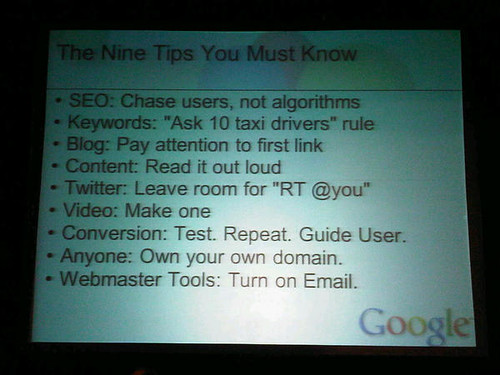
Courtesy of @VegasBill

Related stories
About the author

In 2019, Barry was awarded the Outstanding Community Services Award from Search Engine Land, in 2018 he was awarded the US Search Awards the "US Search Personality Of The Year," you can learn more over here and in 2023 he was listed as a top 50 most influential PPCer by Marketing O'Clock.
Barry can be followed on X here and you can learn more about Barry Schwartz over here or on his personal site.