Google loses ‘right to be forgotten’ case in UK High Court


Google grants roughly 44 percent of “right to be forgotten” (RTBF) search de-listing requests. However, a person in the UK whose request was among the 56 percent not granted challenged Google’s decision and won in the UK High Court.
The search result in question involved a decade-old criminal conviction, reportedly for “conspiracy to intercept communications.” A similar case was decided the other way by the court. The judge distinguished the facts of the two cases and the attitudes of those making the requests.
Google denies more than half of de-listing requests under RTBF
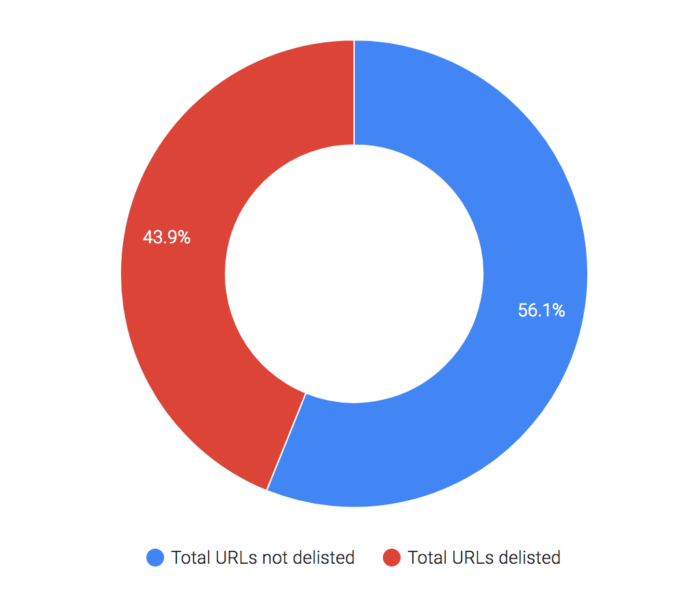
Source: Google Transparency Report (2018)
It’s probably safe to say that this ruling will encourage others similarly denied by Google to seek redress in the courts. However, it’s not entirely clear what criteria will be applied to decide if Google acted correctly or incorrectly in making its decision.
Behind RTBF decision-making is a balancing test, weighing the content behind the removal request versus the public interest or public’s right to know. However, some amount of subjectivity and discretion is possible in these decisions and, it would appear, in the court’s decision-making.
RTBF was established through a 2014 ruling by the European Court of Justice. The practical implementation of that ruling by Google has been relatively smooth. However, there’s ongoing controversy over the scope of removals: whether Google needs to remove content only in the EU or globally.
RTBF is part of Europe’s larger consumer privacy push, along with the General Data Protection Regulation (GDPR) and the not-yet-passed ePrivacy initiative.
Explore more on
Editorial disclosure
Contributing authors are chosen for their expertise and work under the oversight of the editorial staff. Search Engine Land is owned by Semrush. The contributor was not asked to mention Semrush; the opinions expressed are their own.
About the author