The proximity paradox: Beating local SEO’s distance bias
Struggling to rank beyond your map radius? Learn advanced local SEO tactics—entity building, review semantics, and localized content that beat proximity bias.
“How can I rank better beyond my location?” is a common local SEO question.
It’s fairly easy for your local business to be highly visible in Google’s local packs and maps when searching for it while on-site. But as you take your device further away from the locale, you’re likely to see your local rankings decrease.
Why?
Because distance is one of the three main signals Google uses to determine when and where a business should be shown in local results.
The closer a searcher’s device is to a specific business location, the more visible that business will tend to be in local packs and maps. The further away the device is, the less visible the same business will typically be.
But can this proximity bias be overcome so your business is visible to a more distantly located audience?
Why proximity bias exists
When a search phrase has a local intent, e.g. “pizza near me” or “grocery store San Jose,” Google wants to show the searcher business results that are both nearby and relevant.
Discover how you appear across LLMs like ChatGPT, Perplexity, and Google AI, and get AI-powered strategy recommendations.

Let’s understand Google’s emphasis on proximity in local search and how it impacts results in their local packs and maps.
How Google calculates local relevance, prominence, and distance
Google’s Tips to improve your local ranking document outlines how these three signals play a major role in the algorithm they use to rank local business results.
Relevance
This is based on whether Google thinks a specific business is a good match for a particular search intent. For example, if a user searches for “tacos near me,” a nearby Mexican restaurant is a more relevant result than a Chinese restaurant.
Google’s document recommends providing complete and detailed business information to help them better understand the search phrases relevant to your business.
Prominence
Prominence relates to how well-known your business is. This is based on signals like the authority of links your website receives from other sites and the reputation your business has earned via Google Business Profile reviews and ratings.
Winning links from authoritative local and industry websites, and improving your review and rating metrics have a positive influence on this factor.
Distance
This simply refers to the proximity between a business location and a specific searcher at the time they perform a search. This is the signal we’ll be investigating today.
Examples of proximity-driven search results
You can see Google’s proximity bias in action in a couple different ways.
Google Maps
Search for an important keyword phrase related to your company while physically located at it.
Then, take your phone to another neighborhood across town, or go beyond your city’s borders, and perform the same search.
You’ll likely see that your rankings drop off in Google Maps and Google’s local packs.

Gridded local rank tracker
It can be educational to do this exercise manually, but it’s more practical to use a gridded local rank tracker. These tools emulate location and let you automate the investigation of multiple keyword phrases.
A popular tool of this kind is Whitespark’s Local Ranking Grids.
In the following screenshot, you can see how the Good Earth supermarket in Marin County, California, is visible to people searching for the phrase “grocery store” at different distances.
The market is located near the place marker (the white donut) and has a Google Maps ranking of 3—the green circle. Moving a bit to the west, that drops to a ranking of 6, and then 14. For every other distance in the graph, the market isn’t ranking within the first 10 Maps entries.

By clicking on the dot where the market is ranking 39th—just east of its number three ranking—Whitespark’s tool shows us which competitors are outranking our sample grocery store for users in that locale (below).
As we can see, in the spot where Good Earth is 39th, Safeway is earning the top ranking. And we can do this same research for all points on this grid.

Gridded local rank trackers provide the most efficient way to see the proximity effect in Google’s local results, but it’s important to remember that multiple factors contribute to local rank.
For example, proximity is likely contributing to Safeway outranking Good Earth in the above screenshot, but prominence and relevance are probably playing a part, too. Don’t make the mistake of only focusing on a single factor.
Understanding mobile location precision and hyperlocal intent
How does Google know where your potential customers are located in proximity to your place of business?
Mobile location precision
Google offers extensive documentation on how they use a combination of information to understand where users are located, including:
- Android device settings
- Web and app activity
- Mobile and wi-fi network signals
- IP addresses
This enables them to pinpoint local searchers with a high degree of precision, with the goal of showing them nearby, relevant local business results.
Search intent
In addition to calculating proximity, Google also has to interpret the intent behind each search phrase.
Google’s understanding of search intent can vary quite a bit. You may find that your business only ranks well for searchers in close proximity to your location for some phrases, but that your visibility may extend to a wider radius for others.
Some searchers will use explicit geographic modifiers in their search language, e.g. “grocery store downtown san rafael.” By being explicit, the searcher is making it clear to Google that they want to see results within a tight geographic radius.
Hyperlocal intent
However, consider the difference of intent between someone searching for “coffee” or “sports stadium.”
Even though the searcher is not specifying “coffee near me” or “coffee san francisco,” Google believes the search phrase “coffee” has a strong hyperlocal intent.
In other words, they believe someone using this phrase wants to see nearby cafes, so they return a local pack for this search showing results clustered within a tight, neighborhood-level radius.

Compare this to the results for a search like “sports stadium,” where the radius is much wider and Google shows entries from all around the San Francisco Bay Area.

Google still believes “sports stadium” has a local intent—we know this because they are returning a local pack result. But they are casting a wider geographic net to make up those results.
From this exercise, it’s clear that Google associates some keyword phrases like “coffee” with a hyperlocal intent. However, they have determined that “sports stadium” also has local intent, but that those searchers will be willing to go further afield to visit a major sports venue.
The limits of “just optimize GBP”
Can your local business overcome Google’s biases? Advice suggesting that you just need to optimize your Google Business Profile (GBP) is generic, unhelpful, and even misleading.
Why listing optimizations alone can’t offset geography
Although your business info should be as complete as possible in your GBP, it’s unlikely that updating your details alone will be enough to overcome Google’s proximity bias.
Instead, your business will need to build up its signals of relevance and prominence to increase its chances of surmounting Google’s emphasis on searcher-to-business distance.
Let’s look at some examples of how Google’s proximity bias can be overcome.
Stronger signals
If your business has built up stronger signals of relevance and prominence than competitors who are physically nearer to a searcher, you may succeed at outranking them for some search phrases.
For example, imagine a searcher looking for “restaurant with good blueberry pancakes.” A restaurant that is 20 minutes away from the search and which has earned more structured citations and/or multiple reviews that specify that it serves this dish might outrank one that’s just three minutes away that lacks these signals of prominence and relevance.
Low competitive level
If your business is located in an area with a low competitive level (e.g., you’re operating one of the only dental practices serving five small towns in a rural area), then Google is likely to show you as a result across a significantly wider radius than if your practice is just one of many in a single town.
Specializing in rarities
If your business specializes in some goods, services, or amenities that are hard to find, you may find yourself ranking across a wider radius for search terms related to these offerings.
Let’s return to our grocery store example.
Earlier, we saw how the Good Earth market only ranked well within a very tight radius for the core search term “grocery store.” But, this particular supermarket focuses on organic groceries and has built up relevance and prominence for this specialty.
Look at how much more visible they are across a wider radius when we change our search term from “grocery store” to “organic groceries”:

Local search, yet remote audience
A unique scenario surrounds business models that are local but which need to be visible to a remote audience.
Think of a hotel in San Francisco, California that wants to be seen by potential guests in New York City, or an addiction treatment center in Taos, New Mexico that needs to attract patients from across the southwest.
In cases like these, Google is dependent on users specifying location in their searches (e.g. “hotel san francisco” or “addiction treatment center taos”). Google cannot understand the local intent of remote searchers unless they specify their desired geography.
Build entity strength to influence rank
In Google’s world, an entity is a person, place, organization, or concept.
While entity-oriented search is a complex topic, in the local context, it’s easiest to think of entities as places Google has stored information about in its Knowledge Graph.
The more Google knows about all aspects of your business, and the more it sees publishers and consumers citing and interacting with your business, the stronger the search engine’s understanding of your entity will be.
Becoming a stronger entity may enable you to overcome some of Google’s proximity bias.
Treat your business as an entity
When it comes to proximity, your street address is your business’ anchor. Where you’re located will have a major impact on where you rank.
But before you start hunting for new premises, there are specific actions you can take to build up your relevance and prominence. Instead of thinking of your business as a mere address on the map, you can strive to become an entity and give Google the maximum amount of information about it.
Review language diversity
Take a look at the wide radius throughout which this Puerto Rican restaurant is highly visible and ranks highly for one of its menu items, a “cuban sandwich” or “cubano:”

For miles around, Google users are seeing this restaurant if they’re hungry for this sandwich. How does that happen?
In part, this could stem from the business owner uploading a menu to their Google Business Profile that features this item.
But what other sources could be contributing to Google’s understanding of this restaurant being an entity that’s strongly associated with this particular dish?
One area to focus on is review language diversity: earning Google Business Profile reviews that mention specific aspects of a business, like location, amenities, menu items, inventory, and services. Each review is a chance to increase the volume of words associated with the business entity.
In the example of this restaurant, we can make a good guess that its reviews mention Cuban sandwiches, as well as a diversity of other search phrases.
Strengthen review signals
Look at the “Reviews” section of this restaurant’s Google Business Profile—right below the star rating, you’ll see a set of tabs labeled “plantains,” “tostones,” “cubano,” etc. These are known as “Place Topics.” These tabs calculate the number of times a specific topic comes up in reviews, and they link to the reviews containing those words.
As you can see, this restaurant’s “cubano” sandwich has been mentioned 73 times by reviewers:

If there is a specific product, service, or amenity for which your business wants to be more visible, earning reviews that mention it can help.
To encourage this, reach out to customers and structure your review requests to ask for feedback about a particular detail. Here’s a sample review request template you can customize for this purpose:
Hi [customer name],
This is [name, business title] from [business name]. We’d really appreciate a review of the [product name] you recently purchased from us. If there’s anything that could have been better, you’re welcome to phone me at [direct phone number], and I’d be eager to make things right for you. Your review will help neighbors know we’re offering [product name], and we’d be so grateful if you could review it on Google.
[Google Review Link Generator Here https://www.semrush.com/free-tools/google-review-link-generator/]
We appreciate your business and hope to see you again soon!
[name, business title]
You can also increase the authenticity of your customers’ reviews by asking them to include a photo if they have one, or by sending them a unique photo for their use.
Another tactic is to ask some reviewers if they find your proximity to specific neighborhoods or landmarks convenient. Ask them if they would mention this in their reviews. This could help Google more strongly tie your business to particular geographic areas.
Earn unstructured citations
Unstructured citations are online mentions of a local business on a platform other than a formal business directory.
For example, unstructured citations can be published on blogs, online news sites, online lifestyle and tourism magazines, sponsor pages, event sites, community hubs, and social media platforms.
Look at the unstructured citations coming up for our sample restaurant (Sol Food) when we encounter a Google AI Overview for the search term “cubano marin” (Marin is a county in Northern California). The unstructured citations from a 10 best list on Yelp and a local lifestyle magazine indicate how prominent this restaurant has become across the region when it comes to this particular sandwich:
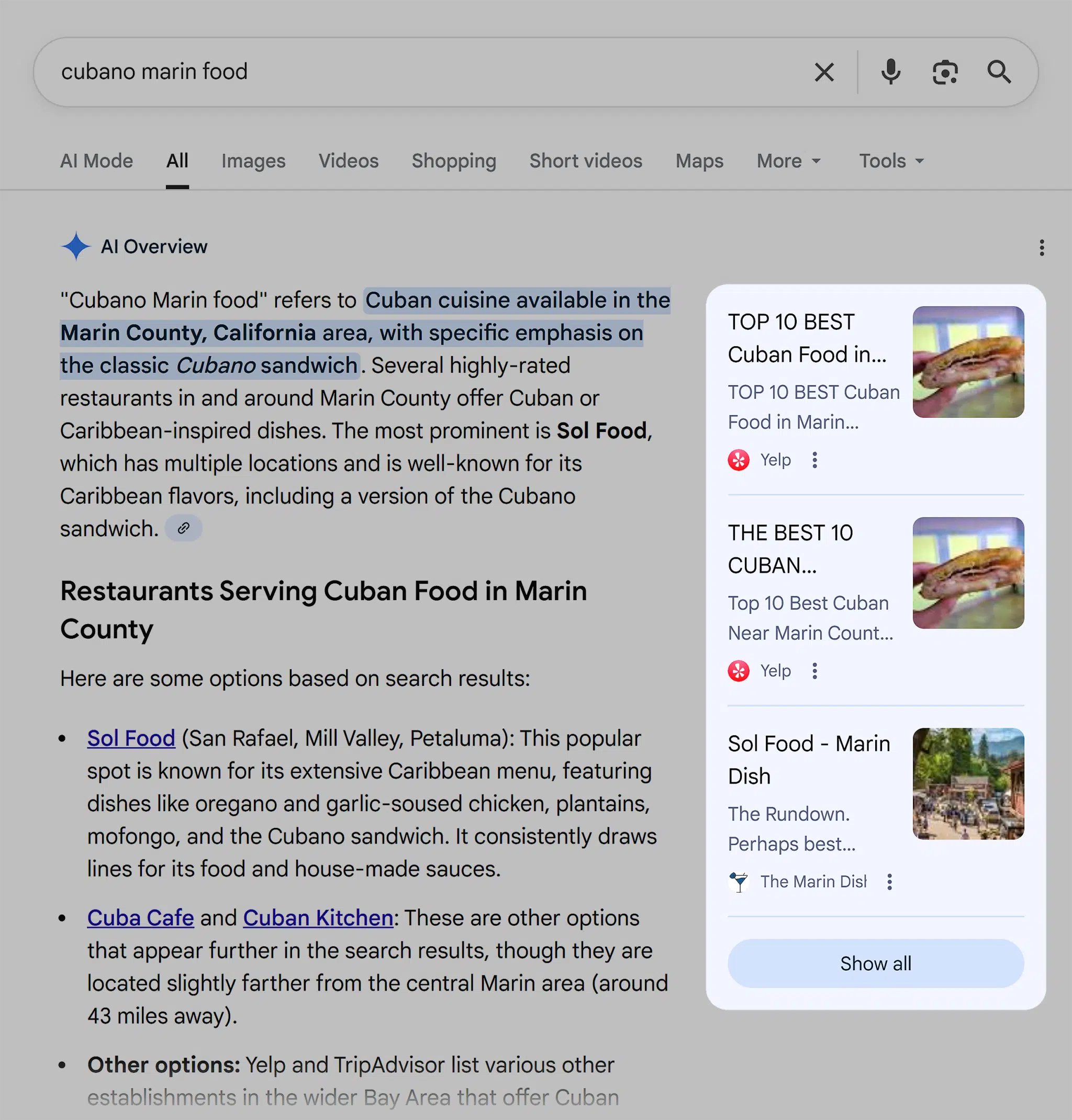
Unstructured citations like these strengthen Google’s understanding of the connection between the entities “Sol Food,” “Marin,” and “Cubano.” Having many of these authoritative references can help your brand overcome some of Google’s proximity bias.
Other ways to earn unstructured citations include:
- Sponsoring local sports teams, organizations, and events
- Cross-promoting and networking with local business peers
- Contributing content as a guest on hyperlocal blogs, podcasts, and video channels
While unstructured citations do not need to include links to positively impact your entity, it’s ideal to acquire them when you can. Search Google for terms like “our sponsors” or “upcoming events” plus your geographic terms to find ready-made opportunities for local link building.
Will schema help me overcome Google’s proximity bias?
While local business schema markup on your website can increase your feelings of confidence that Google is properly understanding the location of your business, there is no evidence that it impacts local rank.
Claire Carlile’s take on this FAQ sums up the necessity of ensuring that if you do use schema as part of an entity SEO effort, you should be sure you’re keeping it accurate over time to avoid confusing Google:
“It’s worth making sure that you have structured data that aligns with the entity information that you want Google to associate with your entity—so that could be person schema for a person, organization schema for your organization, and local business schema for a local business. But be aware that you need to be consistent across sources and platforms—don’t just add your schema and then forget about it.”
How to properly localize content
You can influence review content with how you word requests. You can earn unstructured citations by how you participate in local community life.
But the only online space over which you have full control is your company’s own website.
Use the following cheat sheet to ensure that you are sending strong location signals to Google and to customers.

- On-page local SEO–Optimize all website page titles, headers, image file names, and main body text with geographic terms like city and neighborhood names.
- Contact information–Put complete name, address, and phone number in website masthead, on contact and about pages, and on any location landing pages.
- Location landing pages–Create a unique page for each physical location of the business and put complete contact information at the start of it.
- Real-world NAP consistency–Ensure all online mentions of your name, address, and phone number exactly match real-world store signage and phone greetings.
- Multimedia authenticity–Use photos, videos, and first-party reviews as proofs that your business is a legitimate local entity at a stated location.
- Content localization–Document and address local customer FAQs that speak to community needs, interests, culture, regulations, and conditions via website content.
- Schema markup–If you implement LocalBusiness Schema markup, be sure to update it if core business details change.
- Third-party reviews–Actively acquire reviews on platforms like Google Business Profile that prove real people are interacting with your business at a specific location.
- Unstructured citations–Research opportunities for participating in community life that result in online mentions and links to your business from local or industry publishers.
- Structured citations–Get listed on prominent local and industry online business directories like GBP, Yelp, Apple Business Connect, and Bing Places.
- Guideline compliance–Know and adhere to the guidelines of any third-party platform where your business is listed to avoid suspensions and other unwanted outcomes.
- Social media–Ensure consistent contact info on all social media channels and interact with your local community as a further proof of business authenticity.
Built for how people search today. Track your brand across Google rankings and AI search in one place.
Overcome the proximity bias by specializing
We’ve covered some practical advice on coping with the reality of Google’s proximity bias and looked at examples of how it may be overcome in certain instances. But some local markets may be so competitive that you find it impossible to expand your local ranking radius for core search terms because there are simply too many other nearby strong competitors.
In cases like these, you may need to turn to paid advertising like Google Local Ads to maximize visibility for important keywords in specific geographic regions.
But this isn’t your only option. Identifying a specialized good or service that can set your brand apart across a wider radius (like our Cuban sandwich example) could be a path to expand local pack visibility.
This requires competitive research to identify local market gaps you can fulfill, and it also takes a significant dose of creativity. Once source of inspiration can be marketing for local nostalgia. If you can build up your prominence and relevance for a specialized offering, it’s often your best path to overcoming Google’s proximity bias.
About the Author