Offline SEO: How to build authority beyond the digital space


Pre-internet, local businesses marketed themselves offline via traditional channels like print, radio, and television. Then, with the emergence of the internet, online promotional opportunities were available, like websites and digital assets such as Google Business Profiles, which powers Google Maps and Google local search.
Online SEO best practices like keyword research, content development, and the creation of local business listings became important for marketing in the online space and are now well-established.
Many local brands have successfully made the leap from offline marketing to representing themselves well online.
Google Maps, launched in 2004, played a key role in allowing local brands to make the offline-to-online leap to represent themselves on the web. Instead of relying on paid ads in phone books, any eligible business could not be part of Google’s online directory for free.
However, today, the prevalence of local business listing spam—the creation of listings for fake business locations and the publication of fraudulent reviews—is placing a new emphasis on offline authenticity. Both consumers and search engines need to trust that business locations and reputations are being represented honestly online.
With consumer safety and brand credibility at risk, if you can prove that your business truly exists and is thriving offline, the authenticity you build in the real world can create online rewards and take your marketing strategy to the next level.
This article will walk you through the creation of offline signals that reinforce the validity of your online SEO efforts. (This is not to be confused with off-page SEO, a term referring to digital marketing efforts that take place off your website but on the wider web.)
What is an offline signal?
An offline signal is anything not in the digital space that informs consumer behavior or adds to Google’s knowledge of a business entity and contributes to business authenticity.
Some examples of offline signals include:
- Legible storefront signage
- Answering phones with a brand name that matches what’s in your Google Business Profile title
- Credit card transactions at your place of business
The SEO toolkit you know, plus the AI visibility data you need.

Why offline signals matter now
For more than 20 years, local SEO campaigns have emphasized the importance of online, digital marketing signals to help your business. However, today, a shift toward real-world authenticity via offline signals is occurring because significant challenges face local businesses and the search engines and platforms that depend on them.
Online signals that used to guide SEO campaigns include:
- Creating an accurate online presence with basic business information like name, address, phone number (NAP) on major platforms like Google Business Profile
- Expanding your brand’s digital footprint with consistent and accurate structured citations—local business listings—in local business indexes like Bing Places, Yelp, and YP.com
- Growing authority, organic ranking, and local ranking via links from relevant third-party websites
Challenges today that face local businesses and search engines include:
- Local business listings spam: Environments like Google Business Profile (GBP) are polluted with fake listings and fraudulent reviews, putting consumer trust in these platforms at risk.
- AI scraping fraudulent local business content: If a bad actor has created fake listings or has published fraudulent reviews (which are illegal in the US), AIs trained on this information will simply recycle untrustworthy information, perpetuating a false version of the commercial landscape.
GBP scams make headlines—for example, Google’s discovery of a single entity that created 10,000 fake listings. A recent study estimates that US consumers are experiencing $300 billion in annual harm from review fraud in the health, legal, and home services sectors.
It’s a serious problem that scammers can create Google Business Profiles for business locations that don’t exist.
For example, a shady garage door repair company can claim it has a showroom at a particular address which, when examined, turns out to be an empty field.
By contrast, when a business has clear real-world signage on a genuine store front, Google can read this, for example, in data collected via its Streetview cars and other methods. Google can also collect information like foot traffic, location, WiFi, and point-of-sales data to confirm that a business location is legitimate.
What counts as an offline-to-online signal?
Developing authenticity is crucial for a local business, because it translates into digital proof that a company is real.
Here are a variety of signals that can set a genuine business apart from a fraudster, decreasing its chances of being viewed by Google as a scam and being removed from its local business index.
Foot traffic and location data
A combination of technologies enable Google to pinpoint or approximate user location and movement. In local search settings, Google can track consumer behavior via:
- GPS signals
- Position and velocity-detecting sensors like accelerometer and gyroscope
- Mobile network signals
- WiFi signals
When device users allow Google to collect their location data, Google uses this information to populate GBP features like “Popular times,” “Visit duration,” and “Wait estimates.”
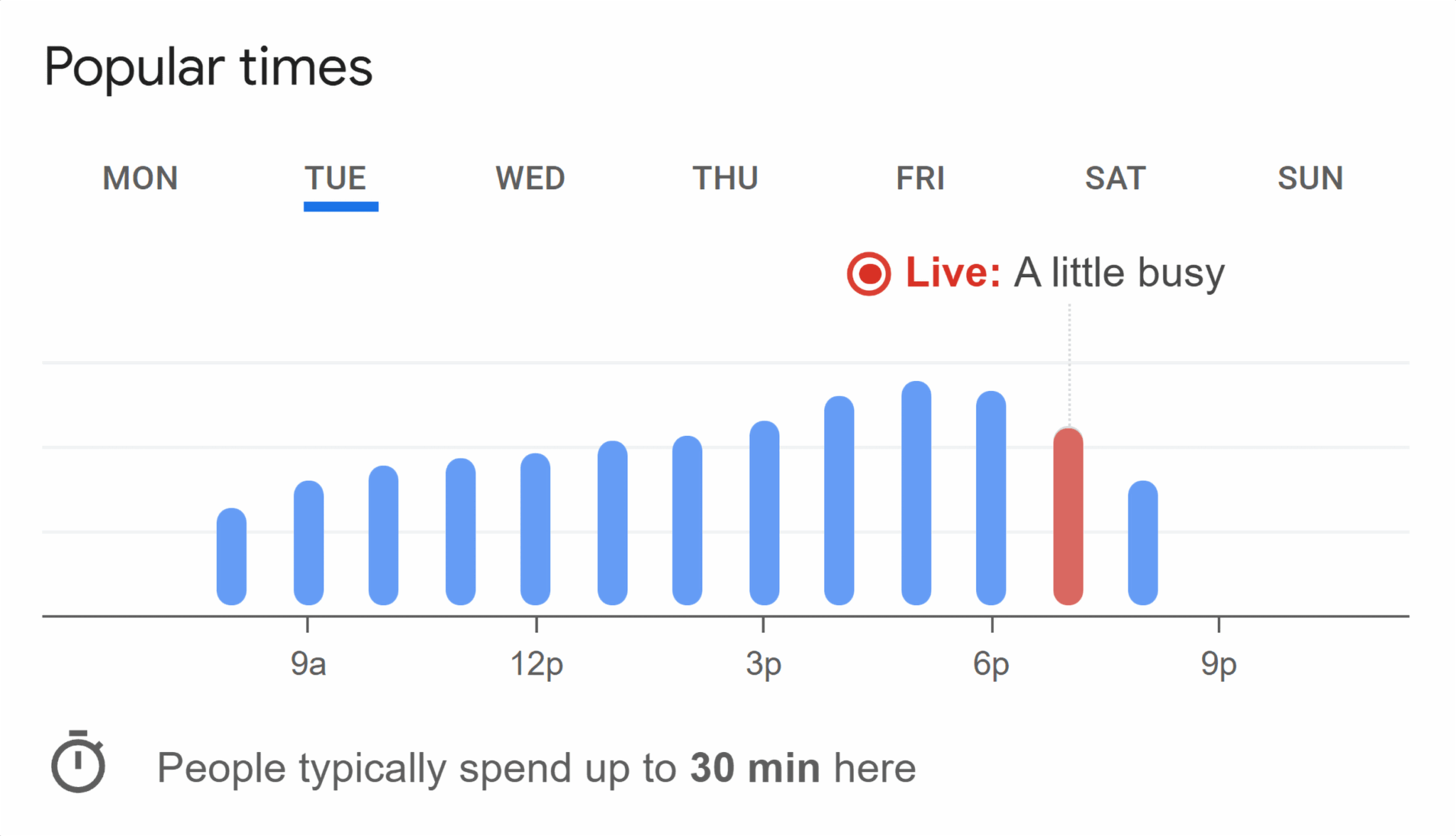
Thinking back to our hypothetical fake garage door showroom in an empty field, it’s easy to see how having these basic signals of real-world consumer behavior can confirm legitimacy in the eyes of Google—it’s unlikely for a non-location to have popular times.
WiFi and network presence
The data Google collects via mobile and WiFi technologies can help set a real business apart from a fictitious one. Google says:
“Mobile and Wi-Fi network signals can help Android estimate the device’s location, especially in environments where GPS signals aren’t available or accurate, including in dense urban areas or when indoors.”
Point-of-sale and transactions (indirect signals)
Google tracks consumer credit card transactions, giving it confirmation that sales are actually occurring at a specific location. Further, when store apps are integrated with services like Google Analytics, Google also has access to this data.
There’s an obvious link between transaction volume, consumer activity, and the existence of a business, though these signals don’t necessarily vouch for the trustworthiness of a brand. Scammers can have a high volume of these metrics, too.
Local press, sponsorships, and offline mentions
Any online mention of a local business that gets indexed by Google adds to its understanding of that entity—these are known as structured citations. They are becoming increasingly important because they vouch for the validity of real-world companies.
For example, when it makes local news that a siding company has donated materials and labor to fixing up a town hall, Google can index structured citations like these:
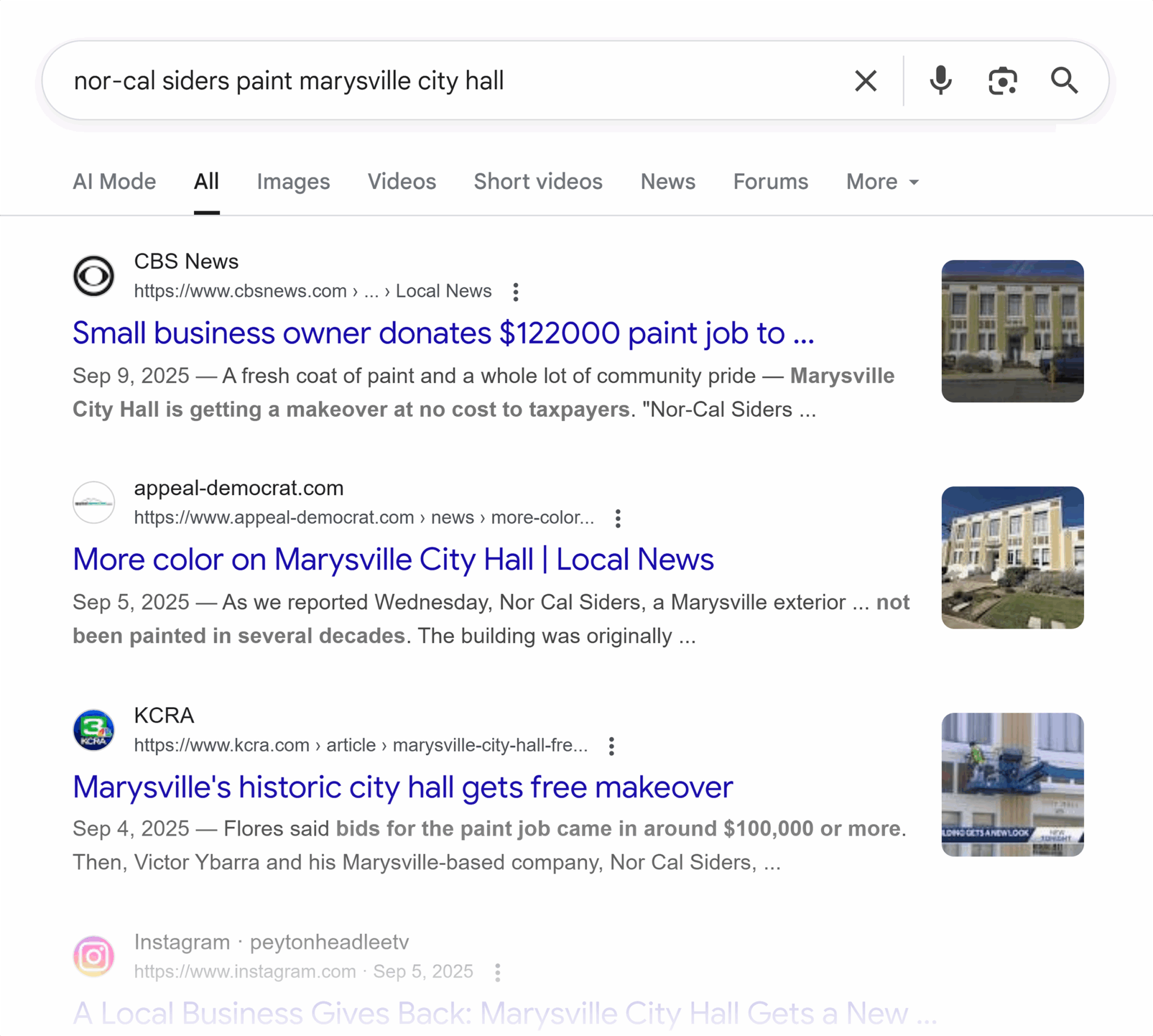
Sources of structured citations can include:
- Local event, team, and organization sponsorships
- Hosting and participating in community events
- B2B cross-promotion arrangements on local business websites
- Being cited on or contributing to hyperlocal blogs, podcasts, and video channels
- Creation of scholarships
- Advertising in, or being cited by, local newspapers, radio, or television
- Social media mentions and forum discussions
Any online record of offline business activity reinforces entity trust. Google instructs its Quality Raters—who evaluate whether relevant results are being returned to searchers—to consult a variety of sources to understand business reputation. Consumers also encounter these structured citations.
Clearly, a non-existent business is unlikely to engage in a promotion like offering to paint the local city hall.
User-generated proof
While reviews have become a main target for fraudsters in the local business sector, there are several elements that can increase the legitimacy of this content, including:
- Photos included in reviews, proving that a customer has either really been at a store location or hired a company for a service.
- Videos included in reviews that show customers visiting locations, store premises, inventory, staff at work, or complete projects.
- Handwritten testimonials collected directly from customers by the business, providing an authentic, human touch.
- Social media location tags on platforms like Instagram, TikTok, and Facebook that associate social media posts about local businesses with specific geographic locations, such as visiting a #cupcakebakery in #sanfrancisco.
Not only do signals like these instill consumer trust in the validity of brands, but they contribute to Google’s understanding of the authenticity of local entities.
How search engines capture and interpret offline data
Search engines like Google have extensive data pipelines for capturing consumer movements, behaviors, and transactions. This happens via a combination of:
- Mobile carriers
- Android/iOS signals
- Location tracking
- Aggregator partnerships
- Product usage such as the use of Google Analytics
Google states it uses captured data like this behind the scenes to:
- Make the online experience more useful
- Help searchers remember places they’ve already been
- Display anonymous community trends like popular business times
While the proprietary nature of Google’s algorithm makes it hard to claim that user or business data has a direct impact on local rankings, such data can certainly indicate that a business location is valid and being visited by the public.
Google’s focus on ground truth for local entities
Multiple Google patents and patent applications seek to tie search queries to specific results on the basis of human activity. This is all part of Google’s effort to create an online mirror of the offline world.
For example, one patent focuses on “inferring geographic locations for entities appearing in search queries.” In this dynamic, Google references the use of geographic signals to link website content to real-world entities like buildings and landmarks.
Matching offline behavior with digital signals
Google can cross reference multiple data points.
For example, imagine a business creates a Google Business Profile for a company called “Vegan Pizza Pan,” at 600 Market Street in downtown San Francisco. A Google Streetview car then passes through the neighborhood and captures imagery of a business at that location with signage reading “Mike’s Pizza.”
This creates a dilemma for Google (and customers): Is “Vegan Pizza Pan” the same business as “Mike’s Pizza?”
Imagine Google then phones the business, and a staff member simply answers, “Mike’s.” The Google rep will have to ask further questions to validate what the actual name of the place is.
If the listing gets suspended because Google isn’t confident about its name, the owner will end up having to supply documentation (like business licenses and tax certificates) revealing that the full legal name of the business is “Mike’s Vegan Pizza Pan.”
All that trouble could have been avoided by being consistent in offline branding.
Tactics to amplify your offline authority online
Use these tips to create a strong digital record of your offline presence so that both consumers and search engines like Google have ample proof that your business is legitimate.
Encourage reviews with context and authenticity
Google has become so skilled at parsing image content that they can now group photos.
Look at this example of a GBP photo set broken down into more than a dozen image categories:

Imagine a searcher trying to find a local spot to order a Cuban sandwich. Images customers have taken of this menu item would certainly boost the searcher’s confidence that their needs can be fulfilled by this restaurant because the photos act as proof:

The images section isn’t the only area of a Google Business Profile where the public can upload photos. Reviews that contain photos say “I was here” to both fellow customers and to Google, like this review showing off a Cuban sandwich:
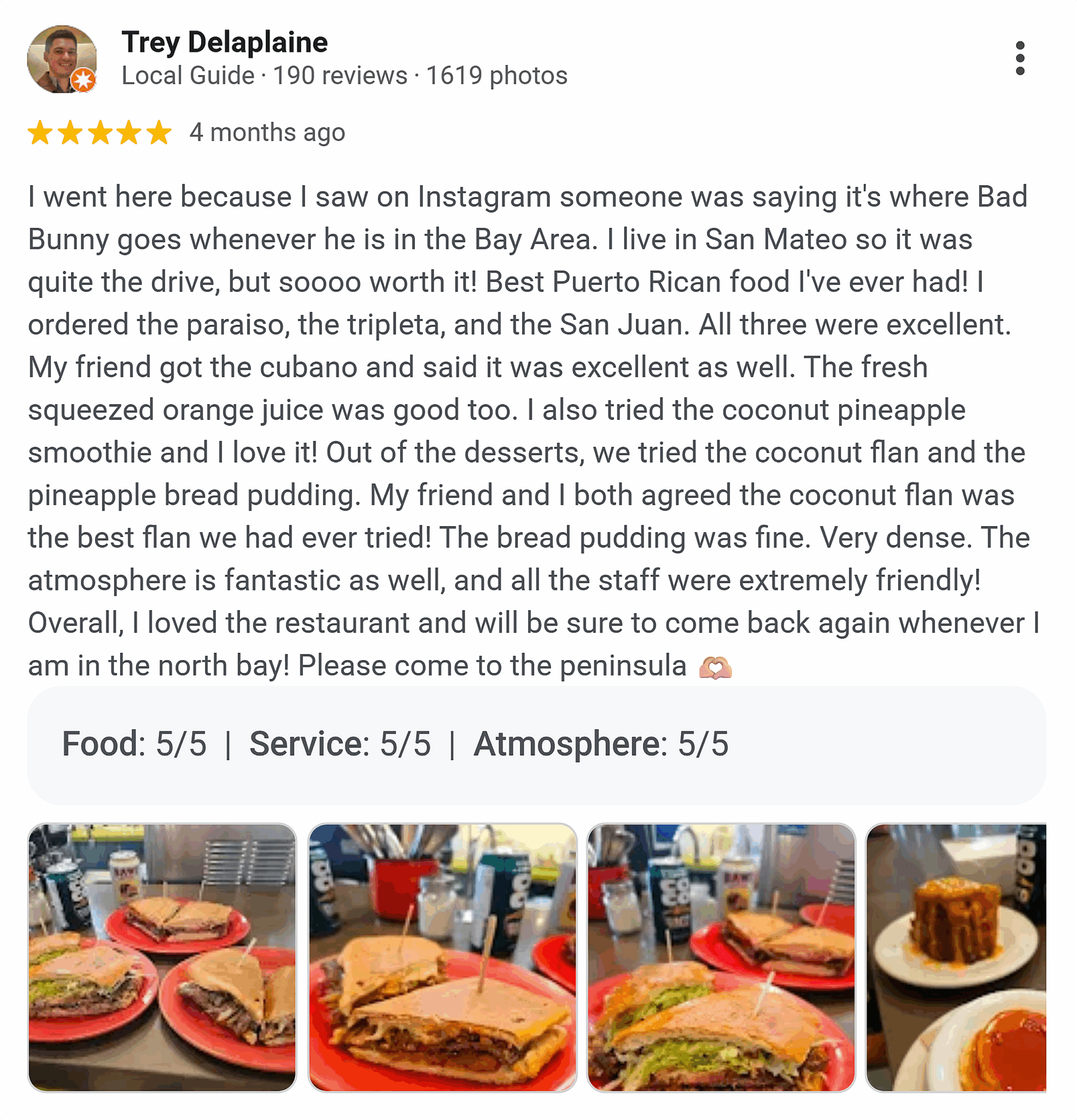
Encourage reviewers to include images in their reviews with these tactics:
- Create a photo-worthy brick-and-mortar location. Look at the eye-catching restaurant featured in the above reviews: It’s a place patrons enjoy photographing because of its aesthetics.
- Design in-store signage letting customers know you’d love them to photograph your premises and review you.
- Designate selfie hot spots that inspire customers to photograph themselves at your place of business.
- Update your review request templates to include a special request for customers to upload photos when they review you.
- Send photos to customers of service area businesses (SABs), like contractors, landscapers, and interior designers, showing before-and-after shots or completed projects. Ask customers to use these images in their reviews.
- Experiment with sending product and service photos as part of your review requests, but be sure the imagery is unique and does not stem from manufacturers, or your reviews will look suspicious instead of authentic.
- Share customer-uploaded photos on your social profiles, giving socially active patrons an extra reason to want to photograph your business.
- Vary your proofs by asking some customers for hand-written testimonials at the time of service. Publish this content on your website as GBP Updates posts, owner-uploaded GBP image content, and across your social profiles.
Leverage local PR and community ties
Doing good in a community can create strong signals of authenticity.
Earlier, we looked at an example of a siding company fixing up a local city hall. Almost any local business can earn similar PR with the following steps:
- Plan to contribute to the community by hosting/participating in events, donating to valued institutions or local causes, sponsoring projects or sports teams, or developing some other form of benefit.
- Outreach to the appropriate parties: For example, contact the local no-kill animal shelter and ask if it would help them to receive a donation of 5% of your sales during the holiday shopping season. Chances are, they’ll welcome the offer.
- Outreach to local media with your story. This can include local reporters, bloggers, podcasters, video channel hosts, etc. Give them something to talk about in their neverending search for fresh and interesting local content.
- Once stories go live about your community benefit program, be sure to share them on your website and social profiles, increasing the chances of them being seen by the community and indexed by Google.
- If a project has an end date, set a time to embark on your next community involvement effort and repeat this process.
A single program can earn your business multiple structured citations, vouching for the authenticity of your role in the community and setting you apart from shady brands.
Optimize physical location for digital feedback loops
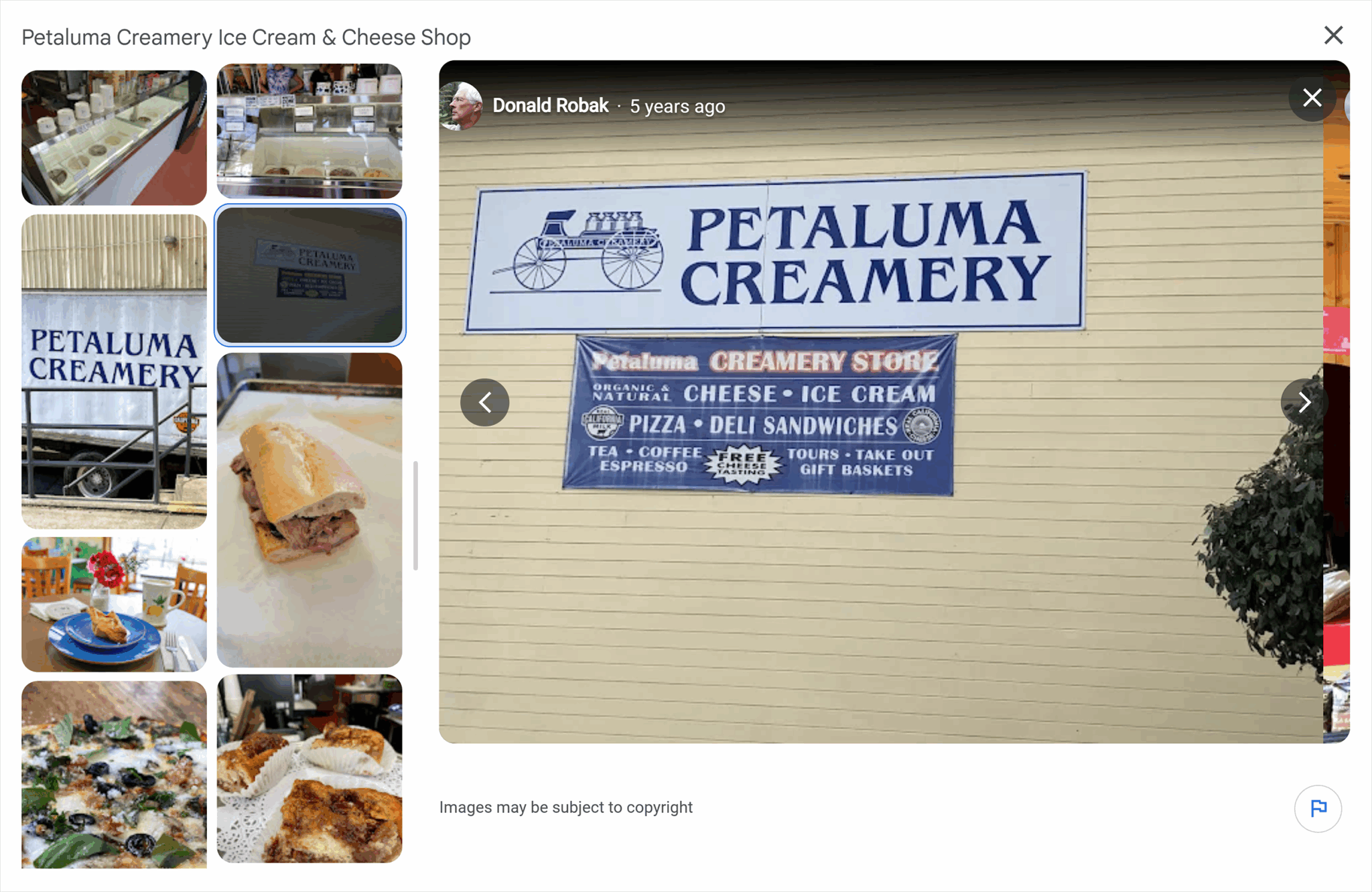
The clarity of your storefront signage doesn’t just help pedestrians and drivers find your premises on the street, but Google can read this content in photos, too. It’s an important part of validating that you’re running a real business.
Invest in bold signage that customers want to photograph, like the following example which consistently signals that real people have been to this dairy bar:
Integrate offline data with first-party systems
Experiment with loyalty app check-ins and QR codes to bridge offline-to-online consumer experiences.
Loyalty apps
Loyalty apps are meant to improve customer retention, decrease spend on new customer acquisitions, and increase sales by offering existing consumers points or other rewards for checking in.
Local retail brands that are enrolled in Google Merchant Center (GMC) can also make use of its loyalty program where available.
This GMC add-on enables you to list out offers like customer points, loyal customer free shipping deals, and loyal shopper discounts. Activity can then be tracked via a loyalty program performance report, and, of course, any Google product you use gives additional information to the search engine about the validity of your business.
QR codes
QR codes aren’t a good fit for every business, and the most data about their success in the small local business world tends to stem from the restaurant industry. Consumer response to them also varies.
A survey by Toast found that:
- 81% of restaurant-goers still prefer print traditional menus to QR codes
- 26% say the small print of QR codes is their least favorite thing about them
Uniqode has an interesting round-up of QR code experiments for your inspiration, but it mainly features large enterprises.
What could be more applicable to local brands of all sizes is Google’s QR code generator for Google Business Profile reviews.
Look up your business in Google and click the “ask for reviews” button in your New Merchant Experience display, which will bring up this screen:

This will generate a QR code that, when accessed, takes customers directly to the action of leaving a review on your GBP.
Another very simple way that local businesses can enhance their offline-to-online authenticity signals is via featured event posts on Google Updates. Here’s an example from a hotdog restaurant offering an ongoing special event:

However, as Claudia Tomina notes in her recent post on why some GBP event posts don’t show on your listings:
- This post type is only available in certain business categories.
- It is only available on mobile devices.
- Posts should feature both the days of the week and hour information so that Google has enough context to display these posts on the right day: For example, Google may reject a post which reads, “Happy Hour from 4pm to 6pm,” but will accept “Happy Hour every Monday – Thursday from 4pm to 6pm.”
Schema
While Featured Event posts are limited by GBP category, there are no limits on which businesses can use Schema to markup events posted to your website and third-party sites.
Google offers this complete tutorial, including code samples for creating structured data around events. By following Google’s instructions to the letter for directly feeding them event content, your major happenings could appear in the “Events” SERP feature, increasing engagement and signaling to Google that your business is real and hosting real events:

Measuring the impact of offline signals
How do you know if your efforts to prove authenticity are delivering results? Track these four patterns to measure how real-world activities drive online growth.
Google Business Profile performance lifts via customer service improvements
The most direct offline-to-online key performance indicator (KPI) any local business can measure is the impact of customer service on consumer ratings and review sentiment.
A major review survey from GatherUp shows that 60% of consumers feel motivated to write negative reviews to warn their communities of bad experiences.
Just 24% will choose to transact with a business that’s average star rating is 3 stars.
If your company has entered the 3-star danger zone, you can track the outcomes of consumer experience improvement initiatives via:
- Increased review volume. The same survey shows that the number one reviewer motivation is to give rewards for great customer experiences.
- Increased positive sentiment in reviews dating from your new initiative. Sort GBP reviews via the “newest” tab to analyze sentiment within a specific timeframe.
- Gradual positive impact on your average GBP star rating.
- Increased conversions as your average rating improves and your most recent reviews speak of positive customer experiences. This can include more requests for driving directions, more clicks-to-call, and more clicks-to-website from your GBP, as shown by the “Performance” tab in your New Merchant Experience dashboard.
- Increased sales as a result of increased GBP conversions.
- Increased Local Pack and Maps ranking position due to increased star rating, review recency, and review volume, which are hypothetical ranking signals.
Increased review recency via active review acquisition
Studies and surveys indicate that review recency impacts both local rankings and consumer behavior. The majority of consumers say they consult the most recent reviews first in trying to understand whether to trust a local business for a transaction.
Given the influence of this one metric, a proactive review acquisition campaign is essential to proving that real people are visiting a real business, and also to whether that business can be trusted by the local public.
Before you start a new review acquisition campaign, measure the velocity at which your business typically receives reviews.
For example, a small business might receive 10 new reviews a month without asking. Once a campaign is underway, track increased velocity of incoming reviews to understand how active requests via email, text, signage, print material, and in-person asks are driving growth in this vital metric.
Digital footprint growth via unstructured citation development
We’ve looked at multiple examples of the good brands do in communities and how that can result in great online PR. When you begin a new campaign of public outreach, track its outcomes in terms of:
- Number of new local publisher mentions earned, in online news, hyperlocal blogs, local podcasts, video channels, etc.
- Authority of new unstructured citations earned—online mentions of your business on anything other than a formal local business directory. Document the types of publications citing your brand and measure their authority with a free tool like Semrush’s Website Authority Checker to assess the SEO benefits each mention is providing in addition to proving basic local business authenticity.
- Incorporate top structured citation sources into your “How did you hear about us?” consumer surveys to track whether specific mentions are driving consumer discovery.
Correlate online gains with offline outcomes
Gain insight into whether the above online visibility and reputational improvements correlate to increased offline activity, using mobility data tools like Placer.ai and SafeGraph. These products track:
- Foot traffic
- Demographic information
- Visitor behavior signals, such as visit frequency and dwell time
Theoretically, improvements in consumer experiences should improve reputation metrics like average star ratings and positive recent consumer sentiment in reviews. This should then increase offline activity such as visits and transactions.
The future of offline-to-online strategy in local SEO
It is still too early to predict the degree to which local consumers will adopt options like AI into their local business processes. If these products deliver accurate information that is more useful than existing formats like Google Local Packs and Maps, then there is a good use case for the technology.
If, however, they scrape and promote local business listings and review fraud, resulting in consumer misdirection and harm, they will likely fail to win public trust.
Here are some developments to keep an eye on.
Google’s review fraud takedown
Google routinely makes public announcements about its efforts to combat review fraud, like this blog post saying that they removed 45% more suspicious reviews in 2023 vs. 2022.
Google said that the evolution of their machine learning algorithms are assisting with this effort, but local businesses have a better view of exactly how listing and review fraud impact their communities despite these takedowns.
With AI enabling the scaling of review fraud, local brands should pay close attention to whether consumer trust in third-party reviews trends up or down over time.
Rollout of new Google Lens features
AI-enabled image recognition technology is being billed as a game changer.
Google says that 72% of shoppers use their phones while shopping in-store, and that over half of consumers leave stores without making a purchase because they lack confidence in a particular product.
All retail models should check out Google’s evolving set of in-store and local shopping features powered by Google Lens.
Though you can’t directly submit images to Google Lens, run your Google Business Profile product images through the Cloud Vision API to see if Google can understand them.
Do augmented reality and virtual reality (AR/VR) have a genuine use case for local brands?
AR and VR are classic examples of well-funded tech experiments that struggle to meet their goals of engineering human behavioral changes.
Despite claims like those from Meta CEO Mark Zuckerberg that people without augmented reality glasses will be at a disadvantage in the future, Meta’s Reality Labs is posting quarterly losses of billions of dollars.
Practically speaking, AR/VR technology is unnecessary for most small-to-medium local businesses at present.
Track, optimize, and win in Google and AI search from one platform.
Enterprise brands, however, may want to experiment with its try-before-you-buy functionality. For example, Macy’s Room Planner helps customers preview how furniture would look in their homes.
The right mix of emergent technologies will be unique to each business. Experimentation is key, but so is thoughtful observation that will allow you to differentiate between practical use and mere marketing hype.
Every legitimate local business has multiple options for proving its authenticity to both search engines and consumers. The best results come from tying trustworthiness to a strong reputation for delivering excellent customer experiences.
Learn more about consumer behavior
Online experiences drive offline wins, and your brand can’t maximize its leads without creating trustworthy digital experiences for potential customers.
Learn how both structured and unstructured citations influence consumer behavior, and how to make the most of them for your brand.
Explore more on
Editorial disclosure
Search Engine Land is owned by Semrush. We remain committed to providing high-quality coverage of marketing topics. Unless otherwise noted, this page’s content was written by either an employee or a paid contractor of Semrush Inc.
About the author


