Publisher LLM visibility: Steal The Spruce’s winning playbook


If you’re a digital publisher, you’ve probably seen a drop in organic traffic. You’re not imagining this: Google search traffic to publishers has already declined by 33% globally. Industry leaders forecast a further 40% drop by 2029.
But while many publishers are losing visibility, The Spruce, a home improvement and lifestyle site, is thriving.

Why? Strong AI visibility.
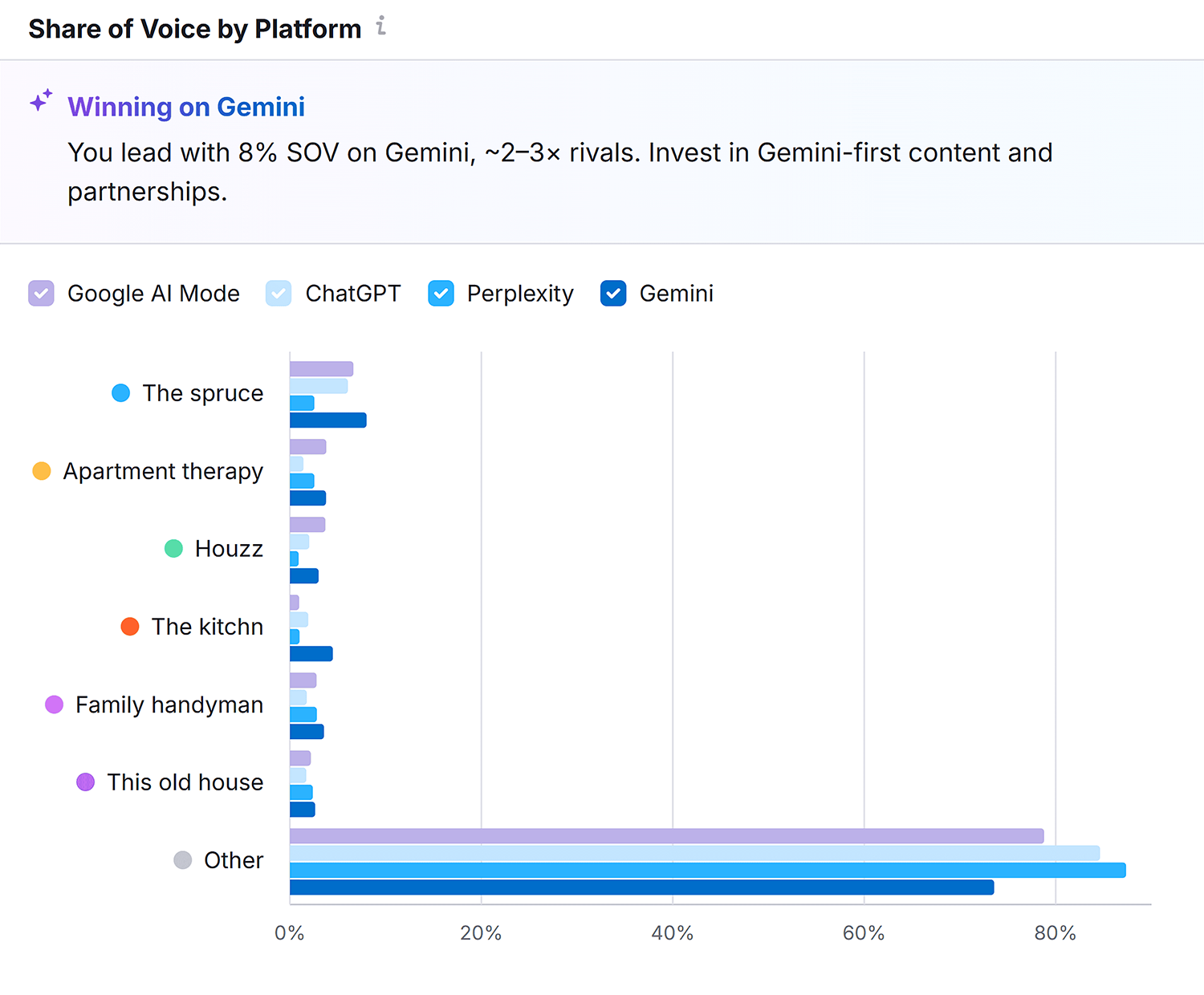
The Spruce gets mentioned by large language models (LLMs) at rates comparable to heavy-hitters like CNET and Consumer Reports, according to Semrush’s AI Visibility Toolkit.

They’re even outperforming direct competitors in LLM Share of Voice.
So what’s their secret?
In this case study, we’ll reverse-engineer exactly what The Spruce is doing to win at LLM visibility. And show you how to replicate their strategy — even if you don’t have their resources.
But first, we’ll explain why getting mentioned by LLMs is a must for publishers.
Why LLM visibility matters for publishers
As AI systems like Google’s AI Overviews, AI Mode, and ChatGPT answer questions directly, fewer people click through to publisher sites from search engines.
But those same LLMs are shaping trust before a visit happens.
The SEO toolkit you know, plus the AI visibility data you need.

When your brand appears in AI answers, users start associating you with that topic, even if they don’t click right away. And when they’re ready to act, they’re far more likely to come to you directly.

You build brand awareness, authority, and direct traffic just by becoming part of the conversation. (No matter what happens with your organic traffic.) This is especially important as publishers shift toward memberships and premium content.
AI visibility builds the credibility you need to make those models work.
Consider The Spruce. They’re dominating AI visibility across platforms, beating out top competitors like Bob Vila, Apartment Therapy, Family Handyman, and Houzz.

They have 72.9K mentions and 25.8K cited pages in Google’s AI Overviews alone.

A citation is when an AI response attributes information to your content, typically with a link or source label. For example, when we asked ChatGPT for the best floor cleaners, it recommended multiple options and cited The Spruce’s buying guide as one of its sources.
That builds credibility.

Recommendations work differently.
This is when LLMs suggest your brand as the answer, whether or not they include a direct link to your site. Users remember your name and visit directly to read content, sign up for newsletters, or make a purchase.
For example, when Google Gemini was asked, “What’s a good website for gardening DIYs,” it recommended The Spruce.

There was no direct link, but it described The Spruce as a “powerhouse for home and garden DIYs” and labeled it “Best for comprehensive guides and beginner-friendly projects.”
That’s a compelling endorsement.
So, how is The Spruce getting all of this AI visibility? Let’s dive deeper into their playbook.
Note: The LLM visibility data in this article comes from Semrush’s AI Visibility Toolkit. Want to see how your site is performing in LLMs? Sign up for a free trial of Semrush One, which includes the AI Visibility Toolkit and Semrush Pro.
Strategy #1: Site-wide trust signals that build credibility
When it comes to LLMs, they’re less about claims and more about trusting evidence. Showing up in AI answers is one thing — showing up positively is another.
If AI systems cannot clearly verify who wrote your content, how it was reviewed, and why it should be trusted, they are far less likely to surface your brand as a reliable source.
That is why trust signals are gold. The Spruce has high sentiment scores compared to key rivals.

Trust signals are one of the reasons for this high score. Semrush’s report shows that one of The Spruce’s key sentiment drivers is “recognized as a legitimate, trustworthy brand with editorial standards.”

Here’s how they display these trust signals on their site. For starters, The Spruce structured its Editorial Policy page to be easily parseable by machines.

Each section has a clear heading and supporting details about how The Spruce’s content is produced, reviewed, and maintained.
This includes:
- Fact-checking and vetting workflows
- How accuracy and corrections are handled
- Sourcing requirements
- How (and when) AI is used

This creates clean, crawlable signals for AI systems, so they can more easily extract, attribute, and reuse information accurately.
They also layer in credibility markers at the page level. Every buying guide includes a “Why Trust The Spruce?” section with information about the writer and contributors’ experience.

Author bios provide even more detail about relevant experience and subject-matter expertise. For example, one Spruce writer notes his “10+ years of remodeling and construction experience.”

The Spruce also gives expert reviewers and fact-checkers bylines and bios for added trust and accuracy. This article was reviewed by an electrical contractor with 36 years of experience:

“Last updated” dates also appear prominently throughout their content. Retrieval systems tend to prioritize updated pages, increasing the likelihood that the content will be pulled into AI responses.

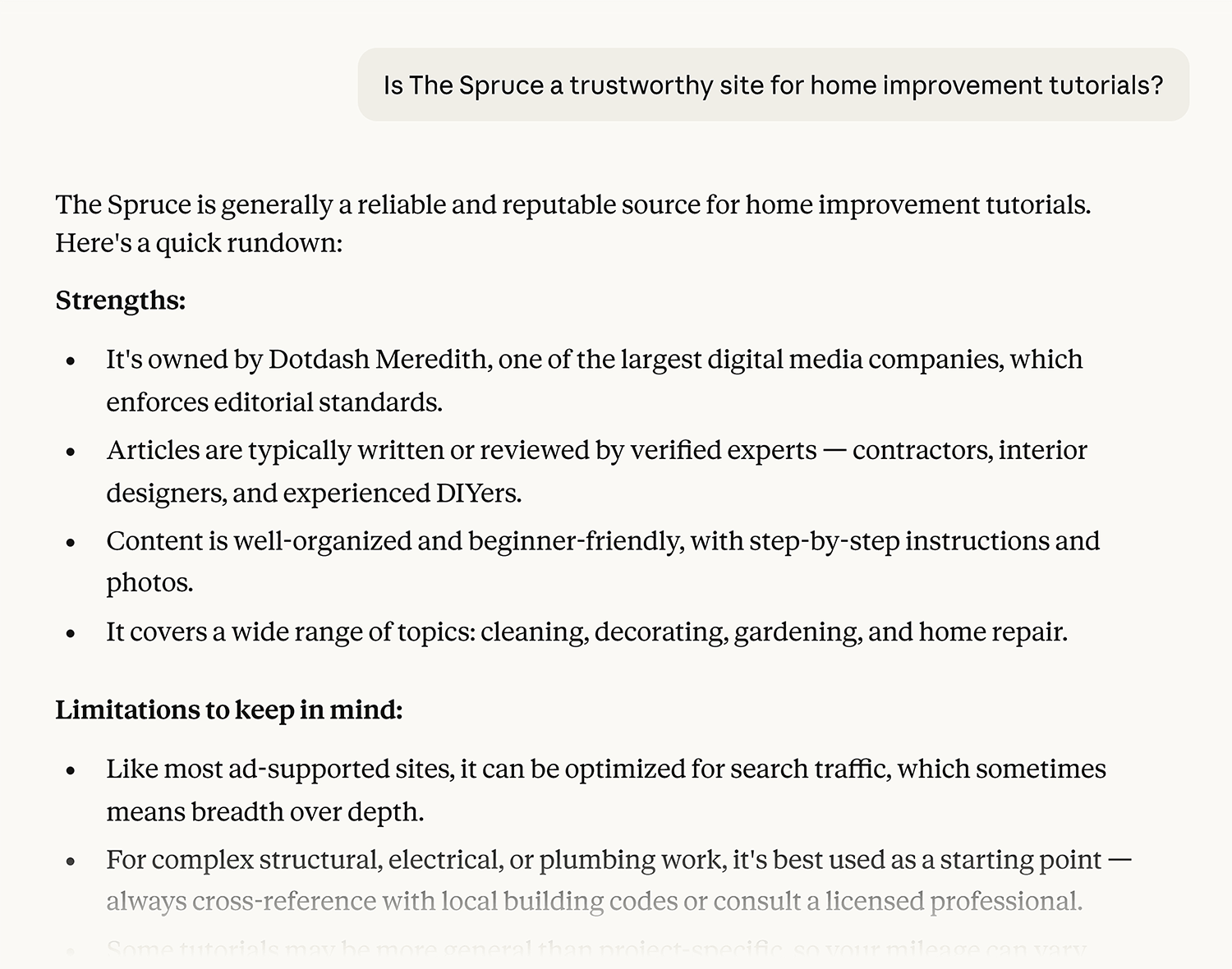
These trust signals are reflected directly in how AI models describe The Spruce. Claude highlights its expert writers and editorial review process when assessing the site’s trustworthiness.
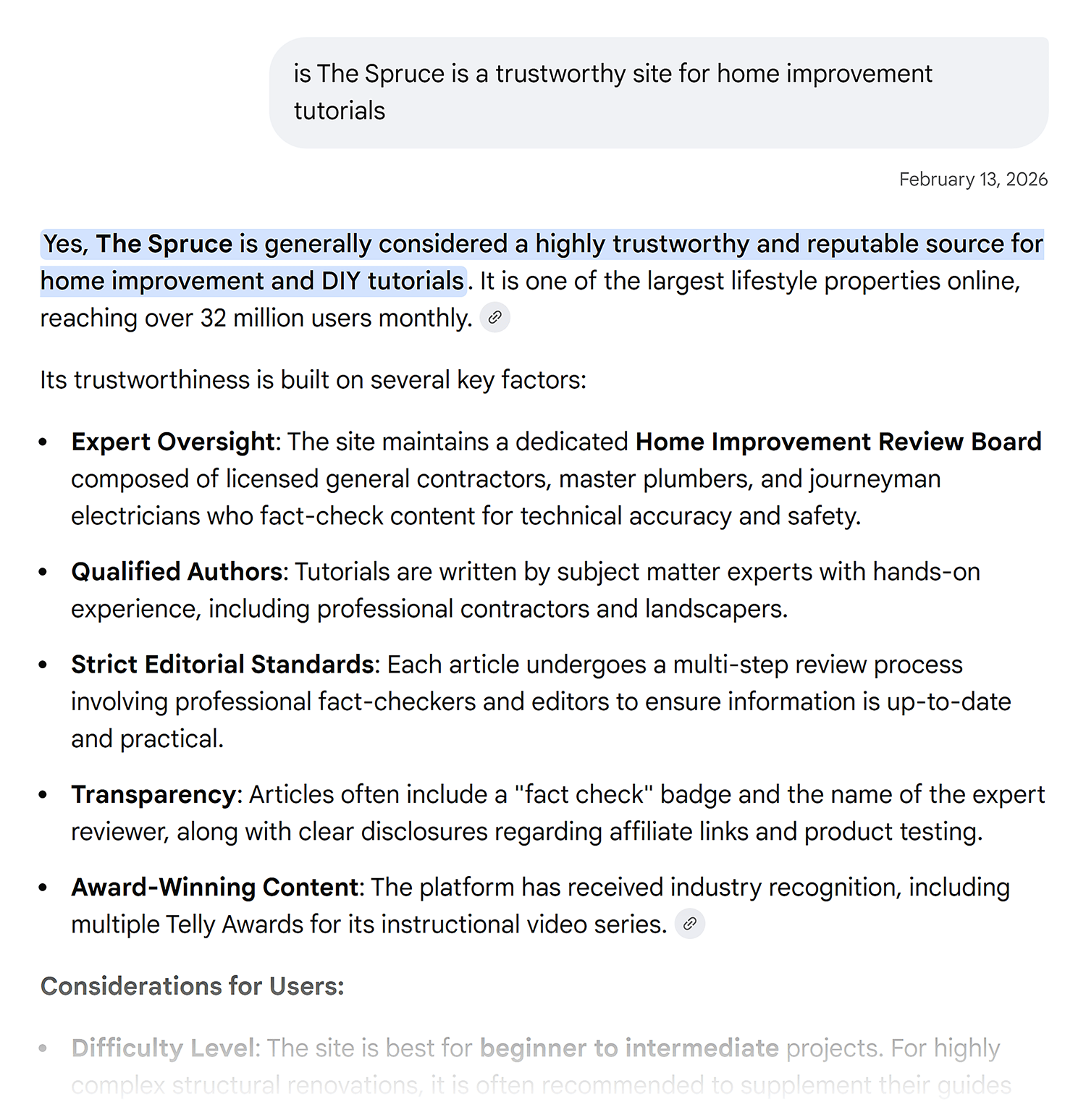
Google AI Mode points to its “transparency,” “strict editorial standards,” and “qualified authors.” In this case, we can see that trust is the foundation, not a supporting detail.
Steal this: Build quick trust signals (and broadcast them across your site)
- Create an “Editorial Standards” page and link to it in your footer. This makes it easy for LLMs to find and parse your editorial processes.
- Add “Last Updated” dates to your content templates, especially for product reviews.
- Standardize author bios with relevant credentials. Don’t just list names — explain why this person qualifies to write about this topic by including their experience, education, awards, and areas of expertise.
- Make expert contributions obvious. If you use external experts, add clear attribution and credentials.
Further reading: Trust, Authority & Search Rankings
Strategy #2: A rigorous product testing process
LLMs reward proof, so if you’re an affiliate site, the depth of your testing methods — and how you clearly present it — matters for LLM visibility.
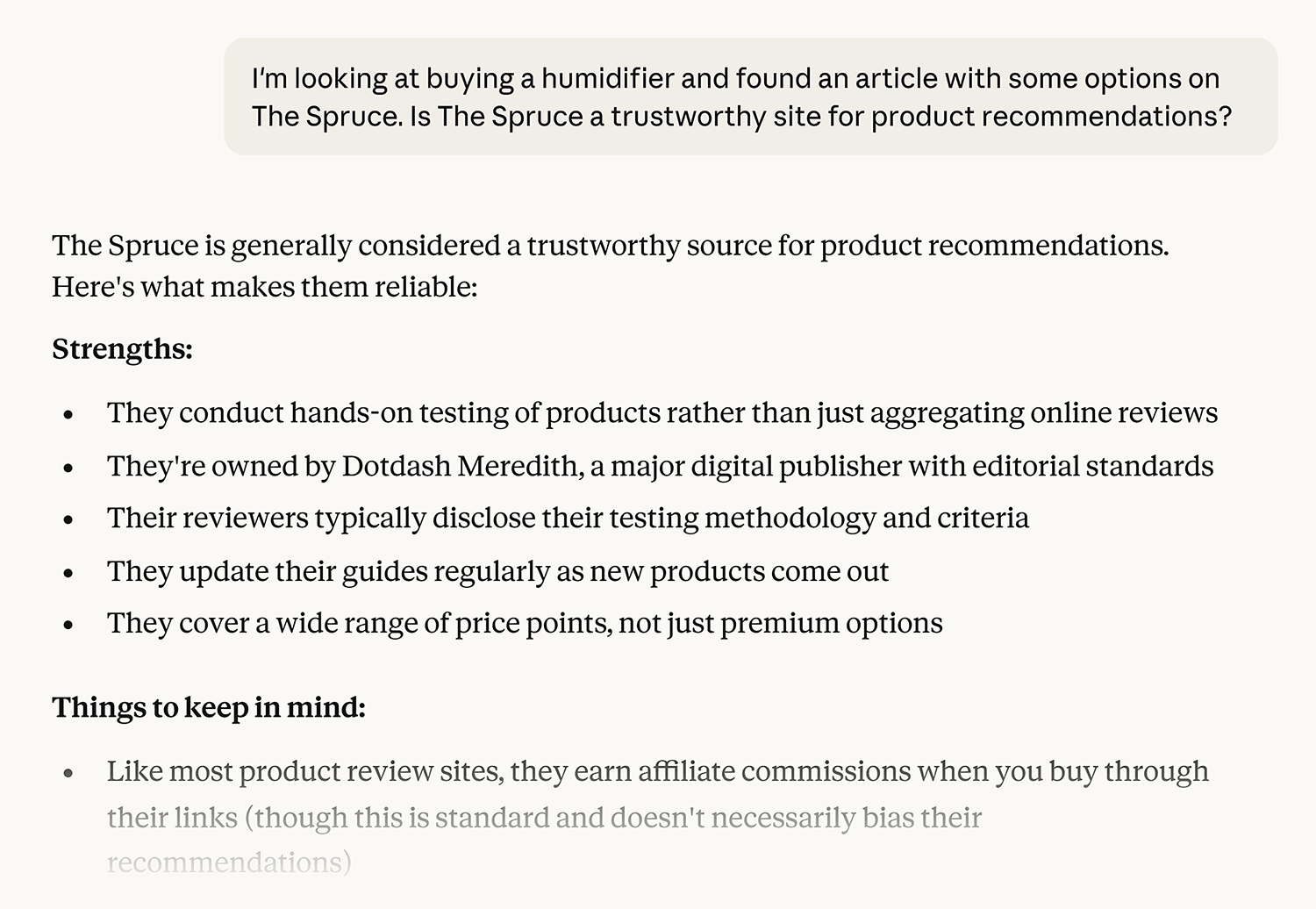
LLMs are more likely to surface content that includes concrete testing language, such as “we tested this for 40 hours.” When asked if The Spruce is a trustworthy site for product recommendations, Claude cites their “hands-on testing” and “testing methodology.”
When evaluating whether a BISSELL vacuum is good for pet hair, ChatGPT pulled detailed testing insights directly from The Spruce’s review and linked to its buying guide, which contains affiliate links.

One of the reasons The Spruce’s testing data shows up in LLM responses is the level of detail. They document their methodology with extreme specificity in every buying guide and structure it for easy parsing.

Every buying guide includes:
- A “How We Tested” section breaking down their entire methodology
- “What We Like” and “What We Don’t Like” boxes for each product
- Photos showing products in actual use
- Direct quotes from testers about real-world performance
- Specific metrics like ease of setup, cleaning effectiveness, and value assessment
This level of detail gives LLMs quotable, credible data they can extract and cite in answers.

They also have a dedicated page explaining their “The Spruce Approved” badge, which they award only to products that meet their rigorous standards.

Another critical factor in their success is transparency about affiliate commissions. They prominently display affiliate information and state that they recommend only “what’s worth the money” based on their testing data and expert reviews.

As a result, “hands-on product testing” and “clear disclosure of affiliate model” rank as one of The Spruce’s top sentiment drivers.

Steal this: Upgrade your product testing
- Pick three to five hero products each quarter and rigorously test them. Start with your highest-traffic buying guides or most competitive product categories. Document your process with real photos, specific observations, and measurable results.
- Create a “How We Test” page and link to it from every product guide. Include your methodology, criteria, and timeline to give LLMs a single comprehensive resource to reference.
- Use consistent, specific language across all reviews: “We tested X for Y weeks under Z conditions” signals rigor to LLMs better than vague claims like “we thoroughly researched this.”
Strategy #3: Structure content for easy extraction
LLMs reward content they can reuse without interpretation. The same elements that make content easy for readers to scan also make it easier for AI systems to locate, classify, and cite information as standalone answers.
The Spruce structures its content in an LLM- and reader-friendly way. Elements like the “Key Points” box in their contractor red flags article summarize main takeaways into citation-ready chunks.

“Meet the Expert” boxes clearly attribute advice to licensed professionals, sending explicit credibility signals.

Descriptive subheadings create another layer of extractability. Each section is written to deliver a complete, self-contained point, so models don’t need surrounding context to extract meaning.

As a result, this article is The Spruce’s most-cited page across LLMs, appearing in over 8.3K answers.

In their best air mattresses guide, they go even further by pairing products with specific use-case labels:
- “Best for quick and simple setup”
- “Best for guests”
- “Most comfortable”
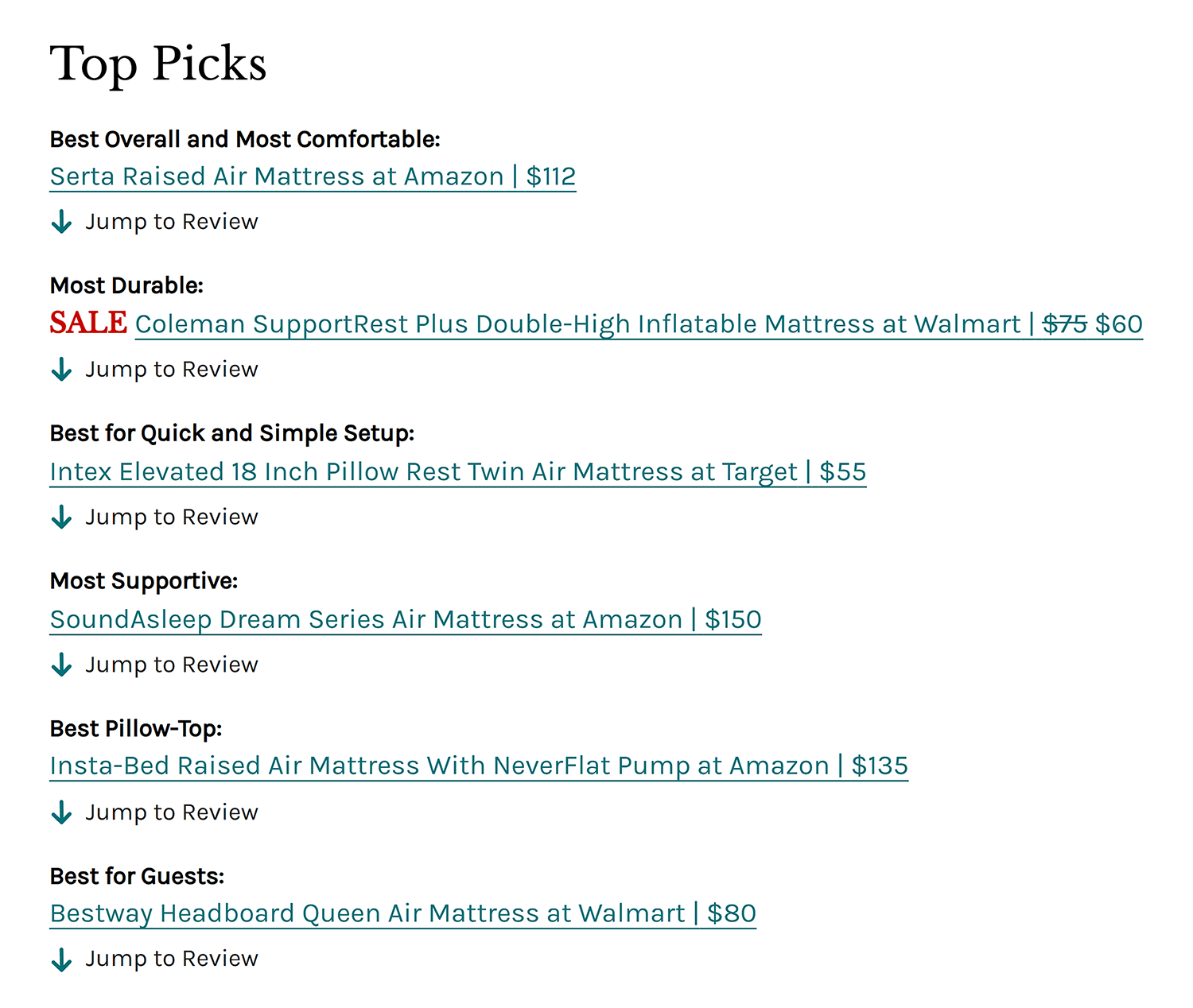
These labels mirror how people actually phrase AI prompts, making it easier for models to match recommendations to intent.
Pros and cons boxes create the same advantage.

Google AI Mode quoted The Spruce’s testing notes almost word-for-word because the phrasing was already structured for reuse.
It described one mattress as “exceptionally stable and supportive.”

That exact phrasing comes from The Spruce’s “What We Like” box.

This is the advantage of quotable content: AI won’t need to interpret your expertise; it will simply lift it directly.
Steal this: Format your content for maximum LLM visibility
- Add scannable elements. Include a table of contents, pros and cons lists, comparison tables, and key takeaways, depending on the topic. These elements help LLMs understand your article structure before processing the full text.
- Use specific, descriptive labels for recommendations. Instead of “Best Overall,” write “Best for Small Apartments” or “Best for Heavy Traffic.” Match the specific language users type into AI systems.
- Make H2s descriptive and standalone. Instead of “Features,” write “What to Look For in a Floor Cleaner.” Instead of “Results,” write “How Each Vacuum Performed on Pet Hair.” These headings can be pulled into AI answers as standalone snippets.
Strategy #4: In-depth how-to content that demonstrates real expertise
One strong how-to should answer dozens of related questions.
The Spruce wins AI visibility because it covers topics both broadly and deeply. Readers can learn how to do just about anything on The Spruce, from repairing a chimney to killing weeds with salt.

That breadth (paired with instructional depth) positions them as a reliable source for nearly any home-related question.
The AI Visibility Toolkit analyzes recurring patterns in how LLMs describe brands to identify what drives visibility. According to this data, The Spruce ranks #1 for “beginner-friendly education support” and “expert-tested product guidance,” outperforming Houzz, Bob Vila, and other competitors.
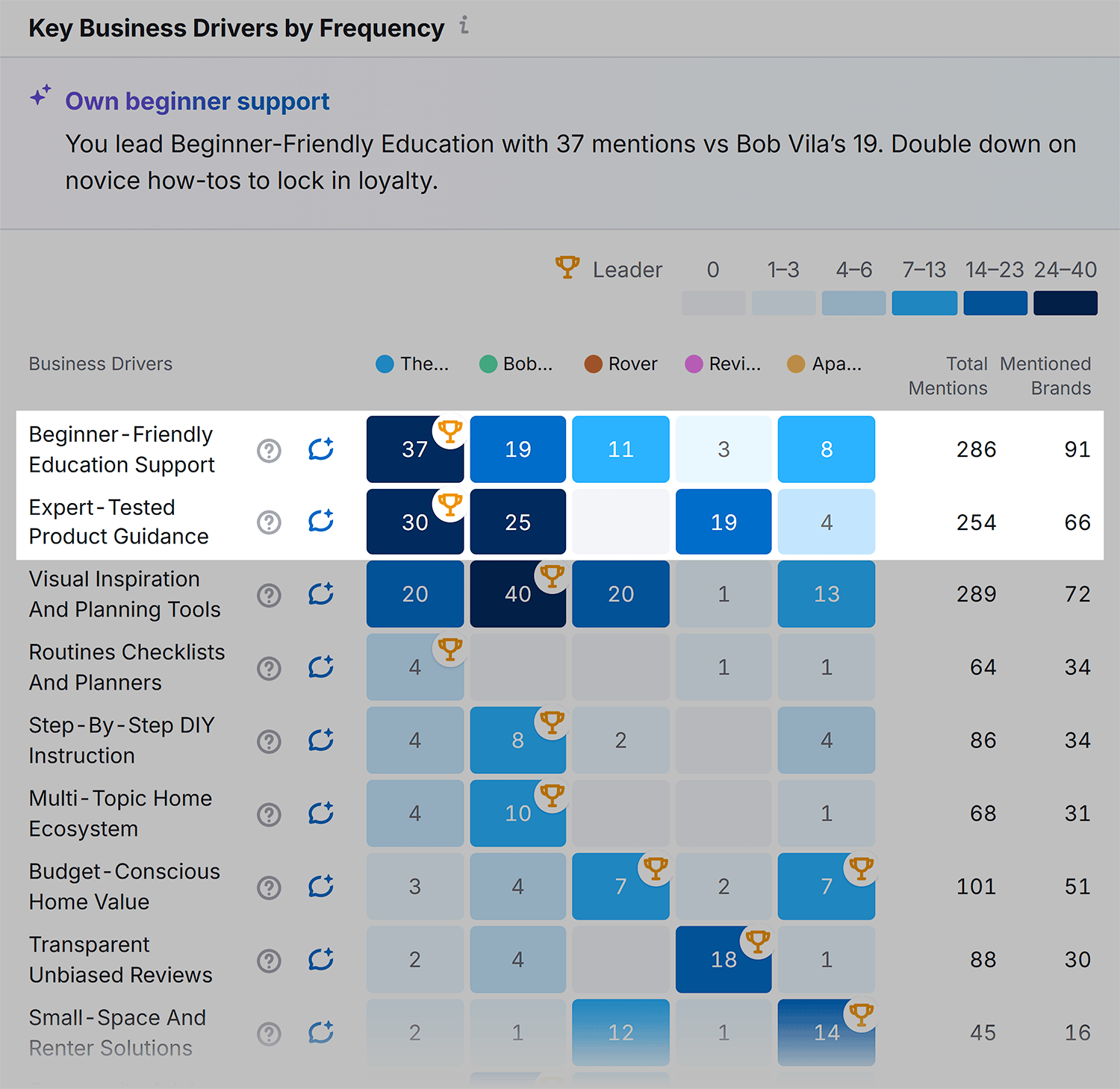
That visibility comes from expert-backed how-tos that consistently includes:
- Step-by-step instructions
- Tutorial videos
- Comprehensive lists of required tools and equipment
- Estimated time commitments
- Cost ranges
- Skill level assessments
This creates highly specific, citation-worthy content that LLMs can confidently surface.
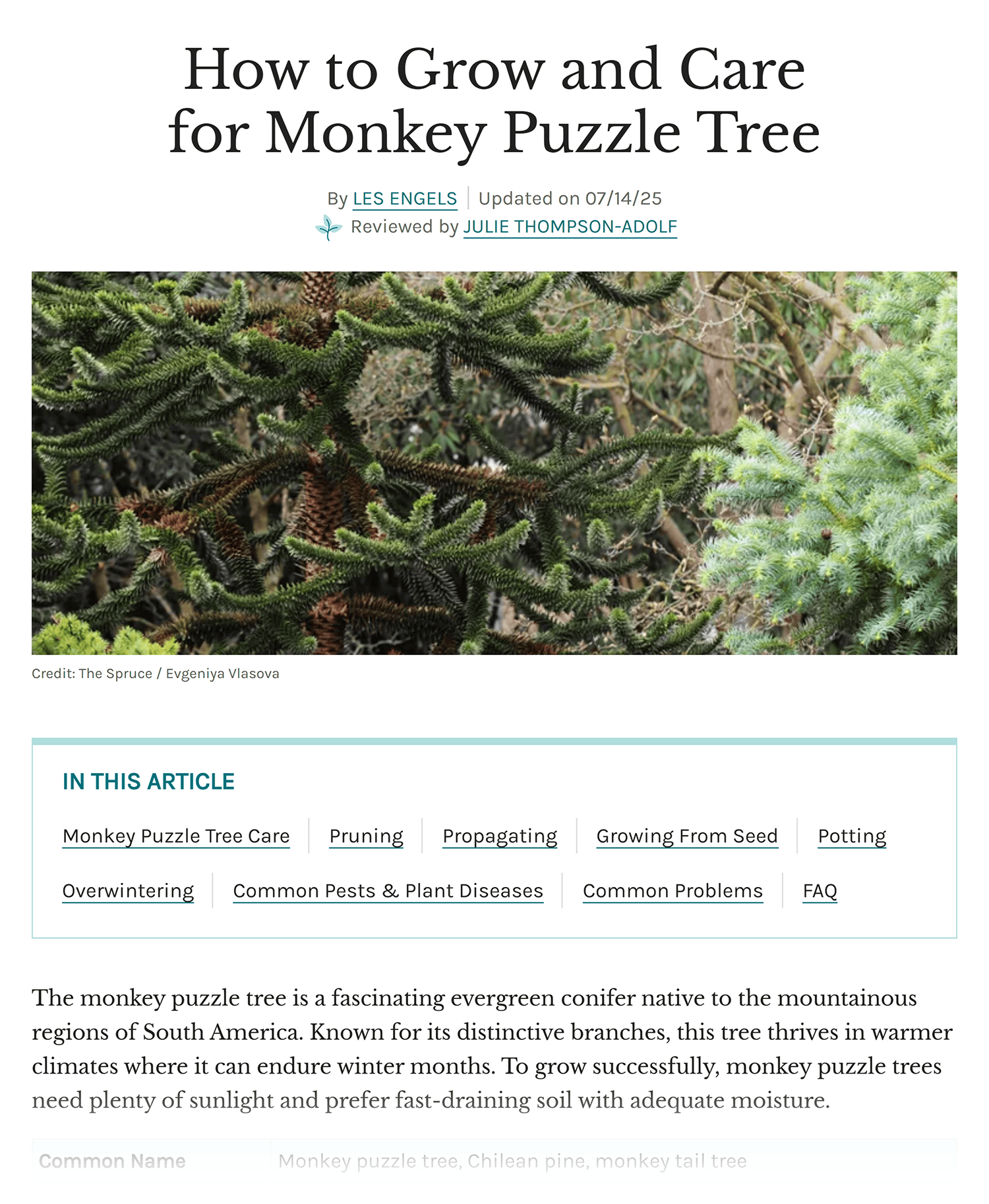
Its monkey puzzle tree care guide is a strong example, and that’s why it showed up in AI Mode as the top source.
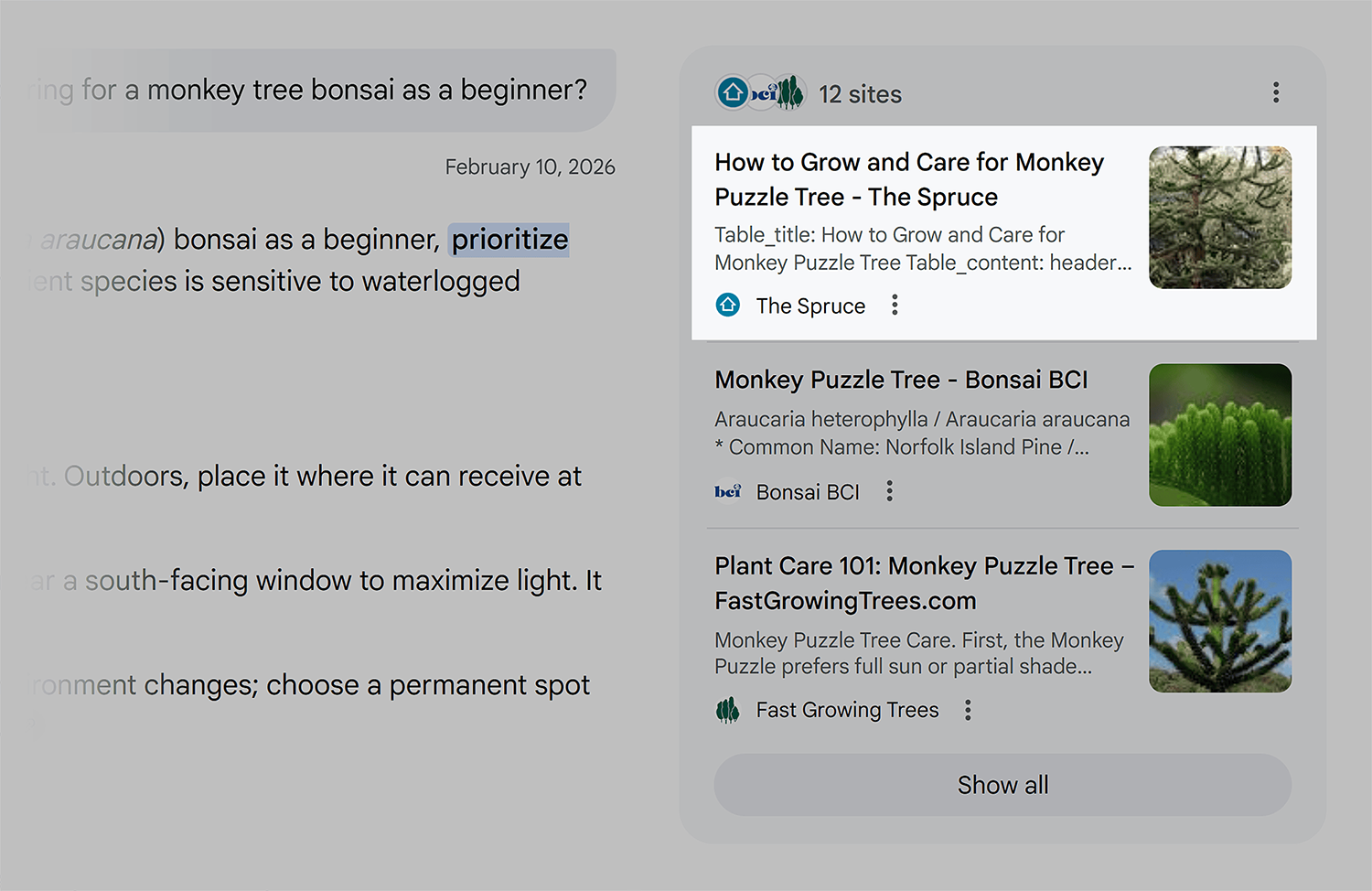
The guide was written and reviewed by master gardeners with deep subject-matter expertise.

It includes helpful specifics, such as how much sunlight the plant needs per day, what hardiness zone it grows best in, and common pests. This is the kind of detailed information LLMs cite when generating answers.
Just like one SEO-optimized article can rank for dozens of related keywords, one thorough how-to can generate AI mentions across multiple related queries.
In AI search, that same depth creates repeated mentions across multiple prompts. For example, when searching “how to propagate a monkey puzzle tree by seed,” AI Mode cited The Spruce’s guide again.

The same pattern holds for higher-risk topics. For YMYL (Your Money or Your Life) topics that could affect user safety, they pair depth with formal credentials.
Their water heater guide was written by a licensed architect and builder. And reviewed by a licensed master plumber with over 40 years of experience.

Beyond credentials, the guide includes step-by-step instructions, supporting photos, and a full list of tools, equipment, and materials needed to complete the project safely.
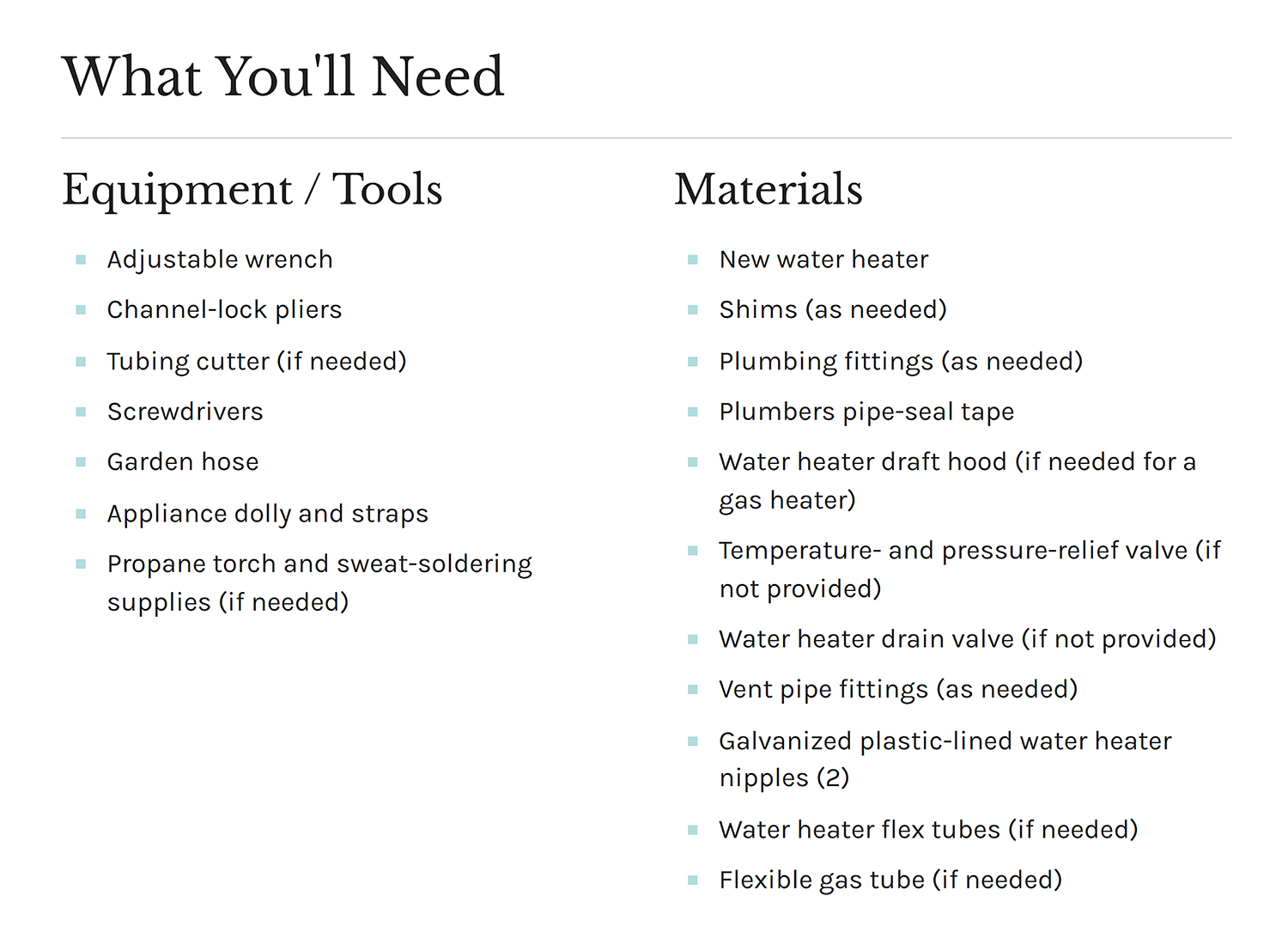
So when searching, “Do I need a propane torch to replace a water heater at home,” AI cited the same guide again.

Covering topics thoroughly — and widely — helps improve The Spruce’s visibility in LLMs. When processing a search like “how to replace a water heater,” AI systems break queries into multiple related queries (a process called query fan-out).

So, a comprehensive article that addresses all these angles helps The Spruce get cited across multiple AI answers.
Steal this: Add depth without blowing up production
- Build comprehensive FAQ sections that address multiple related queries in one article. Each question becomes another potential LLM citation.
- For safety-critical topics, prominently feature qualified experts. Display credentials for both writers and reviewers when covering YMYL topics.
- Include use cases and skill-level guidance. Help readers (and LLMs) understand which approach works best for different situations: beginner vs. advanced, rental vs. owned home, temporary vs. permanent solutions.
- Link related how-to and buying guides together. When you publish “How to Install Kitchen Backsplash,” link to “Best Tile Adhesives” and “Top Backsplash Materials.” This creates content clusters that reinforce your topical authority.
Strategy #5: Third-party mentions that build brand authority
LLMs evaluate more than your site. They also evaluate what the rest of the internet says about your brand. The more often trusted sites reference your content, the more likely AI systems are to cite you. That’s why third-party mentions play such a big role in LLM visibility for publishers.
The Spruce is a textbook example. Their Website Authority Score is 81. And they have millions of backlinks from authoritative domains such as the BBC, CNN, Britannica, and Adobe.

But backlinks are no longer enough. Brand mentions (and the sentiment behind them) also influence how often LLMs trust and surface your content.
Industry publications regularly reference The Spruce, including leading names like Tasting Table, Fixr, and House Beautiful.

These editorial mentions signal to LLMs that The Spruce is a trusted voice in home topics.
Co-citations strengthen that signal even further. This happens when a brand is mentioned alongside other well-established publishers.
The Spruce frequently appears next to names like Consumer Reports, CNET, and Wirecutter in product review roundups.

Another industry post names The Spruce among the best home improvement sites, alongside Bob Vila and This Old House. These co-citations matter because they help AI systems group brands into the same “trusted source set.”
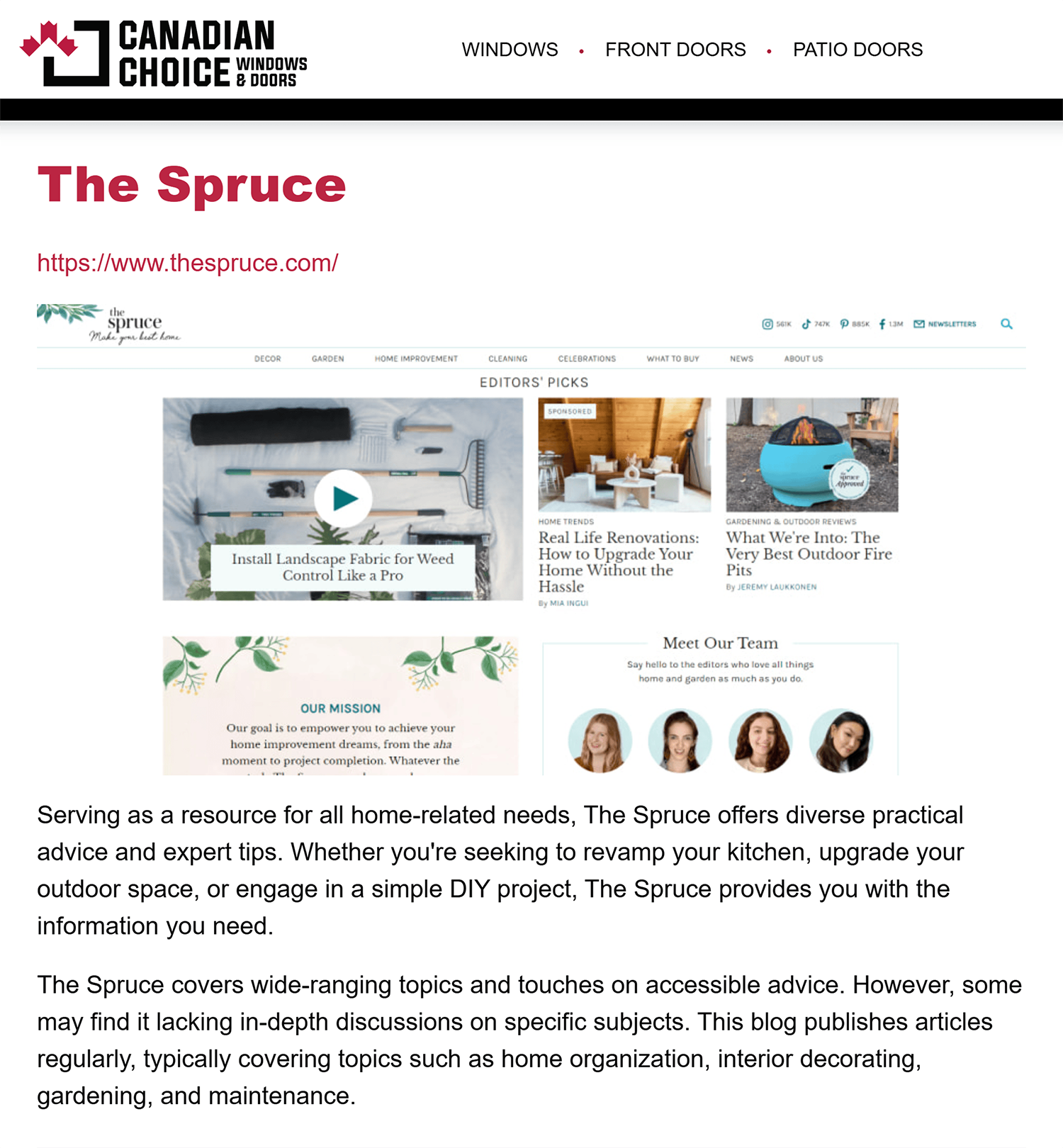
Mentions in online communities and forums reinforce this signal.
In a gardening thread on Reddit, multiple users independently recommended The Spruce.

Independent reviews add yet another layer of validation by detailing The Spruce’s pros, cons, and overall credibility.

All of these brand mentions compound. When a publisher is consistently mentioned across authoritative media, niche communities, and peer comparisons, LLMs are more likely to reference it in answers.
Steal this: Earn third-party mentions
- Create content that earns editorial mentions. Share original data, testing results, expert frameworks, and definitive guides.
- Focus on depth over volume. A single comprehensive guide that becomes “the” resource on a topic will attract more citations than ten shallow posts.
- Get featured in industry roundups and comparison articles. Reach out to relevant publications when they’re creating “best of” lists or buyer’s guides in your category. Being mentioned alongside established competitors builds co-citation signals that strengthen your authority.
- Participate authentically in niche communities. Answer questions on Reddit, Quora, and industry forums where your audience seeks advice. But don’t spam. Provide genuine value that earns organic mentions.
Strategy #6: AI search licensing and partnerships
The strongest publishers are optimizing for AI citations and monetizing them.
The Spruce is a clear example of this. As part of the People Inc. (formerly Dotdash Meredith) portfolio, which signed an OpenAI licensing deal in 2024 and a pay-per-usage AI content licensing deal with Microsoft in 2025.
This means their content is explicitly licensed for LLM training and retrieval systems.
These deals fundamentally change the revenue equation. The old model looked like this: Traffic leads to ads or affiliate clicks, which leads to revenue. The new model: Content licensing leads to direct payment from AI companies.

So, even if LLMs summarize The Spruce’s content without sending traffic, they’re still getting paid for that usage. It’s protection against the exact scenario most publishers fear.
Steal this: Positioning for future AI deals
Licensing deals at this scale aren’t realistic for many publishers, and that’s okay. The more important lesson is how The Spruce earned them.
- Join publisher trade groups that are exploring collective AI licensing, such as the News Media Alliance’s AI licensing program.
- Focus on being citation-worthy first. Build authority by creating comprehensive, trustworthy content that LLMs want to reference.
- Measure your AI visibility. Track where and how your content appears in AI answers so you can demonstrate real usage and brand value when partnership opportunities arise.
- Don’t chase licensing deals too early. The Spruce earned their deal by becoming a source AI companies needed to include. The deals followed the authority — not the other way around.
Ready to replicate this LLM visibility playbook?
The Spruce’s success in AI search wasn’t accidental. It came from intentional investments in content quality, authority, and distribution — the same fundamentals that drive rankings in traditional search and LLMs.
But you don’t need their budget to get started.
Track, optimize, and win in Google and AI search from one platform.
Begin with one rigorous product test this quarter. If you’re an affiliate site, for example, add “How We Tested” sections to your buying guides. Then, work on increasing your third-party mentions, content depth and breadth, and trust signals.
The Spruce positioned itself for success in AI search. And it’s easy for you to do the same.
Sign up for a free trial of Semrush One to see exactly how your site appears across major LLM platforms, including sentiment, share of voice, prompt coverage, and more.
Then, dive deeper into ranking in AI search with Good GEO is good SEO.
Explore more on
Editorial disclosure
Search Engine Land is owned by Semrush. We remain committed to providing high-quality coverage of marketing topics. Unless otherwise noted, this page’s content was written by either an employee or a paid contractor of Semrush Inc.
About the author


