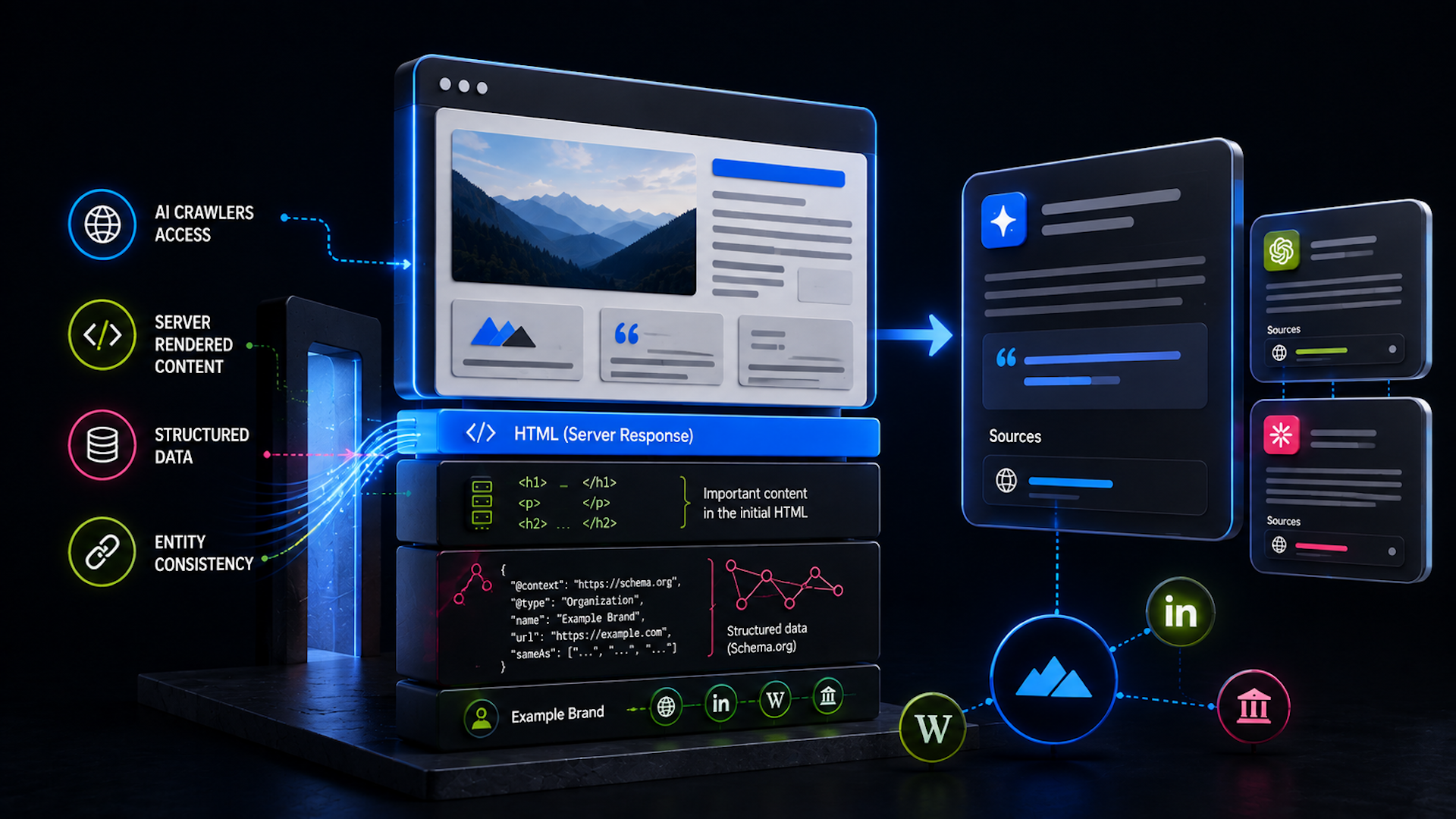
Google AI Overviews: What are they and how are they triggered?

The world of search is changing fast. When you type a question into Google, instead of the familiar list of blue links, you’re greeted by a generative AI box at the top of the page. It summarizes, explains, and even links to articles for you, so you can get to an AI-generated answer fast.
It’s helpful and efficient. It feels like Google is stepping in and saying, “I know you have a lot to do, so start here.”
That box has a name: It’s an AI Overview.
The SEO toolkit you know, plus the AI visibility data you need.

What is an AI Overview, and why does it appear sometimes and not others?
And where do you, as a marketer or content lead, fit into all of this?
You don’t need to understand machine learning or Google’s internal systems to wrap your head around it. We’ll take this new technology piece by piece and make it manageable.
What are AI overviews on Google?
An AI Overview uses large language models (LLMs) to answer a query, usually including a written explanation, bullet points, and links to the pages it used as sources. As of now, AI Overviews are not replacing website links, they sit above them. However, they are changing how information is discovered, skimmed, and explored.
When you see an AI Overview, think of it as Google stepping in at a moment of uncertainty. It’s trying to simplify the process. It provides a concise explanation first, then allows the user to read further if they wish to. The path forward is clear — less time is spent searching and more time is spent understanding.

Where do AI Overviews show up on Google?
AI Overviews most often appear at the top of the search results, above traditional organic listings.
Google constantly tests where and when these overviews appear, adjusting based on the type of query and what it believes will genuinely help the user.
Sometimes these AI-powered overviews show up right at the top. Sometimes it appears further down the page. Sometimes it doesn’t appear at all.

Whether an AI Overview appears depends on the query itself, the intent behind it, and the level of uncertainty Google has in answering the query.
Broader, learning-style queries like “What is magnesium glycinate used for?” or “Symptoms of magnesium deficiency” are far more likely to trigger an AI overview than something highly specific like “ABC magnesium glycinate 120 tablet price.”
Anatomy of an AI Overview
At a glance, an AI Overview includes these elements:
- Written explanation
- Cited sources supporting that explanation
- Specific placement on the page
Each affects how your content shows up and how it’s read.
Let’s walk through them.
Written explanation
An AI Overview is primarily answering a question from a user.
Google looks across multiple pages, identifies shared facts and explanations, and then compresses that information into a short summary. Sometimes that summary appears as paragraphs, sometimes as bullet points, often as a mix.
Most AI Overviews are a few hundred words, depending on how complex the query is.
For example, if someone searches, “Is magnesium glycinate better than citrate for anxiety?”, the explanation might cover absorption, gut tolerance, calming effects, and when one form is typically preferred over the other.
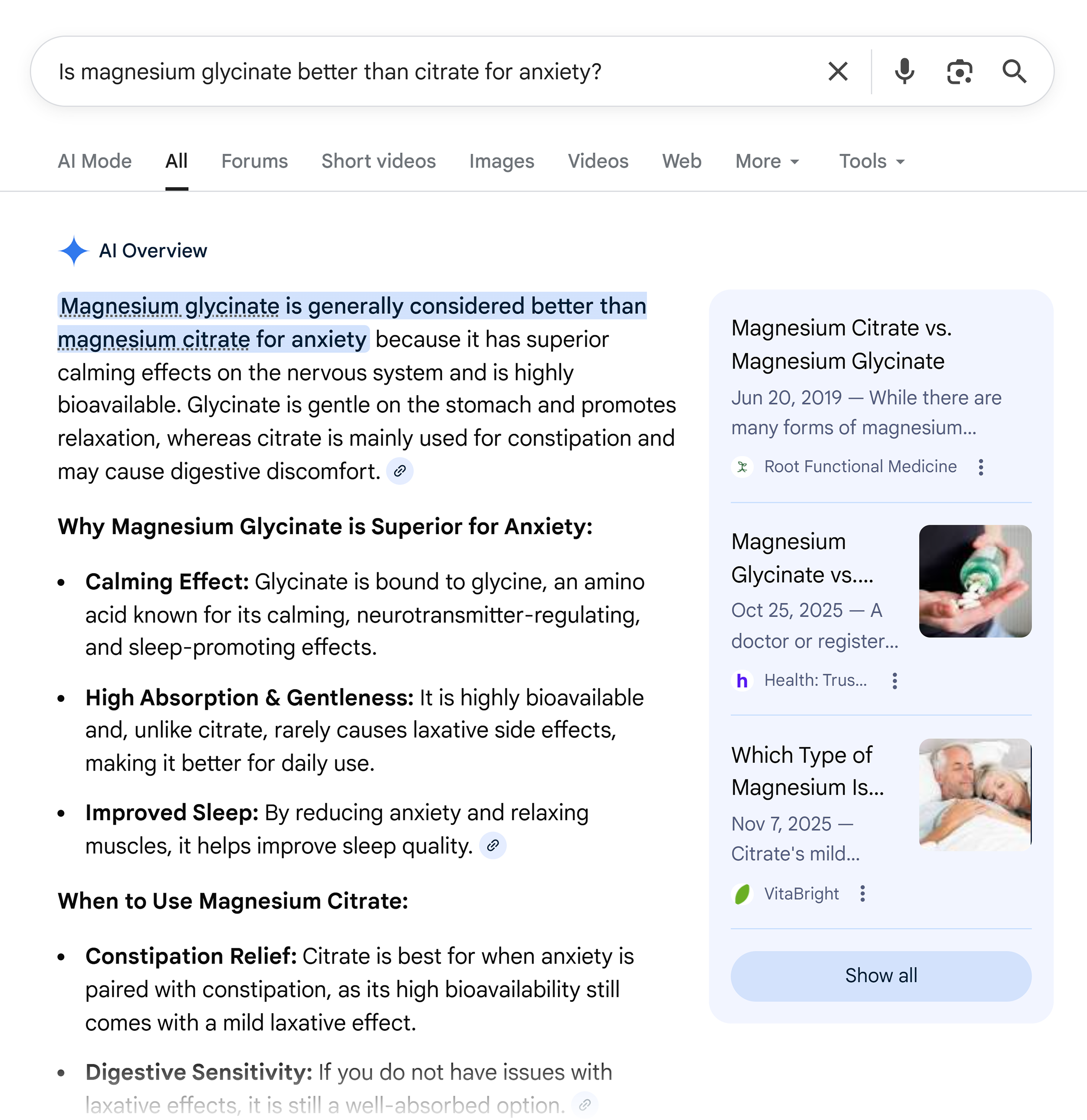
Information is being condensed so the user can understand it quickly.
Content that is clear and well-structured is easy to summarize. And content that’s easy to summarize is easier to include in an overview.
Supporting links
How does Google decide which pages to pull in?
Most AI Overviews draw from multiple pages at once, usually between four and eight, depending on the topic and query.
Pages aren’t being judged on their own. They’re being used alongside others to support an explanation.
If your magnesium comparison guide is included for the above query, your brand becomes part of the reference set Google uses to explain the topic — and that’s a strong place to be.
Visual placement
On desktop, the AI Overview usually appears above the organic results.
On mobile, it often fills most of the first screen.
That placement matters — people read the overview first to get oriented, then they decide whether to scroll, click into a source, or change their search.
Everything else on the page is read through the context of that first explanation.
Are AI Overviews shown on mobile and desktop the same way?
AI Overviews appear on both mobile and desktop.
On mobile, the overview often fills most of the first screen at the top of the results. It’s highly visible and gently pushes organic listings further down. For many users, it becomes the first thing they read before deciding whether to scroll.
On desktop, the overview usually appears as a box above the results, sharing space with ads, People Also Ask boxes, and other SERP features. Because of that, it tends to feel less dominant.
The content itself is the same across devices, but user interaction is not.
Mobile users often read the overview first and only scroll if they want more depth.
Desktop users are more likely to scan the overview and the organic results together, moving between them to build context.
How AI Overviews work
At a high level, Google uses AI to read and analyze a huge number of web pages at once.
It scans across sources; looks for shared facts, repeated themes, and consistent explanations; and then pulls those together into a short, structured summary that appears at the top of the search results.
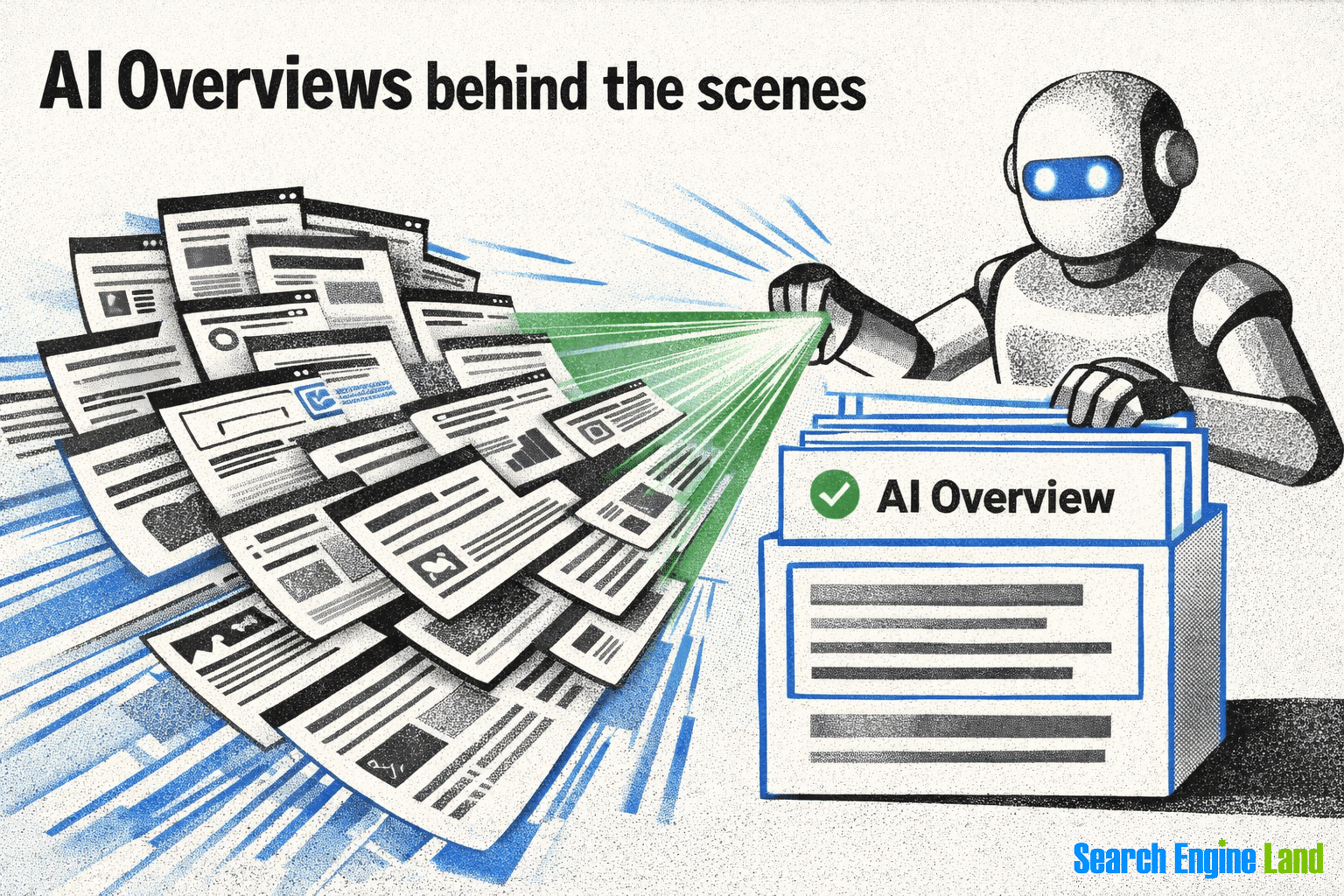
The point is to help the user make sense of a topic without opening several tabs, cross-checking answers, or trying to figure out what overlaps and what doesn’t.
The system still relies entirely on the web. It pulls from existing pages, reflects the most common and consistent information, and then points users back to those original sources if they want to go deeper.
What’s happening is compression — AI Overviews turn a scattered set of answers into a single, readable snapshot of what the internet already knows, so the user can understand a topic fast and decide what to explore next.
What triggers Google to show an AI Overview?
Google shows an AI Overview when it’s algorithms believe a search query would benefit from synthesis rather than simple retrieval.
In other words, when sorting through a list of links feels like work for the user, Google steps in and offers a summarized explanation.
This usually happens when the question is complex, when the answer is spread across multiple sources, or when the user is in learning or comparison mode in Google.
It also tends to appear when a quick, structured explanation would reduce confusion or help the user get oriented before they decide what to do next.
What types of search queries trigger AI Overviews?
AI Overviews are still most common for informational queries, where people are learning, orienting themselves, or trying to understand something for the first time.
But that’s no longer the full picture.
AI Overviews have started appearing more often for queries with clear intent — especially where users are comparing options, looking for brands, or narrowing in on a decision.
This shift shows up clearly when you look at keyword data.
According to a Semrush report, since October 2024, the percentage of keywords triggering an AI Overview has increased across several intent types, including commercial, transactional, and navigational searches.
The infographic below shows how that distribution has changed.
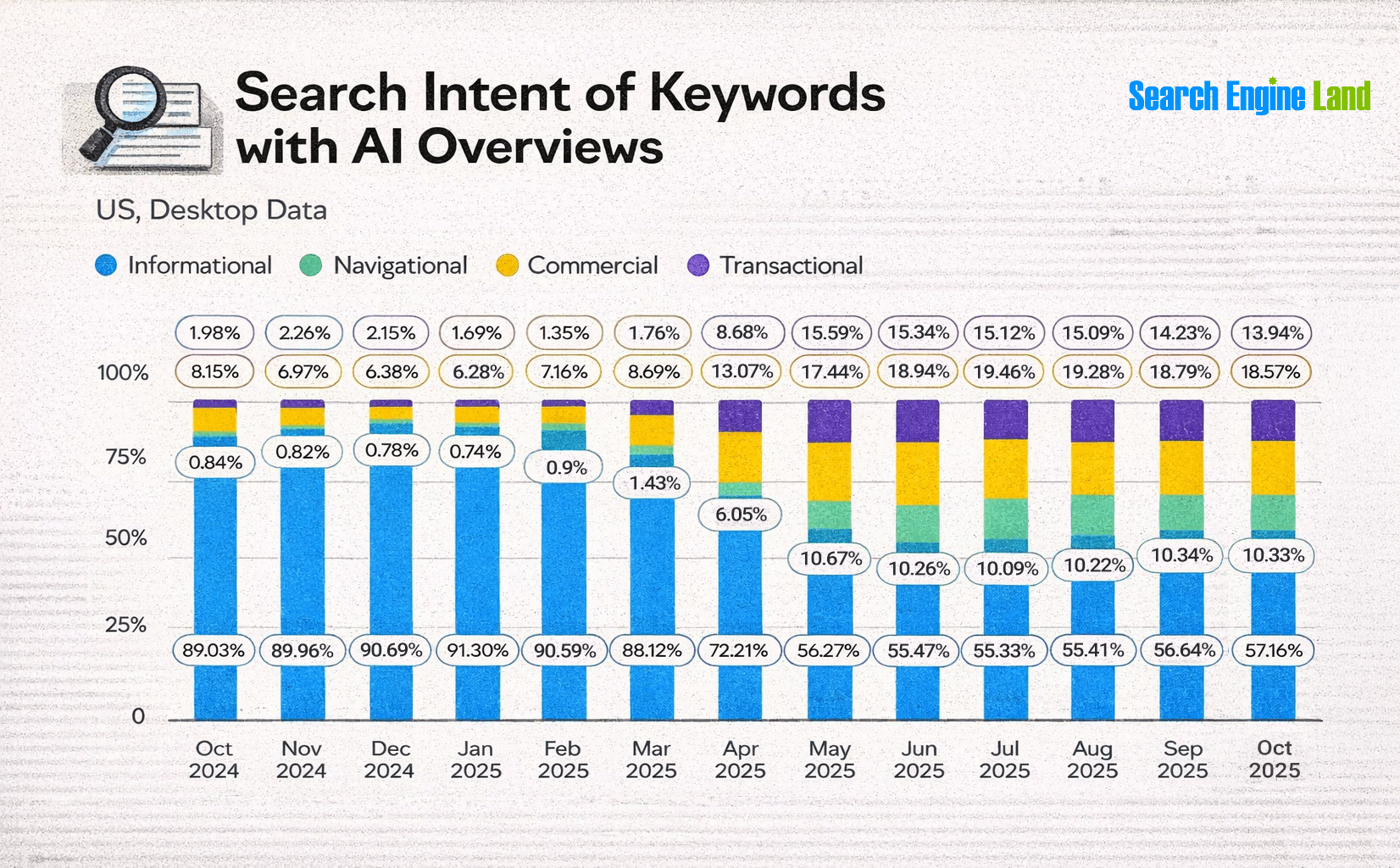
Search intent and keywords that trigger AI Overviews
Not all searches are created equal. Searchers have different intentions: to learn, to decide, to buy, to get somewhere specific, etc.
Google categorizes these differences, and AI Overviews tend to appear more often for certain types of queries than others.
Let’s walk through the main search types and what they look like in practice.
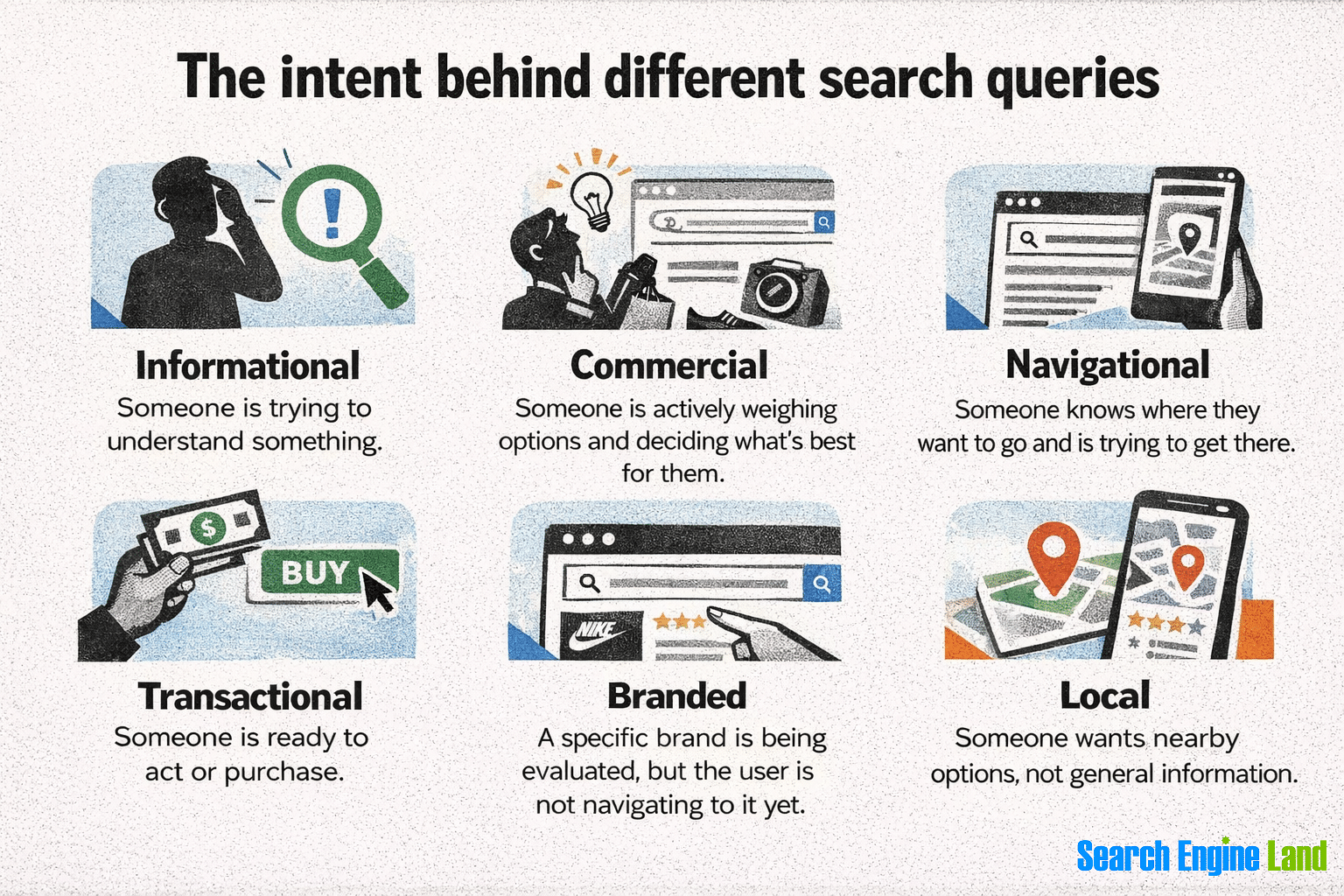
Informational searches
These searches most commonly trigger AI Overviews. They are searches where someone is trying to understand something, for example:
- “What are the symptoms of magnesium deficiency?”
- “What is magnesium glycinate used for?”
- “How does magnesium help with anxiety?”
At this stage, the user is orienting themselves — they want context and clarity, and they want to feel more sure about a topic.
This is where AI Overviews work beautifully. Google can summarize a topic, reduce confusion, and offer a great starting point without the user having to piece together information on their own.
If your content explains concepts clearly, simply, and accurately, this is one of the strongest ways for it to surface.
Commercial searches
The second most common category, commercial searches appear when someone is actively weighing options and trying to decide what’s best for them. The question is no longer “What is this?” but “Which one should I choose?” For example:
- “Best magnesium supplement for anxiety”
- “Magnesium glycinate vs. citrate”
- “Is magnesium glycinate better for sleep?”
AI Overviews often appear here because they can bring together multiple perspectives, highlight differences, and help users feel more confident before committing.
This is where thoughtful comparison content really matters. Structure, nuance, and clarity carry far more weight than persuasion.
Navigational searches
Navigational searches are about getting somewhere specific, for example: “ABC magnesium website.”
Here, the user already knows where they want to go. They are not confused or exploring, they are navigating.
An AI Overview would just add friction to these searches rather than remove it, so Google usually steps aside and lets a link to the destination take priority.
Transactional searches
These are action-focused queries, for example:
- “Buy magnesium glycinate”
- “Magnesium glycinate near me”
The user wants options, availability, and next steps, not an explanation.
AI Overviews appear far less often here because a summary would slow down the journey instead of help it along.
Branded searches
Branded searches sit in an interesting middle space.
When the brand is part of a learning question rather than the final destination, AI Overviews can still appear.
- “Does ABC magnesium help with sleep?”
- “Is ABC magnesium glycinate good for anxiety?”
Here, the brand is being evaluated but not yet being navigated to. Google still sees uncertainty and curiosity, so it offers context. The brand becomes part of the explanation.
Local searches
These searches tend to be practical and immediate. For example:
- “Magnesium glycinate pharmacy near me”
- “ABC magnesium stocker nearby”
Much like transactional searches, these queries are driven by clarity and urgency. Users want nearby options, and surprisingly, more often they are looking for information, but just businesses.
According to Whitespark: “On average, AI Overviews are currently appearing in 68% of local business-type queries.”
How frequently do AI Overviews appear?
AI Overviews appear in about 13% of all searches. That means around one in eight searches includes an AI Overview layered into the results.
For a lot of people, they are part of their everyday search experience.
But AI Overview prevalence varies by query type. When you zoom into highly informational spaces — health, finance, education, and technology — the percentage climbs much higher.
So if you work in a space where people are learning, researching, comparing, or trying to understand something complex — think supplements, symptoms, side effects, or product differences — AI Overviews, increasingly, are the front door.
Why does this matter?
Because if 13% of your queries trigger an AI overview, those tend to be the ones where people are uncertain and actively forming opinions. These are moments to build trust with your content so users can make decisions.
AI Overviews sit early in that process and shape how information is encountered before a user clicks to individual pages.
That’s the layer of visibility AI overviews introduce. Don’t you want your content to be part of that experience?
How AI Overviews are changing search results for different industries
As we’ve mentioned, AI Overviews don’t appear for every query. They show up more often in industries where people have questions, uncertainty, or a need for context and less often in spaces where search intent is clear. Content that explains, compares, or helps people understand something is more likely to be summarized with an AI Overview. Content that supports immediate action is more likely to be listed out with links.

This is why a comparison article tends to see more AI Overview exposure than a “Buy now” page.
And AI Overviews shape the learning and decision-making process that happens before purchase.
Industries most affected by AI Overviews
AI Overviews appear most frequently in industries where information is layered, nuanced, or tied to personal decision-making. These are spaces where people want help understanding before they act.
Health and wellness
Searches here often start with uncertainty. People want to understand symptoms, benefits, risks, and trade-offs.
Queries like:
- “Is magnesium glycinate better than citrate for anxiety?”
- “What are the symptoms of magnesium deficiency?”
- “Does magnesium help with sleep?”
For these searches, AI Overviews typically present a short explanation, outline key differences or considerations, and then point users to supporting sources.
The goal is orientation first, depth second.
Finance and insurance
Here, users often compare options or try to understand long-term implications.
These queries include:
- “Fixed vs. variable interest rate”
- “Is life insurance worth it?”
AI Overviews summarize key factors, risks, and definitions so users can make sense of the topic before engaging with tools, providers, or calculators.
Education
Learning-focused searches benefit from understanding.
Queries like:
- “What is cognitive behavioral therapy?”
- “What does SEO mean?”
AI Overviews help users understand the concept before they commit to longer reading.
Technology
Rapid change and technical language make synthesis especially useful.
Queries like:
- “What is server-side tagging in GA4?”
- “How does AI search work?”
Industries less affected by AI Overviews
Some searches are driven by clarity and readiness rather than exploration.
Ecommerce product queries
When someone searches: “Buy magnesium glycinate 120 tablets,” they are looking for availability, pricing, and options.
AI Overviews appear far less often in these cases because explanation isn’t the priority.
Highly navigational searches
Queries like “ABC magnesium website” are about getting somewhere specific. The user already knows what they want.
Brand-specific transactional searches
Queries such as “ABC magnesium glycinate price” will show listings, retailers, and category pages. No need for a summary.
Do AI Overviews impact local SEO or Google Business Profiles?
AI Overviews can appear for local-intent queries.
Research from the Whitespark study mentioned above shows that AI Overviews, on average, appear in only around 15% of pure local-intent searches such as “service + location.” That number jumps to 92% when a local query includes an educational or advisory layer to the query rather than simple “near me” intent.
For example, a search like “magnesium IV therapy near me” will typically surface a local pack as expected.
A local query that includes informational intent, such as “How much does IV therapy cost in Tampa?” is more likely to surface an AI Overview.
When an AI Overview does appear in a local context, it often sits above the local pack rather than replace it.
Examples documented by Search Engine Roundtable show AI Overviews referencing local businesses by name, sometimes even mentioning specific services, while the map pack still appears underneath.
The result is a layered search experience. A business that appears in both places is doing two jobs at once: It helps the user understand the option, and it’s available when the user is ready to act.
For local businesses, this subtly shifts what visibility looks like — being nearby still matters, but being clear with information matters too.
When your website explains what you do, who it’s for, and how it helps, that information can be used to frame local results before a user ever opens a map, creating trust and relevance early in the search journey.
How are AI Overviews different from traditional Google results?
Traditional search results pages on Google organize information by ranking individual pages.
When an AI Overview appears, Google presents a short, readable explanation at the top of the page so the user can understand the topic before deciding what to explore next.
That explanation is built from multiple sources and synthesized into a single view. For many queries, users can get an initial understanding immediately, then choose whether to click into a source for more detail.
Content is no longer only discovered through position in a list of links on the SERP. Pages that are clear, structured, and useful contribute to how the topic is framed before the user clicks anywhere.
Because of that, the role of content is shifting.
Content still needs to be discoverable, but it also needs to support understanding. It needs to explain concepts cleanly, build trust quickly, and make sense when summarized.
That leads to a different way of thinking about optimization — one centered on clarity, usefulness, and contribution rather than position alone.
How are AI overviews different from featured snippets?
To understand the distinction, it helps to look at how each feature is constructed.
Featured snippets vs. AI Overviews
Featured snippets show a short extract from a single web page at the top of Google’s results. The answer usually appears as a paragraph, list, or table pulled directly from one source.

AI Overviews work through synthesis across multiple pages. Google analyzes several sources, identifies consistent explanations, and generates a structured ai-generated summary that appears in the results along with several cited links.

In practical terms, featured snippets surface a concise answer from one page, while AI overviews present a summarized explanation that reflects information across multiple sources.
Featured snippet visibility has declined as AI Overviews expand
Featured snippets are not disappearing from Google’s search results just yet. However, their overall visibility has declined as AI Overviews appear for a growing share of informational queries.
Analysis from GSQI shows that AI Overviews frequently occupy positions where featured snippets previously appeared, particularly for broader queries that benefit from synthesis across multiple sources.
Featured snippets continue to surface for clear factual queries, while AI Overviews appear more often when a topic involves multiple ideas, comparisons, or broader explanations.
Dig deeper: Featured snippets: How to win position zero
What’s the difference between Google AI Overviews and Google AI Mode?
Google’s AI Overviews and AI Mode are both powered by AI, though they serve very different purposes inside search.
AI Overviews appear directly on the search results page. They summarize what the web says about a topic and help users quickly understand something before deciding what to explore next. They sit alongside traditional results links and are reshaping how information is discovered.
AI Mode, on the other hand, is a conversational experience. Instead of scanning a results page, users interact with Google’s AI in a back-and-forth way, asking follow-up questions, refining ideas, and exploring topics more deeply, much like chatting with an assistant.
AI Overviews support discovery and orientation. They help users feel grounded and shape how results are displayed on the SERP.
AI Mode supports dialogue and exploration. It helps users think things through and reshapes how people search altogether.
Both rely on high-quality web content. They simply use it in different ways.
How do AI Overviews affect organic traffic?
AI Overviews can change click-through rates and how traffic flows.
Which types of pages see different outcomes
Pages that tend to see fewer clicks to websites include:
- Simple definitions
- Symptom lists
- High-level “what is” content that fully answers a question on its own
Pages that tend to see more engaged traffic include:
- Comparisons
- In-depth explanations
- Content that adds judgment, nuance, or expert interpretation
How traffic shifts for broad informational queries
For very broad, surface-level informational queries, click behavior is changing. In some cases, this can lead to zero-click searches.
Take a search like “What are the symptoms of magnesium deficiency?”
Before AI Overviews, a health site ranking at the top would receive steady traffic. Users clicked through, scanned the symptom list, spent a short amount of time on the page, and left once they had the information they needed.
Now, the overview presents a structured summary at the top of the page. Symptoms are listed, context is provided, and many users understand the basics without needing to click further.
In these cases, fewer clicks happen to websites because the answer is already visible in the AI Overview.
How traffic shifts for comparative and decision-driven queries
For queries that involve comparison or judgment, it’s different.
Consider a search like “Is magnesium glycinate better than citrate for anxiety?”
Here, the user is weighing options. They want to understand differences, trade-offs, and suitability. A summary helps orient them, but the user needs more information.
When AI Overviews appear for these searches, they often surface nuanced points and reference more detailed sources.
Users can read the overview, then click through to understand dosage, edge cases, contradictions, and an expert perspective.
Google has acknowledged this shift, noting:
“We’ve seen that when people click to a website from search results pages with AI Overviews, these clicks are higher quality, where users are more likely to spend more time on the site… This may provide a more engaged audience and new opportunities with visitors.”
— Google Search Central Blog, May 2025
Are AI Overviews accurate?
AI Overviews might be improving, but they’re not infallible.
There are cases where an overview misinterprets a source, blends outdated information with newer guidance, or presents an incorrect conclusion with confidence. That confidence is what makes you pause — especially in areas like health, finance, or anything that affects real-world decisions.
These moments are often referred to as hallucinations.
In simple terms, a hallucination happens when an AI system presents information that sounds credible but isn’t fully accurate, properly supported, or correctly interpreted. The system tries to make sense of what it sees, and sometimes the picture it assembles isn’t quite right.
Here’s an example of a hallucination:

Understanding why this happens is important.
AI Overviews are built from what exists on the web. When information across pages is unclear, contradictory, outdated, or loosely structured, the summary can mirror that lack of clarity.
This is where content quality does real work.
Clear explanations, current information, precise language, and strong structure all reduce the risk of being misunderstood or misrepresented. They also increase the likelihood that, when your content is used, it’s reflected accurately.
And when the topic is your own brand, products, or services, this becomes even more important for you.
When it comes to accuracy, it’s often a combination of the systems doing the summarizing and the content they rely on. The stronger your foundations are, the more accurate the summary.
Learn more: How to identify and fix AI hallucinations about your brand
Can AI Overviews use AI-generated content as sources?
AI Overviews are built from the web as it exists today. And that web includes content that is AI-assisted, human-edited, or created through a blended workflow. Because of that, some of the pages used to inform AI Overviews will naturally involve AI at some stage of creation.
Google does not exclude content because it was created with the help of AI. What matters is the outcome of the content, not the process behind it.
Google has been clear on how it evaluates this content. They reward high-quality content that focuses on E-E-A-T: expertise, experience, authoritativeness, and trustworthiness.
If those conditions are met (among many others), content is eligible to be surfaced regardless of whether AI was involved in producing it or not.
Dig deeper: AI-generated content: Benefits, risks & SEO best practices
Can you opt out of AI Overviews?
In 2025, Google shared that you can opt out of AI Overview in a few different ways:
- Use the robots nosnippet tag to opt out of AI Overviews
- Add a meta tag like <meta name=”robots” value=”nosnippet”>
- Wrap certain content in a <div data-nosnippet></div>
- Limit the amount of text shown with <meta name=”robots” value=”max-snippet: 42″>
AI Overviews function like other search features, such as featured snippets or People Also Ask: If Google believes a summary would help answer a query, it may generate one using publicly available web content.
That decision sits with Google.
Track, optimize, and win in Google and AI search from one platform.
The same search controls still apply. Content that isn’t indexed won’t be eligible to appear, but there’s no separate setting to exclude pages from AI Overviews alone.
Boost your site’s performance in AI Overviews
AI Overviews appear when people are still figuring things out, and they shape how topics are understood before anyone clicks, compares, or commits.
Understanding where your content shows up inside them is important and why measurement is useful.
Tools like Semrush One are designed to surface AI Overview visibility alongside traditional rankings, so you can see how your content supports understanding.
The goal is to create content that’s structured for explanation and aligns with how Google synthesizes information. Learn more about how to optimize for AI Overviews and what AI Overview tools to use in the next articles in this series.
Explore more on
Editorial disclosure
Search Engine Land is owned by Semrush. We remain committed to providing high-quality coverage of marketing topics. Unless otherwise noted, this page’s content was written by either an employee or a paid contractor of Semrush Inc.
About the author