Query fan-out in AI search: What is it and how does it work?

Query fan-out is the process AI search engines use to turn one question into many related searches before generating an answer.
Instead of traditional search, which delivered a list of links in response to a single query, AI-powered search uses that single user query to trigger dozens of related searches behind the scenes — query fan-out in action. This then provides more context to understand the user’s intent, context, and follow-up needs.
The SEO toolkit you know, plus the AI visibility data you need.

In this guide, we’ll explain what query fan-out is, how AI engines use it, which platforms rely on it, and how it differs from traditional search.
What is query fan-out?
Query fan-out refers to taking a single search query and delivering results that follow natural tangents a user might have pursued on their own in traditional search. The phrase comes from the idea of something “fanning out” from a central point. That central point is the user’s original question.
The AI interprets the underlying intent and issues several supporting searches in parallel. Each sub-query explores a different facet of what the user wants to learn.
For example, a query like “best cleanser for teenage girls with oily skin” may prompt the system to run sub-searches on skin-type suitability, age-appropriate ingredients, gentleness, and real-world product reviews, even if the user doesn’t explicitly spell out every one of these concerns.
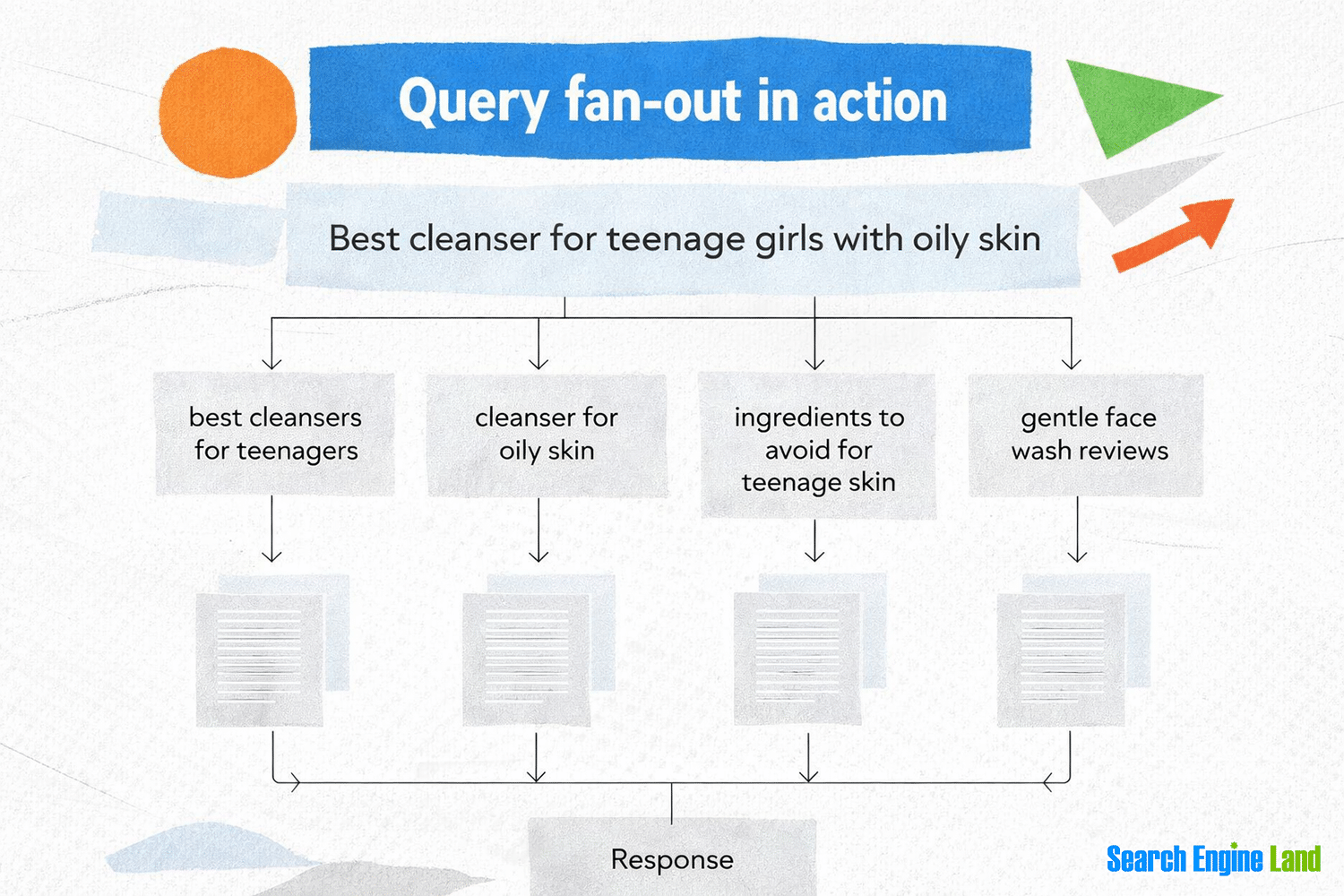
The result is then a synthesized contextual answer that combines insights from multiple sources into one response.
Do AI companies use the term “query fan-out”?
No, “query fan-out” is not a standardized term used by all AI companies in their official documentation. However, some do use this phrase.
The phrase is search industry shorthand. It’s commonly used by practitioners to describe a behavior that exists across AI search systems, even though the AI platforms themselves label it differently.
This same behavior is often broken down and described using more formal terms in company documentation, such as:
- Query decomposition: Splitting one complex question into smaller, easier-to-answer questions.
- Multi-query retrieval: Running several searches at once and combining what they return.
- Query rewriting or query expansion: Rephrasing a query in different ways to capture more relevant results.
- Iterative retrieval: Running follow-up searches based on what earlier searches reveal.
- Agentic planning or tool invocation: Letting the system decide when to run additional searches to complete a task.
Each term emphasizes a slightly different aspect of the same underlying idea: One user question leads to many related searches.
Because there’s no single official label across platforms, “query fan-out” has emerged as a convenient way for SEOs and researchers to talk about this shared behavior without getting lost in system-specific terminology.
A good example comes from Google’s search patents.
In Patent US11663201B2, Google describes a system that takes a single search query and generates multiple related query variants using a trained generative model. Each variant is issued separately, and the combined results are used to produce a final response.
Google never calls this process “query fan-out.” In the patent, the formal term used is “query variant generation.”
However, the behavior matches exactly what SEOs mean by query fan-out: One query in, many related queries out, with the results then synthesized together.
Which AI tools use query fan-out (aka query variant generation) to process queries?
Most AI-powered search engines, including Google’s AI Overviews, AI Mode, Gemini, ChatGPT, Perplexity, Microsoft Copilot, and Grok, use query fan-out expansion methods to answer user prompts.
Here’s how AI models do this.
Google’s AI-powered search experiences
In Google AI Overviews and Google AI Mode, Google says its systems may issue multiple related searches across subtopics and data sources while a response is generated.
The system continues gathering supporting pages as the answer forms, which allows it to surface a broader and more diverse set of links than a classic Google search result.
The reason for this approach is practical: A single keyword-style search can’t reliably cover all the angles of an open-ended question. But running multiple related searches gives the system enough context to produce a helpful response instead of a narrow answer.
Gemini
While Google doesn’t explicitly label “query fan-out” in its Gemini API search documentation, the behavior follows the same logic used in Google AI Mode and AI Overviews:
If needed, the model automatically generates one or multiple search queries and executes them.
This means that when a prompt requires external information, Gemini can generate extra search queries to fill in missing context before responding.
ChatGPT
When a user question requires information beyond the model’s internal knowledge, ChatGPT may partner with other search providers to retrieve current or specialized data.
According to ChatGPT search:
If you type into ChatGPT “What are some good restaurants near me?” and ChatGPT determines from your IP address that you are in the San Francisco area, ChatGPT may rewrite your prompt into the search query “top restaurants San Francisco.”
This behavior — expanding one prompt into related queries and synthesizing the results — aligns with our understanding of query fan-out.
Even though ChatGPT’s documentation refers to this as query rewriting, the underlying logic is the same: Multiple searches are used to fully answer a single question.
Grok
Grok uses a constrained form of query fan-out: The system expands the query, but it does so within tight limits.
Rather than broadly exploring the open web, Grok restates the original prompt in multiple ways and runs a handful of focused searches that reinforce the same constraints. These searches often zero in on authoritative platforms and expand key terms into closely related proxies to confirm quality and relevance.
For example, when a prompt includes a specific attribute — such as quality, location, or experience — Grok may issue follow-up searches that validate that attribute through reviews, comparisons, or adjacent concepts.
Each search reinforces the previous one, helping the system triangulate a reliable answer.
The main distinction is that Grok favors verification through repetition and source constraint rather than broad parallel expansion.
Perplexity
At one point, Perplexity showed the intermediate steps it takes to answer a question.
When you submitted a prompt, Perplexity broke it into multiple related searches and displayed those searches in a dedicated “Steps” view. Each step represented a different angle of the original query.

Rather than hiding the expansion process, Perplexity showed how a single question turns into several focused searches before the final answer is generated.
While the platform doesn’t formally label this behavior as “query fan-out,” the underlying process is the same.
Perplexity no longer appears to show these steps to users, but the backend process is still the same.
Microsoft Copilot
Microsoft Copilot uses an iterative form of query expansion that builds answers step by step.
Instead of running a single burst of parallel searches, Copilot interprets the user’s intent and then issues a series of related searches, where each result helps shape the next one.
These searches are grounded in Bing’s search index and, in enterprise environments, can also draw from internal organizational data.
This approach follows the core idea behind query fan-out but differs in how it’s done. Copilot emphasizes iteration and grounding — refining the query as it goes — rather than generating many sub-queries in parallel.
The common ground
Across AI platforms, the names used to describe the query fan-out process vary:
- Query decomposition
- Query expansion
- Iterative retrieval
- Query variant generation
But the reason they all exist is the same.
Dig deeper: For a technical comparison of how these mechanisms differ across platforms, see iPullRank’s “Query fan-out mechanisms across AI search platforms.”
How does query fan-out work?
Now that you know what query fan-out is, let’s see how it breaks a single user question into multiple related searches while running them in parallel and then combining the results into one coherent answer:

1. Decomposition
The system analyzes the user’s query to identify its core topics and implied questions. It looks for:
- The main subject
- Important attributes or constraints
- Implied comparisons or decisions
- Likely follow-up questions a human would ask next
It does this to figure out what information would be required to give a complete answer. Without this step, the system would treat every query as flat and literal, which represents failure for exploratory or decision-based searches.
Why?
Because such searches depend on understanding intent, trade-offs, and follow-up questions, not just matching words.
2. Expansion
Once the system understands the question’s structure, it expands it into multiple related subqueries. Each sub-query targets a different facet of the original intent.
These sub-queries are not shown to the user, but they function like supporting research questions. Together, they define the full information space the system needs to search.
If you’ve ever thought that AI responses feel broader than traditional results, this is the reason why.
3. Execution
After expansion, the system runs those sub-queries simultaneously across the web or other data sources. This speeds up response generation and prevents early results and answers from being too narrow.
Instead of committing to one interpretation too soon, the system gathers evidence from multiple directions before deciding what matters most.
4. Synthesis
Next comes synthesis, where a large language model (LLM) reviews the retrieved information and looks for patterns and overlaps.
During synthesis, the system:
- Identifies recurring themes
- Resolves contradictions when possible
- Weighs which information best addresses the original question
- Organizes the findings into a readable response
What would otherwise be traditional search results are instead converted into something that feels intentional, structured, and immediately consumable, rather than a list of links.
5. Contextual results generation
The final output reflects the entire fan-out process. Instead of presenting a ranked list of pages, AI search engines return:
- A synthesized explanation
- Supporting passages or citations
- Sometimes images, tables, or structured data
From the user’s perspective, this feels like a direct answer. But behind the scenes, it’s the result of many related searches being pulled together into one response.
An example of query fan-out
When Google applies query fan-out, it produces eight types of sub-queries that follow predictable patterns.
For example, here’s how Google would generate subqueries for the seed query “best cleanser for teenage girls with oily skin”:
| Subquery type | Explanation | Example |
| Equivalent query | Alternative phrasing for the same core question | Best face wash for teenage girls with oily skin |
| Follow-up query | Logical next questions that naturally follow the original query | Does oily teenage skin need a foaming or gel cleanser? |
| Generalization query | Broader versions of the original question | Best cleanser for oily skin |
| Specification query | More detailed or constrained versions of the query | Best gentle cleanser for teenage girls with oily, acne-prone skin |
| Canonicalization query | Standardized or normalized phrasing of the question | Recommended cleanser for teenage girls with oily skin |
| Language translation query | Translated versions used to retrieve multilingual content | Mejor limpiador para chicas adolescentes con piel grasa (Spanish) |
| Entailment query | Implied questions that logically follow from the original intent | Can teenagers with oily skin use salicylic acid cleansers? |
| Clarification query | Questions generated to confirm or narrow user intent | Are you looking for acne control or oil balance? |
These subquery types explain how AI systems answer complex questions without asking the user eight separate follow-up questions. They expand the original query, explore each angle independently, and then synthesize the findings into a single response.
What’s the difference between query fan-out and traditional keyword research?
Traditional keyword research identifies and targets individual search terms, while query fan-out explores and answers the full set of questions behind a single search.
If you’re optimizing for traditional search, the workflow usually looks like this:
- Select a primary keyword
- Create a page to match that keyword’s intent
- Optimize headings, copy, and metadata to rank for that phrasing
Query fan-out takes a different approach.
When you’re optimizing for AI-powered search, the AI engines don’t evaluate your content against a single keyword. Instead, they evaluate whether your page answers all the related questions that appear when a query fans out.
So instead of asking, “Did I target the right keyword?” ask, “Does this page cover the full set of questions someone would logically ask about this topic?”
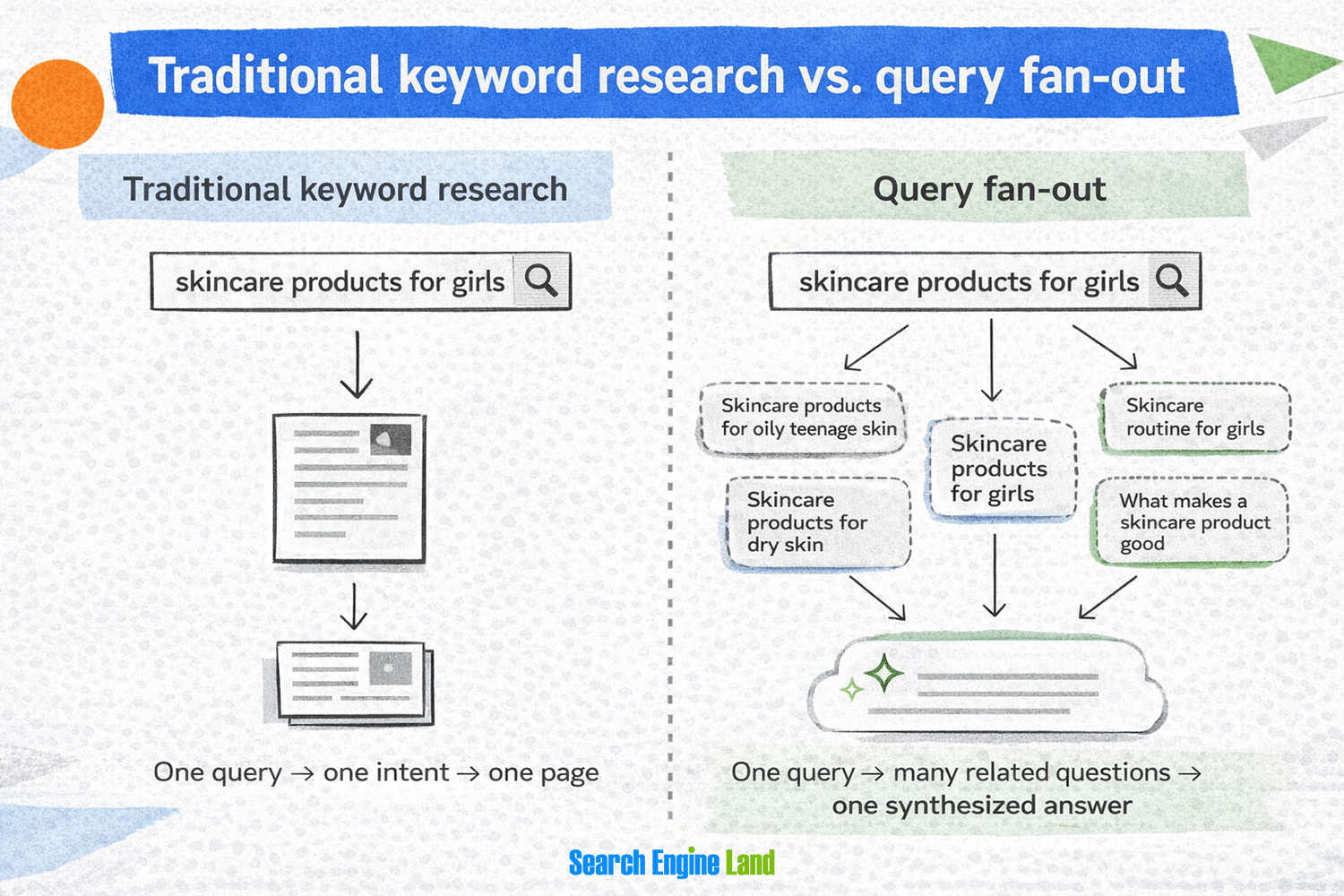
For example, if you’re creating content about “skincare products for girls,” AI search systems might also evaluate your page against related queries:
- “Skincare products for oily teenage skin”
- “Skincare products for dry skin”
- “Skincare products for combination skin”
- “What makes each skincare product good”
- “Skincare routine for girls”
In traditional keyword research, those might all become separate articles. But in an AI search environment, they’re treated as supporting sub-questions of the same topic.
This is why AI-generated answers cover multiple angles even when the original query looks simple — and why ranking for a single phrasing doesn’t guarantee visibility in AI search results.
Dig deeper: Learn more about how to optimize your content for query fan-out.
How does query fan-out affect your SEO strategy?
Query fan-out shifts SEO from optimizing for individual keywords to giving comprehensive answers and covering the full set of questions around a topic.
Why?
Because in AI-driven search experiences, systems don’t evaluate content based on a single query match. They evaluate whether a page answers multiple related sub-questions that surface during query fan-out.
Track, optimize, and win in Google and AI search from one platform.
For example, if a user searches for “skincare for teenage girls,” AI search systems may expand that query into related searches such as “best skincare routine for teenage girls,” “products for oily teenage skin,” and “ingredients to avoid in teen skincare.”
Now, when Google generates an AI Overview, the system pulls information from multiple sources that address each of those queries.
If your page clearly addresses those related questions all in one place, it gives AI search systems more reasons to reuse and cite your content. Pages that answer only one narrow question are less likely to be consistently referenced.
How is your content performing in AI search?
Content can appear in AI Overviews even if it isn’t ranking well in the traditional search results. Pages can also rank well without ever being used in AI-generated answers. That gap makes it harder to understand what’s actually working in AI search.
To better understand how AI search engines break down and process queries across multiple sources, check out our recommended query fan-out tools and software.
If you want visibility into where and how your content shows up in AI Overviews, try Semrush One. It gives you the necessary insights, so you know what to improve next.
Explore more on
Editorial disclosure
Search Engine Land is owned by Semrush. We remain committed to providing high-quality coverage of marketing topics. Unless otherwise noted, this page’s content was written by either an employee or a paid contractor of Semrush Inc.
About the author