The content scaling paradox facing modern marketers


Content marketing can deliver significantly better cost efficiency compared to many traditional marketing tactics, often generating more leads per dollar invested. That’s a compelling business case, which is driving strong demand for content across organizations of all sizes. But here’s where it gets tricky: audiences are becoming overwhelmed.
The traditional response has been to double down on volume, with teams adding more blog posts to editorial calendars, layering email campaigns, and churning out constant social media content. Yet these efforts often fail to produce results that scale alongside the increased output.
Real content scaling isn’t about producing “more stuff.” It’s about building systems that amplify your content’s reach, impact, and efficiency without sacrificing the strategic thinking or quality that makes content genuinely valuable.
In this guide, you’ll learn:
- How to build strategic frameworks that guide scalable content operations
- How to design modular content that maximizes reusability across channels
- How to scale content teams without losing brand consistency
- Which metrics prove your content scaling efforts are effective
Understanding the strategic foundation of scalable content systems
Content scaling requires a systematic approach to build sustainable, high-performing content operations. This goes beyond simply increasing production volume, focusing instead on strategic impact and relevance.
Many teams make the mistake of throwing more writers at the problem. They hire freelancers, spin up content mills, and watch their output numbers climb. But volume alone rarely produces results that scale effectively with effort.
Companies often turn to outsourcing when they lack the time or internal resources to produce content at the desired quality and scale. But outsourcing without a strategic foundation can simply outsource the underlying inefficiencies.
True content scaling builds systems that multiply human capability while maintaining quality and strategic alignment.
Real content scaling vs. content proliferation
Creating more content for the sake of more, without regard to outcome, is the enemy of effective marketing. Content proliferation results in an oversaturated market that can cause users to disengage.
And we get it. You want every opportunity to reach buyers, so more content seems like the answer. But audiences are starting to feel overwhelmed by these attempts. That creates a paradox: more content is needed, but more content also contributes to audience fatigue.
Real content scaling focuses on relevance over volume. It’s about building systems that deliver the right content to the right audience at the right time.

Think of Netflix’s recommendation engine. They don’t show you every movie in their catalog. They show you the ones you’ll actually watch based on your viewing history and preferences.
Scaled content operations start with strategic frameworks that guide every piece you create, distribute, and optimize. These frameworks should:
- Establish clear goals, define target audiences, map content to specific funnel stages, and set measurable KPIs before a single word gets written.
- Create repeatable processes for ideation, production, and promotion, so you’re not reinventing the wheel with each new asset.
- Build in feedback loops that capture performance data and feed it back into your strategy, making each content cycle smarter than the last.
Building your content scaling strategic framework
Alex Birkett’s research introduces the “Content Mise en Place” concept, borrowed from professional kitchens where everything is prepped and organized before service starts. This systematic preparation approach transforms chaotic content creation into smooth operations.
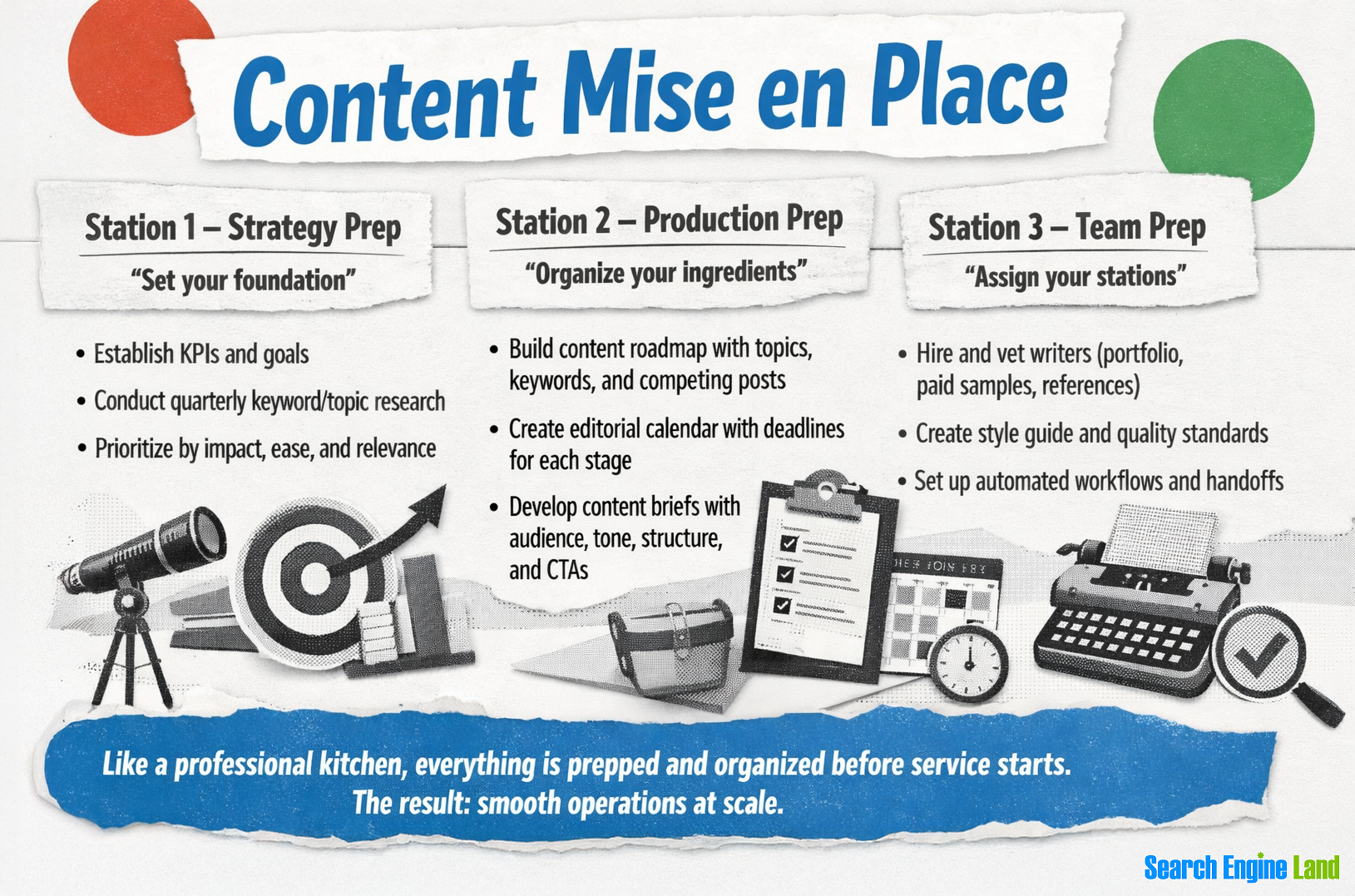
The statistics back this up. Marketers who set clear goals are around four times more likely to succeed. And while that sounds obvious, it’s really not when you realize how many content teams operate week to week without clear strategic direction.
Your strategic framework needs three core components:
- Goal clarity: What specific business outcomes should your content drive? Traffic is a vanity metric if it doesn’t convert to leads or customers.
- Audience specificity: Generic content at scale is just expensive noise. Each piece of content needs clear answers: who is this for, what problem does it solve, and how does it advance business objectives?
- Measurement consistency: You can’t optimize what you don’t measure. Define success metrics upfront so you can track whether your scaling efforts actually improve performance.
This framework becomes your content North Star, guiding decisions about topics, formats, channels, and resource allocation.
Aligning content scaling with business objectives and audience insights
Most scaling efforts fall apart because they optimize for metrics that don’t matter. Content professionals recommend planning ahead and knowing your audiences. Without that alignment, you’re just producing content faster—not smarter.
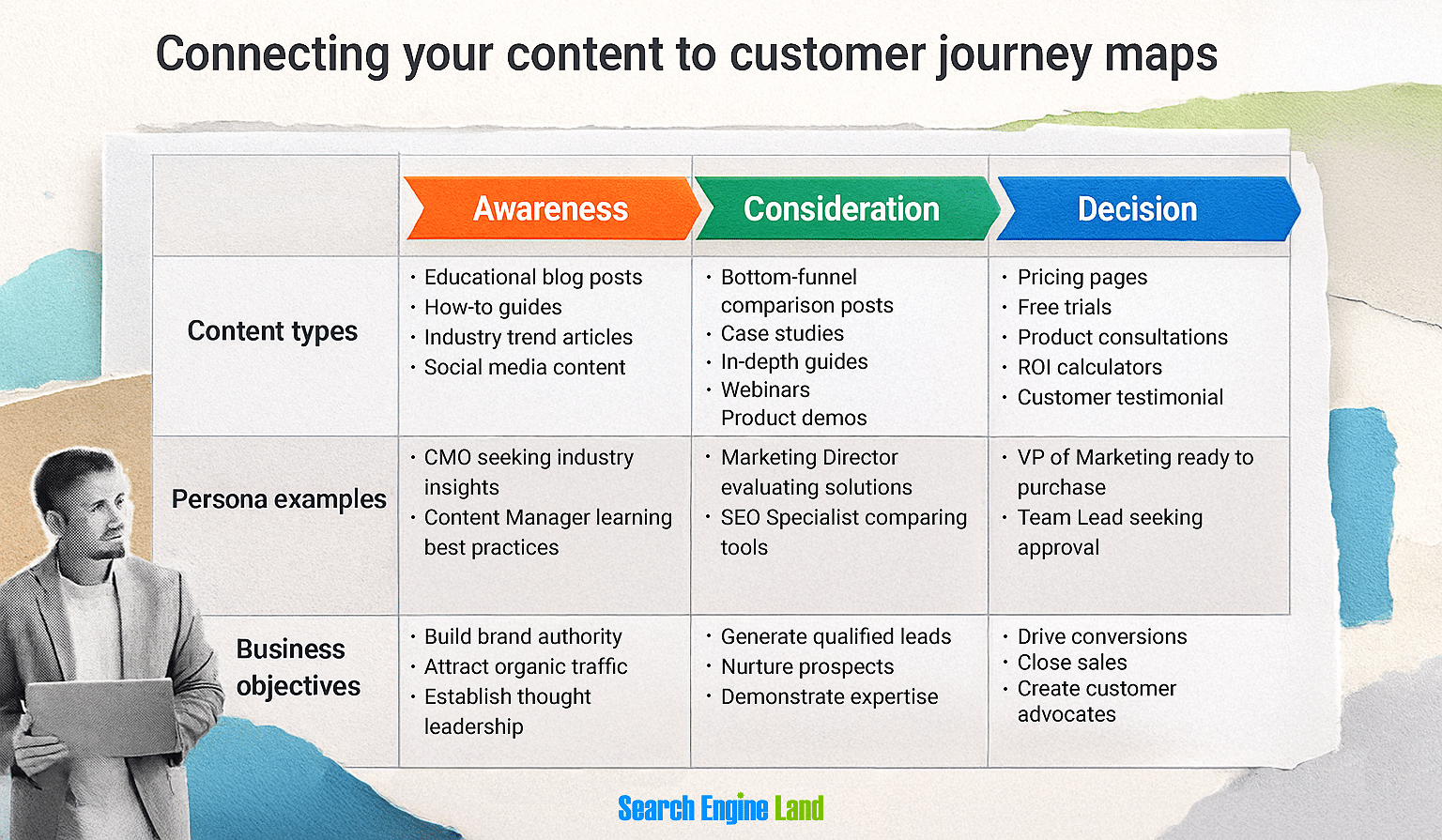
Buyer personas aren’t just marketing fluff when you’re scaling—they become operational requirements. Each content piece needs clear answers: who is this for, what problem does it solve, and how does it advance business objectives?
The magic happens when you map types of content to specific persona stages and business outcomes. Understanding SEO personas helps show how this alignment can translate to search engine visibility and organic growth.
Smart scaling teams build content matrices connecting audience segments, content formats, distribution channels, and success metrics. This systematic approach ensures every piece serves a strategic purpose rather than just filling editorial calendars.
Without this alignment, technology infrastructure becomes expensive overhead rather than a growth enabler.
Building the technology backbone for content operations at scale
Human creativity, subject matter expert (SME) insights, and original research will always be invaluable. When used correctly, technology multiplies human creativity rather than replacing it.
Integrated technology stacks can streamline automatable tasks, freeing up human writers, editors, and strategists to do what they do best. AI-powered tools can assist in the QA process by handling grammar checks, style verification, and compliance management. This allows writers to focus on strategy, SME interviews, and storytelling.
The technology backbone you build determines whether your scaling efforts feel chaotic or controlled.
Selecting and integrating content management systems for multi-channel distribution
Your CMS choice impacts everything downstream: workflow automation, collaboration capabilities, and integration potential with other tools in your stack. Headless CMS architecture separates your content from its presentation layer, enabling multi-channel distribution without content duplication or complex format conversions.
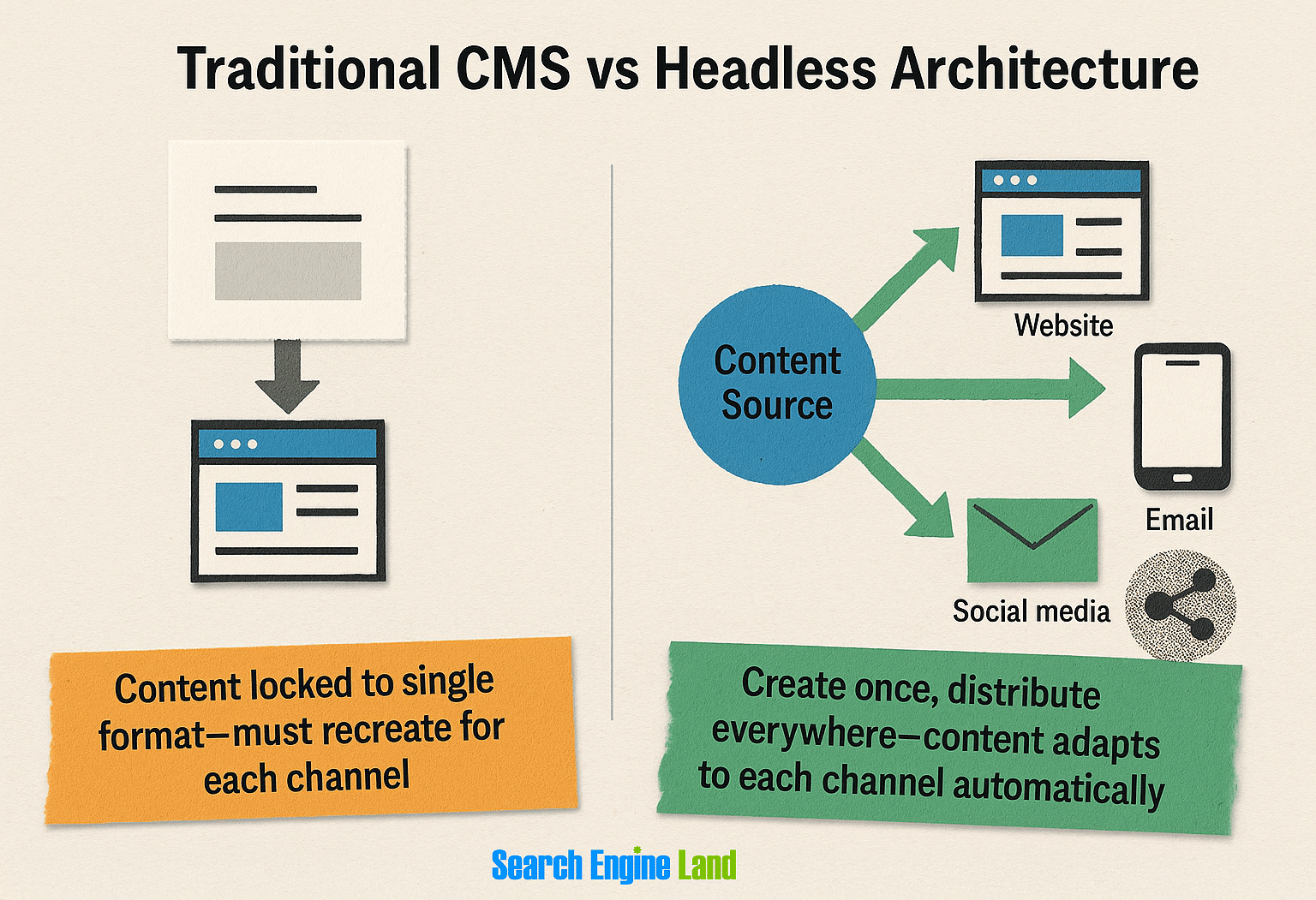
Think about traditional CMS platforms, which lock content into specific presentation formats, often requiring you to recreate similar content for web, mobile, email, and social platforms. Headless architecture changes this.
Separating content from presentation allows teams to create once and distribute across channels. You can write one product announcement and then format it automatically for each channel.
The efficiency gains are significant. Instead of managing multiple content versions, you manage a single source of truth that feeds multiple endpoints. This approach also enables better personalization, since you can tailor the presentation while keeping the core message consistent.
Implementing AI-powered content creation and optimization tools
Today’s AI marketing tools help maintain brand consistency while accelerating production, acting as intelligent assistants that multiply writer productivity rather than replace human creativity.
Platforms like Jasper’s Content Pipelines and Content Toolkit can support entire content workflows, not just individual pieces. These tools maintain a consistent tone across different writers, suggest improvements based on performance data, and handle time-consuming tasks like headline variations or meta description optimization.
The most effective AI content tools integrate with your existing workflow, learning from your brand guidelines and performance history to make increasingly relevant suggestions.
The real value emerges when these AI tools connect with other systems, automatically suggesting optimizations based on SEO data, incorporating personalization variables, or triggering approval workflows.
Creating automated workflows and cross-platform integrations
Automation eliminates manual handoffs between systems and people, creating smooth content pipelines that move from ideation through publication without bottlenecks.
Every time someone manually moves content from one system to another, you’re introducing delays, potential errors, and friction that compounds as you scale. Zapier integration automation can bridge these gaps through triggered workflows that handle routine tasks automatically.
Without automation tools, every handoff demands manual coordination. With smart integrations, writing completion automatically triggers editing, finished edits prompt design, and approvals set social scheduling in motion.
Workflows can automatically update content calendars, generate SEO metadata, populate social templates, and send performance reports once content goes live.

The most effective automated workflows combine marketing funnel automation principles with content-specific requirements: triggers based on content status, automated asset generation, and cross-platform publishing that maintains consistency while adapting to each channel’s needs.
Developing modular content architecture for maximum reusability
Modular content architecture breaks content into reusable components that can be mixed, matched, and repurposed across formats and channels. This maximizes both content value and production efficiency.
Instead of creating standalone pieces, you’re building content “Lego blocks.”
Most teams still think linearly: one blog post, one purpose, one distribution channel. That’s inefficient thinking. With modular architecture, a single webinar can become a cluster of interconnected assets: podcast episodes, social media posts, email sequences, downloadable guides, and bite-sized video content.
Designing content modules and reusable components
Content modules are the atomic units of your content ecosystem. They include headlines, key insights, data points, examples, and frameworks that can be recombined repeatedly without losing impact.
Companies that plan for future repurposing from day one may see higher ROI from their content efforts. They’re not retrofitting existing content; they’re designing for reuse from the ground up, which makes it easier to plan and execute strategy successfully.
When you build content with tomorrow’s needs in mind, not just today’s deliverable, every piece becomes an investment that compounds.
Start with these core modules:
- Problem statements that work across formats
- Solution frameworks with flexible depth levels
- Data points with multiple visualization options
- Customer stories structured for various lengths
- Expert quotes tagged by topic and application
Each module should include metadata such as:
- Topic tags
- Audience segments
- Format compatibility
- Update requirements
Implementing strategic content repurposing across formats and channels
The multiplication effect of content repurposing is real, but only when each individual asset feels native to its platform rather than obviously reused.
Webinars are often rich source material, but many organizations extract value only once and move on. They don’t have to. ON24 emphasizes treating live content as a starting point for broader content reuse. With the help of AI-assisted content workflows, a single 60-minute webinar can be adapted into multiple formats of new content, such as:
- LinkedIn posts highlighting key insights
- Email sequences that expand on core frameworks
- Podcast segments or episodes exploring specific topics in more depth
- Visual assets like charts or infographics for social distribution
- Downloadable guides that compile and organize the main takeaways
But here’s what many miss: effective repurposing isn’t about sheer volume. It’s about preserving quality while adapting content to each channel’s consumption patterns. LinkedIn favors concise insights, email audiences tend to engage with structured detail, and podcast listeners often respond best to longer-form storytelling.
Dig deeper: 6 Overlooked Ways to Repurpose Content
Maintaining quality and brand consistency through content governance
Content governance is the discipline that helps ensure a modular approach remains coherent rather than turning into uncontrolled sprawl. Without clear governance, maintaining consistent, high-quality content at scale becomes harder. This makes governance an important consideration as content operations grow.
Quality issues can also become more visible with modular content. More components and more reuse points increase the risk of brand inconsistency if standards aren’t clearly defined. Without governance frameworks, teams may build efficient systems that still produce uneven or inconsistent content.
Content decay can be harder to manage in modular systems if updates aren’t coordinated. An outdated pricing reference may not live in just one blog post; it can appear across multiple assets derived from the same module until it’s corrected at the source. Without safeguards, inaccuracies can spread throughout the content ecosystem.
Smart governance can include:
- Module-level quality control before reuse or distribution
- Cross-format consistency checks during repurposing
- Defined update triggers when core information changes
- Brand voice validation across derivative content
Scaling content teams and managing distributed production
Scaling content operations requires a shift toward balancing people, process, and technology. While the right infrastructure enables efficiency, successful scaling ultimately depends on assembling the right talent, establishing clear processes, and creating systems that maintain quality while increasing output.
Building internal content teams with clearly defined roles
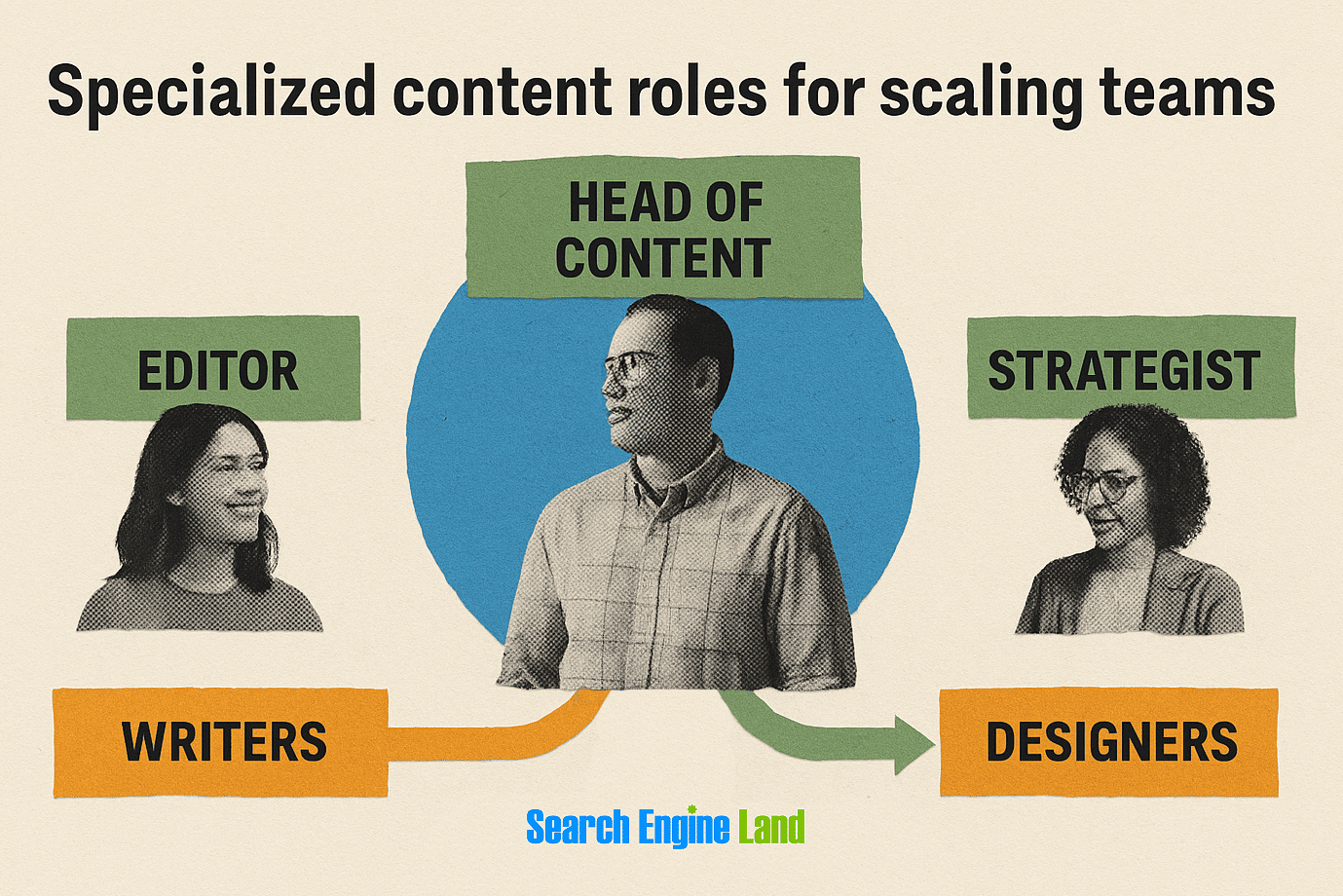
Content teams naturally evolve from individual contributors wearing multiple hats to multiple people working in more specialized roles. As you grow, it’s important to do so strategically.
The key is ensuring each role has clear ownership while maintaining collaborative workflows. Companies scaling effectively invest in documented processes, style guides, and regular team alignment sessions to prevent quality drift as teams grow.
Successful internal teams typically structure around four core functions:
- Strategy: Audience research, content planning, competitive analysis
- Creation: Writers, designers, video producers
- Quality assurance: Editors, fact-checkers, brand compliance specialists
- Optimization: Analysts, SEO specialists, conversion experts

Training and onboarding become especially important at this stage. A consistent brand voice, clear style guidelines, and reliable quality standards can’t live in people’s heads—they need to be shared deliberately. Teams that scale well invest in documented processes, practical style guides, and regular alignment sessions so quality doesn’t slip as more contributors come on board.
That said, not every organization can justify building a fully in-house team. Content needs can be seasonal, and some skills are only needed occasionally. In those cases, strategic outsourcing becomes a practical—and often necessary—choice.
Strategic outsourcing and vendor management for content production
Many companies can’t justify building fully internal content teams, especially when needs are seasonal or require specialized skills. In those cases, strategic outsourcing can complement internal capabilities rather than replace them.
You may benefit from outsourcing support when:
- Your internal team regularly struggles to meet deadlines or has to trade quality for speed
- You need specialized expertise (such as technical writing, video production, or industry-specific knowledge) that’s difficult to justify as a full-time hire
- Content needs fluctuate or are project-based, making permanent roles inefficient
Smart outsourcing isn’t about finding the cheapest option. It’s about working with partners who can meet your brand standards while filling specific capability gaps.
Both internal and external teams need clear content creation processes to work well together. Successful partnerships rely on clear communication, detailed briefs, and ongoing feedback loops that improve quality over time.
For many brands, this leads to a hybrid approach that combines internal leadership with external execution. In practice, that often looks like:
- Keep in-house: Core brand strategy, audience insights, and performance analysis
- Outsource: Specific content formats or high-volume production work

This maintains control over brand narrative while accessing specialized skills and scaling efficiently.
Establishing workflows and approval processes that scale efficiently
Documented workflows that don’t rely on any one person’s expertise make it much easier to scale beyond small teams.
Strong workflows capture more than just what happens. They clarify when things happen, why they matter, and who owns each step.
Many scalable content workflows follow a predictable structure:
- Planning phase: Brief creation and resource assignment
- Production phase: Creation, internal review, and stakeholder approval
- Distribution phase: Publishing, promotion, and performance tracking
Batching similar tasks can also improve efficiency. Instead of constantly switching between ideation, writing, editing, and publishing, teams often see better focus by dedicating specific time blocks to each activity.
Apply the 80/20 approach to approval processes:
- Identify which decisions truly require stakeholder input versus what editors can approve independently
- Reserve executive review for brand-sensitive topics, major announcements, or content with meaningful budget or legal implications
- Route everything else through streamlined editorial approval to keep work moving

Successful workflows also build in feedback loops that capture lessons learned and process improvements. Regular retrospectives help teams identify bottlenecks, refine handoff points, and adjust capacity planning based on actual performance data rather than initial estimates.
These efficient processes enable the measurement and optimization that drives continuous improvement in content operations, setting up the foundation for data-driven scaling decisions.
Measuring and optimizing content performance across channels
Content performance measurement helps turn scattered metrics into insights that inform smarter decisions. Many teams collect a lot of data but still struggle to focus on the signals that actually matter—it’s easy to track everything without gaining real clarity.

Here’s the thing: vanity metrics like page views can be useful for context, but on their own they rarely connect to revenue or growth. Teams that use structured content performance frameworks often improve how well content supports business goals over time. The difference is focus: they prioritize metrics that clearly connect content efforts to outcomes like engagement, conversion, and retention.
Establishing meaningful metrics and KPI frameworks
Content performance measurement helps turn scattered metrics into practical insight that informs your next move. The difference isn’t about having more data—it’s about measuring what actually supports business progress, rather than what simply looks impressive in a quarterly report.
Choosing your metrics
Each metric should answer a specific business question. For example, organic search impressions tell you whether your content is visible in search results. But high impressions with low clicks might mean your titles and meta descriptions need work.
Page views tell you nothing about business impact, while conversion rates and revenue attribution reveal whether your content actually is moving the needle on your bottom line.
Think about this: Would you rather have 100,000 visitors who bounce immediately, or 5,000 visitors who convert at 15%?
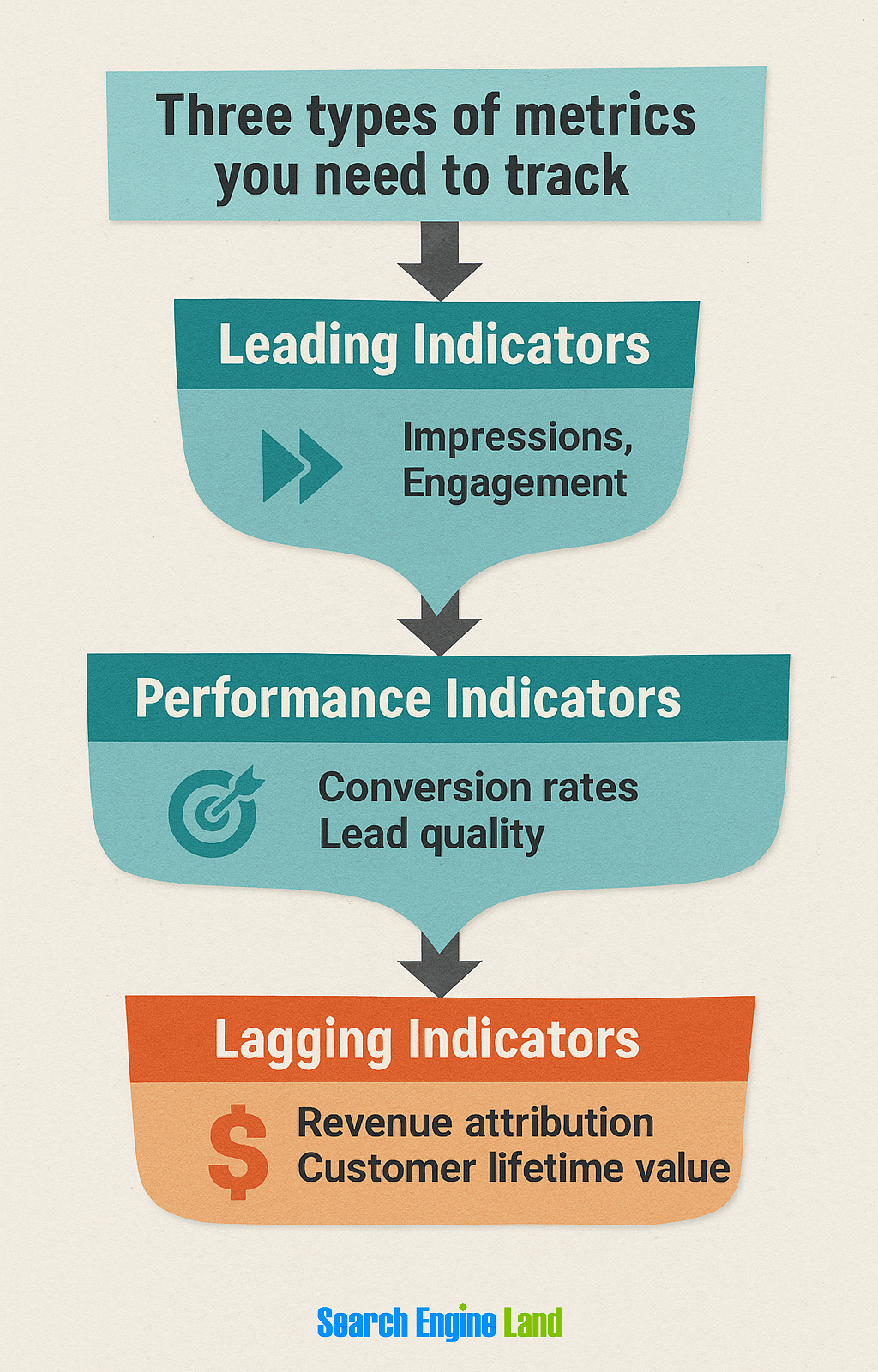
That’s why intentional metrics matter. Smart measurement starts with three metric categories:
- Leading indicators: Organic search impressions and engagement depth signal whether your content strategy is heading in the right direction.
- Performance indicators: Conversion rates by content type and lead quality scores show how well your content moves people toward business goals.
- Lagging indicators: Revenue attribution and customer lifetime value provide insight into whether content investments are contributing to business outcomes.
The magic ultimately happens when you track content performance across the entire customer journey. Successful teams use cohort analysis to track how content touches influence conversion rates over time.
Your content marketing strategy might show strong engagement metrics strong engagement metrics with high rankings, and plenty of clicks or shares. But if that engagement doesn’t translate to sales-qualified leads or conversions, you’ve got an optimization opportunity. That might include adding better or more prominent CTAs to high-performing content or writing more bottom-funnel posts.
Accounting for behavioral analysis
Don’t forget the human element in your measurement framework. User behavior analytics reveal why certain content performs while other pieces fall flat.
Heat maps, scroll depth, and time-on-page metrics help you understand engagement quality, not just quantity. These signals reveal whether visitors actually found what they needed. Did they explore multiple pages, spend meaningful time with your content, or bounce immediately?
That context separates genuinely interested users from accidental or irrelevant clicks.
Implementing personalization and segmentation at scale
Personalization at scale isn’t about showing someone’s name in your email subject line. It’s about delivering the right content experience based on behavioral data and demonstrated preferences.
This is most effective when you’re creating content for specific audience segments across your buyer journey. For example, Adidas partnered with Insider One to use AI-powered personalization across buyer journey segments—targeted coupons for new and returning users, optimized category navigation for mobile shoppers, and behavior-based product recommendations.
The result? A 259% increase in average order value for new users, a 35.5% boost in returning-user conversions, a 50.3% rise in mobile conversions, and incremental gains on homepage and cart pages.
How to scale your personalization efforts
The foundation of scalable personalization is a unified customer data platform. Personalization only works when your content, CRM, and digital marketing tools can share data seamlessly.
Start with behavioral segmentation. How users actually interact with your content is far more insightful than demographics alone. Track content consumption, engagement depth, and conversion paths to build dynamic segments that adapt in real time to user actions.
Finally, test everything systematically. A/B testing individual personalization elements lets you see what truly drives engagement. Measure conversion rate improvements by segment to confirm that your personalization efforts are paying off.

Learning from real-world content scaling implementations
Real success stories reveal the gap between theoretical scaling advice and practical implementation.
For example, a multi-location service provider scaled their local SEO content by building 150+ dynamic, database-driven location pages using HubDB and modular templates, resulting in 23% cost savings, faster delivery, and a system that allows easy long-term management and expansion across markets.
Meanwhile, Tomorrow Sleep scaled its content strategy by mapping topic gaps, creating in-depth, targeted content, and optimizing for search intent, which grew their organic traffic from 4K to 400K monthly within a year and earned multiple top SERP positions, including the featured snippet.
There’s a common thread across these successful implementations: They both treated content scaling as a transformation journey requiring systems thinking. Technology enabled their success, but strategy guided their decisions.
Your roadmap from content chaos to systematic scaling success
Content scaling isn’t about producing more—it’s about producing smarter.
This requires three elements working together:
- Strategic thinking that aligns content with business objectives
- Technology that amplifies human creativity rather than replaces it
- Continuous optimization that turns performance data into actionable improvements
Skip any one of these, and you risk falling back into content chaos.
The next steps are straightforward:
- Align strategy and objectives so every content goal maps to a business outcome
- Review your tech stack, adding or upgrading tools to better support creation and optimization
- Assign clear responsibilities for creation, strategy, and optimization, bringing in new team members or freelancers if needed
- Run a pilot to test quality, relevance, and performance before scaling fully
Companies that succeed at content scaling know that quality and quantity go hand in hand when the right systems are in place.
Dig deeper: Discover the risks, benefits, and best practices of AI-generated content.
Explore more on
Editorial disclosure
Search Engine Land is owned by Semrush. We remain committed to providing high-quality coverage of marketing topics. Unless otherwise noted, this page’s content was written by either an employee or a paid contractor of Semrush Inc.
About the author