How to QA AI-generated content: A complete workflow


Sure, artificial intelligence can write a 2,000-word blog post in minutes. Amazing, right?
But then you hesitate to hit “publish” because you’ve heard about the brands that did exactly that and then ended up publishing hallucinated stats, off-brand messaging, or content so generic it tanked their credibility.
The appeal is obvious. More time for everything else you need to get done. But, then, the risk is also obvious.
AI is an incredibly helpful drafting tool, but it has its limitations, too. For example, it can’t reliably fact-check its own hallucinations, understand nuance in particularly complex scenarios, or catch subtle errors that can erode reader trust. Things like referencing “Google AdWords” instead of “Google Ads,” attributing a statistic to the wrong source, or using a competitor’s branded terminology instead of your own.
The SEO toolkit you know, plus the AI visibility data you need.

In my personal experience, AI also struggles with critical writing components like content structure, parallelism, and repetitive phrasing. While these may seem like minor details, your audience will notice if your bullet list doesn’t follow a consistent structure or you start every sentence with the same phrase throughout your writing.
That said, AI-powered tools are getting better at generating content that sounds “more human.” A 2024 study from MIT found that AI detectors frequently misidentify human-written text as AI-generated, and vice versa. They’re clearly valuable and can speed up content production, but they still require human oversight to ensure quality, uniqueness, accuracy, and brand alignment.
So how can you feel comfortable utilizing AI? The answer is to implement a structured Quality Assurance (QA) workflow that combines AI efficiency with human judgment.
In this article, we’ll walk through a complete QA process for AI-generated content, covering what to automate, what requires human review, and how to build a checklist that keeps your content consistent. That way, you’ll feel confident scaling content production with AI and can avoid the risk of low-quality, inaccurate, or off-brand content that could ding your brand instead of helping it.
How to QA your AI-generated content
The most effective QA workflows use a hybrid approach that combines the competencies of AI tools and deftness of humans symbiotically. AI handles repetitive checks like spelling, formatting, and plagiarism detection. Humans handle nuanced tasks like evaluating tone, verifying facts against primary sources, and ensuring content actually answers the search intent.
And, perhaps most importantly, AI can’t add the “human” element that makes content truly valuable and unique. You need actual humans to leverage their own experience, offer unique insight, and potentially work with subject matter experts (SME)s to deliver something exceptional.
This may change in the future, of course, but for now, AI is limited in what it can do.

Think of it this way: AI excels at pattern recognition and speed. It can scan thousands of words for spelling errors in milliseconds.
But it can’t tell you whether a statistic from 2019 is still accurate or relevant or whether you might accidentally be using phrasing that misses nuance (and potentially results in an inaccurate explanation).
AI also can’t give you the kind of sage advice that only comes from making certain mistakes and learning how to both recover and avoid them in the future.
For example, I now have a personal rule to never let AI draft a conclusion for any piece I’m working on because, nine times out of 10, it produces a generic summary that undoes all of the momentum I worked hard to build into the piece.
Your QA workflow should leverage both the strengths of the AI as well as the humans. Automate what you can, and then layer in human review for everything that requires context, judgment, or expertise.
Define quality criteria
Without defined criteria, your QA process becomes subjective and inconsistent, which is the enemy of quality at scale.
At five articles a month, you might not notice. At 50, the cracks will begin to show.
For example, say you have AI write three pieces for your company blog. However, you don’t have your QA processes fully in place. You may end up with one piece that might cite a five-year-old study as “recent” because people aren’t double-checking dates and your team hasn’t set a three-year limit on data. Another may use your competitor’s branded product terminology instead of yours. A third passes QA with a hallucinated statistic because no one documented that stats require source links. The inconsistency compounds. But you can prevent it.
Here’s what to define upfront:
Factual accuracy standards
Determine what types of claims require source verification. Statistical claims, medical information, legal statements, and anything involving specific numbers should always be verified against primary, reliable sources. You’ll want to check:
- Exact numbers and dates cited
- Attributions of quotes and exact quote wording (AI loves to paraphrase!)
- Specific terminology used for regulated industries or in studies, such as medical studies or legal statements
Brand voice guidelines
Document your tone, preferred terminology, and writing style. For example, you’ll want to define things such as whether you say “clients,” “customers,” or “guests,” or whether contractions are on-brand or too casual.
This is your reference point for reviewing whether AI output actually sounds like your brand and helps you train your in-house LLM on brand voice.
Originality thresholds
Decide what plagiarism percentage is acceptable. Many teams set a threshold of less than 10% similarity, but this varies by content type and industry.
You can use tools like Grammarly and Copyscape to assess your content’s originality. They’ll flag what percentage of text is “copied” from other online and academic sources.

While some topics may have more overlap (especially for technical content where you may often be quoting direct sources like the IRS, Google, etc.), sticking to 5-10% is a good guideline for most brands.
Ethical guidelines
Address potential biases, transparency requirements, and any industry-specific compliance needs. If you’re in a regulated industry like healthcare, finance, or legal, this step is especially important.
An AI-generated blog post that casually recommends a supplement dosage or implies guaranteed investment returns isn’t just a quality issue. It can actually become a compliance violation waiting to happen. Inaccuracies here could mean regulatory scrutiny, fines, or worse.
And also important? If mistakes compound on your website, you’re likely to lose customer trust along the way, too.

For example, A SaaS company specializing in SEO software might document their quality criteria like this:
- Accuracy: All statistics must link to primary sources published within the last two years. Product claims require sign-off from the product team. Competitor comparisons need legal review.
- Voice: Tone is conversational but professional. Avoid jargon unless defining it. Never use “synergy,” “leverage” as a verb, or “cutting-edge.” First-person plural (“we”) is acceptable; first-person singular (“I”) is not.
- Originality: Plagiarism score must be below 8%. Any passage flagged above 5% similarity requires human review and possible rewriting.
- Ethics: Disclose AI involvement in content creation per company policy. Avoid gendered language in job-related content. All customer examples require written permission.
Pro tip: Document these criteria in a shared resource your entire team can access. Consistency depends on everyone working from the same standards.
Automate with software and AI tools: Post-writing QA
Several QA tasks are well-suited for automation. These checks are repetitive, rule-based, and don’t require human judgment.
For example, automation can catch repetitive mistakes like every instance where AI writes “KeywordMagik” as “Keyword Magic” or flag when word count exceeds 2,500 (which is the limit to maintain a flat fee with your freelance content editor).
As a note, not every team will have access to tools that automate all of these steps. If you can’t automate a specific review, move it to your human assessment checklist instead.
Spelling and grammar checks
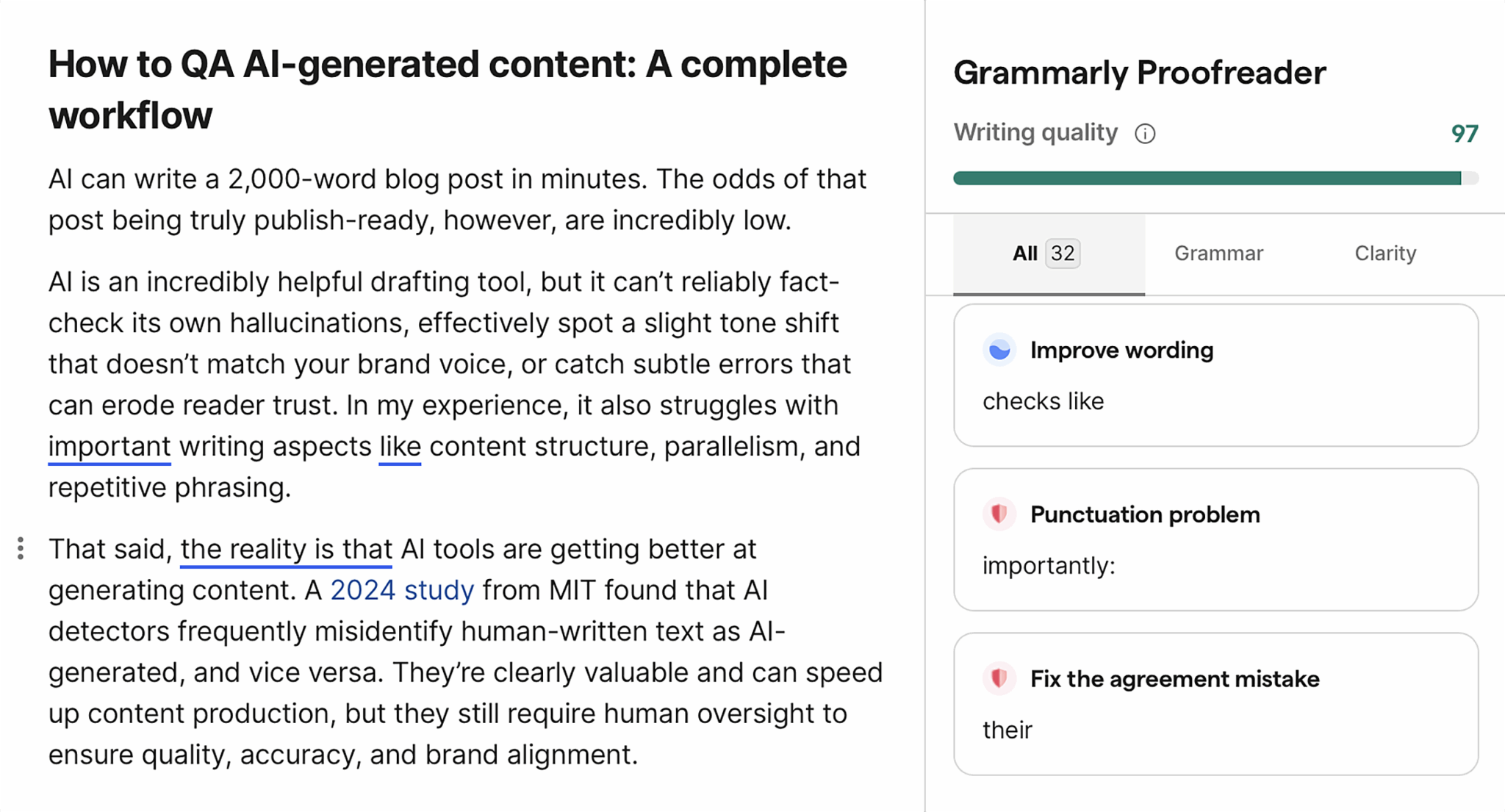
You want your content to be well-written, and that starts with catching typos and awkward phrasing. Speaking from experience, sometimes basic spell check won’t catch “your” when you meant “you’re,” but your readers will — especially the ones deciding whether to trust your expertise. And it may not catch really disastrous wrong spellings like “pubic” instead of “public.” You don’t want your brand to end up viral on the internet for something as easily avoidable as that.
Tools like Grammarly, ProWritingAid, or built-in word processor checkers can catch spelling errors, grammatical mistakes, and punctuation issues. Run these checks before any human review to eliminate obvious errors and speed up the editing process.
Plagiarism detection
Original content builds trust with readers and performs better in search. Duplicated content does the opposite — and can even put you at risk of infringing on someone’s copyright.
Think about it: If our example SEO SaaS company has an article on technical SEO audits that reads exactly like three other posts on the first page of Google, what reason does anyone have to choose yours? Worse, what happens when a reader notices and thinks you lack any expertise of your own? You might have lost a potential customer without even trying, or, more rightly, for lack of trying.
Use tools like Copyscape or Grammarly’s plagiarism checker to scan for copied content. AI models can inadvertently reproduce phrases or sentences from their training data, so this step is essential even when you’ve written detailed prompts.
AI detection checks
Some publishers penalize content that reads as “obviously AI-generated.” Knowing where your content falls on the spectrum helps you decide how much humanization it needs.
In theory, tools like Originality.ai, GPTZero, or Copyleaks can flag content that reads as machine-written.
However: AI detection tools are notoriously unreliable. They frequently produce false positives (flagging human writing as AI) and false negatives (missing obvious AI content). In my personal experience, it’s not worth utilizing these tools unless you have a client who insists on using them. Instead, rely on your own experience as a reader. If it doesn’t sound like human writing to your own ear, edit it until it does.
And as an important note: It’s critical to respect publisher and client boundaries around AI content creation. If a contract requires entirely human-written content, abide by that. Again, speaking from experience: Trust is everything in these relationships.
Brand voice compliance
Consistent brand voice builds recognition and trust. If you’ve got one piece that’s full of emojis and puns and another that reads like a technical manual, it confuses readers and dilutes your brand identity.
If our make-believe SaaS SEO tool has help docs that are playful and conversational but the AI-generated blog posts sound like they were written by a legal team, readers notice. One voice says “approachable startup,” while the other says “faceless corporation.” You can’t be both.
Some enterprise tools like Jasper can check content against your documented brand guidelines, comparing word choice, sentence structure, and tone against your established standards.

If you don’t have access to brand compliance software, this check moves to human review, and a final human check is always a good step to ensure accuracy.
Formatting verification
Proper formatting makes content easier to read and signals professionalism. It may also help search engines and AI crawlers understand your content better. Inconsistent formatting, on the other hand, distracts readers and can make your brand look careless.
Automated checks can verify that your content meets basic formatting requirements, including verifying that:
- Word count limits are followed
- Title or sentence case is correct
- No extra spaces appear before or after punctuation
- All required sections are present
That said, AI often struggles with complex structural decisions. I’ve seen drafts that bury the main takeaway in paragraph six instead of leading with it or that consistently forget introductory paragraphs after H2s, even when it’s in the style guide. As a result, this should be something assessed during the human review, too.
Offensive language detection
One inappropriate phrase can both damage your brand’s reputation and alienate your audience. Catching problematic language before publication protects both.
For example, when drafting a blog post about SEO tactics, AI might generate outdated terms like “black hat SEO,” or for a hiring post it might use gendered language like “manpower” that your team wants to avoid, or it might rely on common phrases that are now considered ableist like “blind spot” or “falling on deaf ears.”
These can slip through because AI reflects its training data and the training data isn’t always what you would have chosen for your own website.
Content moderation tools can scan for potentially offensive, biased, inappropriate, or even outdated language. This is especially important if you’re publishing at scale or working with multiple AI-generated drafts. Of course, it’s always important to keep an eye out for questionable phrasing during the manual review, too, just to be safe.
Conduct human review: Post-writing QA
Human review catches what automation misses, and the reality is that AI still has some significant limitations that we need to account for. These checks require context, judgment, and human expertise that AI tools can’t replicate.
Verify facts against primary sources
AI hallucinations and misinformation are real, and they’re very common. Models confidently generate statistics, quotes, links, and claims that are partially or completely fabricated.
For example, I recently edited an AI-generated post for a client. Every. Single. Statistic. Was. Hallucinated. But, at a quick glance, they all looked real. The post linked out to very trustworthy sources like the Mayo Clinic and the CDC. But when clicking to the site, the data either wasn’t there or the link went to a broken page that didn’t exist.
In order to avoid these kinds of issues, here’s how to approach fact-checking:
- Always cross-check with primary sources. Don’t rely on secondary summaries or aggregator sites. If AI cites a study saying “fan-out optimization may drive a 150% increase,” find the original research that makes that claim (not just other sites repeating the data after the fact).
- Check source links directly. AI might claim that a source says something it doesn’t actually say. We’ve seen AI cite articles to support a claim about Core Web Vitals, but clicking through revealed the article was about something else entirely. Click through and verify that the linked content supports the claim being made (and that the link isn’t a hallucination itself!).
- Use established fact-checking resources. Sites like Snopes, PolitiFact, or industry-specific verification resources can help confirm or debunk common claims.
- Verify statistics with research. If AI generates a specific number or percentage, trace it back to the original study or report. Check the methodology and publication date to ensure it’s still relevant.
- When in doubt, remove the claim. If you can’t verify something, don’t publish it. An unsupported claim damages credibility and trustworthiness more than a missing statistic.
At this stage, you also want to verify that external links or citations point to high-quality, trustworthy sources. References to low-authority sites will also undermine your content’s credibility.
Pro tip: Create a shared document where your team logs verified facts and their sources. This becomes a reference library that speeds up future fact-checking.
Read the content aloud
This simple technique reveals awkward phrasing, unnatural sentence structures, and flow issues that look fine on screen but sound wrong. If possible, have more than one person complete this step.
Reading aloud also helps you catch:
- Sentences that are too long or complex
- Repetitive word choices
- Transitions that don’t connect ideas smoothly
- Tone shifts that feel inconsistent
For example, an AI draft for our SaaS SEO tool’s blog might produce a sentence like: “When you’re looking to improve your rankings, you need to look at the keywords you’re ranking for and look for opportunities to rank higher.”
Read silently, it seems fine. Read aloud, you’ll hear “rank” four times and some version of “look” three times in one too-long sentence. That’s how you catch it before your readers do.
Check the content against the brief & style guide
AI can — and often does — stray from what you actually asked for in both the brief and the style guide. It might add sections you never requested, skip headings that were in your outline, or drift toward a different audience entirely.
And one of my favorite frustrations? AI has a tendency to skip the style guide’s recommendations on title case vs. sentence case, so be sure to double check that.
This is a human check, not an automated one. AI can technically verify that headings exist, but only a human can judge whether the content actually addresses what was outlined and whether any additions are relevant or just filler.
Check that:
- All required headings and sections from the brief are present and fully written
- No extra sections were added without a clear reason
- The content addresses the correct target audience
- Stylistic requests are consistent with your guidelines
- The CTA aligns with search intent and the brief’s goals
For example, I once received an AI draft for a “beginner’s guide to keyword research” that included an entire section on Python scripts for automating keyword clustering.
Was it technically related? Sure. But was it appropriate for the audience? Absolutely not. Assuming that any beginner would need instructions for Python is a far cry from reality. The AI added what it thought was helpful without considering who would actually be reading.
Complete SEO checks
Review keyword usage to ensure primary and secondary keywords appear naturally throughout the content. Check that the page title, meta description, and internal links are optimized and aligned with search intent.
Tools like Clearscope, Surfer SEO, or Semrush’s SEO Writing Assistant can help evaluate keyword coverage and content optimization.
Confirm search intent alignment
The content should actually answer what searchers are looking for, so review the target keyword’s search results and compare your content against what’s currently ranking.
Ask yourself:
- Does this content address the primary question behind the search?
- Are we providing the depth of information users expect?
- Does the format match user expectations (tutorial vs. overview vs. comparison)?
Say our SEO SaaS company is writing a blog post about email marketing best practices. They generate an AI draft, and it produces a high-level overview of why email marketing matters with brief mentions of segmentation and subject lines.
But when they check the search results, they notice that the top-ranking pages all include specific, numbered lists, like “12 Email Marketing Best Practices for 2025.” They cover deliverability, A/B testing, automation sequences, and compliance with detailed how-to instructions.
The company’s AI draft missed that search intent. In this example, searchers want actionable tactics they can implement, not a conceptual introduction. The content needs restructuring before it’s ready to publish. Because they reviewed ahead of publishing, the company’s marketing team has a clear-cut path on how to restructure their own blog post to match the actual needs of their potential readers who could convert to customers.
Add a human touch
AI-generated content often lacks personality, specific examples, and the kind of insights that come from real experience.
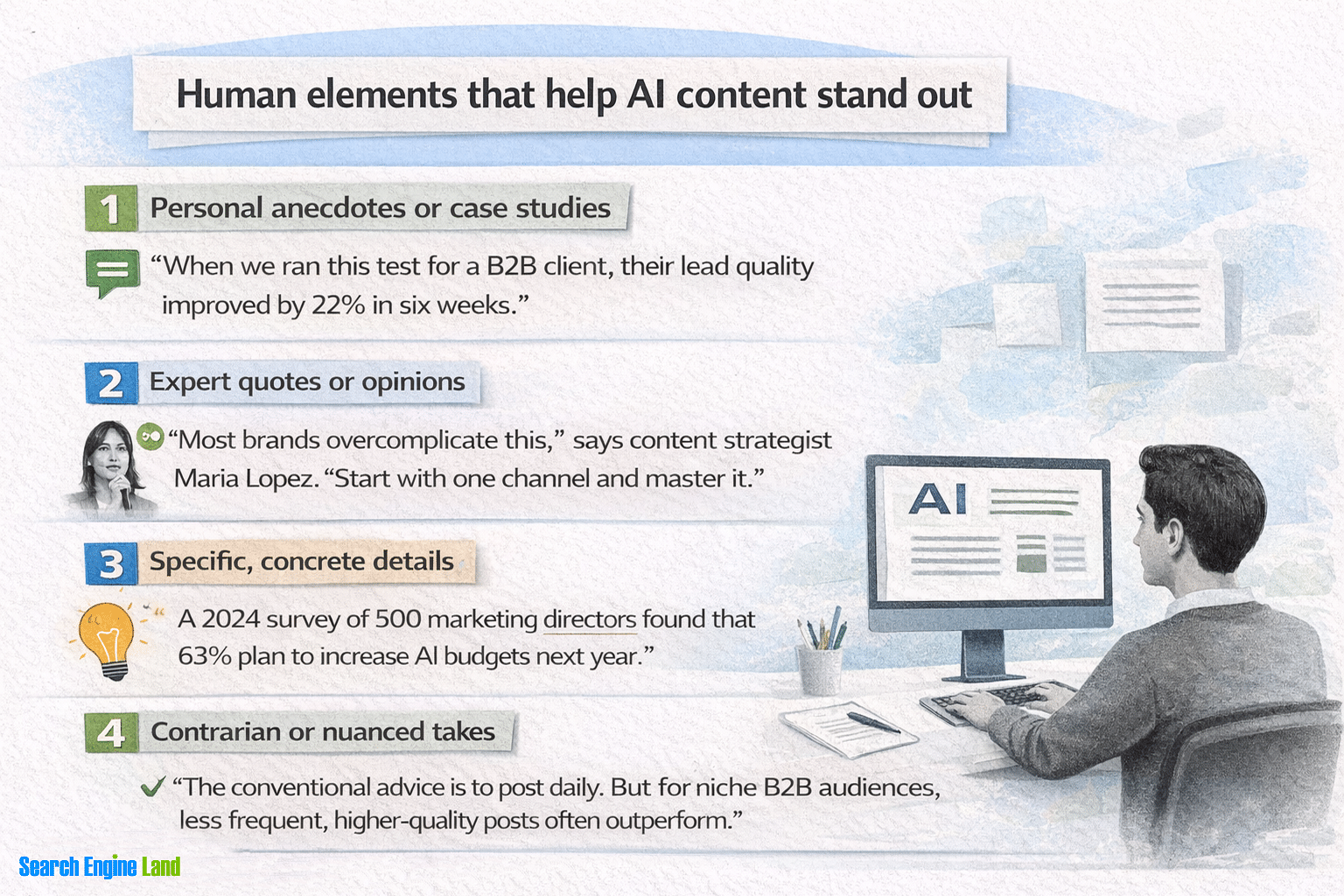
Look for opportunities to add in the following:
Personal anecdotes or case studies
Real examples from your work or your clients’ experiences make content more credible and engaging.
Ditch the AI’s generic “many businesses see improved rankings with proper keyword tracking.”
Instead, make it personal and real-life. For example, our SEO SaaS company could opt for: “When we onboarded a mid-size ecommerce client last year, they discovered they’d been tracking vanity keywords for months. Within six weeks of shifting focus, their organic leads increased 34%.”
Expert opinions or quotes
Original insights from subject matter experts add value that AI can’t replicate.
Our SEO SaaS company’s blog post on algorithm updates becomes far more credible when it includes a quote from their head of product that utilizes real world insights: “We analyzed 10,000 domains after the March update, and the sites that lost traffic had one thing in common.” That’s a powerful data point!
This is something that AI can’t match (at least not without hallucinating or plagiarizing it).
Specific, concrete details
Replace generic statements with precise information.
Instead of “many companies struggle with SEO reporting,” our SEO SaaS company could write “a 2024 survey of 500 marketing directors found that 62% spend more than three hours per week on manual reporting tasks,” and link to the the survey they took that shows just that.
This kind of specificity is what customers want to see, and it’s what builds true thought leadership which, in turn, engenders trust.
Contrarian perspectives or nuanced takes
AI tends toward consensus opinions. Human reviewers can add the kind of nuanced analysis that differentiates your content.
Where AI might write “backlinks are essential for SEO,” that’s nothing thrilling. Or new. We already know that.
A human editor at the SEO SaaS company could add: “But for newer sites in low-competition niches, we’ve seen clients rank on page one with zero link building — content quality alone got them there.”
The reality is that, while many people are exploring how to use AI, people don’t necessarily want or trust AI-generated content. If you’re able to add your own stories, share SME insights, or provide authoritative details to back up an argument, it’s a surefire way to prove a human was involved and to win trust.
Conduct human review: Post-publishing QA
Even well-written content loses credibility when readers encounter broken links, missing images, or formatting that looks off. As a result, if you’re letting AI or automated tools upload content to the CMS, you can conduct additional checks once content goes live to ensure everything displays correctly and functions as intended. This includes:
- Verifying on-page elements. Confirm that the page title and meta description appear correctly in the CMS. Check that these elements match what you intended and display properly in search results preview tools.
- Reviewing all images. Verify that images are present, properly sized, and optimized for page speed. Confirm that every image includes descriptive alt text for both accessibility and SEO purposes.
- Testing all links. Click every internal and external link to confirm they work, load correctly, and return a 200 status code. Broken links create poor user experiences and can negatively impact SEO.
- Checking formatting consistency. Review the published page to ensure formatting matches your site’s CSS styles. Verify heading sizes and colors, link styling, bullet point spacing, and paragraph breaks all display as expected.
Integrate and iterate
A QA workflow isn’t static. It should evolve based on what you learn from each review cycle as well as when you adopt new tools.
For example, if you add a new tool that can handle built-in guardrails, like Jasper, you might add a step in your workflow for Jasper to re-review edited content against compliance requirements.
As a result, it’s essential to integrate feedback reviews and process adjustments into the overall workflow.
Note: It can’t be stressed enough how important it is that compliance and brand tone checks are never fully outsourced to AI without human review. No AI tool is perfect, and too much is at stake.
Build continuous improvement into the process
Track the types of errors you catch most frequently. If AI consistently struggles with specific content types or makes the same mistakes, adjust your prompts or generation parameters to address these patterns.
For example, your QA reviews might reveal that AI keeps using title case for subheadings when your style guide requires sentence case. Or it consistently references your old product name instead of the rebranded version. Or it adds a generic “Conclusion” heading when your brand never actually does.
Once you spot these patterns, update your prompts to explicitly address them: “Use sentence case for all subheadings. The product is called ‘Acme Pro,’ not ‘Acme Suite.’ Never use ‘Conclusion’ as a heading.” These small refinements compound over time, reducing the errors and the effort that your human reviewers need to catch them.
Handle pushback effectively
Stakeholders sometimes resist thorough QA processes because they add time to content production.
If you hear, “This adds too much time,” reframe the conversation around risk rather than time. A 30-minute QA review can prevent hours of corrections, reputation damage, or compliance issues later. One published error can undermine the credibility you’ve built over months. Make this clear to your leadership teams.
If you hear, “We trust the AI,” shift the focus away from their faith in AI and towards consistency and brand protection. A simple response you can leverage? “Trust isn’t the issue — predictability is. QA makes sure every piece that goes out sounds like us and says what we actually mean.”
The issue isn’t whether AI is trustworthy in general. The issue is ensuring predictable, brand-aligned outcomes every time. QA creates that consistency.
Refine prompts based on QA findings
Use patterns from your QA reviews to improve future AI outputs. If you consistently catch the same issues, incorporate those corrections into your prompts, style guides, or AI training data.
For example:
- If AI regularly produces content that’s too generic, add specificity requirements to your prompts. In practice, that might look like requiring AI to have at least three anecdotes in each post, requesting it to replace phrases like “many marketers” with statistics, or requiring it to target a specific ideal customer profile (ICP).
- If tone is consistently off, provide more detailed voice guidelines and a writing sample for it to reference. For example, you could paste 200 words of your best-performing content into the prompt and ask it to write in that voice, specify it “use contractions and keep sentences under 20 words,” or list banned phrases like “utilize,” “leverage,” and “in order to.”
- If facts are frequently wrong, include instructions to flag claims that need verification. For example, you could add “mark any statistic with [NEEDS SOURCE],” tell it “do not invent studies or percentages,” or require it to write “[VERIFY]” after any claim it’s uncertain about.
Pro tip: LLMs can be helpful research and writing tools, but they are deeply prone to hallucinations. Since they rely heavily on text predictor technology, telling them “do not invent studies or percentages” will not necessarily prevent them from doing so sometimes. You’ll always need to fact check and verify.
Monitor published content performance
Track how AI-generated content performs after publication. Metrics will vary based on your goals and content type: organic traffic, engagement rates, conversions, ad clicks, or social shares.
For example, say your AI-generated blog posts pass every item on your QA checklist. Spelling is clean, facts are verified, formatting looks good. But after three months, you notice these posts have 40% higher bounce rates than your human-written content and significantly fewer conversions? There’s a problem.
The issue might not be what your QA process catches; it might be what it misses. Perhaps the AI content lacks the specific examples that keep readers engaged. Or the introductions bury the main point instead of leading with it. Or the content technically answers the search query but doesn’t go deep enough to satisfy reader intent.
Let’s look at an example. The SEO SaaS company wrote a post on “how to recover from a ranking drop.” It passed every QA check, but it’s full of advice like “analyze your backlink profile” without demonstrating what that actually looks like in practice. It’s not showing, simply telling. That isn’t actionable for the reader.
Meanwhile, a competitor has a similar post that walks through a real recovery story replete with screenshots, timelines, and specific metrics. Readers stay on that page and engage with it while they bounce from yours. That’s a problem that needs to be fixed by updating your own content to be as or even more helpful than your competitors’.
To spot and fix these kinds of issues, use performance gaps to refine your quality criteria. Add checklist items that address the patterns you’re seeing, such as: “Introduction states the main takeaway within the first two sentences,” “Each section includes at least one specific example or data point,” or “Content depth matches or exceeds top-ranking competitors.”
QA checklist for AI-generated content
Use this checklist template to standardize your review process. Assign clear ownership for each task to prevent items from falling through the cracks.
| QA Stage | Owner | Item |
|---|---|---|
| Post-writing | AI | Introduction was included |
| Post-writing | AI | Spell check |
| Post-writing | AI | Plagiarism check |
| Post-writing | AI | AI detection check |
| Post-writing | AI | Offensive language detection |
| Post-writing | AI | Brand voice/guidelines are being followed (voice, tone, grammar, etc.) |
| Post-writing | AI | Word count limit was obeyed (if one was set) |
| Post-writing | Human | Correct title case was used |
| Post-writing | Human | The correct audience was targeted in the content |
| Post-writing | Human | All headings were written and the notes for each section of content were followed |
| Post-writing | Human | No extra headings or sections were added without authorization |
| Post-writing | Human | The content and CTA align with search intent |
| Post-writing | Human | Fact checking: All claims must be fact checked because AI hallucinations are highly likely to happen if it’s used to write content (recommend doing this with both AI and then humans) |
| Post-writing | Human | Read the content out loud in its entirety, have more than one person do this if possible |
| Post-writing | Human | SEO checks: Keyword usage (in tools like Clearscope), page title, meta description, internal links, AI overview optimization, external links, content type for search intent, etc. |
| Post-writing | Human | Add a human touch if possible |
| Post-publishing | Human | Confirm page title and meta description have been added |
| Post-publishing | Human | Confirm all images have been added, optimized for speed, and that they include ALT text |
| Post-publishing | Human | Click on all internal and external links to make sure they work and load and return a 200 status |
| Post-publishing | Human | Make sure formatting is correct and follows the site’s CSS styles (heading color and size, link color, bullet point spacing, etc.) |
Balancing speed and quality for successful AI content creation
AI can dramatically accelerate content production. What once took days can now take hours. But faster output means nothing if the content doesn’t perform.
Track, optimize, and win in Google and AI search from one platform.
Brands that prioritize quantity over quality end up with hundreds of mediocre pages that don’t rank, don’t convert, and don’t build trust. Worse, low-quality AI content can actively damage your reputation. The speed advantage disappears if you’re spending months recovering from a content quality crisis.
The brands winning with AI content take a different approach. They align AI output with a clear content strategy, document their processes so quality stays consistent across team members, and invest in thorough human review. AI handles the heavy lifting, and humans ensure the final product actually serves readers.
Here’s how to set yourself up for success:
- Test new workflows with a gradual rollout. Start with five to 10 pieces of AI-generated content before scaling. A small pilot can help to reveal gaps in your QA checklist, show you where AI consistently struggles, and allow you to refine your process before errors multiply across hundreds of articles.
- Keep rigorous assessment processes in place. Review your QA workflow regularly and track which checks catch the most issues and which feel redundant. A QA process that doesn’t evolve becomes a checkbox exercise rather than a quality safeguard.
- Find ways to keep the human element alive. AI-generated content tends toward generic consensus. The details that make content memorable — original examples, expert insights, a distinct point of view — come from humans. Build time into your workflow for adding these elements.
For a deeper look at how AI fits into your content strategy, explore our complete guide to AI-generated content. Or, you can see how AI is actually impacting SEO to adjust your strategy for the coming changes.
Explore more on
Editorial disclosure
Search Engine Land is owned by Semrush. We remain committed to providing high-quality coverage of marketing topics. Unless otherwise noted, this page’s content was written by either an employee or a paid contractor of Semrush Inc.
About the author


