Intrepid searchers have been spotting click counts displaying under certain AdWords ads on Google.com, and the search giant has confirmed it’s doing a small experiment.
Both Vinny O’Hare and Steven Weldler spotted the user interface test, in which a click count was displayed underneath the URL portion of the ad. In one implementation, the text simply said the number of clicks followed by “clicks.” In the other, the text said “clicks for this advertiser,” seeming to indicate that the clicks are not for that single creative, but for the advertiser overall.
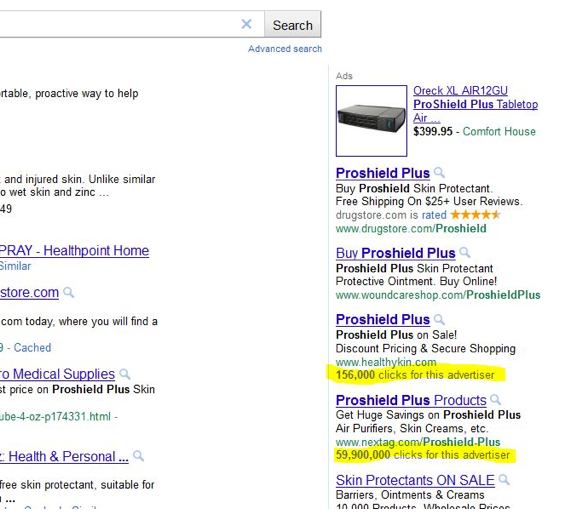
Image via Vinny O'Hare
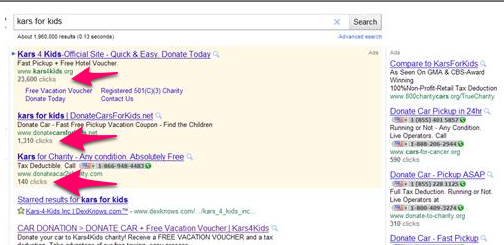
Image via Steve Weldler
A Google spokesperson confirmed that the display of clicks was part of a very small experiment on the look and feel of search results pages. It’s not clear exactly how clicks were calculated — are they on that particular ad creative or on every ad featuring that landing page URL, or on every ad placed by that advertiser? Why are they displayed on some ads, but not on others? Is it clicks for that query or clicks overall? Google typically has lots of experiments going on at once, and doesn’t comment in detail about new features until they’re rolled out.
One would suspect that a click count might encourage users to click on ads that others had previously clicked on. In some ways, displaying a click count just reinforces that relevance (as measured in clicks) is one of the signals Google uses for ranking.
How might advertisers like to have the clicks on their ads displayed publicly? I suppose it would depend on how the display effects performance. One could imagine some interesting conversations occurring within agencies, and between agencies and clients. Google assured me that the display of clicks is being done in such a way that is consistent with AdWords advertisers’ terms of service with Google. Still, it’s not clear whether advertisers are aware that they’ve agreed to allow public display of what most likely consider proprietary information.
Related Topics: Google: AdWords | Top News


to answer some of your questions:
we definitely have not seen it on all our ads or even for all ads for this query term, nor on other ads pointing to this landing page.
Additionally, we have been unable to determine from our internal data a time frame that google is using for number of clicks.
i tend to agree with you that this will be an indicator of relevance, especially for industry leaders.
What I found strange about this was that I couldn’t replicate it using the Chrome browser. I found it using Firefox and Steve checked it in IE.
So if you were doing PPC you could see the amount of clicks from the top 3 positions and adjust your CPC accordingly. On some keywords you may see it doesn’t pay to be in the 3rd spot altogether.
Pamela, i have tested it with myself but there is not counts with the ads, may be they this is experiment and they are showing with some accounts.
icheapmarketing – You don’t have to be signed in to see this. Right now if you do a search for hand bags using firefox you should see it.
Personally i cant this becoming the norm as it goes against Google model of access to all. Effectively this is only really a advantage for those with large or old ppc accounts.
Could be a “Project Vince” style of enhancement for Adwords. By this I imply that big advertisers will get a boost over small advertisers.
Interesting development, I think it gives an unfair advantage to big players or established players in the market, I hope it doesn’t become the norm, it would be interesting to see exactly what they are measuring, if it’s just clicks I don’t think this would be an indicator of relevance, an advertiser could have a high bounce rate.
More clicks shown equals more clicks from searchers. It’s social proof. So dependent on what the clicks measure the bigger budget players will win out. But also could be useful for copying proven ads too.
Premium member since 01/2009
Given that it appears to be a count of clicks for the advertiser, not related to the keyword or even the product category, it’s a huge advantage for the Comparison Shopping Engines, and Marketplaces like Amazon, Overstock, etc. Not just the size of the company advertising, but the breadth of offering will lead to advantage. This would be a bad turn of events for narrowly focused advertisers competing against generalists.
It has been three days or so and I am still seeing these results. I just put a video up on Youtube showing exactly what I am seeing. Like I said it doesn’t matter if I am signed into a Google account or not the results are the same.
http://www.youtube.com/watch?v=dYHJOXeVVCM
Do you think Google translate this testing into organic results? I doubt it, because, as John Trimble, definitely goes against the mentality of “access for all”. Clearly, this testing entirely pushes out anyone with a smaller budget.
And Boyd Butler is right, like lemmings to the sea I can forsee the average user just clicking on the ads with the most clicks instead of looking to the organic results. Bad news for seos!
Premium member since 05/2011
In Google’s defense in regards to proprietary information, they actually reached out to us a few days prior to the launch of this experiment to advise of the test and give the option to opt out.