MSN Introduces Dramatically Improved Redesign, Portal Drives Nearly 50% Of Bing Queries

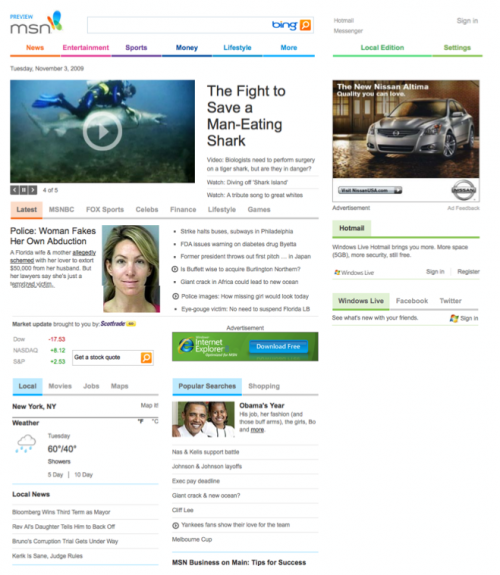
Billed as the first major redesign in a decade, Microsoft has introduced a dramatic new look and feel for the MSN portal. The redesign simplifies and cleans up most elements on the site. Among other things, it makes video more central, incorporates Facebook and Twitter, creates a dedicated new local area and emphasizes search.
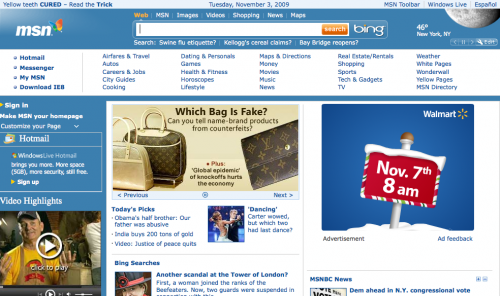
MSN, which Microsoft says now has 600 million users globally (which would make it larger than Yahoo), is a huge asset for a number of reasons, not the least of which is the fact that it drives roughly 45% of Bing’s queries. Even a cursory look at the old and new MSN homepages reveals the superiority of the new design:
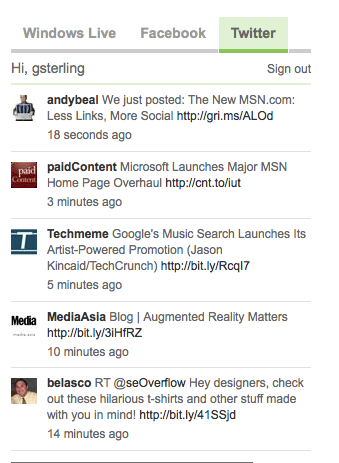
After users log in and grant access to their Twitter and Facebook accounts, the activity streams of both sites appear in the lower right of the MSN homepage (the blank area above):
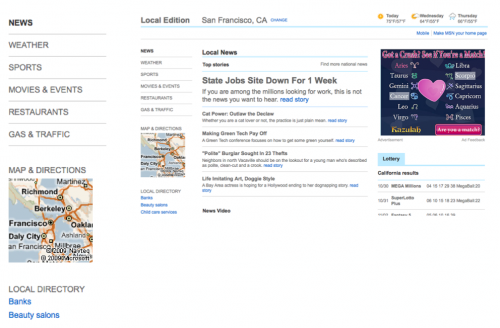
The new local edition does a nice job of aggregating a range of local content (e.g., restaurants and entertainment, news, film, traffic, gas prices, etc.) and presenting it in a direct and accessible manner, with maps and local search functionality as well.

Microsoft told me that the redesign was prompted by user feedback and a growing internal sense that the old design was cluttered and had grown stale. When I met with Microsoft we also discussed and compared the Yahoo homepage redesign of several months ago. The most prominent feature of the Yahoo homepage redesign is the left column of widgets or apps, which ask users to select and personalize the page accordingly.
Microsoft expressed skepticism that lots of people will in fact get involved with a high degree of explicit personalization like this. There will, however, be personalization on MSN but it will not be as obvious to end users as the personalization elements on the Yahoo site. Microsoft will be offering “smart headlines” based on user location, behavior and demographic segment.
The new MSN will roll out globally over the next several months. Interestingly the look of the MSN portal may be slightly different country to country, depending on variables unique to each local market. Microsoft also says that it will bring the new MSN experience to mobile devices as well.
I haven’t systematically gone through every link and page in the new MSN site but from what I’ve been able to look at, it’s a big improvement over the former design.
If Microsoft enjoys success with the new MSN site it’s likely to directly benefit Bing. Previously many users were reportedly abandoning MSN for Google to conduct search queries. That’s probably less likely to happen now. But we’ll see what transpires over the next month or two. Regardless the new design makes MSN a much better place to visit.
Here’s a review of MSN designs over the past several years. See also related discussion on Techmeme.
Explore more on
Editorial disclosure
Contributing authors are chosen for their expertise and work under the oversight of the editorial staff. Search Engine Land is owned by Semrush. The contributor was not asked to mention Semrush; the opinions expressed are their own.
About the author