Do you shove lots of ads at the top of your web pages? Think again. Tired of doing a Google search and landing on these types of pages? Rejoice. Google has announced that it will penalize sites with pages that are top-heavy with ads.
Top Heavy With Ads? Look Out!
The change — called the “page layout algorithm” — takes direct aim at any site with pages where content is buried under tons of ads.
From Google’s post on its Inside Search blog today:
We’ve heard complaints from users that if they click on a result and it’s difficult to find the actual content, they aren’t happy with the experience. Rather than scrolling down the page past a slew of ads, users want to see content right away.So sites that don’t have much content “above-the-fold” can be affected by this change. If you click on a website and the part of the website you see first either doesn’t have a lot of visible content above-the-fold or dedicates a large fraction of the site’s initial screen real estate to ads, that’s not a very good user experience.
Such sites may not rank as highly going forward.
Google also posted the same information to its Google Webmaster Central blog.
Sites using pop-ups, pop-unders or overlay ads are not impacted by this. It only applies to static ads in fixed positions on pages themselves, Google told me.
How Much Is Too Much?
How can you tell if you’ve got too many ads above-the-fold? When I talked with the head of Google’s web spam team, Matt Cutts, he said that Google wasn’t going to provide any type of official tools similar to how it provides tools to tell if your site is too slow (site speed is another ranking signal).
Instead, Cutts told me that Google is encouraging people to make use of its Google Browser Size tool or similar tools to understand how much of a page’s content (as opposed to ads) is visible at first glance to visitors under various screen resolutions.
But how far down the page is too far? That’s left to the publisher to decide for themselves. However, the blog post stresses the change should only hit pages with an abnormally large number of ads above-the-fold, compared to the web as a whole:
We understand that placing ads above-the-fold is quite common for many websites; these ads often perform well and help publishers monetize online content.This algorithmic change does not affect sites who place ads above-the-fold to a normal degree, but affects sites that go much further to load the top of the page with ads to an excessive degree or that make it hard to find the actual original content on the page.
This new algorithmic improvement tends to impact sites where there is only a small amount of visible content above-the-fold or relevant content is persistently pushed down by large blocks of ads.
Impacts Less Than 1% Of Searches
Clearly, you’re in trouble if you have little-to-no content showing above the fold for commonly-used screen resolutions. You’ll know you’re in trouble shortly, because the change is now going into effect. If you suddenly see a drop in traffic today, and you’re heavy on the ads, chances are you’ve been hit by the new algorithm.
For those ready to panic, Cutts told me the change will impact less than 1% of Google’s searches globally, which today’s post also stresses.
Fixed Your Ads? Penalty Doesn’t Immediately Lift
What happens if you’re hit? Make changes, then wait a few weeks.
Similar to how last year’s Panda Update works, Google is examining sites it finds and effectively tagging them as being too ad-heavy or not. If you’re tagged that way, you get a ranking decrease attached to your entire site (not just particular pages) as part of today’s launch.
If you reduce ads above-the-fold, the penalty doesn’t instantly disappear. Instead, Google will make note of it when it next visits your site. But it can take several weeks until Google’s “push” or “update” until the new changes it has found are integrated into its overall ranking system, effectively removing penalties from sites that have changed and adding them to new ones that have been caught.
Google’s post explains this more:
If you decide to update your page layout, the page layout algorithm will automatically reflect the changes as we re-crawl and process enough pages from your site to assess the changes.How long that takes will depend on several factors, including the number of pages on your site and how efficiently Googlebot can crawl the content.
On a typical website, it can take several weeks for Googlebot to crawl and process enough pages to reflect layout changes on the site.
Our Why Google Panda Is More A Ranking Factor Than Algorithm Update article explains the situation with Panda, and how it took time between when publishers made changes to remove “thin” content to when they were restored to Google’s good graces. That process is just as applicable to today’s change, even though Panda itself now has much less flux.
Meanwhile, Google AdSense Pushes Ads
Ironically, on the same day that Google’s web search team announced this change, I received this message from Google’s AdSense team encouraging me to put more ads on my site:
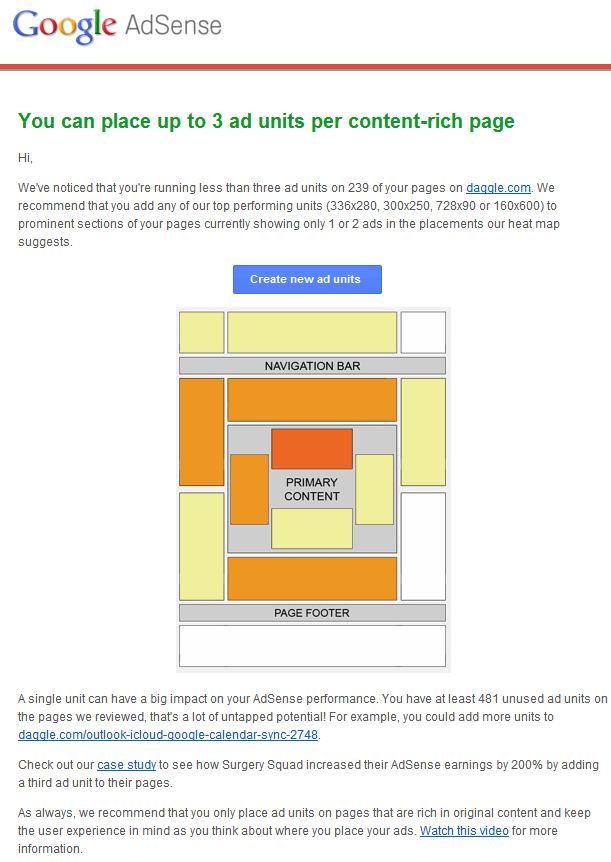
This was in relation to my personal blog, Daggle. The image in the email suggests that Google thinks content pretty much should be surrounded by ads.
Of course, if you watch the video that Google refers me (and others) to in the email, it promotes careful placement, that user experience be considered and, at one point, shows a page top-heavy with ads as something that shouldn’t be done.
Still, it’s not hard to easily find sites using Google’s own AdSense ads that are definitely pushing content down as far down on their pages as they can or trying to hide it. Those pages, AdSense or not, are subject to the new rules, Cutts said.
Pages Ad-Heavy, But Not Top-Heavy With Ads, May Escape
As a searcher, I’m happy with the change. But it might not be perfect. For example, here’s something I tweeted about last year:

Yes, that’s my finger being used as an arrow. I was annoyed that to find the actual download link I was after was surrounded by AdSense-powered ads telling me to download other stuff.
This particular site was heavily used by kids who might easily click on an ad by mistake. That’s potentially bad ROI for those advertisers. Heck, as net-savvy adult, I found it a challenge.
But the problem here wasn’t that the content was pushed “below the fold” by ads. It was that the ratio of ads was so high in relation to the content (a single link), plus the misleading nature of the ads around the content.
Are Google’s Own Search Results Top Heavy?
Another issue is that ads on Google’s own search results pages push the “content” — the unpaid editorial listings — down toward the bottom of the page. For example, here’s exactly what’s visible on my MacBook Pro’s 1680×1050 screen:
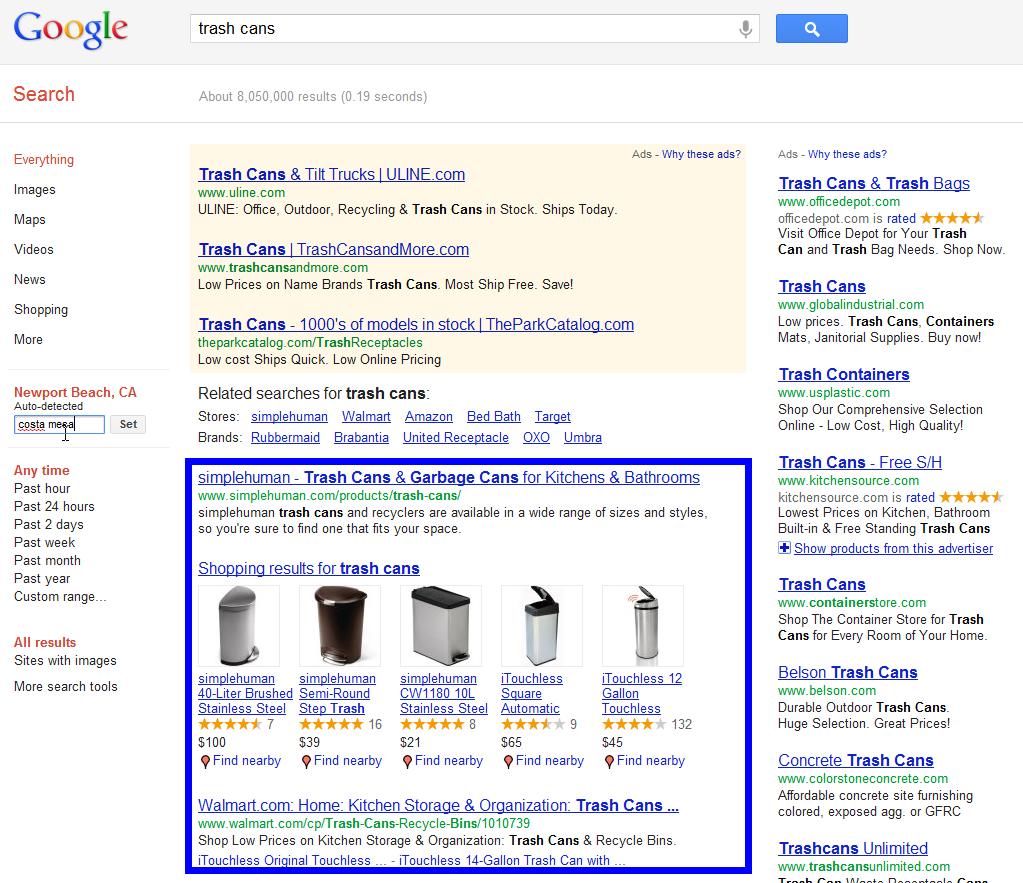
(Side note, that yellow color around the ads in the screenshot? It’s much darker in the screenshot than what I see with my eyes. In reality, the color is so washed-out that it might as well be invisible. That’s something some have felt has been deliberately engineered by Google to make ads less noticeable as ads).
The blue box surrounds the content, the search listings that lead you to actual merchants selling trash cans, in this example. Some may argue that the Google shopping results box is further pushing down the “real content” of listings that lead out of Google. But the shopping results themselves do lead you to external merchants, so I consider them to be content.
The example above is pretty extreme, showing the maximum of three ads that Google will ever show above its search results (with a key exception, below). Even then, there’s content visible, with it making up around half the page or more, if you include the Related Searches area as content.
My laptop’s screen resolution is pretty high, of course. Others would see less (Google’s Browser Size tool doesn’t work to measure its own search results pages). But you can expect Google will take “do as I say, not as I do” criticism on this issue.
Indeed, I shared this story initially with the main details, then started working on this section. After that was done, I could see this type of criticism already happening, both in the comments or over on my Google+ post and Facebook post about the change.
Here’s a screenshot that Daniel Weadley shared in my Google+ post about what he sees on his netbook:
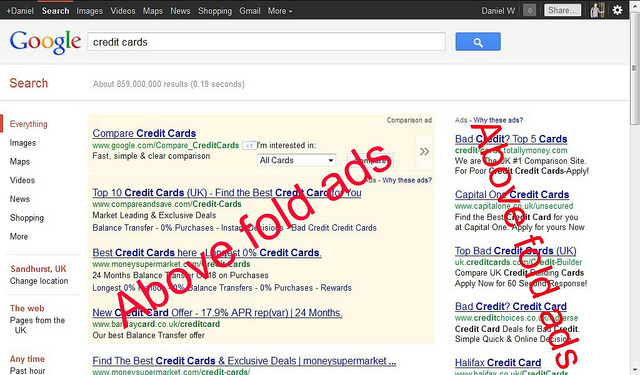
In this example, Google’s doing a rare display of four ads. That’s because it’s showing the maximum of three regular ads it will show with a special Comparison Ads unit on top of those. And that will just add fuel to criticisms that if Google is taking aim at pages top-heavy with ads, it might need to also look closer to home.
NOTE: About three hours after I wrote this, Google clearly saw the criticisms about ads on its own search results pages and sent this statement:
This is a site-based algorithm that looks at all the pages across an entire site in aggregate. Although it’s possible to find a few searches on Google that trigger many ads, it’s vastly more common to have no ads or few ads on a page.Again, this algorithm change is designed to demote sites that make it difficult for a user to get to the content and offer a bad user experience.
Having an ad above-the-fold doesn’t imply that you’re affected by this change. It’s that excessive behavior that we’re working to avoid for our users.
Algorithms? Signals?
Does all this talk about ranking signals and algorithms have you confused? Our video below explains briefly how a search engine’s algorithm works to rank web pages:
Also see our Periodic Table Of SEO Ranking Factors, which explains some of the other ranking signals that Google uses in its algorithm:

Name The Update & More Info
Today’s change is a new, significant ranking factor for our table, one we’ll add in a future update, probably as Va, for “Violation, Ad-Heavy site.”
Often when Google rolls out new algorithms, it gives them names. Last year’s Panda Update was a classic example of this. But Google’s not given one to this update (I did ask). It’s just being called the “page layout algorithm.”
Boring. Unhelpful for easy reference. If you’d like to brainstorm a name, visit our posts on Google+ and on Facebook, where we’re asking for ideas.
Now for the self-interested closing. You can bet this will be a big topic of discussion at our upcoming SMX West search marketing conference at the end of next month, especially on the Ask The Search Engines panel. So check out our full agenda and consider attending.
Postscript: Some have been asking in the comments about how Google knows what an ad is. I asked, and here’s what Google said:
We have a variety of signals that algorithmically determine what type of ad or content appears above the fold, but no further details to share. It is completely algorithmic in its detection–we don’t use any sort of hard-coded list of ad providers.
Related Articles
- It’s Official: Google Now Counts Site Speed As A Ranking Factor
- Google Forecloses On Content Farms With “Panda” Algorithm Update
- Why Google Panda Is More A Ranking Factor Than Algorithm Update
- Taking a Closer Look at the Google’s Panda 2.5 “Flux”
- The Periodic Table Of SEO Ranking Factors
- Search Engine Land Guide To SEO
- What Is SEO / Search Engine Optimization?
Related Topics: Features: Analysis | Google: SEO | Google: Web Search | Top News


It is all about the user experience.
There are many respected sites that should reconsider their business model and serve the users better – as opposed to just using them to serve up more ads.
Thanks Google!
It’s a good thing Google doesn’t try to rank their own search results then, since they’re mainly just ads above the fold!
Just one more reason that sites should give more attention to contextual links instead of display ads – I assume the algorythm isn’t affected by text-links within the content?
Hats off to Google for this one. And thanks Danny for all the videos, interviews and links! With this, Panda and the Search plus your life changes it really looks like a seismic shift on what “true” SEO is all about in that the stuff that’s been repeated year after year e.g. great content, users experience etc. is finally going to become a lot more accountable.
I have gotten a couple of the Adsense messages lately saying that I am missing out on revenue by not utilizing the max number of ads on my pages for one of my sites (including yet another in the last couple days – irony). I pretty much ignore these because I expected they would come out officially and say something like this eventually. Echoing Jill’s comments… if there ever was a reason Google had to rank their own search results pages they would be screwed.
So how are they defining an “ad”? AdSense only? Anything they recognize from an ad platform or affiliate program? Banners? Other PPC ads? Have they told us exactly what they apply the penalty for?
One thing Google (and Web publishers) need to keep in mind is that CPM display advertisers typically want their ads served “above the fold” because they’re paying for eyeballs.
It might be tempting to shove display ads toward the bottom of the page to avoid any risk of getting whacked by Google’s “page layout” algorithm, but unless advertisers knew they were buying below-the-fold ad placement, they’d feel cheated–and rightly so.
Can Google differentiate between an “ad” an a banner with a picture? Should kitchen remodeling company be penalized because the top half of their website features huge images (considering how people shop for a new kitchen)?
I’m wondering, too, why Google is giving a pass to sites that habitually use annoying overlay ads, pop-ups, and pop-unders. Is it because the algorithm can’t detect those, or is it because such ads (especially overlay ads) are often used by big-name media sites?
The change is good BUT… …I would love to see a big brand offering pages stuffed with ads demoted in SERPs. Any examples or is it just the small guy? :)
I’m glad that Google made a statement on this… my first thought was “how hypocritical!” Between the adwords and Google Places, the first organic result is oftentimes buried below the fold.
How ironic- the largest ad revenue generating machine on the internet now wants to dictate to you how to design your web site while stealing money from you through Adwords and Adsense. If Google was really interested in ‘improving the user experience’, they should start by removing all those obnoxious ads at the bottom, or start of videos on YouTube. Let’s see how many ads now move ‘below the fold’.
Matt and Google never really say what constitutes an ad versus what constitutes content in this update. For example on a page about hammers I would find images of the hammers to be content, but also an ad could be above the fold about hammers that is also an image. How is that quantified? What about a contact form on a contact us page buried in javascript? What about a large flash player, since those can be ads too?
Does Google look for most of the common ad codes? are they using the “headless bot” as Michael King (ipullrank) suggested last year on Seomoz? Will they punish a news website that uses large images before the news content? And exactly what resolution is being used to discover Above the Fold versus Below the Fold content?
Lots of questions, but overall likely a good move for users as a whole. Publishers using a narrow layout should switch to something more widescreen friendly so they can get content and ads above the fold.
With this update say you are an e-commerce site and above the fold is YOUR OWN ads for products you sell. Would this count as ads above the fold or not or would it be wise to add text above the fold first then the ads for products?
What do you think this means for Perfect Market?
OK first of all even if you keep saying above the fold, does not mean it is the correct term to use. Google is using the term to reflect a policy that when in place will handcuff all but their collective of sites enamored by the AD words faithful. Even when I launched my first Internet property in 1994 it was accepted as above the scroll.
Secondly, anyone in their right design mind would avoid ad heavy above the scroll ad placement simply because mobile as opposed to web is starting to edge out traditional content delivery.
The acceptance of Google requirements as a way to guarantee indexing seems to me like a monopolistic move by Google, and one that might raises the eyebrows of DC FCC & SEC looking at companies who have gained massive amounts of ad traffic through collecting and distribution of copyright works without the creators permission. Oh I’m sorry YouTube is now a legitimate and respected video channel, and the Google read a book division is legal as well.
I am not Google bashing, I appreciate all they have done since 1996. However ,setting AD space and quantity limits on a global basis appears to be a power grab that might backfire internationally.
My two cents…..
Ironic really when this page has ads at the top and all down the sides too ;)
Page Layout Algorithm will be far more helpful than something stupid like “Florida”. I will stick with that in all future references I make to the event.
As for any “hypocrisy” on Google’s part, I’ll start waving red flags when I see them indexing their own search results. That’s a technicality but the PAGE LAYOUT ALGORITHM IMPROVEMENT was directed only at changing their search results, not changing the Web.
To answer Joe, I have a new client with a large flash movie on her home page and little else. She would cry if she had to give that up. Good news is she has not dropped in rank at all.
To quote Google, “This algorithmic change does not affect sites who place ads above-the-fold to a normal degree, but affects sites that go much further to load the top of the page with ads to an excessive degree or that make it hard to find the actual original content on the page.”
If Google sees just one ad, or one image, or one Flash movie, it will leave it alone. Of course we all worry about what they say they are doing and what, in fact, their software is successfully accomplishes.
Premium member since 12/2008
FWF, no this is all about the amount of display ads showing up ahead of content.
Rob, I’m checking to see if I can find out more on how they define an ad. What for a postscript.
Durant, I think many people are missing the bigger point here. Google’s pretty clear that it’s not saying you can’t have ads above the fold. It’s saying that there should also be some content above the fold. For most sites I go to, that’s the case. You get ads, but you also can easily find content. This is targeting sites — in particular I’d say “Made for AdSense”-style sites, that really load up the ads.
Ben, As I said to Rob, I’m checking. But there are some pretty common indicators of what ads are out there. This isn’t going to be perfect, but my guess is that if you’re running ads from any common networks, and overloading them at the top, they’ll figure that out.
Durant, could be they can’t detect. But also, it’s because those don’t actually prevent you from getting to content easily. They can be annoying for some users, but they’re also often easily dismissed. We run overlays here ourselves in a very careful manner (or so we think), where people might see them 2 or 3 times in total per month (we use cookies so you don’t get them over and over), and they’re easy to close and get right to the content.
Joe, see my replies above, but I’m pretty sure this isn’t about just looking for pictures. You can imagine that most pictures are called from within the site itself, won’t have things like tracking codes that can be detected, links going out of the site….
Stuart, really don’t know, but I wouldn’t worry unless you are shoving so many of your own ads above the fold that the product info can’t be found.
Dennis, yep, we have ads. And this totally won’t cause us to change anything. That’s because the ad we have at the top of the page by no means fills all the “above the fold” space. And the side ads aren’t an issue. That’s really important for people to understand — and I highlighted this, too. This isn’t penalizing ad-heavy sites. It’s penalizing sites that are top-heavy with ads. There’s a difference, and it’s important to get that.
hmm I think Matt is going to banned from the eHow private yacht for this one.. again!
Danny – Does this only relate to “web pages” with lots of ads above the fold? Or does it relate to AdSense for Search partners as well? I can’t stand when I search on a random website that says “Powered by Google” and then my SERP has 7+ paid links before the organics. By the time I get down to the first organic it sometimes is below the fold. It’s hard to distinguish from Google’s blog if this algorithm change will only affect webpages and not SERPs. Any thoughts?
I would be interested to know if HTML search engines set up on a page are considered ads?
I have a site that the only “AD” on the entire site is a search engine.
User-friendly approach of Google’s algorithm is always welcome but I don’t understand when Matt says that websites with less content above-the-fold will be affected. My concern is for Artist/Band/Music websites in which larger images and videos are displayed above-the-fold and this is also for better user experience! There is no other way to do this on such websites. Will these sites also be affected by this layout algorithm update. I’ll be glad to get an answer from Google in this regards and some tips that can help such websites perform better despite this update.
Thanks Danny, 3 questions here..
1 – What kind of penalty is this? I noticed that pages im actively backlinking took a smaller hit than other pages. And some pages with little competition are still #1. So curiosu to know if some backlinking can overcome part of this.
2 – Being top heavy for ads, can you ajust width of site, make header smaller as to get more content above the fold, would something like that help? Right now i have 3 ads above the fold and i know with changes i can get more content. all 3 ads pull pretty good, one is in banner, one is in top left next to title and then the top right sidebar.
3 – how are they determing this, is it a ratio of # of words above the fold to the # of ads
Thanks
Chris
Hi Danny,
the funny thing is that last spring we met Google Adsense in Dublin and they convinced me to place the ads above the fold to increase earnings (for them and for me). That was a wrong move since traffic is down 30% since yesterday compared to last week.
It is true, above the fold is Ad-Heavy and major blocks of content are below the fold. However, the user has still a great experience as he can easily find the content he is looking for. There is also a “call to action” above the fold. While the idea behind the update is great, the algo might lack the necessary fine tuning.
Anyway, I am taking out 1 of the 3 ads above the fold.
My question: How long does it take until the site is back in SERPs. When they talk about weeks, do they mean 2 or 20 weeks?
(the site has 200,000 pages, 24,000 pages get crawler per day)
Thanks,
Mike
So will this now govern how themes are built in the future for example WordPress theme twenty10 has a smaller header area than say twenty11. I do not use either theme personally but lots of people do. Do twenty10 users now have an advantage over twenty11 users? It would seem they do. Few people would argue that twenty10 gives users a better experience than twenty11. Anyway the repercussions of a change like this are going to be far reaching. On a brighter note all my sites are doing better!
However I have noticed that one of my competitors that usse the CTR theme is doing better than me. Who knew that using a grey hate / border line black hat theme would help you in the serps. But it actually makes sense as those sites have no big pictures above the fold and the content body starts at about 135 pixels down from the top. Weird thing is although my competitor is not strictly a made for adsense site. It does have that feel.
I really think Matt and the team haven’t thought this one out properly. I feel a rollback or at least major modifications to the current system will be quick on the heels of this release. Anyway lets see what happens. We should soon be seeing some graphs like the ones that came out post panda. They will be interesting.
Hi Danny.
Since this affects the fold landscape based on ads, why not call it ‘adscape?’
Question:
As I understood there is a site-wide penalty if too many pages have too many Ads above the fold.
But, what if lots of our pages have little content (i.e. statistics of previous sport games) and the ENTIRE page (ALL the content and the 3 Ads) are ABOVE the fold.
Would you still leave all the ads there or would you say: “For little content, place less ads”?
Thanks,
Mike
Quote:
“NOTE: About three hours after I wrote this, Google clearly saw the criticisms about ads on its own search results pages and sent this statement:
This is a site-based algorithm that looks at all the pages across an entire site in aggregate. Although it’s possible to find a few searches on Google that trigger many ads, it’s vastly more common to have no ads or few ads on a page.
Again, this algorithm change is designed to demote sites that make it difficult for a user to get to the content and offer a bad user experience.
Having an ad above-the-fold doesn’t imply that you’re affected by this change. It’s that excessive behavior that we’re working to avoid for our users.”
What a load of horse**#¤&/%¤!!!!
It’s goddamn double standard – Say one, do the opposite!
Do you need screenshots from European countries Danny??
Let me know and I’ll provide you with some proof (screenshots) that Google doesn’t give a shit about organic results (=push all organic below the fold)…
I’m horrified!
The screenshot of the error message from Google AdWords, telling someone they didn’t have enough ads, is very funny. The tiny content box surrounded by junk has become a cliche of bad web design, and now Google is recommending it.
Ads on Google’s search result pages have gotten out of hand. I’ve been using “DVD player” and “new movies” as bad examples, and a writer at Wired used “credit”. Your example of “trash can” has even more screen space full of Google ads. Yes, most Google search result pages don’t have that many ads. Just the ones that have sales potential. Google clearly has a “do as we say, not as we do” attitude about this.
Cluttering search results with ads may be a bad business decision on Google’s part. Ad clutter didn’t work out well for Myspace and Yahoo. Myspace became so ad-heavy it was a joke just before it tanked. Both of those companies dominated the Web in their day. Now, both are nowhere. There’s a lesson there.
On this note, our Ad Limiter (http://www.sitetruth.com) browser add-on removes all but one ad on each Google, Bing, and Yahoo result page. Search results look much better after this de-cluttering.
This is simply about shifting advertisers spend from publishers sites onto search.
Will this hurt sites that are 100% affiliate based. Meaning that they have content but everything that they sell is on the site is an affiliate ad or and affiliate link.
So I guess this means that http://www.google.com will be ranking lower now. :-)
I’m losing about 30% of Google search traffic to a calculator website since the Page Layout update. Based on a week’s worth of data and historical trends, I am convinced the site was penalized. I assume it was for ads unless I am missing something else. During a season when visits should be up by more than 10%, traffic from Google dropped by more than 20% starting Thursday January 20th.
I tend to think the calculators are similar in value to an artist or video site where greater than 90% of the page value is in a small space and you don’t really need multiple pages of text to get your point across.
The layout of pages in question is intended to keep 95% of the value of each page — the calculator forms — accessible, with minimum scrolling. Using Google Browser Size I’d say it does this for greater than 90% or 95% of users depending on the page. The main value is easy to find. For an example see this calculator page. In my opinion, any textual content on calculator pages only holds 5% to 10% of the page value; people come for the calculators. Users might read content at first but they keep coming back for the calculators.
Obviously I disagree with how the updates have assessed my websites although, I can agree with the core logic. Therefore, I’ll be reworking page layouts over the coming weeks. Of course I can rearrange ad space and top-fill with more content. My real hope is that regaining traffic doesn’t require excessive text above the fold, and/or the calculators, obscuring the real value.
Site was hit on January 20 by 35%:
Is it the Page Layout Algorithm or Panda 3.2 ?
Thanks,
Great blog! I noticed my website has gone down tremendously in the rankings and traffic since January19, 2012 to present. I had two 330 x 250 Google Adsense ads above the fold on atleast 1000 pages and all have been removed February 9th. Is there a way to find out if this is the reason for my loss of 70% of traffic and business or possibly something else? Our site was ranked in the top 2 for my most important keywords but now 10 to 21. Any help would be GREATLY appreciated!!
Lots of interesting comment here. I’m particularly interested in what constitutes “ads”. For years we have been paying for Google Adwords to attract say less than 10% of our website visitors to http://www.letting-in-scotland.co.uk specific pages. I had fascinating discussion with their team after they stopped our ads on Adwords because our site had too many adverts. Well our site advertises properties to let as do many others – this is their raison d’aitre and provide a service to househunters. Several large national sites do the same. I tried to comply by putting some info re our areas in the top area of page but this made no difference, and to my mind is just waffle from a web-visitor perspective (who just wants to find a place to rent). Some of the dialogue follows: (my response first): Thanks for that (Google responder)..
Fascinating insight into these guidelines.
Sadly even with adjustment (which would probably realistically be of a
space-filler nature) I don’t think we can currently meet these guidelines
(because the essence of our site is to advertise properties for let from
landlords and agents!) but we will have a look at it.
I’m sure there must be many similar websites in a similar situation but
perhaps not yet aware of it.
Even Gumtree must be struggling in this field.
Regards (Me)
—– Original Message —–
From: “AdWords Support”
To: (Me)
Sent: Monday, June 07, 2010 11:23 AM
Subject: Re: [#652012849] Ad Position and Performance
Hello (Me), Thanks for your email. I reviewed this account and found that this is
because your site http://www.letting-in-scotland.co.uk has violated our Landing
page Quality Guidelines. High ad quality and landing page quality are
necessary for providing a positive user experience. Google AdWords therefore
doesn’t permit ads directing to landing pages that were specifically made to
display more ads (a practice known as “arbitrage”). Furthermore, we’re
extending the definition of arbitrage to include websites that are primarily
occupied by display ads. See below for an exact definition of arbitrage in
terms of display area occupied by ads, specifically the ratio of ads to
unique, non-ad content visible above the fold (i.e. without scrolling) on a
standard browser.
A landing page is not considered arbitrage if all of the following
conditions are met. Measurements should be made above the fold on a 1024 x
768 pixel display with a maximised browser window.
1. 30% of the browser display area consists of unique and relevant content.
- This excludes search boxes, headers, navigation links, logos, etc.
- Specific, well-organised commercial offers (such as those found on retail
sites) may count as unique and relevant content as long as they provide
significant user value.
2. The browser display area used for ads doesn’t exceed the browser display
area used for unique and relevant content. For example, if there’s only the
minimum-allowable 30% unique and relevant content, there may not be more
than 30% advertising. If there’s 50% unique and relevant content, there may
be up to 50% ads. In no case should there be more than 50% ads.
3. The site has user value other than providing ads. For example, Google
provides web search, news sites provide regularly updated original content,
etc.
Here are instructions for checking that your website complies with our
arbitrage policy:
1. Open the site in a new browser.
2. Expand the browser to 1024 x 768 pixel display.
3. Make sure that you have minimal browser menus and that your font is set
to medium or normal.
4. Scroll to the very top of the page – evaluation is based on what appears
above the fold.
5. The site is considered compliant if the area of ads is less than or equal
to the area of content.
Please use the instructions above to evaluate your entire website and, if
necessary, bring it into compliance with our arbitrage policy. If you’re not
in compliance, you may receive a low landing page quality score, which can
negatively affect your Quality Scores, cost per clicks and ad positions.
Learn more about landing page quality at
http://adwords.google.com/support/bin/answer.py?answer=113575&hl=en_GB.
Sincerely,
The Google AdWords UK and Ireland team